NVIDIA’s Double AI Bet: $5B for Ilya Sutskever’s SSI and a Possible $250B OpenAI Backstop
NVIDIA is making two very different bets on the future of frontier AI. The first is already official: **Safe Superintelligence Inc. (SSI)**, the secretive AI lab led by OpenAI co-founder and former chief scientist **Ilya Sutskever**, has entered a long-term strategic partnership with NVIDIA. NVIDIA publicly confirmed an investment in SSI and access to its next-generation **Vera Rubin** platform. Reuters later reported, citing a person briefed on the deal, that the equity investment is **\$5 bill
NVIDIA’s Double AI Bet: $5B for Ilya Sutskever’s SSI and a Possible $250B OpenAI Backstop
Introduction
NVIDIA is making two very different bets on the future of frontier AI.
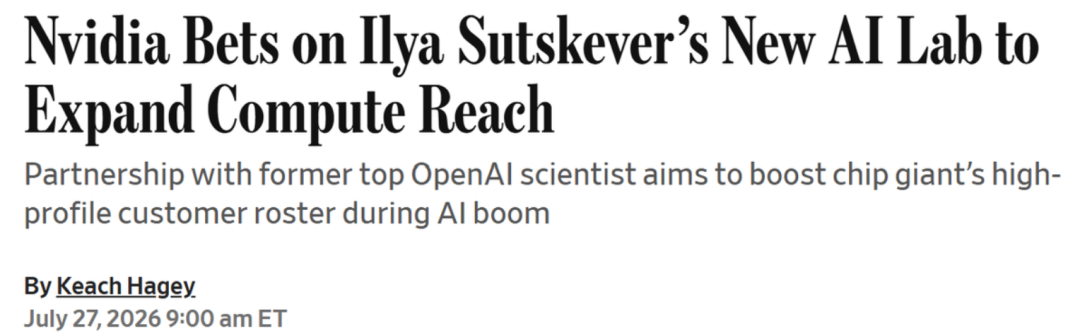
The first is already official: Safe Superintelligence Inc. (SSI), the secretive AI lab led by OpenAI co-founder and former chief scientist Ilya Sutskever, has entered a long-term strategic partnership with NVIDIA. NVIDIA publicly confirmed an investment in SSI and access to its next-generation Vera Rubin platform. Reuters later reported, citing a person briefed on the deal, that the equity investment is $5 billion.
The second deal is far larger, but it is not final.
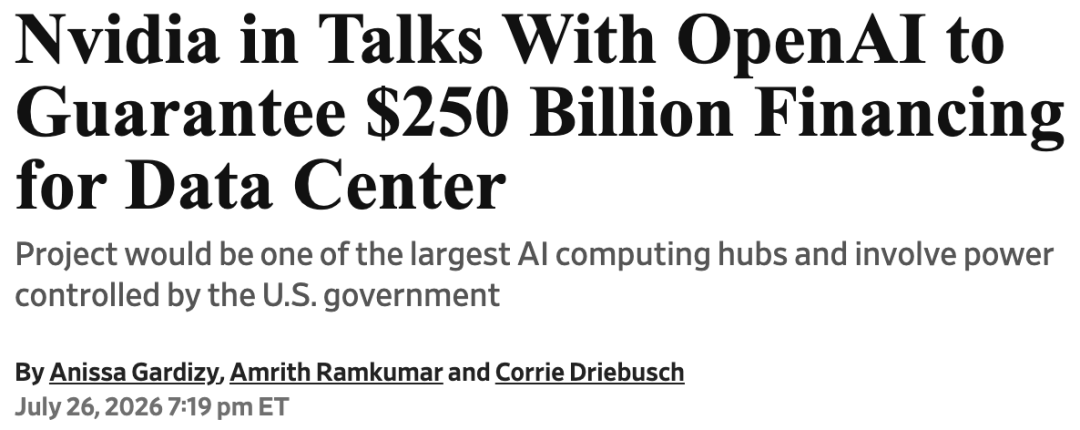
The Wall Street Journal reported that NVIDIA is in talks to provide roughly $250 billion in financing guarantees** connected to a proposed OpenAI data-center project in southern Ohio. The facility could eventually require around 10 gigawatts of power and cost more than **$500 billion including the chips inside it.
These two moves point in different directions.
SSI represents a research-heavy bet on a new approach to advanced AI. OpenAI represents the scale-heavy path: enormous infrastructure, enormous power demand, and continued expansion of model training and inference capacity.
NVIDIA appears interested in both.
Ilya Sutskever Returns With an NVIDIA Partnership
SSI has operated with unusually little public communication since Sutskever founded it in 2024.
Its official website still describes a narrow mission:
Build safe superintelligence as the company’s sole product and objective.
Unlike many AI startups, SSI has not built its public identity around a chatbot, developer platform, consumer app, or enterprise product.
That is deliberate.
The company says it wants its business model, investors, and technical organization aligned around one long-term research goal rather than short-term product cycles.
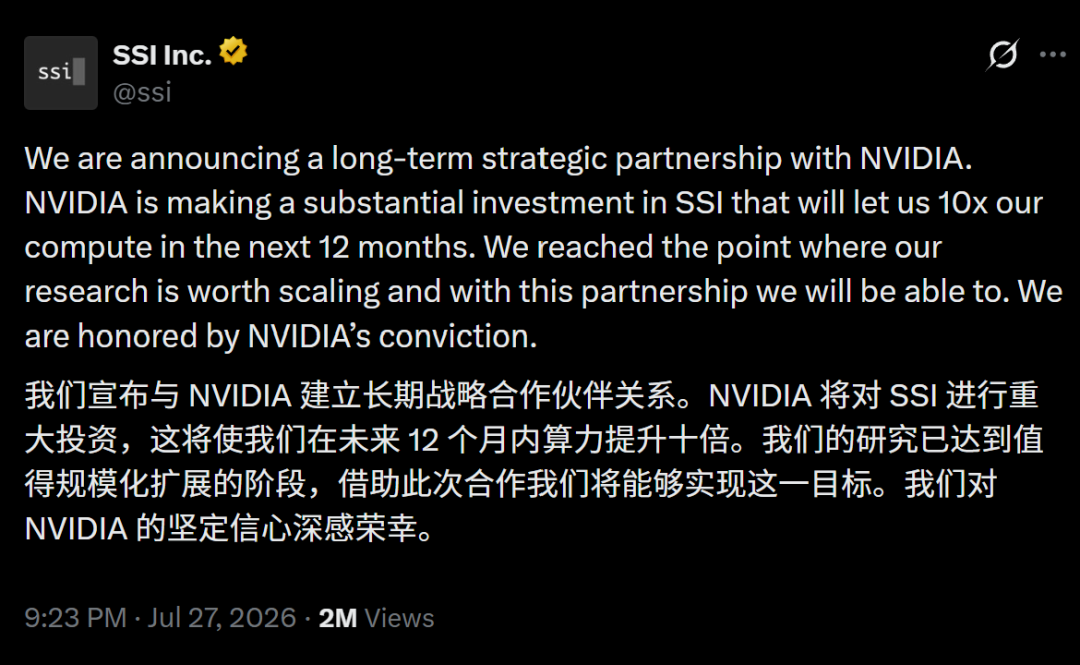
On July 27, 2026, that quiet period was interrupted by a joint announcement from SSI and NVIDIA.
The companies said they had entered a long-term strategic partnership that would substantially increase SSI’s access to computing resources.
NVIDIA also made an investment.
The official announcement did not disclose the dollar amount. Reuters subsequently reported that the equity investment is $5 billion.
That distinction matters:
- The partnership and investment are officially confirmed.
- The $5 billion amount comes from reporting based on a source briefed on the transaction.
SSI Says Its Research Is Ready to Scale
The most important sentence in the announcement came from Sutskever himself.
He said SSI now has research that is “worthy of scaling up.”
NVIDIA used similar language, saying SSI had spent the previous two years quietly developing a new research direction for powerful and robustly aligned AI.
The companies did not reveal the architecture, algorithm, training method, or model behind that statement.
What they did reveal is that NVIDIA was given unusual access to SSI’s closely guarded research before entering the partnership.
That makes the investment more notable than a standard infrastructure contract.
NVIDIA is not simply supplying GPUs to a new customer. According to its own announcement, the company saw enough of SSI’s internal work to decide that the next stage should receive significantly more compute.
SSI’s Compute Is Expected to Increase by an Order of Magnitude
The partnership gives SSI access to NVIDIA’s Vera Rubin platform.
NVIDIA says the combination of its investment and next-generation hardware will allow SSI to increase its compute by an order of magnitude.
SSI’s own public announcement described the plan more directly: it expects to increase available compute by roughly 10× over the next 12 months.
The companies also plan to collaborate on technical development of NVIDIA’s current and future compute platforms.
That arrangement is strategically useful to both sides.
SSI receives:
- Much more computing capacity.
- Access to Vera Rubin.
- A direct relationship with NVIDIA’s engineering organization.
- A path to scale large research experiments.
NVIDIA receives:
- A major new frontier-AI customer.
- Feedback from a highly specialized research lab.
- Early insight into workloads that may shape the next generation of AI infrastructure.
Why Vera Rubin Matters
Vera Rubin is NVIDIA’s next-generation AI infrastructure platform.
It combines Rubin GPUs, Vera CPUs, high-speed networking, NVLink, storage components, and rack-scale systems designed for large training, post-training, reasoning, and agentic workloads.
NVIDIA is positioning the platform around a metric that is increasingly important for AI labs: not simply peak compute, but how much useful intelligence can be produced for a given amount of power and infrastructure.
That matters because advanced AI research is becoming constrained by several resources at once:
- GPU supply.
- Power.
- Memory.
- Network bandwidth.
- Data-center capacity.
- Capital.
- Training time.
A new algorithm can be valuable because it improves capability.
A new hardware platform can be equally valuable if it allows the same algorithm to be explored at a much larger scale.
SSI appears to believe it now has a research direction worth testing at that scale.
What Is SSI Actually Researching?
This is the part that remains intentionally unclear.
The source article speculates that SSI may have discovered a new architecture or a fundamentally different training paradigm.
There is not enough public evidence to state that as fact.
Neither SSI nor NVIDIA has announced:
- A replacement for Transformers.
- A new model architecture.
- A published research paper.
- A named model.
- A new reinforcement-learning algorithm.
- A working superintelligence system.
What can be stated more confidently comes from Sutskever’s public interviews.
Sutskever Thinks Current Models Generalize Poorly
In a November 2025 interview with Dwarkesh Patel, Sutskever argued that current AI systems generalize much worse than humans.
Humans learn from far less data than modern language models, yet can often transfer knowledge to new situations more effectively.
That gap appears central to his thinking.
He Expects a Return to a Research-Driven Era
Sutskever described AI development as moving away from a period dominated primarily by predictable scaling and back toward a period where new research ideas matter more.
This does not mean compute becomes irrelevant.
The SSI–NVIDIA deal makes the opposite point.
New ideas still need large experiments.
The difference is that more GPUs alone may not be enough if the underlying learning method has reached diminishing returns.

Continual Learning Is Part of the Vision
Sutskever has also described a future system more like a highly capable young person than a finished database of all human knowledge.
In that framing, a superintelligent system could continue learning during deployment rather than depending entirely on one giant pretraining phase.
That raises research questions around:
- Continual learning.
- Generalization.
- Transfer across domains.
- Updating without catastrophic forgetting.
- Internal feedback.
- Learning from limited experience.
These ideas are consistent with Sutskever’s public statements.
They do not prove that SSI has solved them.
The “15-Year-Old Superintelligence” Analogy
One of Sutskever’s more memorable analogies is a hypothetical superintelligent 15-year-old.
The idea is not that the system would literally have a human age.
It is a way of distinguishing between raw learning capability and preloaded knowledge.
A human teenager does not know every profession.
But a highly capable person can learn a new profession from relatively limited experience.
Sutskever has argued that future AI may need something closer to this ability: deep generalization and continual adaptation, rather than simply memorizing a larger fraction of the internet.
This view helps explain why SSI can simultaneously argue that the scaling era is changing while accepting an enormous increase in computing capacity.
The new compute is not necessarily meant to repeat the same recipe at a larger scale.
It may be intended to test a different recipe at a serious scale.
NVIDIA Is Betting on the Research Layer, Not Just Selling Hardware
The SSI partnership also says something about NVIDIA.
The simplest version of NVIDIA’s business is easy to understand: AI labs need GPUs, so NVIDIA sells GPUs.
Its strategy is now broader.
NVIDIA increasingly participates in equity investments, cloud infrastructure, AI factories, networking, CPUs, model research, software, robotics, energy and infrastructure partnerships, and customer financing.
This gives the company exposure to more than the sale of a chip.
When NVIDIA backs a frontier lab, it can strengthen the ecosystem that creates demand for its infrastructure.
It can also learn earlier what future workloads require.
For a company designing hardware several years ahead, that information is valuable.
Why SSI Is Strategically Interesting to NVIDIA
SSI is unusual because it does not need to optimize around near-term product revenue.
Its official structure is built around one objective: safe superintelligence.
That creates a research environment where the lab can spend time on approaches that might be too speculative for a company under quarterly product pressure.
For NVIDIA, this is potentially useful.
If SSI’s work leads to a new training paradigm, continual-learning system, or other breakthrough, NVIDIA wants its hardware to be relevant to that workload.
The investment can therefore be viewed as a form of technical optionality.
NVIDIA is buying access to a leading AI researcher, a frontier research team, a potential new class of workloads, and a future customer with extremely high compute demand.
The exact value of that option cannot be measured today because SSI has not released its research.
A Much Larger OpenAI Financing Plan Is Also Being Discussed
The SSI partnership was followed by an even larger report.
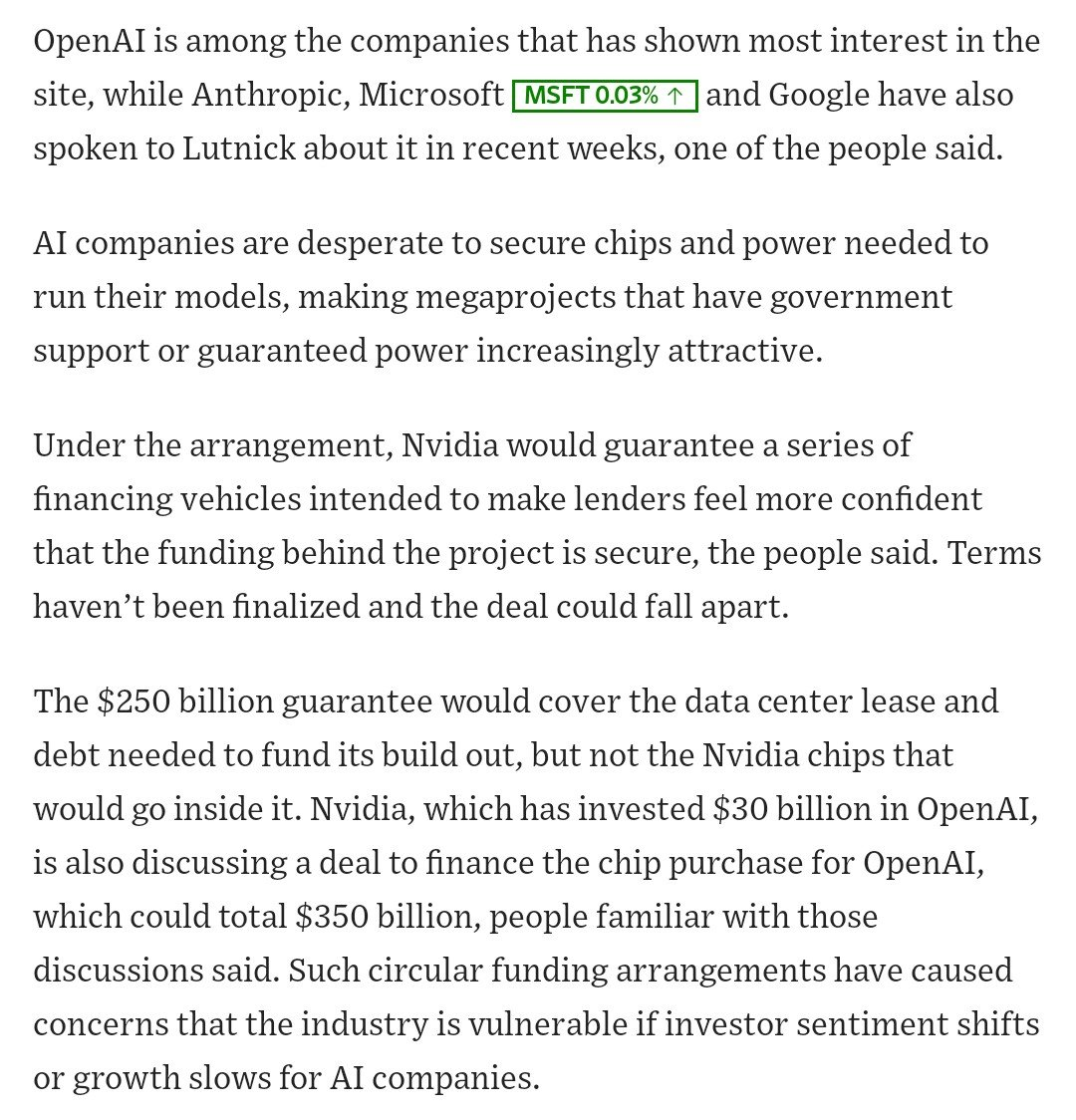
The Wall Street Journal said NVIDIA is in talks to provide roughly $250 billion in financing guarantees connected to a planned OpenAI data-center project in southern Ohio.
This is not a $250 billion cash investment.
It is closer to a financial backstop.
The proposed project is being developed by SB Energy, a SoftBank subsidiary.
According to WSJ and Reuters reporting, the project could eventually include:
| Reported Project Detail | Current Status |
|---|---|
| Location | Southern Ohio |
| Developer | SB Energy, a SoftBank subsidiary |
| Potential tenant | OpenAI |
| Potential power capacity | 10 gigawatts |
| Estimated total cost | More than $500 billion including chips |
| NVIDIA guarantee under discussion | About $250 billion |
| First phase | About 800 megawatts |
| First-phase target | 2028 |
| Deal status | In discussion; not finalized |
The scale is extraordinary.
A 10-gigawatt data-center system would be far beyond the size of a conventional hyperscale campus.
It would require not only AI chips, but enormous investments in power generation, transmission, cooling, construction, networking, land, financing, and long-term energy contracts.
What a $250 Billion Guarantee Actually Means
The easiest mistake is to interpret the reported guarantee as NVIDIA transferring $250 billion directly to OpenAI.
That is not what has been reported.
The proposed structure is a financing guarantee or credit backstop.
OpenAI does not have an investment-grade credit rating and remains a private company spending heavily on infrastructure.
A lender financing a massive data-center project therefore has to evaluate whether OpenAI can make the long-term lease payments.
NVIDIA’s balance sheet could be used to make that financing more attractive to lenders.
In simplified form:
- SB Energy develops the data-center project.
- OpenAI agrees to lease capacity.
- Lenders provide capital for construction.
- NVIDIA guarantees part of the financing risk.
- Lenders receive stronger credit support than OpenAI could provide alone.
The guarantee could lower financing costs and make a project of this scale easier to fund.
It also transfers risk toward NVIDIA if the underlying obligations are not met.
The Terms Are Not Final
This point deserves emphasis.
The OpenAI financing arrangement is not an announced transaction.
WSJ reported that the parties are in discussions and that the terms have not been finalized.
Reuters separately reported the same talks based on the WSJ story.
The deal could change substantially or fail to close.
For publication, phrases such as these are accurate:
- “NVIDIA is reportedly in talks.”
- “NVIDIA is considering a guarantee.”
- “The proposed structure could provide up to $250 billion in backing.”
Phrases such as “NVIDIA gave OpenAI $250 billion” are not accurate.
NVIDIA Could Also Finance OpenAI’s Chip Purchases
The reported structure may include another financial layer.
WSJ said NVIDIA is also discussing financing for OpenAI’s purchase of NVIDIA chips, potentially totaling as much as $350 billion.
That figure is separate from the roughly $250 billion data-center financing guarantee.
If both arrangements reached their maximum reported scale, NVIDIA would be deeply involved in both sides of OpenAI’s infrastructure expansion:
- Helping the facility obtain financing.
- Helping OpenAI finance the accelerators placed inside it.
This is where concerns about circular financing arise.
Why Investors Worry About Circular Financing
A simplified AI infrastructure loop can look like this:
- A chip supplier invests in or financially supports an AI company.
- The AI company uses that capital or financing to buy compute.
- Much of that compute uses the same supplier’s chips.
- The chip supplier records higher demand and revenue.
- The ecosystem raises more capital to expand again.
This structure is not automatically problematic.
Strategic financing is common in capital-intensive industries.
The risk appears when demand depends too heavily on financing supplied by the same companies that benefit from the spending.
If AI revenue grows fast enough, the infrastructure can be supported by real customer demand.
If revenue growth slows, the interconnected financial commitments become more difficult to unwind.
Reuters Breakingviews noted that large-scale AI financing increasingly exposes technology companies to credit and infrastructure risk beyond their traditional business models.
OpenAI’s Path Is the Opposite of SSI’s
The contrast between SSI and OpenAI is striking.
SSI is small, secretive, research-first, focused on one long-term objective, publicly cautious about conventional scaling, and only now increasing compute by roughly 10×.
OpenAI is running major consumer and enterprise products, serving a global user base, committing enormous sums to cloud and data-center capacity, building toward infrastructure measured in gigawatts, and seeking more direct control of its compute.
These are not necessarily incompatible technical philosophies.
OpenAI also conducts research on new methods.
SSI also needs huge amounts of compute.
The difference is emphasis.
One path is centered on finding a new research breakthrough.
The other path must simultaneously advance research and operate AI products at enormous global scale.
NVIDIA Is Hedging Across Both Futures
Viewed together, the two stories look like a portfolio strategy.
Bet One: Scaling Continues to Matter
If frontier AI continues to improve through more training, more inference, more agents, and more users, OpenAI and other hyperscale customers will require extraordinary infrastructure.
That future is good for NVIDIA.
The proposed Ohio project is a pure expression of that thesis: massive power, massive capital, and massive accelerator demand.
Bet Two: A New Paradigm Emerges
If conventional scaling eventually hits harder limits, the next major leap may come from a new learning method.
SSI is explicitly searching for that kind of shift.
If Sutskever’s new research direction works, NVIDIA wants its hardware to be the platform that scales it.
That future is also good for NVIDIA.
The Common Denominator Is Compute
The two paths appear philosophically different, but both still require computing infrastructure.
OpenAI needs compute to operate and expand current frontier systems.
SSI needs compute to validate a new research direction.
NVIDIA’s position is strongest if both paths continue to require its platforms.
What Is Confirmed and What Remains Reported
| Claim | Status |
|---|---|
| SSI and NVIDIA signed a long-term strategic partnership | Officially confirmed |
| NVIDIA invested in SSI | Officially confirmed |
| Investment is $5 billion | Reported by Reuters/Bloomberg sources |
| SSI will gain Vera Rubin access | Officially confirmed |
| SSI compute will increase by an order of magnitude | Officially confirmed |
| SSI says it can 10× compute over 12 months | Publicly stated by SSI |
| SSI has a new research direction | Officially confirmed in broad terms |
| SSI has invented a post-Transformer architecture | Not confirmed |
| NVIDIA is considering a $250B OpenAI financing guarantee | Reported by WSJ/Reuters |
| OpenAI Ohio project could reach 10 GW | Reported by WSJ/Reuters |
| Project could cost more than $500B including chips | Reported by WSJ/Reuters |
| NVIDIA may finance up to $350B of OpenAI chip purchases | Reported by WSJ |
| The OpenAI financing deal is signed | Not confirmed; talks are ongoing |
This distinction is important because the original source mixes official announcements, financial reporting, interpretation, and speculation.
What to Watch Next
SSI Research Disclosure
The biggest unknown is technical.
SSI has said its research is ready to scale, but the public still does not know what the research is.
A paper, model, benchmark, or demonstration would make the partnership much easier to evaluate.
Vera Rubin Deployment
The speed with which SSI can deploy Vera Rubin infrastructure will determine whether the promised compute increase arrives on schedule.
OpenAI Financing Terms
The reported $250 billion guarantee has not been finalized.
Final terms would reveal how much risk NVIDIA is actually willing to assume.
Power and Construction
A 10-gigawatt data-center plan depends on power generation, transmission, land, permits, construction, and government support.
These constraints can be more difficult than obtaining GPUs.
Revenue Versus Infrastructure Commitments
The long-term health of the AI infrastructure boom depends on whether AI companies generate enough economic value to support the enormous capital commitments now being discussed.
常见问题
How much is NVIDIA investing in Safe Superintelligence?
NVIDIA officially confirmed that it made a substantial investment in SSI but did not disclose the amount in its press release. Reuters reported that the equity investment is $5 billion, citing a person briefed on the deal.
What does NVIDIA’s partnership give SSI?
SSI will receive access to NVIDIA’s Vera Rubin platform and expects its available compute to increase by roughly an order of magnitude. The companies will also collaborate on the technical development of NVIDIA’s current and future compute platforms.
What is Safe Superintelligence Inc.?
SSI is an AI research company founded in 2024 by Ilya Sutskever and colleagues. Its stated mission is unusually narrow: build safe superintelligence without being distracted by conventional product cycles.
Has SSI revealed its new AI architecture?
No. SSI and NVIDIA say the company has developed a new research direction that is worth scaling, but they have not published the architecture, algorithm, model, or training method behind it.
Is NVIDIA giving OpenAI $250 billion?
No confirmed direct $250 billion investment has been announced. WSJ reported that NVIDIA is discussing a roughly $250 billion financing guarantee that could support OpenAI’s lease obligations for a massive Ohio data-center project.
How large could the OpenAI Ohio data center be?
The reported project could eventually reach about 10 gigawatts of power capacity and cost more than $500 billion including the chips installed inside it. The plan is still under discussion and could change.
What is the separate $350 billion NVIDIA–OpenAI figure?
WSJ reported that NVIDIA is also discussing possible financing for OpenAI’s purchases of NVIDIA chips, potentially reaching $350 billion. That is separate from the proposed $250 billion financing guarantee.
Why is NVIDIA investing in AI labs if it already sells GPUs?
Strategic investments can secure long-term customers, provide early insight into future AI workloads, and strengthen the ecosystem that creates demand for NVIDIA infrastructure. The approach also gives NVIDIA exposure to research breakthroughs that could shape the next generation of computing.
相关工具
- NVIDIA Vera Rubin: NVIDIA’s next-generation rack- and pod-scale platform for training, reasoning, agents, and large AI infrastructure.
- NVIDIA DGX Cloud: NVIDIA’s AI cloud and infrastructure environment for large-scale model development and operation.
- Safe Superintelligence: SSI’s official website describing its single-product mission to develop safe superintelligence.
- NVIDIA Data Center Platforms: Official information about NVIDIA’s current AI data-center hardware and networking portfolio.
- NVIDIA Vera Rubin NVL72: The rack-scale Vera Rubin system built around Rubin GPUs, Vera CPUs, NVLink, and high-speed networking.
Related Links
- NVIDIA–SSI Official Partnership Announcement: NVIDIA’s official announcement covering the investment, Vera Rubin access, and order-of-magnitude compute expansion.
- SSI Official Website: The company’s mission statement and description of its research-first structure.
- WSJ on the Proposed $250B OpenAI Guarantee: The original report on the Ohio project, financing guarantee, and separate chip-financing talks.
- Reuters on the Proposed OpenAI Data Center Financing: Independent summary of the reported negotiations and 10-gigawatt project.
- Ilya Sutskever on the Return to a Research Era: A long-form interview covering generalization, continual learning, and SSI’s research philosophy.
- NVIDIA Vera Rubin Production Announcement: Official details on the Vera Rubin platform and its role in large AI factories.
Summary
NVIDIA has entered a long-term partnership with Ilya Sutskever’s Safe Superintelligence, giving the lab access to Vera Rubin and enough new infrastructure to increase its compute by roughly an order of magnitude. NVIDIA confirmed an investment, while Reuters reported that the equity amount is $5 billion.
At the same time, NVIDIA is reportedly considering a far larger financial role in OpenAI’s infrastructure expansion. A proposed $250 billion guarantee could support financing for a 10-gigawatt data-center project in Ohio, while a separate discussion could involve up to $350 billion in financing for NVIDIA chip purchases. Those OpenAI arrangements remain negotiations, not completed deals.
The two bets cover different versions of the AI future: one in which massive scaling continues to dominate and another in which a new research paradigm becomes the next breakthrough.
NVIDIA’s strategy is less about choosing between scaling and new research than about making sure both paths continue to run on NVIDIA infrastructure.