BrainCo Unveils an Integrated Brain-to-Robot AI R&D Platform at WAIC 2026
BrainCo introduced a new brain-to-robot research and development platform at the 2026 World Artificial Intelligence Conference, or WAIC, in Shanghai. The system combines a non-invasive EEG headset, AI-based intent decoding, and commercially available robots, allowing a person to direct robotic actions through neural signals.
BrainCo Unveils an Integrated Brain-to-Robot AI R&D Platform at WAIC 2026
Introduction
BrainCo introduced a new brain-to-robot research and development platform at the 2026 World Artificial Intelligence Conference, or WAIC, in Shanghai. The system combines a non-invasive EEG headset, AI-based intent decoding, and commercially available robots, allowing a person to direct robotic actions through neural signals.
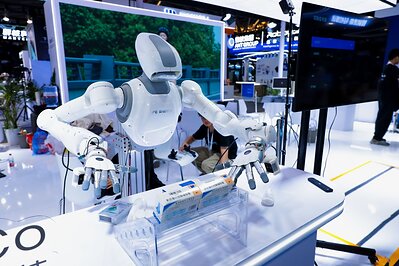
During the demonstration, a participant wearing a lightweight EEG headset focused on actions such as grasping a cup. The system interpreted the user’s intended movement and sent the corresponding command to a robotic arm, without relying on spoken instructions, buttons, or visible physical control.
BrainCo describes the system as the world’s first integrated Brain-to-Robot AI R&D Platform. That description is a company claim published in its press release and has not been independently verified in the source material.
BrainCo displayed robotics and embodied AI hardware at its WAIC 2026 booth.
Translating Human Intent into Robot Action
The central product shown at WAIC was BrainCo’s Brain-Controlled Robot AI Platform. It is designed to turn detected neural activity into instructions that a robot can execute.
The workflow has three main stages:
- Signal collection: The user wears an EEG headset that detects electrical activity from the brain.
- Intent decoding: AI algorithms analyze the signals and identify the intended motor or control action.
- Robot execution: The decoded intent is converted into commands that the connected robot can perform.
According to BrainCo, the complete process takes less than 200 milliseconds.
At the conference, the robotic arm demonstrated tasks that required controlled movement, including grasping a cup and picking up an apple. The company says the platform can work with different commercially available robotic systems rather than depending on one proprietary robot.
Potentially compatible hardware categories include:
- Humanoid robots
- Industrial or research robotic arms
- Quadruped robots
- Other programmable robotic platforms
This broader hardware compatibility is intended to make the system easier to integrate into existing robotics research pipelines.
The Neuro-Embodied-AI Framework
BrainCo refers to the underlying architecture as Neuro-Embodied-AI. The framework divides the task across three connected layers.
The brain-computer interface first captures and decodes the user’s intent. An AI layer then interprets that intent in more detail and breaks a complex objective into actionable steps. Finally, the robot’s own control system handles the physical movement.
In simplified form, the process is:
Human neural signal
        ↓
BCI intent decoding
        ↓
AI task interpretation and planning
        ↓
Robot control and physical execution
The company presents this system as an extension of its previous work in brain-computer interfaces and medical rehabilitation, now applied to embodied AI and robotics research.
Closing the Data Gap in Robot Training
BrainCo also introduced an Embodied AI Data Collection Solution at its WAIC booth. The system is designed to address a persistent problem in robotics: the limited supply of high-quality, real-world data for training robots to perform complex physical tasks.
Robots require large and varied datasets to learn actions such as:
- Folding clothes
- Assembling components
- Manipulating small objects
- Handling fragile materials
- Completing tasks that require dexterous hand movement
Collecting this type of data can be slow and expensive. A useful dataset may need to capture not only the robot’s final movement, but also the human demonstration, environmental context, force, position, timing, and task intent.
BrainCo’s data collection system uses proprietary hardware that includes a dual-arm wheeled collection platform and a high-precision data glove. The company says the system can record data from three main sources:
- Robot execution
- Human demonstrations
- Virtual simulation
It also captures EEG signals from the human operator. This means the dataset can include both the visible hand movement and the neural activity associated with the person’s intended action.
BrainCo says this combination could provide a continuous supply of training data grounded in real-world tasks, while preserving information about both physical execution and human intent.
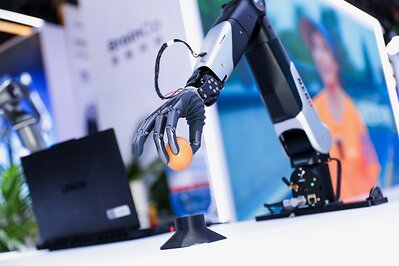
The WAIC display included a dexterous robotic hand performing a precision task.
Ten Years of Brain-Computer Interface Development
BrainCo was founded in 2015 and has spent the past decade developing non-invasive brain-computer interface technology.
The company says its research has focused on two difficult parts of BCI development: detecting weak neural signals and decoding those signals accurately enough to identify a user’s intention. Its broader goal has been to move BCI technology beyond laboratory research and into systems that can be used in rehabilitation, assistive devices, and human-machine interaction.
Nyx He, Partner and Senior Vice President at BrainCo, said that the company’s BCI research has helped it translate intended actions into machine operations. BrainCo views the integration of BCI, AI, and embodied AI as a possible next stage of human-machine collaboration.
Alongside the two new R&D platforms, BrainCo displayed three additional products at WAIC 2026.
Revo 3 Dexterous Hand
The Revo 3 Dexterous Hand is a robotic end effector with 21 degrees of freedom. According to BrainCo, it includes full-palm tactile sensing, sub-millimeter grasping precision, and a grip force of up to 70 newtons.
The hand is intended for robotic manipulation tasks that require more precise control than a basic mechanical gripper can provide.
Intelligent Bionic Hand
BrainCo’s Intelligent Bionic Hand is a 383-gram prosthetic device. The company says it decodes neural and electromyographic signals to support independent movement of all five fingers, with control precision of 0.1 degrees.
The device represents the rehabilitation side of BrainCo’s work, where biological signals are translated into movements that assist the user directly.
Intelligent Bionic Leg
The Intelligent Bionic Leg is a prosthetic knee system that uses real-time sensor data and proprietary algorithms to adapt to the user’s movement state.
Rather than operating with a single fixed response, the system is designed to adjust dynamically as the wearer changes pace, position, or activity.
BrainCo’s booth was also visited by Alexander De Croo, Administrator of the United Nations Development Programme, who was introduced to the company’s latest BCI and robotics products.
What the Platform Is Intended to Support
The two systems introduced at WAIC address different parts of robotics development.
The Brain-Controlled Robot AI Platform focuses on translating human intention into robot action. The Embodied AI Data Collection Solution focuses on collecting the multimodal data required to train and improve robotic systems.
Together, they are intended to support research in areas such as:
- Human-robot interaction
- Brain-controlled assistive robotics
- Embodied AI training
- Robotic manipulation
- Neural intent decoding
- Prosthetic control
- Multimodal robot datasets
The announcement does not provide public pricing, an open-source repository, detailed hardware compatibility requirements, or a general release schedule. Researchers interested in the platform will need to contact BrainCo for current access and integration information.
Frequently Asked Questions
What is BrainCo’s Brain-to-Robot AI platform?
It is an R&D system that uses an EEG headset and AI algorithms to decode a person’s intended action, then converts that intent into commands for a robot. BrainCo demonstrated the platform with a robotic arm at WAIC 2026.
How does the brain-controlled robot system work?
The EEG headset captures neural signals, an AI model interprets the intended movement, and the result is translated into a robot command. BrainCo says the full process takes less than 200 milliseconds.
Does the platform require an invasive brain implant?
The demonstration described in the press release used a lightweight, non-invasive EEG headset. It did not require a surgically implanted brain-computer interface.
Which robots can work with the platform?
BrainCo says the system is designed to support a range of commercially available robots, including humanoids, robotic arms, and quadruped robots. The company has not published a complete compatibility list in the announcement.
What is Neuro-Embodied-AI?
Neuro-Embodied-AI is BrainCo’s term for a framework that connects neural intent decoding, AI-based task interpretation, and physical robot execution. It links what a user intends to do with the actions performed by a machine.
What data does BrainCo’s embodied AI system collect?
The company says the system records robot execution, human demonstrations, virtual simulation data, high-precision glove data, and EEG signals from the human operator. This combines visible movement with information related to intended action.
Is the Brain-to-Robot platform commercially available?
The press release does not provide public pricing or a general availability date. Researchers and robotics teams should contact BrainCo directly for current access, hardware support, and deployment requirements.
Was the “world’s first” claim independently verified?
No independent verification was included in the source article. The phrase comes from BrainCo’s own company announcement and should be understood as an attributed product claim.
Related Tools
- BrainCo: The official company website for its brain-computer interface, rehabilitation, and neurotechnology products.
- BrainCo Developer Documentation: BrainCo’s developer portal for supported SDK documentation and technical resources.
- ROS 2: An open robotics middleware framework commonly used to connect sensors, software, and robot hardware.
- MoveIt 2: An open-source motion-planning framework for robotic arms and manipulation systems.
- Gazebo: A robotics simulation platform for testing robot behavior and environments.
- NVIDIA Isaac Sim: A simulation environment for robotics development and synthetic training data generation.
Related Links
- Official PR Newswire Release: The complete BrainCo press release distributed on July 17, 2026.
- BrainCo Official Website: Official information about the company and its neurotechnology work.
- BrainCo English Corporate Site: BrainCo’s English-language overview of its BCI technology and solutions.
- WAIC 2026 Event Overview: Shanghai’s official introduction to the 2026 World Artificial Intelligence Conference.
- ROS 2 Documentation: Official documentation for the ROS 2 robotics software ecosystem.
- MoveIt 2 Documentation: Official guidance for robot motion planning and manipulation.
- Gazebo Documentation: Official documentation for the Gazebo robotics simulator.
Summary
At WAIC 2026, BrainCo introduced a platform that connects non-invasive EEG-based intent decoding with robotic execution. The system captures neural signals, interprets the intended action with AI, and converts the result into robot commands in a process the company says takes less than 200 milliseconds.
BrainCo also presented an embodied AI data collection solution that combines robot execution, human demonstrations, simulation, data-glove measurements, and EEG signals. The aim is to provide richer datasets for training robots on complex physical tasks.
The announcement also highlighted BrainCo’s Revo 3 Dexterous Hand, Intelligent Bionic Hand, and Intelligent Bionic Leg. However, public pricing, broad availability, detailed compatibility information, and independent validation of the company’s “world’s first” claim were not included.
The central idea is to connect human intent, AI interpretation, robot action, and training-data collection within one research workflow.