GLM-5.3 API Launches With a 60 Artificial Analysis Score and Open Weights Planned for August 28
Zhipu AI has officially opened API access to GLM-5.3 , its latest flagship model for complex coding, long-horizon agent tasks, and cybersecurity-related workloads. The August 19 an
GLM-5.3 API Launches With a 60 Artificial Analysis Score and Open Weights Planned for August 28
Introduction
Zhipu AI has officially opened API access to GLM-5.3, its latest flagship model for complex coding, long-horizon agent tasks, and cybersecurity-related workloads.
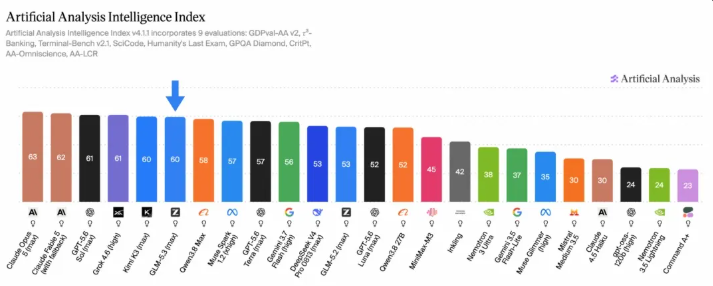
The August 19 announcement puts the model directly into Z.AI's production API stack and GLM Coding Plan. On the current Artificial Analysis Intelligence Index, GLM-5.3 (max) scores 60, placing it in the same broad frontier range as several leading proprietary models and tying Kimi K3 (max) on that index.
The model is not yet open-weight at the time of writing. Zhipu's August 19 announcement, repeated by several Chinese technology and financial outlets, says the weights are planned for release on Friday, August 28, 2026.
GLM-5.3 Reaches 60 on the Artificial Analysis Intelligence Index
The headline number in the AIBase report is the 60-point Artificial Analysis Intelligence Index score.
Artificial Analysis currently lists GLM-5.3 (max) at 60, the same score shown for Kimi K3 (max). The result places GLM-5.3 among the strongest models in the current comparison set, though one aggregate index should not be treated as proof that two models perform identically on every workload.
A useful snapshot is:
| Model | Artificial Analysis Intelligence Index |
|---|---|
| GLM-5.3 (max) | 60 |
| Kimi K3 (max) | 60 |
| Claude Fable 5, selected high-end configuration | Above 60 in current AA comparisons |
| GLM-5.2 (max) | 53 |
The important generational change is the jump from GLM-5.2 to GLM-5.3 while keeping the same underlying base model.
The Main Improvements Come From Post-Training
Z.AI says GLM-5.3 uses the same base model as GLM-5.2. The performance increase comes from additional post-training rather than a newly trained foundation model.
The official documentation highlights improvements in three areas that match the original AIBase article:
- Complex software engineering
- Defensive cybersecurity and vulnerability analysis
- Long-horizon agent tasks
In Z.AI's own Code Bench, the company reports roughly a 50% performance gain over GLM-5.2. Public benchmark results also show substantial gains in terminal-based and long-running software-engineering tasks.
For example, Z.AI reports GLM-5.3 improving from 4.6 to 28.3 on Terminal-Bench 3.0 and from 46.2 to 66.9 on DeepSWE v1.1 compared with GLM-5.2.
Those figures are vendor-published benchmark results and should be read in that context.
Cybersecurity Performance Also Improved Sharply
Z.AI says the additional post-training unexpectedly produced stronger cybersecurity capabilities as training scaled.
On the company's published evaluation set, GLM-5.3 reached 84.5% on CyberGym, compared with 77.2% for GLM-5.2. The company also reports much larger gains on deeper exploitation-oriented benchmarks such as ExploitBench and ExploitGym.
The pattern is notable because GLM-5.3's improvement becomes larger as tasks move from identifying a vulnerability toward reasoning through a longer exploitation chain.
At the same time, Z.AI's own benchmark table shows that some closed frontier models remain ahead on the more difficult exploitation evaluations. So the correct takeaway is not that GLM-5.3 dominates every security benchmark, but that its post-training produced a substantial generation-over-generation improvement.
GLM-5.3 Pushes the Intelligence-to-Cost Frontier
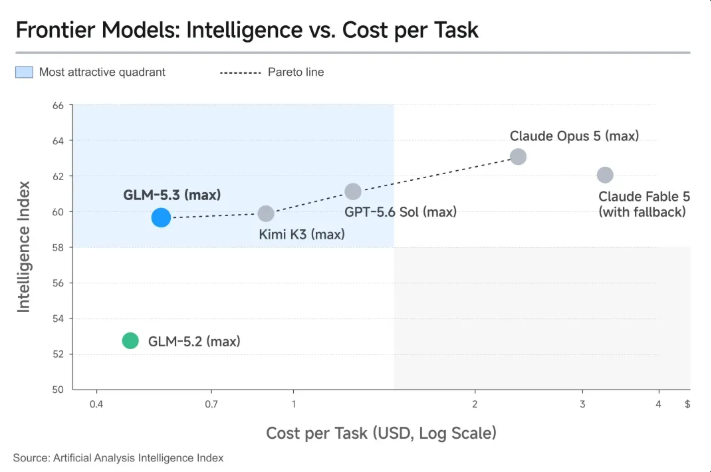
The second chart in the original report focuses on price rather than raw benchmark position.
Artificial Analysis currently lists the first-party Z.AI API at:
| Token Type | GLM-5.3 Price per 1M Tokens |
|---|---|
| Input | $1.40 |
| Cached input | $0.26 |
| Output | $4.40 |
Those prices are exactly the same as the current official pricing for GLM-5.2.
Artificial Analysis calculates a blended rate of roughly $0.90 per 1M tokens** under its 7:2:1 cached-input/input/output mix. It also reports an evaluation cost of about **$1,238.50 for GLM-5.3 on its Intelligence Index.
The cost chart therefore supports the original article's main point: GLM-5.3 combines a frontier-level aggregate score with comparatively low API pricing.
That does not mean every production task will be cheaper. Real cost depends on output verbosity, caching rate, prompt size, reasoning effort, tool calls, and how many agent turns are required.
API Pricing Is Unchanged From GLM-5.2
Z.AI's official pricing page confirms that both GLM-5.3 and GLM-5.2 currently use the same token rates.
This is significant because the model adds substantial capability without raising the headline API price.
For teams already using GLM-5.2, the migration decision is therefore mainly about behavior and compatibility rather than a new token-cost tier.
Developers should still run regression tests before switching production traffic because GLM-5.3 changes several model behaviors and parameters.
GLM-5.3 Uses Forced Reasoning
One of those differences is reasoning configuration.
GLM-5.3 always runs with thinking enabled and supports three reasoning-effort levels:
lowhighmax
The default is max.
Z.AI warns that applications using the older configuration below will fail when moved directly to GLM-5.3:
{
  "thinking": {
    "type": "disabled"
  }
}
For GLM-5.3, thinking must remain enabled. For complex coding work, Z.AI recommends the deepest effort level:
{
  "model": "glm-5.3",
  "thinking": {
    "type": "enabled"
  },
  "reasoning_effort": "max"
}
This is an official configuration example rather than a block from the short AIBase source, and it is included here because it directly affects developers migrating from GLM-5.2.
Context Window and Output Length
The official model documentation lists:
| Specification | GLM-5.3 |
|---|---|
| Input modality | Text |
| Output modality | Text |
| Context window | 1,000,000 tokens |
| Maximum output | 128K tokens |
| Reasoning | Always enabled |
| Reasoning effort | low / high / max |
GLM-5.3 also supports function calling, structured output, streaming responses, context caching, and streaming tool calls.
The model is currently text-only, so developers who require direct image understanding need to use a separate vision-capable model or workflow.
GLM-5.3 Is Now Available in ZCode and GLM Coding Plan
The AIBase article notes that GLM-5.3 has already been integrated into ZCode and the GLM Coding Plan.
That is confirmed by Z.AI's current product documentation.
ZCode describes itself as an agentic development environment built around GLM-5.3 for planning, coding, reviewing, debugging, testing, and long-running project work. Its workflow is designed to keep project files, terminal output, browser context, execution state, and Git changes within one ongoing task.
The GLM Coding Plan also lists GLM-5.3 as a supported model. The current plan uses a points-based quota system, with off-peak usage—including weekends—consuming fewer points.
Z.AI also supports GLM-5.3 through several API protocols, including OpenAI-compatible Chat Completions, OpenAI Responses, and Anthropic Messages endpoints, subject to plan and account restrictions documented by Z.AI.
A Minimal GLM-5.3 API Call
For developers who want to test the newly opened API directly, Z.AI's official documentation uses the model identifier:
glm-5.3
A basic cURL request follows the same structure as Z.AI's documented Chat Completions interface:
curl -X POST "https://api.z.ai/api/paas/v4/chat/completions" \
  -H "Content-Type: application/json" \
  -H "Authorization: Bearer your-api-key" \
  -d '{
    "model": "glm-5.3",
    "messages": [
      {
        "role": "user",
        "content": "Review this project architecture and identify the highest-risk engineering bottlenecks."
      }
    ],
    "thinking": {
      "type": "enabled"
    },
    "reasoning_effort": "max"
  }'
The endpoint and model configuration above follow Z.AI's current official documentation. Developers using the Coding Plan should check its separate endpoint rules because subscription traffic and standard API billing are not always interchangeable.
The Weights Are Planned for Release on August 28
The final point in the original article is the open-weights release.
On August 19, Zhipu-related announcements reported that the GLM-5.3 weights would be opened the following Friday, which corresponds to August 28, 2026.
At the time this Markdown file was prepared, that date had not yet arrived. Artificial Analysis still classified GLM-5.3 as proprietary because downloadable model weights were not yet publicly available.
The most accurate wording is therefore:
Zhipu has announced a plan to release GLM-5.3's model weights on August 28, 2026, but the weights are not yet publicly available at the time of writing.
Once the weights are actually published, developers should verify the official repository, model card, license, parameter count, supported inference frameworks, and deployment requirements before treating the release as ready for self-hosting.
常见问题
What is GLM-5.3?
GLM-5.3 is Zhipu AI / Z.AI's latest flagship text model for complex software engineering, agent tasks, reasoning, and cybersecurity-related work. It uses the same base model as GLM-5.2, with the main capability gains coming from additional post-training.
What score does GLM-5.3 get on Artificial Analysis?
Artificial Analysis currently gives GLM-5.3 (max) a score of 60 on its Intelligence Index. Kimi K3 (max) also scores 60 in the current comparison, although model behavior differs significantly across individual benchmarks and workloads.
How much does the GLM-5.3 API cost?
Z.AI currently charges $1.40 per million input tokens, $0.26 per million cached input tokens, and $4.40 per million output tokens. These rates are the same as the official GLM-5.2 pricing.
Does GLM-5.3 support a 1M-token context window?
Yes. Z.AI's official documentation lists a 1,000,000-token context window and a maximum output length of 128K tokens for GLM-5.3.
Can reasoning be disabled in GLM-5.3?
No. GLM-5.3 requires thinking to remain enabled. Developers can control reasoning depth with reasoning_effort values of low, high, or max, with max as the default.
Is GLM-5.3 already open source or open-weight?
Not yet at the time of writing. Zhipu has announced that the weights are planned for release on August 28, 2026, but the public weight package and final license still need to be verified after release.
Can GLM-5.3 be used in coding agents?
Yes. Z.AI has integrated the model into ZCode and GLM Coding Plan, and its documentation lists compatibility with multiple agentic coding tools and API protocols.
Is GLM-5.3 multimodal?
The current GLM-5.3 API documentation lists text input and text output only. It is not a direct image-input model in its current form.
相关工具
- ZCode: Z.AI's agentic development environment designed around GLM-5.3 for long-running coding and project workflows.
- Z.AI API Platform: The official platform for accessing GLM models, API keys, billing, and developer services.
- GLM Coding Plan: Z.AI's subscription plan for using GLM models in supported coding-agent tools.
- Artificial Analysis: Independent model analysis covering GLM-5.3 intelligence, pricing, speed, and context size.
- Z.AI Developer Documentation: Official API, model, migration, pricing, and integration documentation.
Related Links
- GLM-5.3 Official Model Documentation: Official specifications, capabilities, reasoning settings, endpoints, benchmarks, and quick-start examples.
- GLM-5.3 Official Launch Blog: Z.AI's launch article on coding, long-horizon agents, and emerging cybersecurity performance.
- Z.AI Pricing: Official token pricing for GLM-5.3, GLM-5.2, and other Z.AI models.
- Migrate to GLM-5.3: Official migration checklist covering the model ID, forced thinking, reasoning effort, streaming, and tool calls.
- ZCode Documentation: Official guide to using GLM-5.3 inside ZCode's agentic development workflow.
- GLM Coding Plan FAQ: Official information on supported models, quota behavior, endpoints, and plan restrictions.
- Artificial Analysis GLM-5.3: Current independent benchmark and price analysis for GLM-5.3 (max).
Summary
GLM-5.3 is now available through Z.AI's API and coding ecosystem. Its current Artificial Analysis Intelligence Index score is 60, while Z.AI says the largest generation-over-generation gains come from post-training focused on complex coding, long-horizon agents, and cybersecurity tasks.
The model keeps GLM-5.2's API pricing while adding a 1M-token context window, up to 128K output, and mandatory reasoning with adjustable effort levels. It is already integrated into ZCode and GLM Coding Plan.
Zhipu has also announced that GLM-5.3's weights are planned for release on August 28, 2026. Until the actual repository and license are published, it should still be described as API-accessible with a scheduled open-weight release rather than as an already downloadable open model.
The key change is straightforward: GLM-5.3 raises capability without raising the headline GLM-5.2 API price, while a public weight release is scheduled to follow.