Xunce Technology’s 389% Revenue Surge: How Enterprise Data Became a Usage-Based AI Business
The price of general-purpose model inference continues to fall. Model providers are competing on input-token prices, output-token prices, caching, batch processing, and increasingl
Xunce Technology’s 389% Revenue Surge and the Rise of Usage-Based Enterprise AI Data
Introduction
The price of general-purpose model inference continues to fall.
Model providers are competing on input-token prices, output-token prices, caching, batch processing, and increasingly efficient architectures. On the surface, this suggests that enterprise AI should become cheaper every year.
Yet many organizations are discovering a different cost curve.
The base model may be inexpensive, but production AI still needs:
- Clean private data.
- Reliable real-time feeds.
- Industry-specific rules.
- Structured context.
- Access controls.
- Audit trails.
- Evaluation.
- Human feedback.
- Integration with operational systems.
- Continuous monitoring.
A low-cost model cannot make a reliable decision from data it cannot access, understand, or trust.
This gap between cheap general inference and expensive enterprise implementation is central to the growth story of Shenzhen Xunce Technology Co., Ltd., listed in Hong Kong under stock code 3317.
Xunce does not develop a general-purpose foundation model. Its core business is real-time data infrastructure and data analytics for asset management and a growing range of other industries.
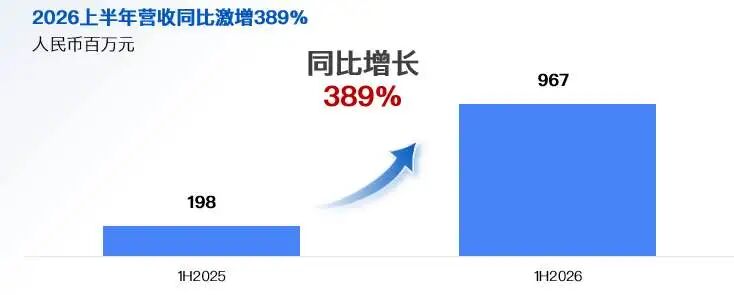
On July 31, 2026, the company issued a positive profit alert estimating that first-half revenue had reached approximately RMB 967.02 million, up 388.76% year over year.
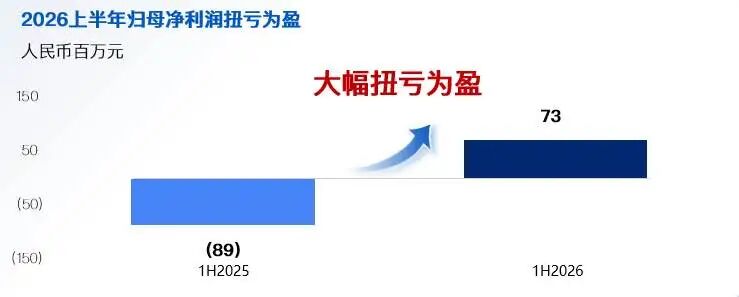
The company also expects to report its first profitable first half since its establishment.
At the center of its current strategy is TokenONE, a product the company describes as a TokenOS operating system for turning enterprise data and domain knowledge into measurable, callable “scenario Tokens.”
The phrase sounds similar to the tokens used by language-model APIs, but the two concepts are not identical.
Understanding that distinction is essential to understanding both the opportunity and the uncertainty behind Xunce’s new business model.
Cheap General Tokens Do Not Eliminate Enterprise AI Costs
A standard language-model token is a unit created when text is divided by a tokenizer.
Model providers commonly charge according to quantities such as:
Input tokens
Output tokens
Cached input tokens
Reasoning tokens
Those units help measure model computation and API usage.
Xunce uses the word Token more broadly.
Its “scenario Token” is presented as a packaged enterprise-data or domain-knowledge unit that can be called by an AI application and connected to a business decision.
Examples might involve:
- A financial risk-control signal.
- A manufacturing-equipment condition.
- A real-time energy-dispatch input.
- A medically relevant structured feature.
- A standardized industrial rule.
- A verified data output for an AI agent.
This means the company’s quoted “per million Token” pricing is not necessarily comparable on a one-to-one basis with the input-token price of a foundation-model API.
The products solve different problems.
| Generic model token | Xunce “scenario Token” |
|---|---|
| Usually a tokenizer-defined text or multimodal unit | A company-defined unit of processed enterprise data or knowledge |
| Measures model input or output consumption | Intended to represent a callable business-data capability |
| Usually based on broadly trained model intelligence | Based on private data, rules, real-time feeds, and industry workflows |
| Commonly priced by model providers | Priced as part of Xunce’s enterprise product and service model |
| Standard technical meaning varies by tokenizer | Product meaning depends on TokenONE’s implementation and contract |
The key business idea is not that one token is inherently worth more than another.
It is that an enterprise may pay more for validated, timely, domain-specific context than for raw general-model computation.
A Revenue Curve That Changed Direction
Xunce’s audited and published annual revenue has grown quickly, although the path has not been smooth.
According to the company’s 2025 annual report:
| Year | Revenue | Year-over-year growth |
|---|---|---|
| 2022 | RMB 287.90 million | — |
| 2023 | RMB 530.46 million | 84.25% |
| 2024 | RMB 631.98 million | 19.14% |
| 2025 | RMB 1.285 billion | 103.28% |
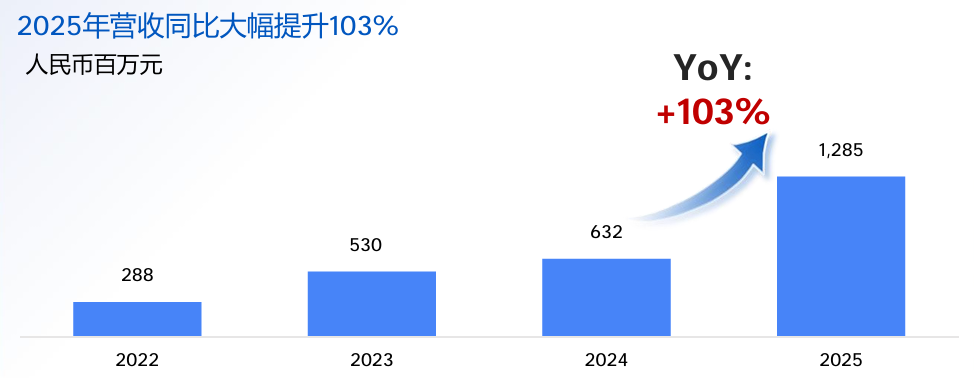
The slower growth in 2024 stands out between two much stronger years.
One possible interpretation is that the enterprise-AI market was still dominated by model training, infrastructure procurement, experimentation, and proof-of-concept work.
Xunce’s products benefit more directly when organizations begin connecting AI to live operational data and deploying it in production workflows.
That interpretation is plausible, but it should not be treated as the only explanation.
Company performance can also be affected by:
- Contract timing.
- Customer concentration.
- Project acceptance.
- Industry budgets.
- Revenue recognition.
- Hardware procurement within solutions.
- Product mix.
- Sales execution.
The annual report confirms that Xunce’s 2025 revenue acceleration came alongside a substantial increase in solution-delivery costs.
Revenue grew 103.28%, while cost of sales increased 234.29%, partly because some projects included hardware procurement and deployment services.
Gross margin declined from 76.68% in 2024 to 61.66% in 2025, although it remained high by ordinary software-and-services standards.
First-Half 2026 Revenue Is Expected to Rise 388.76%
Xunce’s July 31 positive profit alert estimates:
| Metric | First half 2025 | First half 2026 estimate | Change |
|---|---|---|---|
| Revenue | RMB 197.85 million | RMB 967.02 million | +388.76% |
| Profit/(loss) attributable to owners | Loss of RMB 89.43 million | Profit of RMB 72.51 million | Turnaround |
| Adjusted net profit/(loss) | Loss of RMB 104.98 million | Profit of RMB 67.00 million | Turnaround |
The announcement attributes revenue growth to four main factors:
- Concentrated release of enterprise AI demand and increased need for high-quality, structured, scenario-specific data.
- Faster expansion into multiple industries and greater replication of cross-industry products.
- Initial implementation of the Token business model and increasing Token calls.
- International expansion and ecosystem development.
The company attributes the expected profit turnaround to:
- A higher contribution from more profitable businesses.
- Scale effects from platform-based and modular products.
- Lower R&D, sales, and administrative expense ratios.
- Additional investment income from improved capital management.
These details matter because the growth should not be attributed to TokenONE alone.
TokenONE was formally launched on May 25, near the end of the six-month reporting period.
The profit alert presents Token commercialization as one growth factor within a much broader expansion in enterprise AI data infrastructure.
Important: These figures are preliminary and unaudited. Investors and readers should use the detailed interim report, once published, to examine revenue recognition, cash flow, gross margin, receivables, customer concentration, and the exact Token-related contribution.
The Company Had Not Yet Reached Full-Year Profitability in 2025
The source article frames the first-half result as the release of a long period of investment.
That is broadly consistent with the audited history, but the details deserve attention.
For 2025, Xunce reported:
| 2025 metric | Amount |
|---|---|
| Revenue | RMB 1.285 billion |
| Gross profit | RMB 792.08 million |
| Loss for the year | RMB 129.65 million |
| Loss attributable to owners | RMB 94.06 million |
| Adjusted net loss | RMB 54.85 million |
The company therefore entered 2026 with rapid revenue growth but a remaining full-year loss.
Its first-half 2026 profit alert signals a significant change, yet one profitable half does not by itself establish a durable long-term margin profile.
The future result will depend on revenue mix, hardware and delivery costs, sales expenses, R&D intensity, receivable collection, Token-product adoption, competition, customer retention, and continued enterprise AI spending.
What Xunce Actually Does
Xunce describes itself as a provider of real-time data infrastructure and data analytics services.
The company began in asset management, an industry with demanding requirements for low latency, data consistency, traceability, regulatory compliance, risk controls, real-time market information, and reliable decision support.
Its 2025 annual report describes an end-to-end technical system covering:
- Data acquisition.
- Data cleaning.
- Standardization.
- Real-time computation.
- Large-model optimization.
- AI-agent applications.
- Industry-specific solution delivery.
The company has since expanded into areas including telecommunications, electric power, energy, urban operations, high-end manufacturing, healthcare, satellite and commercial aviation, robotics data platforms, and consumer sectors.
In 2025, non-asset-management businesses generated approximately RMB 1.023 billion, or 79.63% of total revenue.
Asset-management revenue accounted for the remaining 20.37%.
This diversification is one of the strongest documented changes in the business.
It reduces dependence on one sector, but it also creates new execution demands because every industry has different data standards, workflows, sales cycles, compliance rules, and integration requirements.
The Business Was Already Mostly Transaction-Based Before TokenONE
The source article describes a transition from one-off projects to Token-based recurring usage.
That direction is important, but the historical revenue model was already more complicated than a simple project-only business.
Xunce’s 2025 annual report divides revenue into:
| Payment model | 2025 revenue | Share of total |
|---|---|---|
| Subscription model | RMB 111.19 million | 8.66% |
| Transaction model | RMB 1.173 billion | 91.34% |
The transaction model had risen from 80.64% of revenue in 2024.
The report says this increase was mainly caused by stronger customer demand for multi-module solutions.
TokenONE therefore represents a new form of usage-linked commercialization, but it is not a complete overnight replacement of a pure subscription business.
A more accurate sequence is:
Subscription and project-style solutions
→ multi-module transaction revenue
→ growing usage-based Token calls
→ possible platform and exchange revenue
The accounting treatment of Token-related revenue should become clearer in future interim and annual reports.
TokenONE Changes the Revenue Formula
Xunce launched TokenONE in May 2026.
The company describes it as a TokenOS that turns heterogeneous enterprise data into measurable, priceable, auditable, and callable scenario Tokens.
Its business-model framing can be written as:
Token revenue
= customers
× modules
× unit price
× number of calls
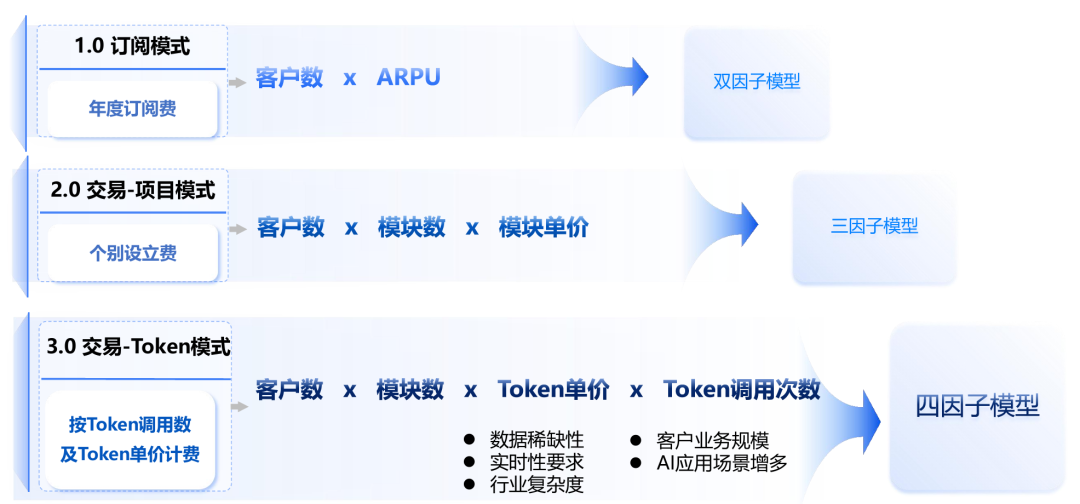
The formula adds a usage variable to the traditional enterprise-software model.
A project may produce one payment when it is delivered.
A usage-based system can continue generating revenue whenever the customer’s AI application calls the service.
This resembles other metered infrastructure businesses:
- Cloud computing billed by consumption.
- API platforms billed by requests.
- Databases billed by queries or compute.
- Payment platforms billed by transactions.
- Communications platforms billed by messages or minutes.
The advantage is alignment with customer activity.
The risk is that revenue becomes dependent on actual consumption rather than contracted shelfware.
If the customer’s AI application is not used, usage revenue may not grow.
What TokenONE Calls a “Token Factory”
TokenONE is presented as a standardized production system for turning raw enterprise data into AI-ready outputs.
The launch materials describe nine processing stages and five major flows.
The exact terminology varies across company materials, but the process broadly includes:
- Data acquisition.
- Data cleaning.
- Data standardization.
- Data labeling.
- Data modeling.
- Real-time computing.
- Tokenized packaging.
- AI-agent or application integration.
- Foundation-model or hybrid-model access.
The five flows connect those steps across data governance, application integration, AI agents, vertical or small models, and measurement, audit, security, and billing.
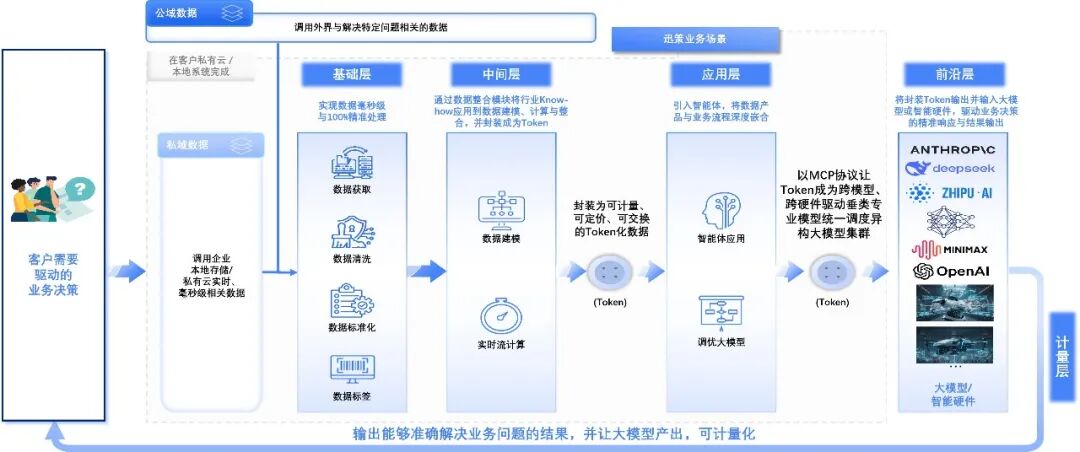
The company’s core argument is that enterprise data cannot simply be copied into a model prompt.
It must first be made accurate, timely, structured, permission-aware, traceable, relevant to the business process, compatible with the target AI system, and measurable for billing and evaluation.
This is a real enterprise problem, even when one does not adopt Xunce’s Token terminology.
How a Scenario Token Might Work
Consider a manufacturing plant with more than 200 types of equipment.
Raw inputs may include sensor streams, maintenance records, alarm logs, quality-inspection results, machine settings, production schedules, and technician notes.
A general language model cannot safely infer equipment condition directly from an unstructured dump of this material.
A production pipeline might instead:
- Identify the relevant machine and operating period.
- Synchronize sensor timestamps.
- Remove corrupted readings.
- Standardize field names and units.
- Apply equipment-specific thresholds.
- Compare current behavior with historical patterns.
- Add known maintenance and fault information.
- Produce a structured diagnostic context.
- Send the result to an agent or decision system.
- Record the call, output, and eventual business outcome.
Xunce would describe the resulting callable data capability as a scenario Token.
The valuable part is not the word Token.
It is the transformation from raw operational data into a reliable decision input.
Company-Reported Token Commercialization Metrics
Xunce reported the following early commercial indicators:
- Token-call annual recurring revenue grew approximately 300% during April, according to May launch coverage.
- Token-related paid revenue represented about 5% of revenue in April.
- The company-attributed July business update says Token-related revenue had exceeded 10% of turnover.
- June Token ARR increased 410% quarter over quarter, according to the same company update.
- Management targets a Token-related revenue contribution of 20%–30% by year-end.
These figures are promising but require careful interpretation.
ARR Is Not Recognized Revenue
Annual recurring revenue is a run-rate metric.
It estimates what recurring revenue might look like over a year if the current level continues.
It is not the same as cash collected, audited revenue, contracted backlog, net profit, or free cash flow.
A Small Base Can Produce Very High Growth
A 300% or 410% increase can occur when the starting value is small.
The absolute Token-related revenue and gross profit contribution matter as much as the percentage increase.
The Product Was Recently Launched
TokenONE had only been public for a short period by the first-half reporting date.
Future reports will be needed to evaluate customer conversion, usage retention, average revenue per customer, gross margin, cost of serving calls, concentration, churn, contract duration, and cash collection.
Why Scenario Tokens Can Be Priced Above Generic Model Tokens
The company says its scenario Token pricing can range from US$10 to US$100 per million Tokens.
This company-reported range is much higher than many general-purpose model input prices.
The comparison is not direct, because the underlying unit is different.
A customer may be paying for a bundle that includes private enterprise data, data cleaning, real-time processing, industry rules, model routing, security controls, auditing, service-level requirements, implementation support, and a business-specific output.
The closest comparison is not necessarily “one LLM token versus one scenario Token.”
It may be:
Commodity model inference
versus
a managed, validated, industry-specific data service
Higher prices are sustainable only when the output creates measurable value or avoids meaningful risk.
Examples might include preventing a faulty transaction, detecting a production defect, reducing machine downtime, improving energy dispatch, accelerating a regulated workflow, or lowering manual review costs.
If the output does not improve the business result, the premium becomes difficult to defend.
Why Xunce Believes It Has an Advantage
Tokenization is easy to describe.
Building a dependable industrial system is harder.
Xunce’s main claimed advantage is a decade of work in real-time data infrastructure.
Its annual report identifies three core product attributes:
- Speed: real-time data aggregation, processing, and output.
- Accuracy: consistent and traceable automated data outputs.
- Scalability: modular solutions that can be combined for different customers.
The company’s original asset-management market is a demanding training ground.
Financial workflows may require millisecond-level responses, exact data reconciliation, full audit trails, strict entitlements, regulatory reporting, and risk and compliance checks.
The company argues that the same underlying capabilities can be replicated in manufacturing, energy, healthcare, robotics, aviation, and other industries.
The 79.63% non-asset-management revenue share in 2025 provides evidence that the business has already expanded beyond finance.
It does not prove that every new vertical will achieve the same margins, retention, or defensibility.
Industry Knowledge Is Difficult to Recreate Quickly
Enterprise AI performance often depends on information that is not available in public training data.
Examples include a factory’s equipment parameters, a hospital’s internal workflow, a financial institution’s risk rules, a power grid’s real-time operating state, a company’s historical failure patterns, product-specific quality thresholds, and industry-specific labeling standards.
A foundation model can provide broad reasoning capability.
Private data and operational feedback determine whether that capability works inside one organization.
The defensibility of an enterprise-data provider may therefore come from long customer relationships, integration depth, historical data mappings, industry-specific modules, operational feedback, security certifications, switching costs, and reliable real-time performance.
These advantages can take years to develop.
They can also be weakened if customers build internal platforms, foundation-model providers move deeper into enterprise data, or open-source data tools reduce implementation costs.
The Next Step: Token Factories
Xunce’s first strategic stage is already underway.
The company plans to build vertical Token factories with industry partners in areas such as finance, healthcare, high-end manufacturing, energy and electric power, intelligent vehicles, robotics, and other data-intensive sectors.
The Token-factory concept is based on repeatability.
Instead of rebuilding every data pipeline from the beginning, Xunce aims to reuse standard modules, industry templates, data-processing rules, security controls, billing logic, and model integrations.
This is the same platform-versus-project tension seen in many enterprise-software companies.
A platform becomes more profitable when new customers can be served with existing components.
It remains a services business when every deployment requires extensive custom work.
Future gross-margin and expense data will show how far Xunce has moved toward true platform economics.
The Planned Second Stage: TokenRouters
Xunce says it plans to launch TokenRouters in the second half of 2026.
The product is described as a platform for compliant Token exchange across enterprises, industries, and scenarios.
The intended model is:
- A company creates scenario Tokens from its private data.
- Approved Tokens become available under defined permissions.
- Another non-competing organization calls or purchases them.
- Usage is measured.
- The parties settle according to an agreed price.
- Security, audit, and compliance controls govern the exchange.
This would expand the revenue logic from one customer’s internal calls to activity across a wider network.
The potential platform effect is obvious.
The implementation challenges are equally significant:
- Data ownership.
- Consent.
- Confidentiality.
- Competition law.
- Cybersecurity.
- Cross-border transfer.
- Model leakage.
- Re-identification.
- Quality assurance.
- Liability for incorrect outputs.
- Standardized pricing.
- Interoperability.
TokenRouters is a planned product, not an established national exchange.
Its commercial adoption should be evaluated after launch.
The Long-Term Goal: Enterprise-Specific Small Models
The third stage in Xunce’s roadmap is enterprise-specific small models.
The reasoning is straightforward.
Some organizations do not want every request to leave their environment or use a large general-purpose model.
They may prefer smaller systems that are cheaper to run, easier to tune, faster, more predictable, private, deployable on-premises, and focused on one task or industry.
A scenario-token layer can provide these models with curated, continually updated enterprise context.
The combination could look like:
Enterprise data
→ governed scenario Tokens
→ private small model
→ business application
→ outcome feedback
→ updated Token pipeline
This architecture may be attractive in finance, healthcare, aerospace, government, and other sensitive environments.
It also means Xunce will face competition from cloud providers, database companies, data-integration vendors, model providers, AI-agent platforms, internal enterprise engineering teams, and industry-software companies.
Why the Growth Story Is Attractive
Several elements make Xunce’s strategy commercially interesting.
Enterprise AI Is Moving from Experiments to Workflows
As organizations connect AI to real operations, they need more data engineering, governance, and monitoring.
Private Data Is Harder to Commoditize
Public model intelligence can become cheaper quickly.
Customer-specific data mappings and feedback loops are less portable.
Usage Pricing Can Expand with Adoption
When customer calls increase, usage-linked revenue can increase without signing a completely new customer for every unit of growth.
Modular Products Can Improve Operating Leverage
Reusable components may lower delivery cost as deployments scale.
Industry Diversification Has Already Happened
Nearly 80% of 2025 revenue came from outside the original asset-management segment.
Profitability Has Begun to Emerge
The preliminary first-half alert indicates a meaningful turnaround.
These points explain the optimism around the company.
They do not remove the risks.
The Main Risks Behind the Token Story
1. Preliminary Results May Change
The July announcement is based on unaudited management accounts.
The detailed interim report may contain adjustments or additional context.
2. Revenue Growth Does Not Equal Cash Generation
Enterprise projects can produce large receivables.
Xunce’s 2025 annual report identified expected credit losses on trade receivables as a key audit matter.
At year-end 2025:
- Net trade receivables were approximately RMB 671.88 million.
- Recognized expected credit losses were approximately RMB 194.01 million.
Cash collection should therefore be reviewed alongside revenue.
3. Token Revenue Is Still Early
The company-reported Token contribution had only recently exceeded 10%.
The majority of revenue still came from the broader existing business.
4. The Definition of a Scenario Token Is Vendor-Specific
There is no universal accounting or technical standard that makes one Xunce scenario Token directly comparable with a token from another provider.
Customers will judge the product by business outcomes rather than terminology.
5. Platform Economics Are Not Yet Fully Proven
If deployments continue to require substantial hardware and customization, margins may remain closer to a solution business than a pure software platform.
6. Competition Will Increase
Major cloud, model, data, and enterprise-software companies are all moving toward private-data integration and agent infrastructure.
7. Cross-Enterprise Token Exchange Is Complex
TokenRouters will need to solve legal, technical, and trust problems before network effects can develop.
8. High Growth Can Create Execution Pressure
Rapid expansion across many industries and countries can strain sales, support, security, delivery, and quality-control systems.
A More Accurate Revenue Formula
The source article presents Token revenue as a four-factor model:
Customers × modules × Token price × calls
That is a useful commercial framework, but a complete business model also needs to subtract costs and account for customer behavior.
A more practical model is:
Token gross profit
= active customers
× active modules
× net unit price
× successful billable calls
− data-processing cost
− model and compute cost
− delivery cost
− support cost
− partner revenue share
− bad debt and collection cost
The words active, successful, and net matter.
A customer may sign a contract without using the service heavily.
A call may fail or produce no value.
A list price may differ from the realized price after discounts.
The long-term quality of the business will depend on these operational details.
What to Watch in the August Interim Results
The detailed interim report should help answer several important questions.
Revenue Quality
- How much came from Token-related products?
- How much came from hardware or deployment?
- How much was recurring or usage-based?
- How concentrated were the largest customers?
Profitability
- What was the gross margin?
- Which business lines generated the profit?
- How much profit came from investment income?
- Did expense ratios improve sustainably?
Cash and Receivables
- Did operating cash flow improve?
- How quickly were receivables collected?
- Did expected credit losses increase?
Token Economics
- How many customers used Token pricing?
- What was the average usage?
- What was the retention rate?
- What was the serving cost?
- Did Token revenue exceed the reported 10% level?
Platform Progress
- How many modules were reused?
- How much customization was still required?
- Was TokenRouters launched on schedule?
- Which Token factories entered production?
These details will matter more than the headline growth percentage.
What the Results Say About Enterprise AI
Even with the necessary caveats, Xunce’s results point to an important market trend.
Enterprise AI spending is broadening beyond foundation models and accelerators.
Organizations are increasingly spending on the layer that connects AI to business reality:
- Data pipelines.
- Real-time context.
- Permissions.
- Domain logic.
- Evaluation.
- Monitoring.
- Application integration.
- Auditing.
As general model inference becomes cheaper, these surrounding systems can represent a larger share of the total value.
This does not mean generic tokens become irrelevant.
It means the cheapest component is not always the most valuable component.
A model call may cost very little.
The trusted data, workflow integration, and accountability required to act on the answer may cost much more.
常见问题
What does Xunce Technology do?
Xunce provides real-time data infrastructure and data analytics services for asset management and a growing range of other industries. Its products connect enterprise data acquisition, cleaning, standardization, real-time computing, analytics, AI agents, and model integration.
Why did Xunce’s first-half revenue grow 389%?
The company’s preliminary profit alert attributes the increase to stronger enterprise AI data demand, expansion into more industries, implementation of the Token business model, and international and ecosystem development. The figure is unaudited and should be confirmed in the detailed interim results.
What is TokenONE?
TokenONE is Xunce’s product for converting heterogeneous enterprise data and domain knowledge into measurable, auditable, and callable scenario Tokens. The company describes it as a TokenOS and a standardized Token-factory system.
Is a Xunce scenario Token the same as an LLM token?
No. An LLM token is normally a tokenizer-defined unit of model input or output. Xunce uses “scenario Token” as a product term for processed enterprise data or knowledge capabilities, so its pricing is not directly comparable with ordinary model-token prices.
Is Xunce profitable?
Xunce reported a net loss for full-year 2025. Its July 2026 positive profit alert estimates a first-half profit attributable to owners of RMB 72.51 million and adjusted net profit of RMB 67 million, subject to the final interim results.
What is TokenRouters?
TokenRouters is Xunce’s planned platform for compliant exchange and use of scenario Tokens across companies and industries. The company said it expected to launch the platform in the second half of 2026, so it should be treated as a roadmap product rather than an established exchange.
Why can industry-specific AI data cost more than generic model tokens?
Industry data may include private records, real-time feeds, validated rules, security controls, auditability, and operational guarantees. Customers may pay a premium when that package improves a high-value decision, but the price is sustainable only if it creates measurable business value.
What are the biggest risks in Xunce’s Token business?
The main risks include preliminary financial data, cash collection, early-stage Token adoption, a non-standard Token definition, customization costs, competition, regulatory complexity, and uncertainty around the TokenRouters platform.
相关工具
- Apache Kafka: An open-source event-streaming platform commonly used to move real-time enterprise data between systems.
- Apache Flink: A distributed engine for stateful stream processing and real-time data computation.
- dbt: A data-transformation framework for building documented and testable analytics models.
- Great Expectations: A data-quality platform for validating datasets before they enter analytics or AI workflows.
- MLflow: An open-source platform for managing machine-learning experiments, models, evaluation, and deployment.
- DeepSeek API: Official API documentation for a general-purpose model provider, useful for comparing base-model access with enterprise-data infrastructure.
Related Links
- Xunce Technology Official Website: Official company information and descriptions of its real-time data infrastructure business.
- Xunce 2026 First-Half Positive Profit Alert: The official preliminary and unaudited revenue and profit announcement filed with HKEX.
- Xunce 2025 Annual Report: Audited financial history, industry revenue mix, payment models, risks, receivables, and company disclosures.
- TokenONE Launch Announcement: Company-issued description of TokenONE, its scenario-Token concept, and product positioning.
- Science and Technology Daily: TokenOS Launch: Independent news coverage of TokenONE’s nine stages, five flows, and early April usage metrics.
- Xunce July 31 Business Update: Company-attributed update on Token ARR, revenue contribution, pricing, partnerships, and roadmap.
- Hong Kong Stock Exchange News: Official repository for listed-company announcements and financial reports.
Summary
Xunce Technology expects first-half 2026 revenue of RMB 967.02 million, representing preliminary year-over-year growth of 388.76%, and its first profitable first half. The official announcement attributes the change to enterprise AI data demand, industry expansion, Token commercialization, international activity, operating leverage, and investment income.
TokenONE adds a usage-based layer to the company’s existing real-time data-infrastructure business. Its scenario Tokens should not be confused with ordinary foundation-model tokens: they are company-defined packages of processed enterprise data, domain knowledge, and callable business capability.
The opportunity is clear. As generic model inference becomes cheaper, trusted private data and production integration may capture more of the value. The uncertainties are equally important: Token revenue is still early, the financial figures are preliminary, receivables require attention, and the planned TokenRouters exchange has not yet proved its economics.
The central lesson is not that expensive Tokens automatically beat cheap Tokens—it is that enterprise AI pays for reliable decisions, not merely for model computation.