Synchrony Partners With OpenAI to Bring Financing, Rewards and Loyalty Into AI Shopping
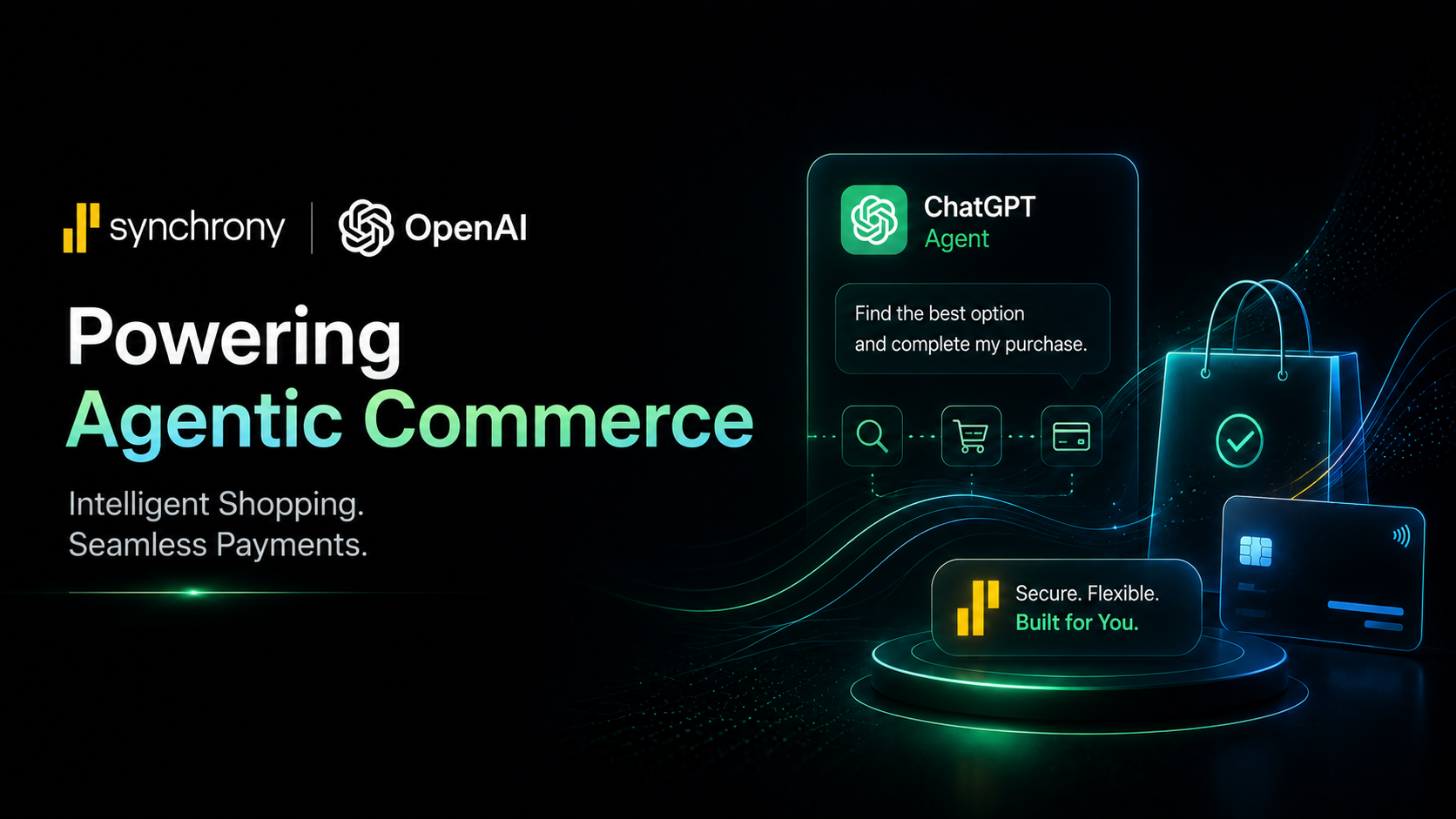
Consumer-finance company Synchrony has announced an enterprise collaboration with OpenAI aimed at bringing financing, rewards, loyalty, and marketplace offers into AI-native shopping experiences.
Synchrony Partners With OpenAI to Bring Financing, Rewards and Loyalty Into AI Shopping
Introduction
Consumer-finance company Synchrony has announced an enterprise collaboration with OpenAI aimed at bringing financing, rewards, loyalty, and marketplace offers into AI-native shopping experiences.
The partnership gives Synchrony a more direct role in the emerging market for agentic commerce, where AI systems help users move from product discovery toward purchasing decisions and, eventually, more deeply integrated transaction flows.
The original AIBase report framed the announcement as a step toward letting shoppers use Synchrony-issued retail credit products inside ChatGPT. That is the broader direction of the collaboration, but there is an important distinction between the long-term goal and what is available today.
Synchrony’s official announcement does not state that Amazon, Walmart, Lowe’s, or other Synchrony-issued private-label cards can already be used to complete purchases directly inside ChatGPT. What it confirms today is an enterprise collaboration with OpenAI, a forthcoming Synchrony Marketplace plugin for ChatGPT, and plans to bring financing, rewards, and loyalty into future AI-native shopping and checkout experiences.
Agentic Commerce Is Still Missing a Smooth Final Step
The attraction of agentic commerce is easy to understand.
A shopper can already ask an AI assistant to compare products, narrow down choices, explain trade-offs, and recommend an option based on budget and preferences.
The harder part is turning that recommendation into a completed transaction.
Historically, AI shopping experiences have often reached a point where the assistant identifies the product and then sends the shopper to a retailer or merchant website to finish the purchase.
OpenAI has experimented with reducing that gap.
In September 2025, the company introduced Instant Checkout in ChatGPT using the Agentic Commerce Protocol developed with Stripe. That early implementation allowed some U.S. users to complete supported purchases without leaving the conversation.
OpenAI’s commerce strategy has since evolved.
Its current merchant documentation says the company is moving away from a standalone Instant Checkout experience and prioritizing richer product discovery together with merchant-owned checkout experiences. Shoppers can discover and compare products inside ChatGPT, while the purchase is generally completed on the merchant’s own website or app.
That context matters when interpreting the Synchrony announcement.
The collaboration is part of a broader effort to make financing, rewards, loyalty, and payment credentials usable in AI-driven commerce, but it should not be read as evidence that every Synchrony retail card can already be loaded into a universal ChatGPT checkout flow.
What Synchrony and OpenAI Have Officially Announced
Synchrony announced the enterprise collaboration on August 17, 2026.
The company says the partnership is intended to strengthen its position as shopping and payments become more agent-driven.
The official announcement identifies three main areas.
1. Financing, Rewards and Loyalty in AI-Native Commerce
Synchrony says it plans to bring its financing, rewards, and loyalty capabilities into AI-native shopping and checkout experiences.
That is broader than simply adding another payment button.
Private-label and co-branded credit products often include:
- Promotional financing
- Merchant-specific rewards
- Loyalty benefits
- Special offers
- Credit-based purchasing options
For an AI shopping agent to become a meaningful commerce interface, it eventually needs to understand not only which product a user wants but also which financing or reward option makes sense for that purchase.
Synchrony’s collaboration with OpenAI is aimed at making those financial products more compatible with that kind of experience.
2. A Synchrony Marketplace Plugin for ChatGPT
Synchrony also plans to launch a ChatGPT plugin that brings offers from Synchrony Marketplace into the ChatGPT experience.
According to the company, consumers will be able to discover:
- Savings
- Promotional financing
- Deals
- Everyday-value offers
- Offers from participating Synchrony partners
This part of the announcement is more concrete than the future payment integration.
The plugin is designed primarily around discovery of offers and financing opportunities, rather than functioning as proof that every Synchrony-issued credit card is already supported for native in-chat payment.
3. OpenAI Models Inside Synchrony
The partnership also runs in the other direction.
Synchrony says it will deploy OpenAI’s latest models—including the GPT-5.6 family—across its enterprise through products such as ChatGPT Work, Codex, and AWS Bedrock.
The company says it plans to use these systems for product development, technology innovation, internal workflows, and broader enterprise AI adoption.
Synchrony also reports that nearly all of its professional workforce has already been actively using AI tools, with expanded access planned through the new collaboration.
Why Retail Credit Cards Matter in AI Shopping
Synchrony is not a conventional payment network like Visa or Mastercard.
Its business is heavily tied to consumer financing and credit programs offered with retail and service partners.
That makes the company relevant to agentic commerce for a different reason.
A shopper may not simply want to know:
Which laptop should I buy?
They may also care about questions such as:
Which option gives me the best promotional financing?
or:
Do I get a better reward if I use my retailer card?
An AI shopping system that cannot see those financing and loyalty options may recommend the right product but still miss an important part of the purchasing decision.
That is the gap Synchrony is trying to address.
Synchrony works with a large network of retailers and service providers and issues both private-label and general-purpose credit products. Its relationships have included major brands such as Amazon and Lowe’s, while Synchrony and Walmart-backed OnePay also launched a new Walmart credit-card program in 2025.
However, the existence of those card programs should not be confused with confirmed ChatGPT payment support for each brand.
As of this update, Synchrony’s official OpenAI announcement does not publish a list of specific retail cards that can be used directly inside ChatGPT checkout.
OpenAI Has Already Been Building the Commerce Layer
The Synchrony deal does not arrive in isolation.
OpenAI has spent the past year building a broader commerce stack around ChatGPT.
Agentic Commerce Protocol
OpenAI and Stripe originally developed the Agentic Commerce Protocol (ACP) as an open standard for connecting AI agents, merchants, and commerce systems.
ACP supports structured product information and provides a framework that can be extended across discovery, shopping, and transaction workflows.
OpenAI now uses ACP as the foundation for richer product discovery in ChatGPT.
Merchants can provide structured catalog data including:
- Product titles
- Descriptions
- Images
- Prices
- Availability
- Promotions
This allows ChatGPT to present more accurate and current shopping results.
Stripe
Stripe powered the original Instant Checkout implementation in ChatGPT.
That system used secure payment tokens so that ChatGPT could help initiate a transaction without directly exposing the shopper’s raw payment credentials to the AI model.
Stripe continues to provide infrastructure for agentic commerce through ACP and related payment technologies.
Visa
In June 2026, Visa and OpenAI announced a strategic collaboration around secure payments in agentic commerce.
Visa says the partnership is designed to bring its network, credentialing, tokenization, authorization, and fraud-monitoring capabilities into OpenAI-powered commerce experiences.
Visa also emphasizes explicit user permissions and controls such as spending limits, merchant restrictions, and required approvals.
Taken together, the Stripe, Visa, and Synchrony relationships cover different parts of the same emerging stack:
| Company | Main Role in Agentic Commerce |
|---|---|
| OpenAI | AI shopping interface and product discovery |
| Synchrony | Financing, retail credit, rewards and loyalty |
| Visa | Payment network, credentialing, tokenization and transaction security |
| Stripe | Commerce infrastructure, payment tokens and protocol tooling |
| Merchants | Product catalog, checkout, fulfillment, returns and customer relationship |
The exact architecture is still evolving, but the direction is clear: AI shopping requires more than a recommendation model. It needs secure connections among merchants, financing providers, payment networks, and the user.
The Commercial Model Is Still Evolving
The original AIBase article also points to an unresolved question: who gets paid when an AI assistant drives a transaction?
That issue has already changed as OpenAI’s shopping strategy has developed.
The initial Instant Checkout model involved fees on completed purchases. OpenAI’s current merchant page, however, says purchases that start in ChatGPT and finish on a merchant-owned site or app do not carry product-feed transaction fees from OpenAI.
This shift illustrates why agentic-commerce announcements need to be read carefully.
The market is moving quickly, and payment architecture, merchant control, revenue sharing, and user experience are still being tested.
Synchrony’s collaboration is therefore best understood as infrastructure and ecosystem positioning rather than a fully completed universal payment system.
Trust May Be the Hardest Part of AI Checkout
Even if the technical pieces work, consumer trust remains a major challenge.
Allowing an AI agent to participate in a purchase raises questions that do not exist in ordinary product search.
Users may want clear answers to questions such as:
- What payment credential is the agent allowed to use?
- What is the spending limit?
- Does the user confirm the final transaction?
- What information is shared with the merchant?
- Who handles fraud or disputes?
- Can the agent apply rewards or promotional financing correctly?
- What happens if the AI selects the wrong merchant or option?
Visa’s agentic-commerce framework emphasizes explicit permissions and tokenized credentials precisely because the AI should not simply receive unrestricted access to a user’s payment information.
OpenAI’s earlier Instant Checkout design followed a similar principle: users confirmed the transaction, while merchants remained responsible for accepting orders, processing payments, fulfillment, returns, and support.
For Synchrony, the same trust problem extends into credit.
Financing and private-label cards can involve promotional terms, eligibility, rewards rules, and merchant-specific conditions. An AI system needs to represent those details accurately without making unauthorized financial decisions on behalf of the consumer.
Synchrony Is Also Looking Beyond ChatGPT
The original report says Synchrony is also exploring integration opportunities with other major AI assistants, including Anthropic’s Claude and Google’s Gemini.
Synchrony’s official August 17 press release focuses on OpenAI and does not provide a detailed rollout schedule for those other platforms.
This distinction is worth keeping clear.
OpenAI is the announced enterprise collaboration. Discussions or exploration involving competing assistants should be treated as potential future expansion rather than an already launched product.
That broader strategy makes sense for a financial-services provider.
If AI assistants become a major commerce interface, Synchrony will likely want its financing and reward products to work across multiple ecosystems instead of depending on one assistant.
The Bigger Shift: AI Is Becoming a Shopping Interface
The significance of the Synchrony partnership is not that ChatGPT suddenly becomes a universal credit-card terminal.
The bigger change is that financial products are beginning to adapt to a world where the shopper may interact with an AI agent before interacting directly with a retailer.
The traditional e-commerce journey looks roughly like this:
Search → Merchant Website → Product Page → Cart → Checkout
An AI-driven version increasingly looks like:
Conversation → Product Discovery → Comparison → Offer / Financing Selection → Merchant Checkout
That makes the AI interface an increasingly important part of the commercial funnel.
Synchrony wants financing and rewards to remain visible inside that new funnel rather than appearing only after the user reaches the merchant’s payment page.
For OpenAI, the collaboration adds another potential layer to ChatGPT’s shopping experience.
For merchants, it raises a more strategic question: how much of product discovery, loyalty, financing, and checkout should happen inside an AI platform, and how much should remain under the merchant’s direct control?
That balance is still being negotiated.
常见问题
What did Synchrony announce with OpenAI?
Synchrony announced an enterprise collaboration with OpenAI to bring financing, rewards, and loyalty into AI-native shopping and checkout experiences. It also plans to launch a ChatGPT plugin for discovering Synchrony Marketplace offers.
Can I already use an Amazon or Walmart Synchrony card directly inside ChatGPT?
The official Synchrony announcement does not say that specific Amazon, Walmart, Lowe’s, or other Synchrony-issued cards are already supported for direct ChatGPT checkout. Reports about those cards describe the broader direction of the partnership, but current availability should not be assumed without an official product announcement.
What will the Synchrony ChatGPT plugin do?
Synchrony says the plugin will let users discover savings, promotional financing, deals, and other offers from participating partners in Synchrony Marketplace. The announcement describes an offer-discovery experience rather than a universal in-chat credit-card wallet.
Can users currently complete purchases directly inside ChatGPT?
OpenAI previously operated a standalone Instant Checkout experience, but its current merchant documentation says it is moving away from that model. ChatGPT now prioritizes product discovery, while purchases are generally completed on merchant-owned websites or apps.
What is agentic commerce?
Agentic commerce refers to shopping experiences where AI agents help users discover products, compare options, make decisions, and potentially participate in parts of the transaction process. Secure permissions, payment credentials, merchant control, and user approval become especially important when the agent moves beyond recommendation into purchasing.
How does Visa fit into OpenAI’s shopping strategy?
Visa and OpenAI announced a 2026 collaboration designed to support secure payments in agentic commerce. Visa provides network infrastructure, credentialing, tokenization, authorization, fraud monitoring, and user-control mechanisms.
How does Stripe fit into ChatGPT commerce?
Stripe co-developed the Agentic Commerce Protocol with OpenAI and powered the original Instant Checkout implementation. Its infrastructure supports secure payment-token exchange and agentic-commerce integrations between AI platforms and merchants.
Is Synchrony using OpenAI only for shopping?
No. Synchrony also says it will deploy OpenAI models and tools internally through ChatGPT Work, Codex, and AWS Bedrock for product development, technology innovation, and enterprise workflows.
相关工具
- Synchrony Marketplace: Synchrony’s marketplace for partner offers, savings, deals, and promotional financing.
- ChatGPT Shopping: OpenAI’s current shopping and merchant-discovery platform built around product discovery and merchant-controlled conversion.
- Agentic Commerce Protocol: An open standard for connecting AI agents with commerce systems and merchants.
- Visa Intelligent Commerce: Visa’s infrastructure for secure AI-assisted and AI-initiated transactions.
- Stripe Agentic Commerce: Stripe’s documentation and tooling for agentic-commerce integrations.
Related Links
- Synchrony Announces Enterprise Collaboration With OpenAI: Synchrony’s official August 17, 2026 announcement describing the partnership, Marketplace plugin, and enterprise AI rollout.
- OpenAI: Power Product Discovery in ChatGPT: OpenAI’s current merchant page explaining product discovery, merchant-controlled checkout, and the move away from standalone Instant Checkout.
- OpenAI: Powering Product Discovery in ChatGPT: OpenAI’s March 2026 product update on richer AI shopping and ACP-based product discovery.
- OpenAI: Instant Checkout and Agentic Commerce Protocol: The original 2025 Instant Checkout announcement, useful for understanding how OpenAI’s commerce approach has evolved.
- Visa and OpenAI Partnership: Visa’s official explanation of its collaboration with OpenAI on secure agentic commerce.
- Stripe and OpenAI Instant Checkout: Stripe’s official announcement of the original ChatGPT checkout system and Agentic Commerce Protocol.
- Stripe Agentic Commerce Protocol Documentation: Technical documentation for agent-driven product, checkout, authentication, and payment workflows.
- Walmart and OpenAI Partnership: Walmart’s official announcement describing its work with OpenAI on AI-first shopping.
Summary
Synchrony and OpenAI are working together to make consumer financing, rewards, loyalty, and merchant offers more compatible with AI-driven shopping.
The near-term product is a Synchrony Marketplace plugin for ChatGPT, while deeper payment and financing integration remains an evolving part of the broader agentic-commerce ecosystem.
OpenAI’s own strategy is changing as well. Rather than making ChatGPT a universal standalone checkout, the company currently emphasizes product discovery inside ChatGPT and merchant-controlled checkout on the retailer’s site or app.
The real story is not that ChatGPT has already become a universal credit-card wallet; it is that banks, payment networks, merchants, and AI platforms are now building the infrastructure needed for shopping agents to participate in the full commerce journey.