Inside WAIC’s “Mind-Reading” Model: How Tezign’s Subjective World Model Simulates Consumer Decisions
At WAIC 2026, nearly every exhibition hall seemed to be filled with the language of agents. More than 1,100 companies occupied an exhibition area exceeding 100,000 square meters, and many booths promised systems that could plan, act, collaborate, and complete work.
Inside WAIC’s “Mind-Reading” Model: How Tezign’s Subjective World Model Simulates Consumer Decisions
Introduction
At WAIC 2026, nearly every exhibition hall seemed to be filled with the language of agents. More than 1,100 companies occupied an exhibition area exceeding 100,000 square meters, and many booths promised systems that could plan, act, collaborate, and complete work.
The harder enterprise question was less visible: once model access becomes widely available, how does an agent understand a customer well enough to support product, marketing, research, or design decisions?
Tezign presented one proposed answer at its booth: the Subjective World Model, or SWM.
The source article describes SWM as a form of AI “mind reading.” That phrase is best understood as a metaphor. The system does not literally access private thoughts. It attempts to estimate stable patterns in how people express themselves, explain their choices, weigh competing values, and behave under constraints.
The architecture supports Atypica, Tezign’s AI research agent for generating and interviewing AI Personas. Tezign then connects the consumer-understanding layer to its Generative Enterprise Agent, or GEA, which is intended to turn research insights into business actions.
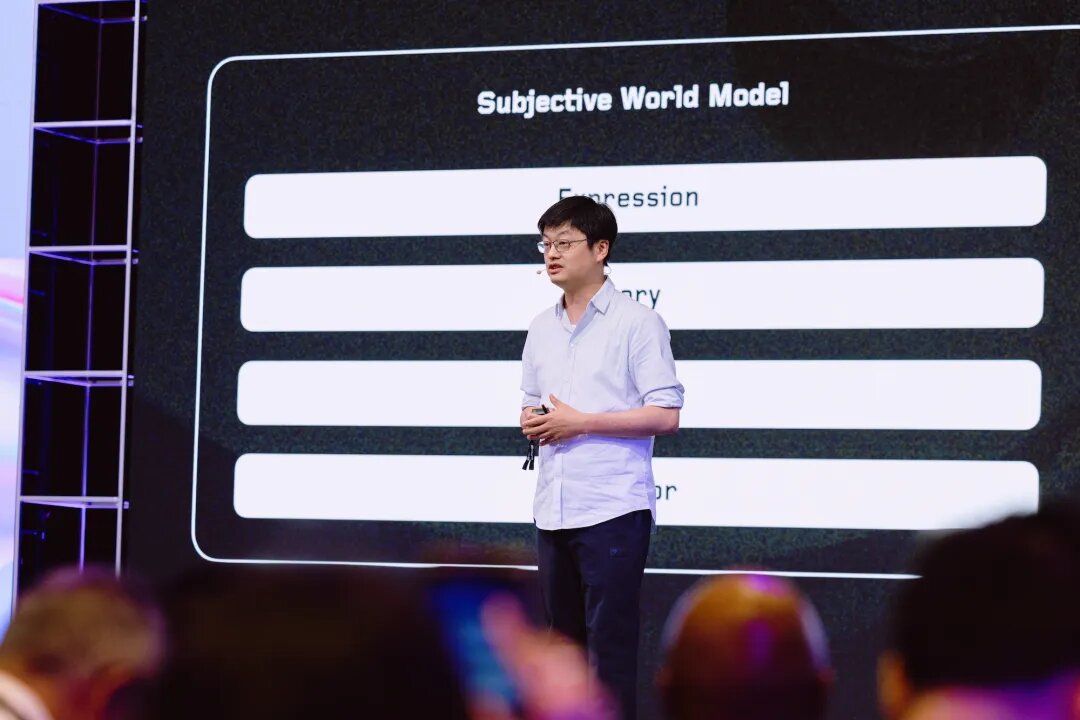
The model is built around a simple but important observation: what people say they prefer and what actually drives their decisions are not always the same.
The Core Architectural Assumption
SWM begins with a familiar finding from consumer psychology and behavioral economics: stated preferences can differ systematically from revealed preferences.
A customer may say that price is the most important factor, then repeatedly choose a more expensive product because of trust, status, convenience, familiarity, social context, or perceived risk.
A questionnaire captures what the person can or chooses to report. A purchase captures one visible outcome. Neither source necessarily reveals the complete decision process.
Tezign’s proposed solution is a four-layer heterogeneous modeling system. Each layer is trained with a different type of data and a different objective, then the layers contribute jointly during inference.
The four layers are:
- Expression Layer — how a person presents and expresses themselves
- Story Layer — how motives develop across a personal narrative
- Cognition Layer — how values, risks, and trade-offs are weighted
- Behavior Layer — how those internal tendencies translate into action

Tezign presents SWM as a structure for modeling people rather than a larger general-purpose language model. Large language models remain part of the surrounding system, but the persona state is not intended to depend only on a prompt telling a model to “act like” a particular customer.
Layer 1: Expression Layer
The Expression Layer uses large volumes of language from social platforms and other native communication environments.
Its objective is to map language patterns to demographic and psychographic features. The system may examine:
- Frequently used words and phrases
- Sentence length and rhythm
- Emotional tone
- Repeated themes
- Style differences across platforms
- Self-presentation patterns
- Signals associated with age, region, profession, interests, or consumption level
In technical terms, the source describes this as a supervised representation-learning task.
A user’s historical text becomes the input. Profile labels or other known attributes provide the supervisory signal. Once trained, users with related characteristics are expected to form clusters in an embedding space.
The resulting representation acts as a persona anchor for the later layers.
Why the Expression Layer Is Useful
Deep interviews contain richer information than social posts, but they are expensive and sparse. Social language is much easier to collect at scale.
Tezign’s approach uses the Expression Layer as a bridge between the two. A smaller number of deeply researched personas can be associated with larger groups whose public language patterns are similar.
The source article argues that this layer is not the primary competitive barrier because social data can be gathered at scale. Its value lies in providing a distribution base for the more expensive Story Layer.
Important Limitations
Language is not a neutral window into identity.
People present themselves differently across platforms, use irony, copy trends, share accounts, change over time, and adapt their tone to an audience. Demographic or psychological inference from language can also introduce bias and privacy risks.
A production system therefore needs clear rules covering:
- Consent and lawful data use
- Personally identifiable information
- Sensitive-attribute inference
- Data retention
- Representativeness
- Bias evaluation
- User correction and deletion
- Appropriate use of probabilistic predictions
An embedding can estimate similarity. It does not prove a person’s identity, motives, or future behavior.
Layer 2: Story Layer
The Story Layer uses long-form, one-to-one interviews.
Tezign reports that its training data includes tens of thousands of hours of in-depth interviews. A typical session lasts one to two hours and produces roughly 5,000 to 20,000 Chinese characters or words of unstructured material, depending on the language and transcription format.
The objective is not ordinary classification or next-token prediction. It is to reconstruct a temporal causal structure behind a decision.
A simplified sequence may include:
- Trigger event
- Formation of consideration
- Comparison and conflict
- Decision point
- Post-purchase interpretation
Consider two customers who buy the same premium coffee machine.
One may be motivated by convenience. Another may want control over quality. A third may see it as part of a new identity after changing jobs or moving home.
The visible purchase is identical. The motivational graph is not.
Motivation Signatures Across Situations
The source argues that real interviews contain a form of cross-context causal consistency.
The same person may describe different purchases using different language, yet a recurring motivational structure can appear beneath those stories. A customer who strongly avoids regret may express that tendency when choosing electronics, insurance, travel, and healthcare.
SWM attempts to identify these recurring patterns as a motivation signature.
The Story Layer is presented as the system’s most difficult data asset to reproduce because it requires lengthy interviews, careful questioning, transcription, interpretation, and repeated accumulation over time.
Why Synthetic Interviews Are Treated with Caution
The source makes a strong claim that synthetic interview data fails at this layer because a generated persona may not preserve one stable internal state across unrelated situations.
That claim should be interpreted as Tezign’s technical thesis, not as a universally established limitation of all language-model systems.
Modern LLM applications can maintain state through context windows, memory systems, structured profiles, retrieval, and external databases. However, a generated persona may still produce plausible answers without being grounded in the consistent behavioral history of a real person.
The relevant distinction is therefore not simply LLM versus non-LLM. It is:
- Prompted simulation versus empirically grounded simulation
- Generated consistency versus measured consistency
- Surface plausibility versus validated behavioral correspondence
SWM attempts to anchor the persona in observed interviews and test it against separate cognitive and behavioral data.
Layer 3: Cognition Layer
The Cognition Layer models how a person weighs values and risk.
Its data may include:
- Behavioral-judgment questionnaires
- Schwartz Value Survey measures
- Big Five personality inventories
- Risk-preference tasks
- Other standardized psychological or behavioral instruments
The layer aims to estimate a value-weight vector and coefficients related to risk preference.
This is where the system tries to quantify the gap between what a person says is important and what appears to influence their actual decisions.
For example, a customer may rank sustainability highly in a survey but consistently prioritize price and convenience when making purchases. The system would not necessarily treat the survey as false. It would estimate how the reported value competes with other values under real conditions.
A Calibration Layer, Not a Personality Label
The purpose is not merely to assign a broad label such as “environmentally conscious” or “risk averse.”
The intended output is closer to a weighted decision profile:
- How strongly does the person respond to possible loss?
- How much uncertainty will they accept?
- When does convenience outweigh price?
- How does social approval affect the choice?
- Which values remain stable across situations?
- Which preferences change under time pressure or scarcity?
The Story Layer supplies narrative evidence. The Cognition Layer supplies a structured calibration of the person’s stated and inferred priorities.
Psychometric measurements are always incomplete and context-dependent. They should support a model, not become a permanent or deterministic judgment about an individual.
Layer 4: Behavior Layer
The Behavior Layer tests whether the first three layers can predict action.
Its inputs include economic-game experiments and, where legally and ethically available, real transaction records.
The source mentions games and behavioral parameters such as:
- Ultimatum games
- Public-goods games
- Trust games
- Loss-aversion coefficient
- Hyperbolic temporal-discounting rate
- Sensitivity to social norms
These tasks place participants under explicit constraints. They ask people to divide resources, cooperate, trust another participant, accept an unequal offer, or choose between immediate and delayed value.
The resulting behavior can be compared with what the person said in an interview or questionnaire.
Why This Layer Matters for New Scenarios
Historical pattern matching works best when the next decision resembles the previous data.
A new product may not have a direct precedent. A customer may never have purchased anything in the category before.
The Behavior Layer attempts to generalize through more basic tendencies. If a persona has an estimated loss-aversion pattern, time preference, and social-norm sensitivity, the model can use those parameters when simulating a response to a new scenario.
This is the source article’s explanation for why SWM may be useful in early product research, where historical sales data does not yet exist.
Behavioral parameters are probabilistic. They should be used to estimate a distribution of possible responses, not to claim certainty about what one person will do.
How the Four Layers Produce an AI Persona
After training, SWM maintains a joint persona state containing:
- A language-style embedding from the Expression Layer
- A motivation graph from the Story Layer
- A value-weight and risk profile from the Cognition Layer
- Behavioral-economics parameters from the Behavior Layer
When a researcher asks a new question—such as “What do you think about this packaging design?”—the layers contribute different parts of the answer.
The Expression Layer affects wording, tone, and emotional style.
The Story Layer retrieves relevant motivations and earlier decision patterns.
The Cognition Layer adjusts for the gap between self-report and modeled priorities.
The Behavior Layer adds stable tendencies that may transfer to an unfamiliar product or context.
The intended result is an AI Persona that remains internally consistent during follow-up interviews.
The source contrasts this with personas generated directly by a general LLM. A more technically precise comparison is:
| Directly Prompted Persona | SWM-Style Structured Persona |
|---|---|
| State may exist only in the active prompt or session | Persona state is represented explicitly across several modeled layers |
| Often optimized for a plausible response | Intended to reproduce measured behavioral patterns |
| Consistency depends on prompt design and memory | Consistency is supported by a persistent persona representation |
| Validation may be qualitative | Validation includes behavioral comparisons and economic games |
| Easy to create at scale | More expensive data collection and calibration |
The difference is not that an LLM can never maintain state. It is that SWM is designed to make persona state a first-class, measurable object rather than an implicit result of prompting.
How Atypica GameLab Tests Persona Accuracy
Atypica is the consumer-research agent built on the Subjective World Model.
Its GameLab evaluation environment asks human participants and AI Personas to complete the same behavioral-economics games, then compares the resulting decisions.
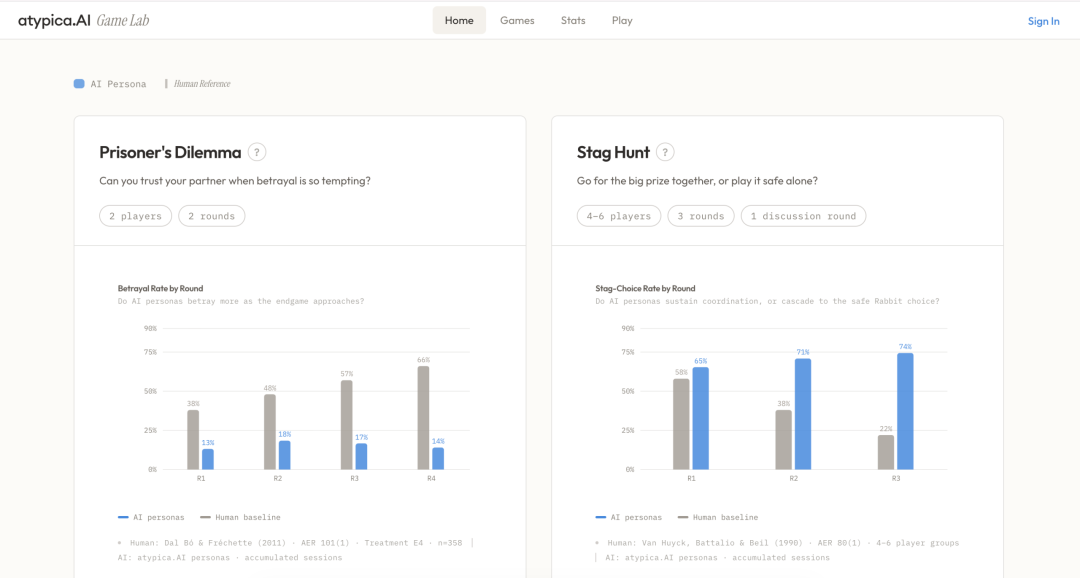
The platform includes game formats such as the Prisoner’s Dilemma and Stag Hunt. These experiments test cooperation, betrayal, coordination, trust, and strategic adaptation over repeated rounds.
A separate analysis interface compares several language models and persona systems by game type.
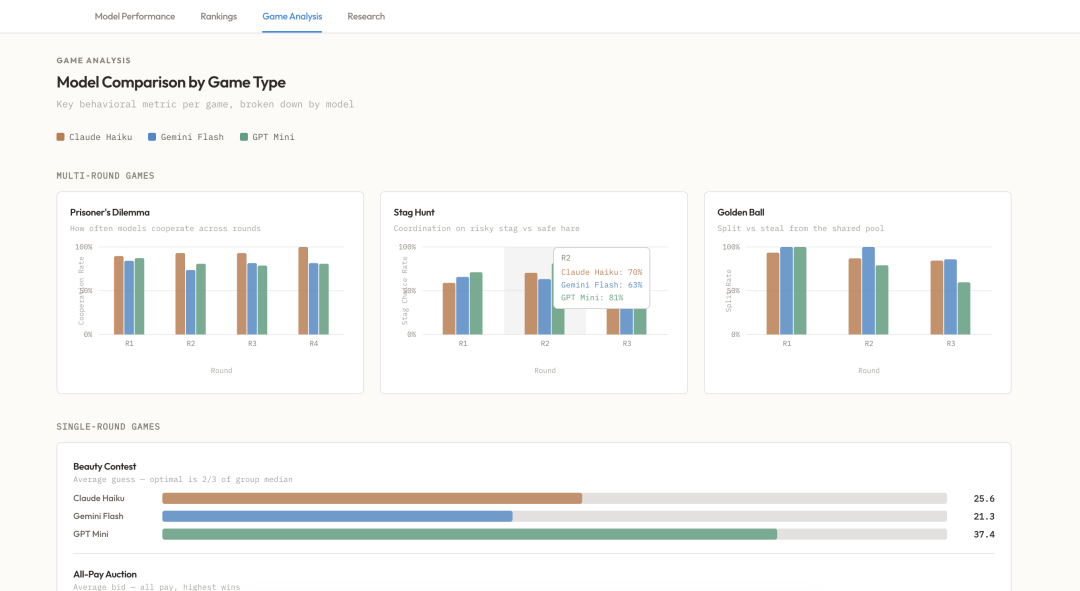
The source reports the following product figures:
- 85% behavioral-simulation accuracy against a human-interview reference
- More than 300,000 AI Personas
- More than 10,000 high-precision personas trained directly from deep-interview material
- Research delivery in under 30 minutes
Atypica’s current public site separately reports more than 300,000 AI Personas, over one million interviews, and research completion in under 30 minutes.
These are vendor-reported product metrics. The public materials reviewed for this article do not provide enough methodological detail to reproduce the 85% figure independently.
Before relying on a persona system for important decisions, an organization should ask:
- What exactly counts as an accurate prediction?
- Is accuracy averaged across people, games, questions, or decisions?
- What is the human baseline?
- How large and representative is the evaluation group?
- Does performance hold for new categories and countries?
- How is uncertainty displayed?
- How often are personas recalibrated?
- What types of decisions should not be simulated?
A score is useful only when its denominator, protocol, confidence interval, and deployment context are clear.
From Understanding Consumers to Executing Enterprise Work
SWM is designed for the understanding side of the workflow.
Tezign’s Generative Enterprise Agent is intended to connect that understanding to execution.
The two systems form a broader loop:
- SWM models consumer expression, motivations, values, and behavior.
- Atypica turns those models into researchable AI Personas.
- Research outputs become structured enterprise context.
- GEA evaluates possible business paths.
- Agent skills execute selected tasks.
- Results return to the context and evaluation systems.
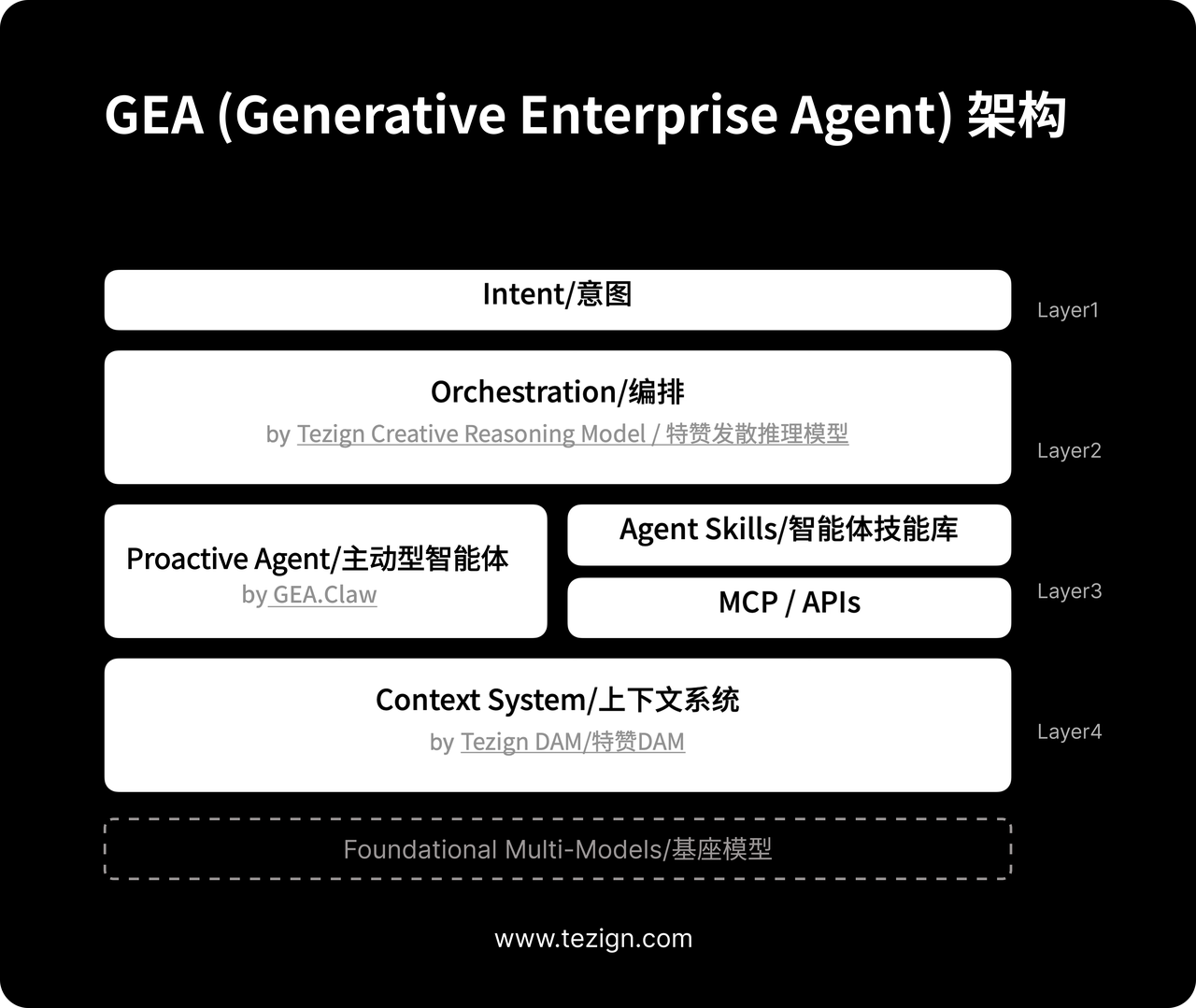
The Four Layers of GEA
Intent Layer
The system begins with a business objective rather than a technical prompt.
An enterprise may ask it to:
- Explore a product opportunity
- Evaluate packaging directions
- Identify a new customer segment
- Design a content-growth plan
- Compare creative strategies
- Conduct an ongoing consumer study
The Intent Layer translates that objective into a structured task.
Orchestration Layer
The Orchestration Layer is driven by Tezign’s Creative Reasoning Model.
Tezign describes the model as divergence-first: it expands several possible paths before judging, selecting, and arranging execution.
Instead of immediately converging on one answer, it may evaluate several combinations of:
- Customer segment
- Product proposition
- Pricing approach
- Creative direction
- Distribution channel
- Market condition
- Operational cost
- Expected outcome
The model then selects tools, models, and agents for the chosen path.
Agent Skills Layer
The execution layer calls modular skills for concrete work.
Tezign reports more than 400 skill modules covering areas such as consumer insights, content creation, data analysis, creative evaluation, and brand-consistency checks.
The system can coordinate more than 30 foundation models during a task, according to company materials.
A modular skill architecture allows the platform to route different subtasks to different models instead of expecting one foundation model to perform every operation equally well.
Context System
The Context System provides persistent enterprise memory.
It can organize:
- Brand guidelines
- Historical decisions
- Research reports
- Product information
- Content assets
- Business rules
- Past campaign results
- Customer insights
- Approved terminology
- Permission and compliance requirements
Tezign describes this as the enterprise’s single source of truth.
The purpose is to reduce context drift across long-running workflows. An agent can refer to the organization’s actual standards rather than relying only on general model knowledge or re-entered prompts.
From Output to a Continuous Business Loop
The source article says GEA has been deployed in consumer research, content marketing, product innovation, and design.
Tezign reports that the system:
- Coordinates more than 30 foundation models
- Uses more than 400 modular agent skills
- Processes more than 10 billion tokens per month
- Operates across more than 50 countries and regions
- Serves more than 180 enterprise customers
These figures come from Tezign’s own product and media materials.
The larger architectural idea is that an enterprise agent should not stop after generating a report or creative asset. It should preserve context, observe feedback, and continue advancing the business objective.
That is a more demanding goal than adding an LLM interface to existing software.
It requires:
- Reliable data pipelines
- Identity and permission controls
- Human approval boundaries
- Versioned business rules
- Auditable agent actions
- Evaluation of intermediate decisions
- Monitoring for drift
- Safe model and tool orchestration
- Clear accountability for final outcomes
Without those controls, persistence can amplify errors as easily as it amplifies useful learning.
Why Tezign Says the Story Layer Is the Real Moat
The source article argues that the four-layer structure itself can be copied.
The claimed competitive barrier is the accumulated Story Layer data: years of long-form interviews linked to cognitive measurements and behavioral experiments.
Compute can train a model faster. It cannot instantly recreate ten years of interviews with real people.
This is the central business thesis behind SWM:
General models will become widely available, while proprietary, validated domain context will continue to differentiate enterprise systems.
The same logic appears in Tezign’s GEA architecture. Foundation models can be replaced or combined. The organization’s research history, brand standards, decision rules, and accumulated outcomes are harder to reproduce.
That does not make a proprietary dataset automatically superior.
Its quality depends on:
- Interview design
- Participant consent
- Sampling coverage
- Cultural and geographic representation
- Labeling consistency
- Interviewer effects
- Data freshness
- Validation against real outcomes
- Governance and access controls
- The ability to correct inaccurate profiles
A large historical dataset can become a compounding asset. It can also become a compounding source of bias if the collection process is weak.
What Must Be Proven Beyond the WAIC Demonstration
SWM presents an interesting architecture for combining language, narrative, psychometrics, and behavioral data.
Several questions remain important for independent evaluation.
Can the Results Be Reproduced?
Public materials describe the architecture and report headline product metrics, but they do not yet provide a complete technical paper, dataset specification, training protocol, or reproducible benchmark.
Independent evaluation would help establish where the method performs better than:
- Human interviews
- Survey panels
- Retrieval-augmented LLM personas
- Agent systems with structured memory
- Conventional segmentation models
- Synthetic-user platforms
Does Accuracy Transfer Across Domains?
A persona calibrated on consumer-goods decisions may not generalize to healthcare, finance, employment, or political behavior.
The model should be evaluated separately for each category, culture, language, and decision type.
How Is Uncertainty Communicated?
A simulation should not return one confident answer when several plausible reactions exist.
Useful outputs may include:
- Probability distributions
- Confidence ranges
- Alternative persona responses
- Sensitivity to assumptions
- Evidence supporting each prediction
- Known blind spots
How Are Privacy and Consent Managed?
Consumer simulation can involve highly sensitive inferences.
Organizations need to know whether individuals consented to the collection and modeling of interview, social, psychological, and transaction data. They also need controls preventing the system from making prohibited or discriminatory decisions.
Where Must Humans Remain in Control?
AI Personas can help generate hypotheses, stress-test ideas, and reduce the number of options requiring expensive field research.
They should not automatically replace real customers in high-impact research.
Human participation remains important when:
- The decision affects safety, rights, or access
- The population is vulnerable
- A new market lacks representative data
- Cultural interpretation is central
- The model reports low confidence
- The result contradicts observed behavior
- The organization needs legally defensible evidence
The strongest use of simulated consumers may be to improve the questions asked of real people, not to eliminate real people from the research process.
The Enterprise AI Shift: From Model Access to Domain Understanding
The article ends with a broader claim about enterprise AI.
During the first phase of adoption, competitive advantage often came from gaining access to a capable model and integrating it quickly.
That advantage is shrinking. Foundation-model APIs are increasingly interchangeable for many standard tasks, and enterprises can route work across multiple providers.
The next source of differentiation is deeper:
- Does the system understand the business domain?
- Can it preserve institutional context?
- Can it model the people affected by a decision?
- Can it validate assumptions before execution?
- Can it convert insights into repeatable workflows?
- Does each completed task improve the next one?
SWM attempts to turn consumer understanding into a reusable technical asset.
GEA attempts to turn that understanding into an execution loop.
At WAIC, the attention-grabbing phrase was “mind reading.” The more realistic proposition is less magical and more useful: combine multiple kinds of human evidence, maintain an explicit persona state, test it against behavior, and connect the result to an enterprise workflow.

Frequently Asked Questions
What is Tezign’s Subjective World Model?
The Subjective World Model is a framework for modeling how people express themselves, explain choices, weigh values, and behave under constraints. It supports Atypica’s AI Personas and consumer-research workflows.
Does SWM literally read people’s minds?
No. “Mind reading” is a media metaphor. The system estimates psychological and behavioral patterns from language, interviews, questionnaires, experiments, and other available data.
What are the four SWM layers?
The four layers are Expression, Story, Cognition, and Behavior. Together they represent language style, motivation history, value and risk weighting, and behavioral tendencies.
How is an SWM persona different from a normal LLM persona?
A normal prompted persona may rely mainly on instructions and conversation context. An SWM-style persona uses an explicit, persistent state built from several types of measured data and is evaluated against behavioral tasks.
What is Atypica GameLab?
GameLab is an evaluation environment that compares decisions made by AI Personas and human participants in behavioral-economics games. It is intended to measure and calibrate how closely persona behavior matches a human reference.
What is GEA?
GEA stands for Generative Enterprise Agent. It is Tezign’s enterprise-agent architecture combining an Intent Layer, orchestration through the Creative Reasoning Model, modular Agent Skills, and a persistent Context System.
Is the reported 85% behavioral accuracy independently verified?
The figure is reported by the source article and Tezign-related materials, but the public information reviewed for this publication does not provide a fully reproducible evaluation protocol. Organizations should request the benchmark definition, sample size, baseline, and domain-specific results.
Can AI Personas replace human consumer research?
They can help generate hypotheses, compare concepts, and conduct frequent early-stage testing. They should not automatically replace real participants, especially in high-impact, culturally sensitive, regulated, or poorly represented research settings.
Related Tools
- Atypica: Tezign’s AI research agent for generating personas, conducting interviews, and analyzing consumer decision patterns.
- Tezign GEA: The official overview of Tezign’s four-layer Generative Enterprise Agent architecture.
- Creative Reasoning Model: Tezign’s divergence-first reasoning and orchestration system for complex business decisions.
- System of Context: Tezign’s persistent enterprise-context layer for assets, rules, decisions, and agent workflows.
- Clipo Idea: A Tezign product that combines creative reasoning with simulated-user validation for social-content planning.
Related Links
- Official Subjective World Model Overview: Tezign’s explanation of SWM, its four data layers, and reported business cases.
- Atypica Official Website: Current product information, persona counts, research workflow, and use cases.
- Tezign GEA Product Announcement: Official details on intent, orchestration, agent skills, and enterprise context.
- Creative Reasoning Model Technical Overview: A description of multi-path divergent reasoning and path evaluation.
- System of Context: Making Data Bring Business Value: Tezign’s explanation of contextual retrieval, context graphs, permissions, and enterprise memory.
- GEA Insight Research: Official material on using enterprise context, AI Personas, and continuous consumer research.
- Tezign at WAIC 2026: Company-reported details from the WAIC exhibition and CCTV interview.
Summary
Tezign’s Subjective World Model attempts to improve consumer simulation by combining four different evidence layers: expression, narrative, cognition, and behavior. The resulting persona is designed to preserve a stable internal state and respond consistently across follow-up questions and unfamiliar scenarios.
Atypica turns that model into a research workflow and uses behavioral games to compare AI Persona decisions with human references. GEA then connects consumer understanding with enterprise planning, model orchestration, agent skills, and persistent business context.
The architecture is promising, but its headline accuracy, transferability, privacy safeguards, and business impact require transparent protocols and independent evaluation. Vendor-reported results should be treated as evidence for further testing rather than universal proof.
The important idea behind SWM is not literal mind reading—it is the attempt to turn consumer understanding from a one-off prompt into a measurable, stateful, and continuously reusable enterprise asset.