Google’s Gemini Shake-Up: Sergey Brin Returns to the Front Line as DeepMind Reorganizes
Google’s Gemini Shake-Up: Sergey Brin Returns to the Front Line as DeepMind Reorganizes
Google’s Gemini Shake-Up: Sergey Brin Returns to the Front Line as DeepMind Reorganizes
Introduction
Google’s AI organization is going through one of its biggest leadership changes since Google Brain and DeepMind were merged in 2023.
The trigger for the latest wave of attention was not a Google announcement about a failed model. It was a sharply worded analysis from semiconductor and AI-infrastructure research firm SemiAnalysis, titled “Gemini is Cooked but GCP is Cooking.”
SemiAnalysis argues that Gemini has lost momentum at the frontier while Google Cloud is benefiting from the same infrastructure that powers Google’s AI ambitions. The firm goes as far as saying that Google DeepMind’s chance of returning to state-of-the-art model leadership has fallen close to zero.
That is an analyst opinion, not an established fact.
Google’s own public position is very different. In August 2026, CEO Sundar Pichai said the company remains committed to the AI frontier, announced a new leadership structure for Google DeepMind, and said Google had begun its most ambitious pre-training run yet for Gemini 4.
Still, the organizational changes are real.
Demis Hassabis has stepped away from day-to-day management of Google DeepMind to become Chair of Google DeepMind and Chief Scientist of Alphabet. Koray Kavukcuoglu now leads Google DeepMind as senior vice president. Jeff Dean and Sanjay Ghemawat are leaving to build a new public-benefit company called Discovery Loop, joined by Oriol Vinyals and Quoc Le. Noam Shazeer has left for OpenAI, while AlphaFold co-creator John Jumper has moved to Anthropic.
And behind the formal organization chart, co-founder Sergey Brin has become increasingly involved in Google’s AI work.
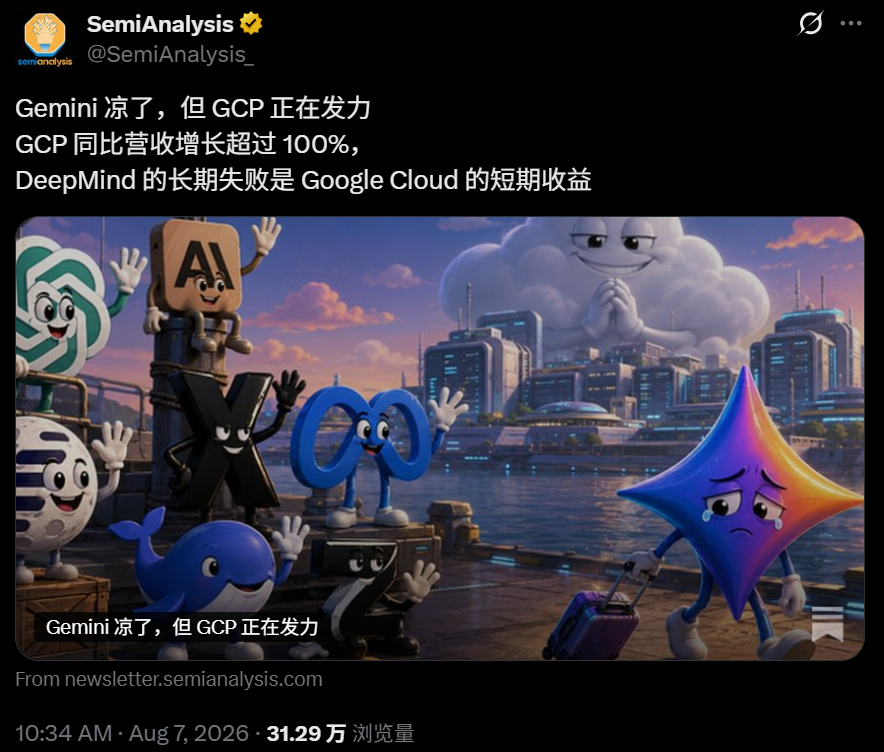
The original Chinese article frames the moment as a near-collapse of Gemini.
The more defensible reading is less dramatic but still significant:
Google is simultaneously dealing with model-release pressure, senior talent departures, a shift in DeepMind leadership, rapidly growing external demand for its TPU infrastructure, and a renewed push to turn Gemini into a faster-moving product organization.
Gemini 4 is now the model that will show whether this restructuring improves execution—or simply rearranges the organization around the same problems.
Nine Months From Gemini 3’s Peak to a Much Tougher Position
When Gemini 3 arrived in late 2025, it was widely seen as one of Google’s strongest moments in the modern generative-AI race.
SemiAnalysis describes Gemini 3 Pro as arguably the best model in the world at the time and says it helped trigger a “code red” response inside OpenAI.
The exact competitive ranking depended on the benchmark and workload, but the broader point is fair: Gemini 3 restored confidence that Google could compete at the frontier rather than merely distribute AI through Search and Android.
By 2026, that confidence had weakened.
Gemini 3.5 Pro Missed Its Planned Public Window
On May 19, Google announced the Gemini 3.5 family.
Gemini 3.5 Flash launched first, while Google said Gemini 3.5 Pro was already being used internally and was expected the following month.
That June public launch did not happen.
At Alphabet’s July 22 earnings call, Sundar Pichai said Gemini 3.5 Pro was still in testing and that Google had already started its most ambitious pre-training run for Gemini 4.
Reuters later described the unreleased flagship Gemini model as a source of investor and industry concern.
SemiAnalysis goes further. It says Google has effectively abandoned Gemini 3.5 Pro and shifted attention to Gemini 4.
Google has not publicly used the word “canceled.”
For publication, the careful wording is therefore:
- Google announced Gemini 3.5 Pro for a later release after Flash.
- The expected June launch did not happen.
- By late July, Google said the model remained in testing.
- By early August, Google leadership was publicly emphasizing Gemini 4.
- SemiAnalysis interprets this sequence as a silent cancellation of 3.5 Pro.
- Google has not formally confirmed that interpretation.
Gemini 3.6 Flash Became the Bridge Model
Instead of a public 3.5 Pro release, Google introduced models including Gemini 3.6 Flash and Gemini 3.5 Flash-Lite.
Google describes the Flash line as a strong combination of performance, latency, and cost for production agents.
SemiAnalysis is far less positive.
Its August report argues that Gemini 3.6 Flash remains behind several competing frontier and open models, depending on the benchmark.
Those rankings are dynamic.
Model quality can vary significantly across:
- Coding
- Reasoning
- Long-context tasks
- Agentic workflows
- Multimodal tasks
- Cost
- Latency
- Reliability
A model that loses one aggregate leaderboard can still be competitive in production if it is cheaper, faster, easier to deploy, or more deeply integrated into a customer’s workflow.
The important change is therefore not that Gemini has objectively “died.”
It is that Google entered 2026 with renewed frontier momentum and is now being judged against faster model cycles from OpenAI, Anthropic, xAI, Meta, and leading Chinese labs.
Google Invented Many of the Pieces—but Often Hesitated to Productize Them
The original article returns to one of the most familiar criticisms of Google’s AI history.
Google researchers co-authored the 2017 “Attention Is All You Need” paper that introduced the Transformer architecture.
Long before ChatGPT became a mass-market product, Google teams were also experimenting with conversational language models.
Former Google and DeepMind researchers have repeatedly described internal systems that resembled later consumer AI assistants.
The source article cites a former DeepMind researcher saying that an internal project called LMChat looked very much like ChatGPT and existed roughly a year earlier.
The exact internal history is difficult to verify from public Google documentation, but the broader pattern is well documented: Google possessed foundational research and strong prototypes while being cautious about how quickly those systems entered consumer products.
That caution had understandable reasons.
Google had to consider:
- Search quality
- Advertising economics
- Safety
- Hallucinations
- Reputation
- Legal exposure
- Product cannibalization
- Infrastructure cost
But by the time ChatGPT reset user expectations, the cost of moving slowly had become much more visible.
SemiAnalysis summarizes Google’s recurring weakness as a lack of organizational conviction.
That is an opinion, but it captures a real strategic tension:
A company with a highly profitable incumbent business has more to protect than a startup whose only path forward is to disrupt the incumbent.
The $2.7 Billion Character.AI Deal Did Not Keep Noam Shazeer for Two Years
The next blow came from talent.
In 2024, Google struck a licensing and hiring agreement with Character.AI.
Reuters and The Wall Street Journal reported that Google paid approximately $2.7 billion in a transaction that brought Character.AI co-founder Noam Shazeer and several colleagues back to Google.
Shazeer was not just another senior hire.
He was:
- A longtime former Google researcher
- A co-author of the Transformer paper
- A founder of Character.AI
- A technical co-lead of Gemini after returning to Google
Less than two years later, he announced that he would join OpenAI.
Reuters reported the departure in June 2026 and noted the unusual contrast between the multibillion-dollar effort to bring him back and the short duration of his second period at Google.
John Jumper Left for Anthropic the Same Week
Days later, another high-profile researcher announced his departure.
John Jumper, a co-creator of AlphaFold and one of the 2024 Nobel Prize in Chemistry laureates, said he would leave Google DeepMind after nearly nine years and join Anthropic.
Jumper’s move was especially notable because AI for science has been one of DeepMind’s defining achievements.
Demis Hassabis publicly thanked him and praised the impact of AlphaFold.
The departure was not framed publicly as an acrimonious split.
Still, from an organizational perspective, Shazeer and Jumper leaving in the same week reinforced the perception that frontier AI labs were successfully recruiting some of Google’s most visible researchers.
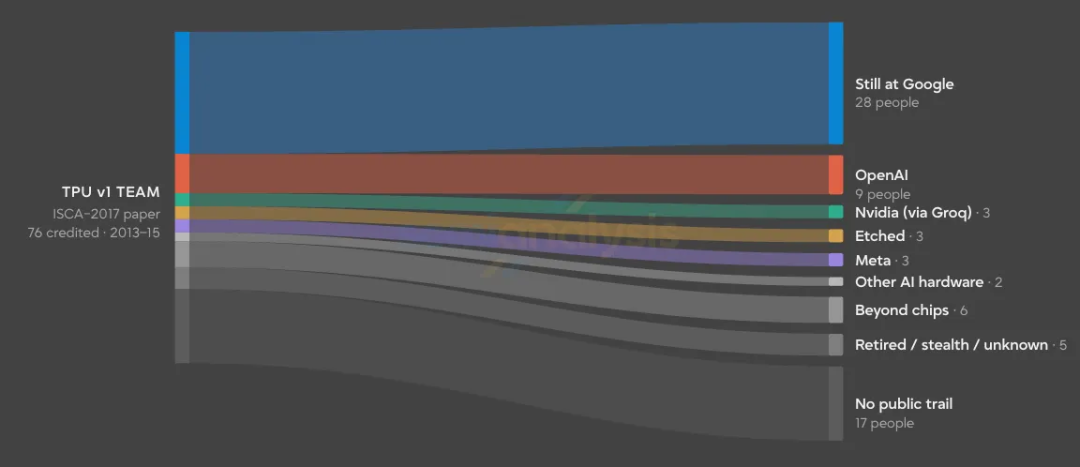
Jeff Dean, Sanjay Ghemawat, Oriol Vinyals, and Quoc Le Then Left to Build Discovery Loop
The largest organizational shock came in August.
Google announced that Jeff Dean and Sanjay Ghemawat would leave after 27 years to create an independent public-benefit corporation focused on accelerating discoveries in machine learning, science, and engineering.
Reuters reported that Oriol Vinyals and Quoc Le were also joining the new venture, called Discovery Loop.
The departure is difficult to overstate.
Jeff Dean has been associated with many of Google’s foundational computing systems, including the infrastructure and machine-learning work that made the company’s modern AI stack possible.
Sanjay Ghemawat has worked alongside Dean on some of Google’s most important distributed-systems technologies.
Oriol Vinyals was a senior Google DeepMind researcher and Gemini leader.
Quoc Le was one of the central figures in Google Brain and modern deep learning at Google.
Discovery Loop Is Not a Hostile Break With Google
The original article describes the departure in almost civil-war terms.
Google’s official announcement is more complicated.
Sundar Pichai said Google would:
- Act as a founding investor in Discovery Loop
- Serve as a Cloud partner
- Collaborate on research frameworks for machine-learning systems
- Continue working with the new company on infrastructure advances
Reuters likewise reported that Discovery Loop received investment from Google and entered a partnership with Google Cloud for computing capacity.
So Google is losing senior people while simultaneously maintaining an economic and technical relationship with their new company.
That can be read in two ways.
The negative interpretation is that Google can no longer keep top technical leaders inside its own organization.
The more charitable interpretation is that Alphabet is finding ways to keep talented teams in its ecosystem even when they want a more independent operating structure.
Both can be true at the same time.
The TPU Question: Google DeepMind and Google Cloud Need the Same Scarce Compute
The source article then moves to a second tension: compute allocation.
Google has spent more than a decade building its own Tensor Processing Units.
Those chips are strategically important because they can be used for:
- Gemini training
- Gemini inference
- Google Search
- YouTube recommendations
- Internal AI workloads
- Vertex AI
- External cloud customers
- Direct TPU system sales
The conflict is straightforward.
Every unit of advanced compute has an opportunity cost.
Google can use it internally to improve Gemini, or it can sell infrastructure and cloud services to customers that may include Gemini’s direct competitors.
Anthropic Has Become a Major TPU Customer
Anthropic has expanded its relationship with Google and Broadcom to secure large amounts of TPU capacity.
Anthropic officially announced in April 2026 that demand for Claude had accelerated and that it was expanding its Google/Broadcom compute partnership.
SemiAnalysis estimates that a significant share of future TPU shipments will go directly to Anthropic.
The source includes the following chart:
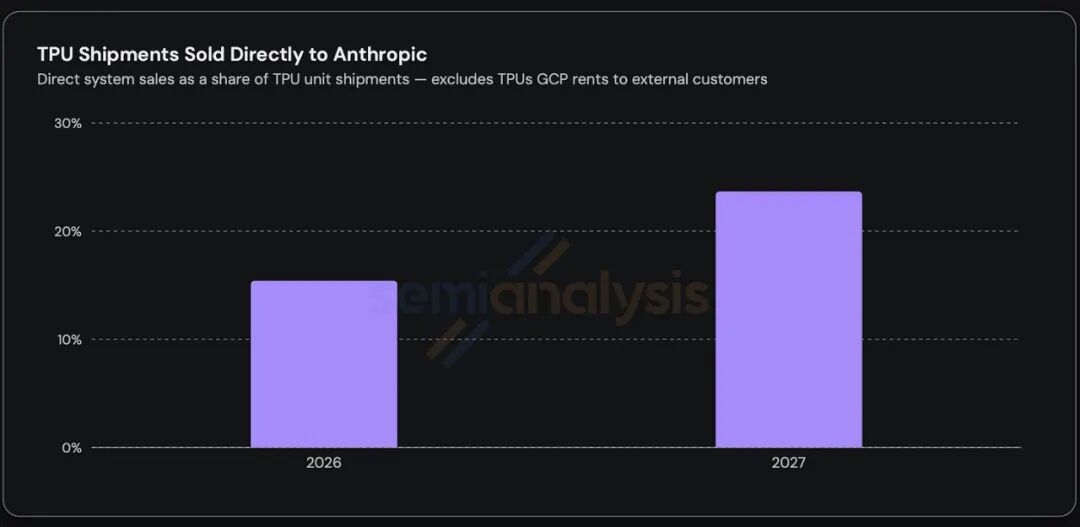
This is a SemiAnalysis estimate, not an official shipment disclosure from Alphabet.
It also excludes TPU capacity that Anthropic may rent through Google Cloud.
That distinction matters because the original article phrases the estimate almost as if Google has officially disclosed that more than 20% of TPU shipments will be handed to Anthropic.
Google has not made that exact public statement.
Sundar Pichai Says Frontier AI Still Comes First
The strongest counterpoint comes from Alphabet’s Q2 earnings call.
When asked directly about TPU allocation, Pichai said Google’s first priority is ensuring it has what it needs to compete at the AGI frontier.
He also acknowledged enormous external demand.
Google is therefore trying to do both:
- Reserve enough compute for frontier model development.
- Sell TPU systems and AI infrastructure to external customers.
The tension is real, but Google rejects the idea that Cloud sales simply take priority over internal model work.
Google Is Supplying Infrastructure to Companies That Compete With Gemini
From a cloud-business perspective, selling compute to outside AI labs is rational.
AWS supports companies that may compete with Amazon products.
Microsoft sells Azure services broadly even while backing OpenAI.
Google Cloud wants to be a platform used by as many major AI builders as possible.
That means Google may profit even when the winning application is not Gemini.
The original article treats this as strategically self-destructive.
The alternative interpretation is that Alphabet is hedging across multiple layers of the AI stack.
If Gemini wins, Google benefits through:
- Gemini subscriptions
- Search integration
- Workspace
- APIs
- Enterprise AI
- Advertising
- Android distribution
If other frontier labs win workloads, Google can still benefit through:
- TPU sales
- Google Cloud
- Data centers
- Networking
- Storage
- Managed AI infrastructure
That is a powerful business position.
The uncomfortable question is whether being a strong infrastructure provider reduces the organizational urgency to make Gemini itself the best model.
SemiAnalysis believes it does.
Google says it does not.
Google Cloud Is Growing Much Faster Than Before
Alphabet’s Q2 2026 financial results provide the clearest evidence that the infrastructure side is working.
Google Cloud revenue increased 82% year over year to $24.8 billion in the second quarter.
Google Cloud backlog reached $514 billion.
Operating income increased to $8.8 billion, more than tripling from the prior year.
Google said AI infrastructure, AI solutions, and core GCP were all important growth drivers.
It also began recognizing revenue from direct TPU system sales to customer data centers.
That is not a forecast.
Those are Alphabet’s reported Q2 figures.
Gemini Is Also Growing—Just Not in the Same Way
The source article contrasts Cloud’s acceleration with a slowdown in Gemini API growth.
SemiAnalysis published an estimate of Gemini first-party API revenue and quarter-over-quarter growth:
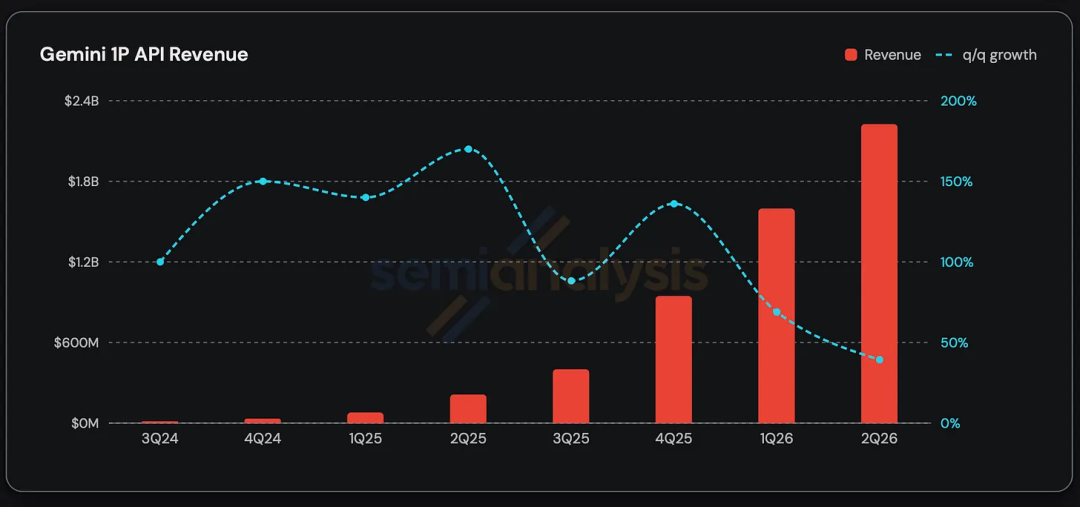
This chart is not part of Alphabet’s official financial reporting.
Google does not publicly break out Gemini API revenue in this form.
Alphabet instead reports usage indicators such as:
- More than 9 million developers building monthly with Google models
- Approximately 22 billion tokens per minute processed by its model APIs
- Nearly 500 Cloud customers processing more than one trillion tokens each over the prior year
- More than 2,000 enterprises consuming more than 100 billion tokens over the prior year
These indicators suggest Gemini usage is substantial and growing.
SemiAnalysis’ argument is narrower: it believes growth in Google Cloud infrastructure is accelerating faster than Gemini’s position at the model frontier.
The Source’s Cloud Growth Chart Is Forward-Looking
The source also includes a SemiAnalysis chart projecting further Google Cloud acceleration:
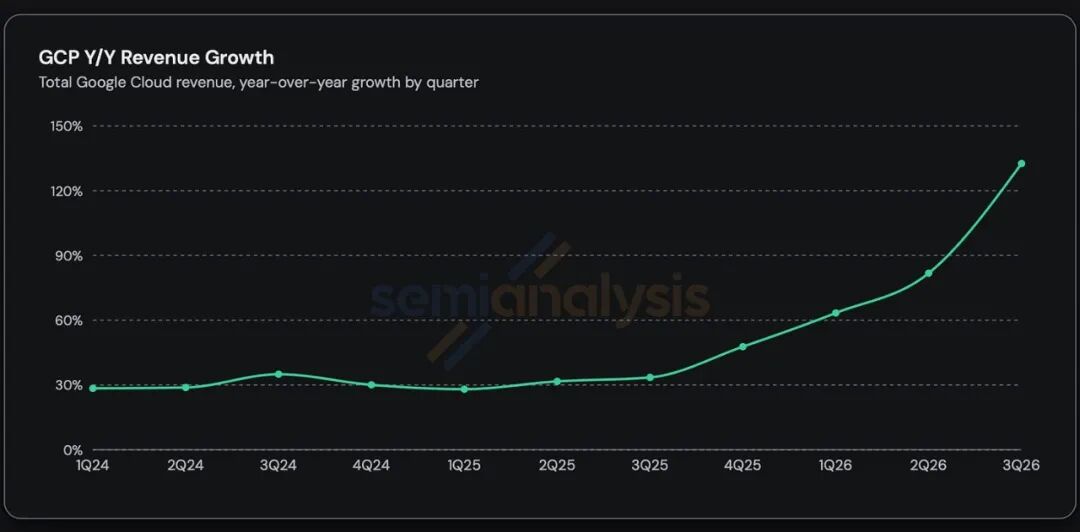
The actual Q2 2026 figure reported by Alphabet was 82% year-over-year growth.
Any higher Q3 or future number shown in the chart is an analyst estimate, not a completed quarter.
A Dangerous Loop—or a Powerful Full-Stack Strategy?
The original article describes a negative feedback loop:
Gemini loses ground
        ↓
Google allocates more compute to Cloud
        ↓
External labs get more TPU capacity
        ↓
External labs build stronger models
        ↓
Gemini loses more ground
That is one possible interpretation.
But Alphabet is trying to produce a different loop:
More AI demand
        ↓
Google builds more TPU and data-center capacity
        ↓
Internal and external AI workloads grow
        ↓
Cloud revenue and infrastructure investment expand
        ↓
Google gets more capacity for frontier AI
Which loop dominates will depend on execution.
The critical variables include:
- How much compute is reserved for Gemini
- Whether Gemini 4 reaches frontier quality
- How fast Google can build new TPU capacity
- Whether external TPU sales are margin-accretive
- Whether Cloud profit is reinvested in AI research
- Whether Google can retain enough research and product talent
The story is therefore not simply “DeepMind loses, Cloud wins.”
It is about whether one company can simultaneously run a frontier lab and a hyperscale AI infrastructure business without one starving the other.
Sergey Brin Has Returned to a More Active AI Role
This is where Sergey Brin enters the story.
Brin stepped away from day-to-day management years ago but began spending more time inside Google after the launch of ChatGPT.
The Wall Street Journal reported as early as 2023 that Brin was working directly with AI researchers on Gemini.
In 2026, his influence has reportedly increased again.
The Financial Times describes Brin as an increasingly important strategic force in the reorganized AI effort.
The BAAI source characterizes this almost as a wartime takeover.
That language is stronger than Google’s formal announcements.
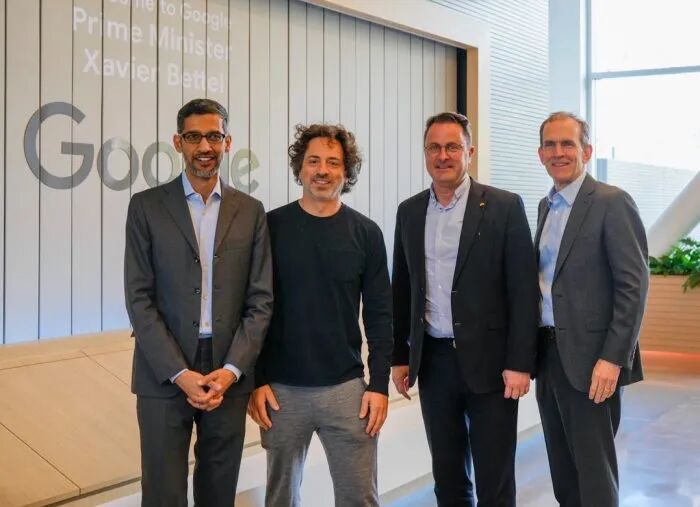
Google’s Official Leadership Announcement Does Not Give Brin an Operating Title
On August 5, Sundar Pichai published a detailed internal-message-style announcement about Google DeepMind’s next chapter.
The formal structure is:
- Demis Hassabis — Chair of Google DeepMind and Chief Scientist of Alphabet
- Koray Kavukcuoglu — SVP of Google DeepMind and Chief AI Architect
- Sundar Pichai — Koray’s direct manager
- Jeff Dean and Sanjay Ghemawat — leaving to build Discovery Loop
Sergey Brin is not named in the formal organization structure.
That does not mean he has no influence.
It means the evidence supports describing him as an increasingly involved co-founder and strategic voice, not as a formally announced replacement CEO of DeepMind.
Koray Kavukcuoglu Now Owns the Day-to-Day Operating Job
The most important formal change is Koray Kavukcuoglu’s role.
Pichai says Koray will oversee:
- Gemini model development
- Frontier AI research
- Gemini app teams
- Developer teams
He reports directly to Pichai.
Reuters says the appointment is expected to push Google DeepMind toward a more product-oriented direction.
That is a much more concrete shift than Brin’s unofficial role.
Demis Hassabis Is Moving Toward AGI Strategy and Science
Demis Hassabis is not leaving Google.
He is stepping away from daily management.
His new roles are:
- Chair of Google DeepMind
- Chief Scientist of Alphabet
- CEO of Isomorphic Labs
Hassabis wrote that he wants more time to focus on the broader path to AGI and its societal impact.
He also plans to spend more time on Isomorphic Labs and AI-driven drug discovery.
This matters because DeepMind has always carried two identities.
It is both:
- A frontier AI laboratory pursuing long-term scientific breakthroughs.
- Google’s core organization for shipping Gemini models and AI products.
Those goals overlap, but they are not identical.
The new structure separates them more clearly.
Koray owns more of the operating and product burden.
Hassabis focuses more heavily on long-horizon science, AGI strategy, and Isomorphic Labs.
The original article interprets this as Google choosing commercialization over DeepMind’s research culture.
Google describes it as a way to strengthen both missions.
The Center of Gravity Is Moving From London Toward Mountain View
DeepMind was founded in London and has maintained a strong research identity there.
The leadership change increases Mountain View’s influence over day-to-day Gemini development.
Reuters and the Financial Times both describe the reorganization as a move toward faster execution and commercialization.
The source article says safety and ethics functions may be moved under legal or public-relations organizations.
That specific claim is not confirmed in Google’s public announcement and should be treated as reporting or internal speculation rather than settled organizational fact.
What is confirmed is narrower:
- Hassabis is stepping back from daily operational management.
- Koray reports directly to Sundar Pichai.
- Gemini models, frontier research, the Gemini app, and developer teams sit under Koray’s remit.
- Hassabis remains chair and an active adviser.
- Google says it still considers fundamental science a core strength.
Staff Anxiety Is Plausible—but Hard to Quantify
The source describes employees calling competitors and looking for exits.
Reuters and FT reporting does indicate unease inside the organization and a significant talent exodus.
There is no public dataset showing how many DeepMind employees are actively job hunting.
That kind of claim should remain attributed to unnamed sources rather than presented as a measurable company-wide trend.
Gemini 4 Is Now the Real Test
For all the drama around people and infrastructure, the outcome will ultimately be judged by models and products.
Google says it has already begun its most ambitious pre-training run yet for Gemini 4.
Hassabis says he is excited about progress on the new model.
Pichai says Google remains committed to the full performance-cost frontier, from low-cost Flash models to its strongest frontier models.
The source article frames Gemini 4 as a last stand.
That may be overstated.
Alphabet is too large and too diversified for one model release to determine whether Google “survives.”
But Gemini 4 is still unusually important.
What Gemini 4 Needs to Prove
A successful release would need to answer several questions.
1. Can Google Return to Frontier Model Quality?
Gemini 4 will be compared directly with:
- OpenAI’s latest models
- Anthropic’s Claude family
- xAI
- Meta
- Leading Chinese open models
The comparison will cover far more than one benchmark.
2. Can Google Improve Coding and Agent Performance?
Coding and long-running agent tasks have become strategically important because they drive:
- Developer adoption
- Enterprise usage
- Automation
- AI-native software creation
- High-value token consumption
Google already has Antigravity, Gemini API Managed Agents, and deep developer distribution.
The model quality has to support that platform.
3. Can It Ship on Time?
The missed 3.5 Pro window created doubts about execution.
A clean Gemini 4 release would matter almost as much operationally as technically.
4. Can Google Turn Distribution Into Durable Usage?
Google has enormous reach.
Alphabet reported:
- 950 million monthly active users for the Gemini app
- Daily active users up 3× year over year
- More than 1 billion monthly active users for AI Mode in Search
- More than 9 million monthly developers using its model ecosystem
Those are extraordinary distribution advantages.
But distribution does not automatically settle the question of model leadership.
Google’s Distribution Machine Is Still Enormous
Even critics of Gemini acknowledge that Google can put AI in front of users through:
- Search
- Android
- Chrome
- Workspace
- YouTube
- Cloud
- Pixel
- Maps
- Gemini app
- Google AI Studio
Few competitors have an equivalent stack.
This makes Google’s position different from IBM or Intel analogies used in bearish commentary.
Google is not merely defending an old product while missing a new market.
It is already one of the largest distributors, infrastructure providers, and model developers in AI.
The question is whether it can remain top-tier at all three layers simultaneously.
Is Google Becoming an AI Infrastructure Company First?
The source ends with its strongest argument.
Perhaps Google no longer has to win the model race to win financially.
If Google Cloud and TPU sales grow rapidly, Alphabet can benefit from the AI boom even when other companies build the most admired models.
That possibility changes the incentive structure.
A simplified view looks like this:
| Layer | Google’s Position |
|---|---|
| Consumer distribution | Search, Android, Gemini App, YouTube, Chrome |
| Enterprise software | Workspace, Gemini Enterprise |
| Model APIs | Gemini API, Vertex AI |
| Frontier models | Gemini family |
| AI infrastructure | TPUs, GPUs, networking, data centers |
| Cloud | Google Cloud Platform |
| Research | Google DeepMind, Google Research |
| AI for science | DeepMind and Isomorphic Labs |
A company that owns this many layers does not need every layer to be number one every quarter.
But there is a strategic risk.
If Gemini becomes structurally weaker than competing models, Google may eventually become dependent on external frontier labs to create the highest-value AI workloads on its infrastructure.
That would be profitable.
It would also be very different from Google’s original ambition to lead the intelligence layer itself.
SemiAnalysis’ Thesis Versus Google’s Thesis
The debate can be summarized clearly.
SemiAnalysis’ View
SemiAnalysis argues:
- Gemini 3 Pro was Google’s recent high point.
- Gemini’s frontier position deteriorated during 2026.
- Google has suffered unusually damaging talent departures.
- 3.5 Pro effectively failed to ship.
- TPU economics increasingly favor Google Cloud.
- External AI labs may become larger beneficiaries of Google’s compute than Gemini itself.
- DeepMind’s long-term failure could become Google Cloud’s short-term financial success.
Google’s View
Google says:
- Gemini demand remains strong.
- Gemini APIs process approximately 22 billion tokens per minute.
- 950 million people use the Gemini app monthly.
- AI Mode exceeds one billion monthly users.
- Google remains committed to frontier AI.
- Frontier model development is the first priority when allocating compute.
- Gemini 4 is already in a major pre-training run.
- Koray’s new role should accelerate execution.
- Hassabis remains deeply involved in long-term AI strategy.
- Google’s full-stack position is a unique competitive advantage.
Both narratives contain real evidence.
The disagreement is about what matters most.
SemiAnalysis focuses on frontier model trajectory and internal incentives.
Google focuses on scale, distribution, infrastructure, enterprise adoption, and its ability to fund the next model generation.
What Is Confirmed, What Is Reported, and What Is Opinion
Confirmed by Google or Alphabet
- Demis Hassabis is now Chair of Google DeepMind and Chief Scientist of Alphabet.
- Koray Kavukcuoglu now leads Google DeepMind as SVP and reports to Sundar Pichai.
- Koray oversees Gemini model development, frontier AI research, the Gemini app, and developer teams.
- Jeff Dean and Sanjay Ghemawat are leaving to build an independent public-benefit company.
- Google is a founding investor and Cloud partner of Discovery Loop.
- Gemini 3.5 Pro was still in testing as of the July 22 earnings call.
- Google has begun its most ambitious pre-training run yet for Gemini 4.
- Gemini App has more than 950 million monthly active users.
- AI Mode has surpassed one billion monthly active users.
- Google Cloud revenue grew 82% year over year in Q2 2026.
- Google says its first priority for TPU allocation is maintaining enough capacity to compete at the AGI frontier.
Confirmed by Public Reporting
- Noam Shazeer left Google for OpenAI in June 2026.
- Google reportedly paid approximately $2.7 billion in the 2024 Character.AI licensing/hiring transaction.
- John Jumper left Google DeepMind for Anthropic.
- Jeff Dean, Sanjay Ghemawat, Oriol Vinyals, and Quoc Le are building Discovery Loop.
- Sergey Brin has been actively involved with Google’s AI work since returning to the office after ChatGPT and has become an increasingly influential strategic voice.
SemiAnalysis Estimates or Opinions
- Gemini’s probability of returning to SOTA is effectively zero.
- Gemini 3.5 Pro has been silently canceled.
- Gemini 3.6 Flash ranks roughly eighth or ninth overall.
- TPU shipment shares going to Anthropic.
- Gemini first-party API revenue and quarter-over-quarter growth estimates.
- Future Google Cloud growth above current reported rates.
- DeepMind’s long-term failure is directly creating Google Cloud’s short-term success.
These may be useful analytical claims, but they should not be presented as Alphabet disclosures.
常见问题
Is Gemini really “dead”?
No. “Gemini is cooked” is SemiAnalysis’ deliberately provocative assessment, not an official or universally accepted conclusion. Google continues to ship Gemini models, serves hundreds of millions of users, and says Gemini 4 is already in its largest pre-training effort yet.
Did Google cancel Gemini 3.5 Pro?
Google has not formally announced a cancellation. The model missed the originally indicated June release window, was still described as being in testing on July 22, and Google is now publicly emphasizing Gemini 4; SemiAnalysis interprets that sequence as a silent cancellation.
Is Sergey Brin now running Google DeepMind?
Not officially. Google’s formal structure places Koray Kavukcuoglu in charge of Google DeepMind’s day-to-day operations, reporting to Sundar Pichai. Brin is reported to be increasingly involved in AI strategy and hands-on technical discussions, but Google has not announced a new operating title for him.
What happened to Demis Hassabis?
Hassabis moved from day-to-day management into the roles of Chair of Google DeepMind and Chief Scientist of Alphabet. He remains involved in AI strategy and model research while spending more time on AGI, science, and Isomorphic Labs.
Why did Jeff Dean leave Google?
Google says Dean wanted to try something new after 27 years. He and Sanjay Ghemawat are launching Discovery Loop, an independent public-benefit corporation focused on machine learning, science, and engineering; Google is a founding investor and Cloud partner.
Is Google selling TPUs to Anthropic?
Yes, Anthropic has a major compute relationship with Google and Broadcom. However, exact future shipment-share figures shown in SemiAnalysis charts are estimates rather than official Alphabet shipment disclosures.
How fast is Google Cloud growing?
Alphabet reported that Google Cloud revenue increased 82% year over year to $24.8 billion in Q2 2026. Cloud backlog reached $514 billion, with AI infrastructure and AI solutions among the major growth drivers.
How many people use Gemini?
Alphabet reported more than 950 million monthly active users for the Gemini app in Q2 2026, while AI Mode in Search surpassed one billion monthly active users. These product-distribution numbers do not directly measure frontier model quality, but they demonstrate Google’s enormous reach.
相关工具
- Gemini: Google’s consumer AI assistant and the main product surface for the Gemini model family.
- Google AI Studio: Google’s official browser-based environment for testing Gemini models and building with the Gemini API.
- Gemini API: Official developer documentation for integrating Gemini models into applications.
- Vertex AI: Google Cloud’s enterprise platform for deploying and managing Gemini models.
- Google Cloud TPU: Google’s official platform for using Tensor Processing Units for AI training and inference.
- Google DeepMind: Google’s frontier AI research organization responsible for Gemini and major scientific AI work.
Related Links
- Google: The Next Chapter of Our AI Momentum: Google’s official August 2026 announcement describing the new roles of Demis Hassabis and Koray Kavukcuoglu and Google’s relationship with Discovery Loop.
- Alphabet Q2 2026 Earnings Call: Official figures for Gemini usage, Google Cloud growth, TPU allocation, Gemini 3.5 Pro testing, and Gemini 4 pre-training.
- Google: Gemini 3.5: Google’s May 2026 announcement of the Gemini 3.5 family and original public timeline for Pro.
- SemiAnalysis: Gemini Is Cooked but GCP Is Cooking: The analyst report that triggered much of the debate summarized in the source article.
- Reuters: Google Shakes Up AI Leadership: Independent reporting on the DeepMind leadership changes, Discovery Loop departures, and market reaction.
- Reuters: Noam Shazeer Leaves Google for OpenAI: Reporting on Shazeer’s departure and the earlier Character.AI transaction.
- Reuters: John Jumper Leaves Google DeepMind for Anthropic: Reporting on the AlphaFold researcher’s move to Anthropic.
Summary
Google’s AI organization is undergoing a genuine reset. Demis Hassabis has moved away from day-to-day management, Koray Kavukcuoglu now runs Google DeepMind’s operations, Jeff Dean and several major technical leaders have left for Discovery Loop, and Sergey Brin is reported to be increasingly involved in AI strategy.
At the same time, the business picture is much stronger than the most dramatic “Gemini is dead” headlines suggest. The Gemini app has more than 950 million monthly users, AI Mode exceeds one billion, Gemini API usage is large, and Google Cloud revenue grew 82% year over year in Q2.
The real tension is that Google can profit enormously from AI infrastructure even when outside laboratories use its TPUs to compete with Gemini. Whether that becomes a strategic weakness or the advantage of a uniquely full-stack AI company depends heavily on Gemini 4.
Gemini 4 does not determine whether Google survives AI, but it may determine whether Google remains a frontier-model leader rather than primarily the infrastructure and distribution platform on which other AI leaders grow.