Will Enterprise Websites Lose the “Click” in the AI Browser Era? What Should You Change When Building with We0.ai?
Yes, clicks will decrease. But that doesn't mean the official website is useless—quite the opposite, it becomes even more important. Its role just shifts: from “waiting for people to click in” to “being seen, understood, and cited by AI first, then bringing people in.”
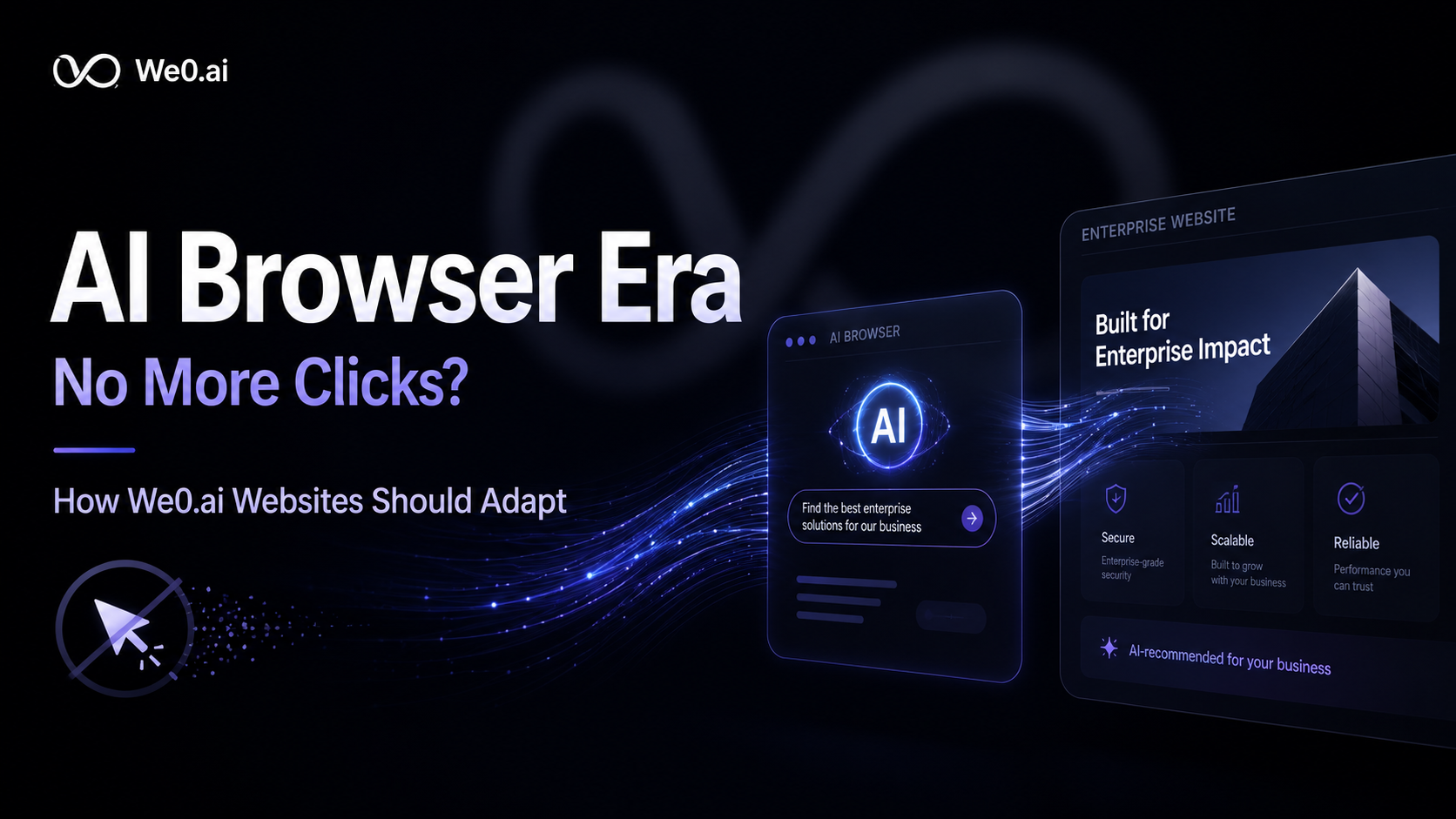
The Bottom Line First
Yes, clicks will decrease. But that doesn't mean company websites are useless—quite the opposite. Websites will matter even more.
Only their role will change:
From "waiting for people to click in" to "being seen, understood, and cited by AI first, then bringing people in."
So the question isn't "should we build a website or not" but rather: if we keep building websites the old way, that definitely won't work anymore.
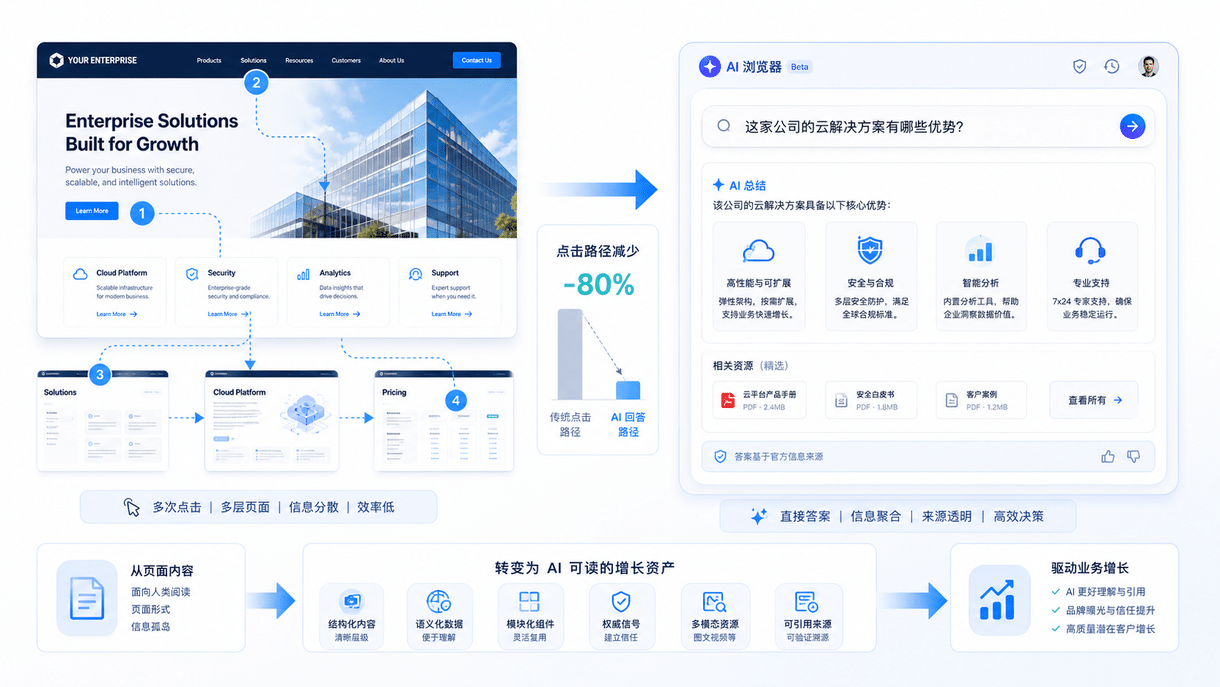
1. Once AI Browsers Go Mainstream, the Access Path Will Change
In the past, users would search, then click a link, land on the homepage, browse the navigation, check case studies, and finally submit a form.
In the future, the more common behavior might be:
- Ask the AI browser directly
- The AI browser provides a summary first
- Users only click once at a critical juncture
- Or they don't click at all—they read the answer first, then decide whether to visit the website
In other words, the website is no longer the "first touchpoint" but the "final confirmation point."
| Old Websites | Future Websites |
|---|---|
| Rely on homepage navigation to find information | Rely on AI reading page structure to find information |
| Rely on multiple clicks to browse | Rely on summaries, cards, and structured content display |
| Rely on forms to collect leads | Rely on AI recognizing value before directing traffic |
| Rely on "looking comprehensive" | Rely on "being understandable" |
The most critical takeaway here: In the future, websites won't compete on the number of pages, but on information density, structural clarity, and citability.
2. The First Thing Enterprise Websites Should Change Isn't Design—It's Information Architecture
Many people's first reaction is: let me make the website flashier.
Wrong.
AI browsers care more about:
- What exactly this company does
- Who it's for
- What results it delivers
- Whether there's evidence
- Which page can directly answer the question
So website transformation should start with these 5 things:
1) Each page answers only one core question
Don't turn your homepage into a company yearbook.
2) Titles should sound like answers, not slogans
For example:
"We0.ai helps showcase websites go live faster and continuously gain SEO/GEO traffic"
reads much more like something AI can understand than "Building future-ready website experiences."
3) Case studies, FAQs, pricing, and service pages should be separated
Don't cram everything into the homepage. AI needs clear page boundaries.
4) Put "evidence" upfront
Data, screenshots, case studies, customer scenarios, before-and-after comparisons—all of these are far more useful than empty claims.
5) Leave structured clues for AI
For example: FAQs, tables, step-by-step guides, comparison blocks, checklists, and Schema markup.
3. It's Not About "Fewer Clicks"—It's About "Fewer Wasteful Clicks"
The problem with many websites isn't too few clicks; it's that the clicks are wasteful.
Users click in and still have to:
- Search around
- Read around
- Guess around
- Ultimately fail to make a decision
With AI browsers, these websites will suffer even more.
Because users are already used to "getting the answer first, then deciding whether to go deeper."
So enterprise websites should shift to this rhythm:
Conclusion first, then evidence.
Value first, then details.
Let AI understand it first, then let people want to click.
4. If You Use We0.ai to Build a Website, Build It as a "Growth Site," Not a "Page Factory"
This is important.
We0.ai isn't just about helping you make a page—it's better suited for: a website that can go live, showcase, grow, and acquire customers.
It's more like a showcase-website growth platform:
- Launch the website first
- Then clearly explain the products / services / case studies
- Then build the SEO / GEO foundation
- Then continuously update content
- Then monitor traffic and leads
It's this chain:
Build -> Showcase -> Grow -> Leads
In this case, the website isn't "done and dusted." It's a continuously working customer-acquisition asset.
How Should Websites Be Reworked with We0.ai?
| Section | How to Change It |
|---|---|
| Homepage | State directly who you are, who you help, and what problems you solve |
| Product pages | Break down features—don't stuff everything into one page |
| Case study pages | Talk about results, talk about before-and-after comparisons |
| FAQ page | Collect the most common questions users ask |
| Content pages | Continuously create long-tail keyword and topic content |
| Contact page | Lower the friction for inquiries and add more conversion entry points |
5. What Really Needs Optimizing Is "AI Readability"
In the future, websites aren't just for people to look at—they're also for AI to read.
So you need to care about these questions:
- Is the page title clear?
- Do paragraphs have hierarchy?
- Is there a conclusion that grabs attention at a glance?
- Do images carry semantic meaning?
- Is the text too empty and vague?
- Is the product's value thoroughly explained?
A website that AI can't understand will also struggle to earn people's trust quickly.
This statement will become more and more obvious over time.
6. The 4 Most Practical Actions We0.ai Should Take
- Rewrite the homepage as a "value answer page," not a company introduction page.
- Strengthen case studies and FAQs separately—these two page types are the most likely to be cited.
- Write content around search intent, not around what the boss wants to say.
- Iterate continuously after launch—see which pages are driving clicks, dwell time, and inquiries.
If you're using We0.ai for a showcase website, don't just focus on "how fast it launches."
What you should focus on is: Can it consistently generate traffic, leads, and customers for you?
Conclusion
As AI browsers gain popularity, enterprise websites won't disappear, but websites that rely solely on clicks will gradually lose their edge.
In the future, the websites that will be worth more are those that:
- Have clear structure
- Have complete information
- Can be understood by AI
- Can be found through search
- Can continuously handle inquiries
This is also where We0.ai should focus its efforts:
Not just to make a beautiful page, but to build a website that can showcase, grow, and acquire customers.
Frequently Asked Questions
1. Will AI browsers cause website traffic to plummet?
Not necessarily. The more likely outcome is "fewer clicks, but high-intent traffic becomes more valuable."
2. Which part of the website should be prioritized for change?
Homepage, case study pages, FAQ, pricing page, and contact page.
3. What types of websites is We0.ai best suited for?
Showcase websites, product websites, service pages, case study pages, portfolios, inquiry pages, and content sites.
4. Do we still need to focus on SEO when building a website now?
Yes, and even more so. Because AI also needs readable, citable content sources.
Related Tools
References
Ready to get started?
If you want to transform your official website from "waiting for clicks" to "AI-readable and continuously attracting customers," try We0.ai.
Summary
The website of the future isn't one that makes people click many times — it's one that makes people trust you faster.