WeO AI for B2B: How Can Businesses Use AI-Driven Websites to Generate More Inquiry Leads?
Many B2B companies have websites.
We0 AI for B2B: How Can Businesses Use AI to Drive More Inquiry Leads Through Their Websites?
A lot of B2B companies have websites.
But honestly, many of those websites merely exist.
A prospect clicks in, glances at the homepage, sees a few perfectly polished slogans, a few service modules, and a Contact Us button. Then what? Nothing.
The real question is not whether you have a website.
The real question is whether your website helps you qualify prospects, build trust, and drive inquiries.
Especially in B2B.
B2B buyers do not submit a form immediately just because they saw a beautiful banner. They search, compare, read case studies, ask AI, browse service pages, and investigate whether you are credible. By the time they actually contact you, they have often already completed a large part of their evaluation.
Demand Gen Report, citing research from 6sense, noted that B2B buyers are nearly 70% through the purchasing process before speaking with sales; and 80% of first contact is initiated by the buyer.
Put simply:
Before your sales team ever meets a prospect, your website is already “interviewing” them for you.
If that website is just a static brochure page, it is very hard for it to generate a steady stream of leads.
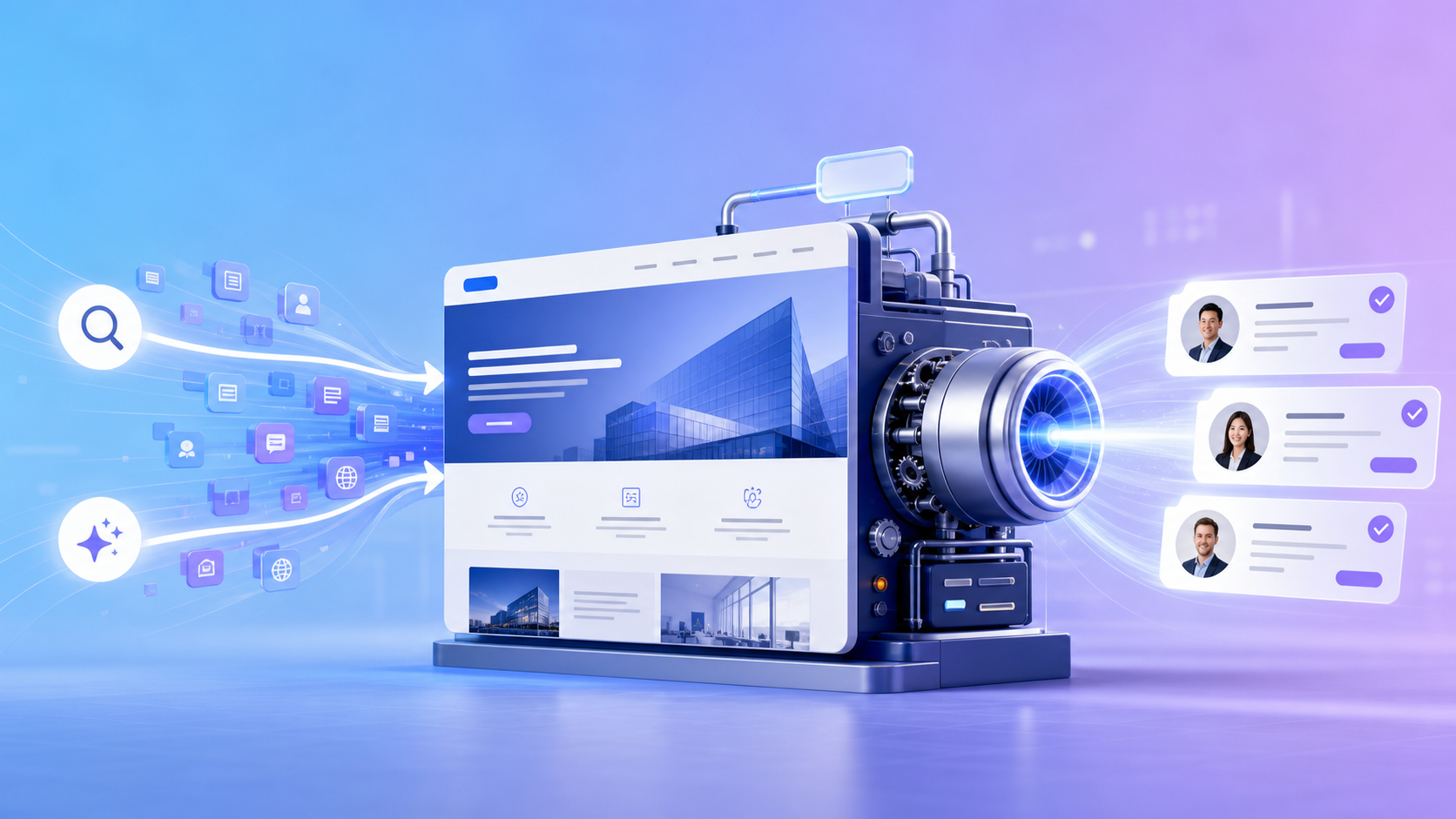
But if it is an AI-powered website—one that can be built, showcased, discovered through search, continuously optimized, and used to guide inquiries—then it is no longer just a website.
It becomes a long-term B2B customer acquisition asset.

The Starting Point of B2B Customer Acquisition Is No Longer “Sales Follow-Up”
In the past, many companies understood customer acquisition like this: run ads, get lists, have sales make calls, and book meetings.
That logic has not completely stopped working, but it has become heavier and more expensive.
Today’s B2B buyers behave more like this:
- They search for problems first, not vendors.
- They review content first, not book sales calls.
- They compare solutions first, not listen to a pitch.
- They form preferences first, then decide whether to contact you.
So the role of a B2B website has changed.
It can no longer just answer, “Who are we?”
It also needs to answer:
- What specific problems do you solve?
- What type of customers are you a fit for?
- How are you different from other solutions?
- Do you have case studies, processes, results, and proof?
- If I want to inquire now, what should I do next?
A website that generates inquiry leads is essentially reducing the cost of decision-making for the customer.
This is also where We0 AI comes in.
We0 AI does not just help businesses generate a webpage. More accurately, it is designed for the growth journey of showcase websites:
Build -> Showcase -> Grow -> Leads
Build the website, showcase the business, gain traffic from search and AI recommendations, and ultimately convert that into inquiry leads.
What Does an AI-Powered Website Actually Do for B2B Businesses?
Do not think of an AI-powered website as “generate a webpage from one sentence.”
That is far too shallow.
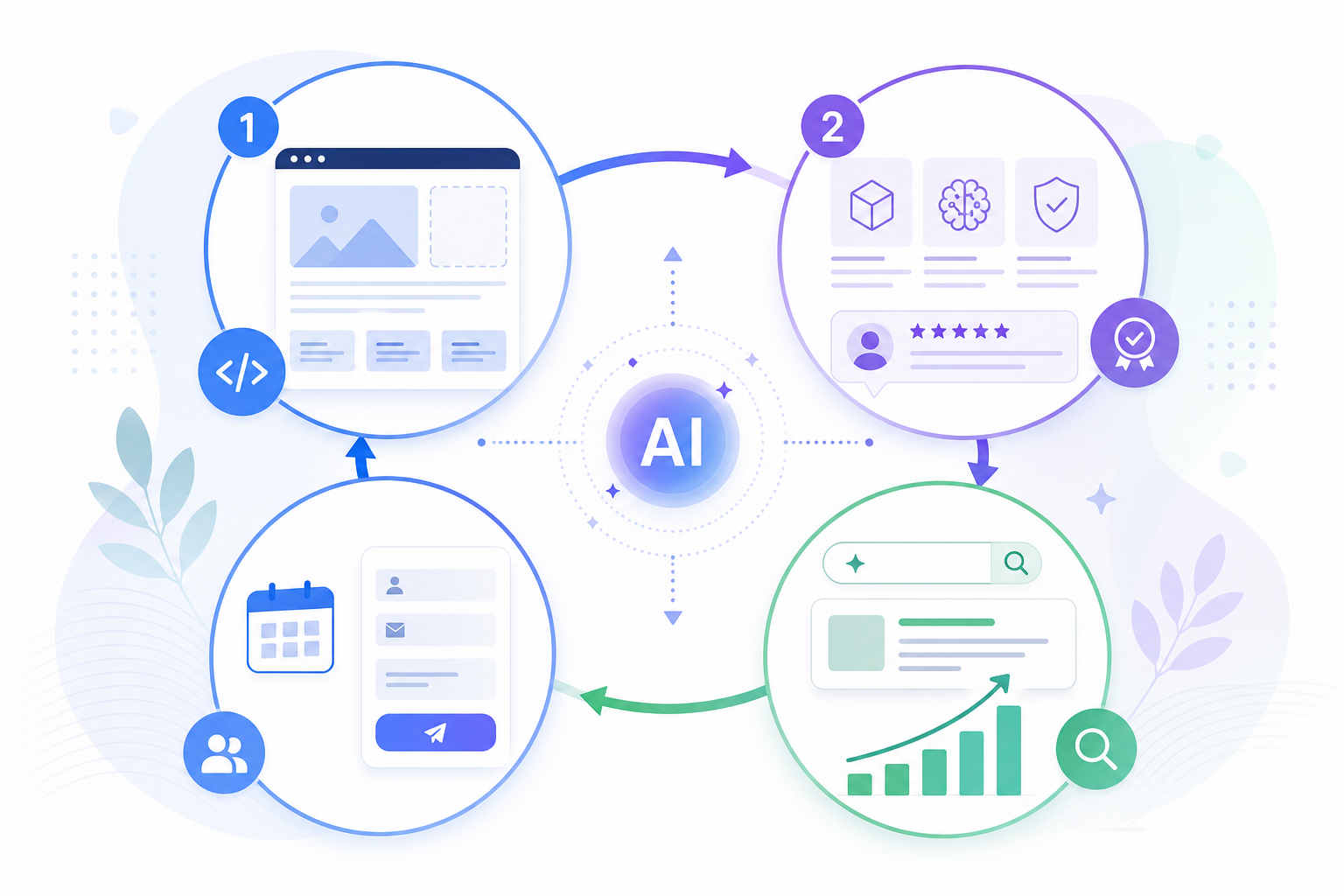
For B2B companies, the real value of an AI-driven website is not that it saves you from dragging a few components around. It is that it turns a website from a “launch project” into a “growth system.”
| Traditional Business Website | AI-Powered B2B Growth Website |
|---|---|
| Finished and then left untouched | Continuously optimized after launch |
| Homepage talks about brand slogans | Pages are structured around buyer problems |
| One Contact Us button | Multiple inquiry entry points and conversion paths |
| Content updates slowly | Can continuously produce SEO / GEO content |
| No visibility into who is visiting | Focuses on traffic data and lead performance |
| More like a business card | More like a customer acquisition asset |
The difference is significant.
A traditional website solves “it looks like we have a company.”
A growth website solves “why should customers choose you?”
We0 AI is much more aligned with the latter.
It is not just an AI website builder. It connects brand messaging, page structure, copywriting, launch, foundational SEO/GEO setup, content updates, data monitoring, and growth review into one system.
For B2B businesses, that matters far more than simply “building a page quickly.”
The First Step: Turn Your Website from a “Company Introduction” into a “Buyer Journey”
One of the biggest problems with many B2B corporate websites is that they are written entirely from the company’s point of view.
The first screen of the homepage says: we are leading, professional, innovative, trustworthy...
There is nothing wrong with those words.
But after reading them, the customer still does not know whether you can solve their specific problem.
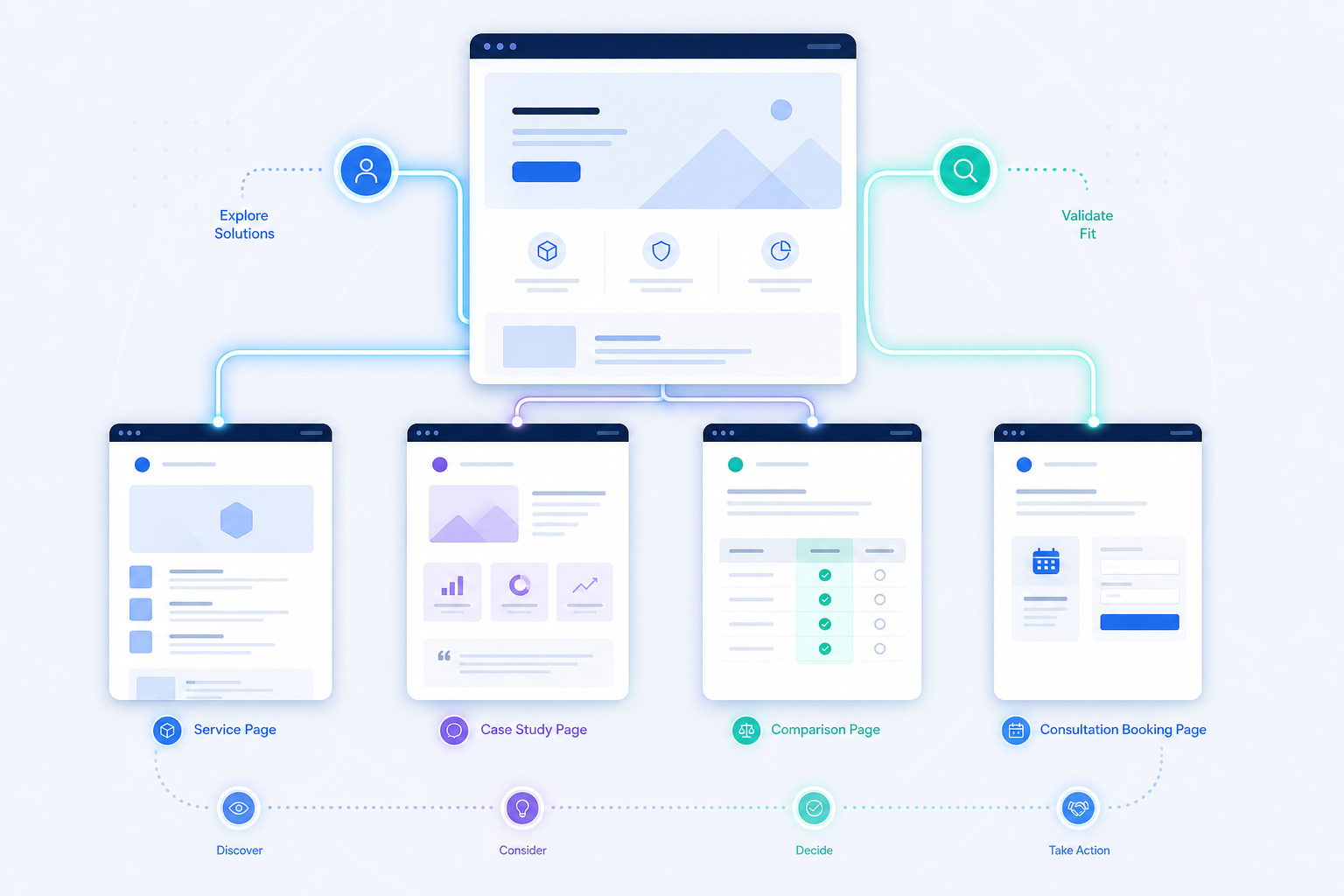
A better approach is to organize the website around the buyer journey.
A B2B inquiry-focused website should have at least these pages
| Page | Purpose | Impact on Inquiry Leads |
|---|---|---|
| Homepage | Quickly explain who you are and what problems you solve | Encourages visitors to keep exploring |
| Service / Product Page | Explain specific capabilities and suitable use cases | Matches real needs |
| Industry / Use Case Page | Speak to different customer segments | Improves lead quality |
| Case Study Page | Show results, process, and credible proof | Builds trust |
| Comparison Page | Explain how you differ from alternatives | Captures high-intent search traffic |
| FAQ Page | Address concerns and purchasing questions | Lowers the barrier to inquiry |
| Consultation / Booking Page | Make the next step clear | Turns interest into leads |
Not every page needs to sell.
Some pages are there to explain, some to prove, and some to convert.
If every page only has a single “Contact Us” button, leads will naturally be fewer—because the customer has not been convinced yet.

The second thing: make your website searchable—and discoverable by AI
B2B consultation leads usually do not appear out of nowhere from the homepage.
They come from many different entry points:
- Searching a specific question on Google
- Seeing a brand or solution in AI search
- Clicking into an article on LinkedIn
- Returning to the official website after viewing a case study
- Searching for a brand term and then entering a service page
- Entering a comparison page while evaluating vendors
This is why SEO and GEO have become important.
SEO helps search engines understand you.
GEO, or Generative Engine Optimization, makes it easier for AI search, AI answers, and AI recommendations to understand and cite you.
Of course, GEO should not be mystified.
At its core, it comes down to one thing: your website content needs to be clear enough, specific enough, credible enough, and cite-worthy enough.
Google Search Central’s SEO Starter Guide also repeatedly emphasizes that website content should help search engines understand it, while also helping users decide whether to visit your site.
For B2B, this becomes more specific:
| Buyer search intent | Suitable content to capture it |
|---|---|
| “how to improve b2b lead generation” | How-to guides, problem breakdowns |
| “best website for consulting business” | Scenario pages, solution pages |
| “AI website builder for B2B” | Product pages, comparison pages |
| “agency website consultation leads” | Industry pages, case study pages |
| “how to get more consultation bookings” | Conversion optimization articles, FAQs |
If your website only has a homepage and an About page, it basically cannot capture these searches.
If you have no content entry points, you have no chance of being discovered.
The value of We0 AI here is not just generating pages, but helping companies continuously add pages, content, and structure around their business.
For example:
- Generate dedicated pages for different services
- Create scenario pages for different customer types
- Generate FAQ content for common questions
- Design landing pages for consultation conversion
- Build out long-tail keywords for SEO/GEO
- Continue optimizing pages based on visit data
This is what a B2B website should be doing.
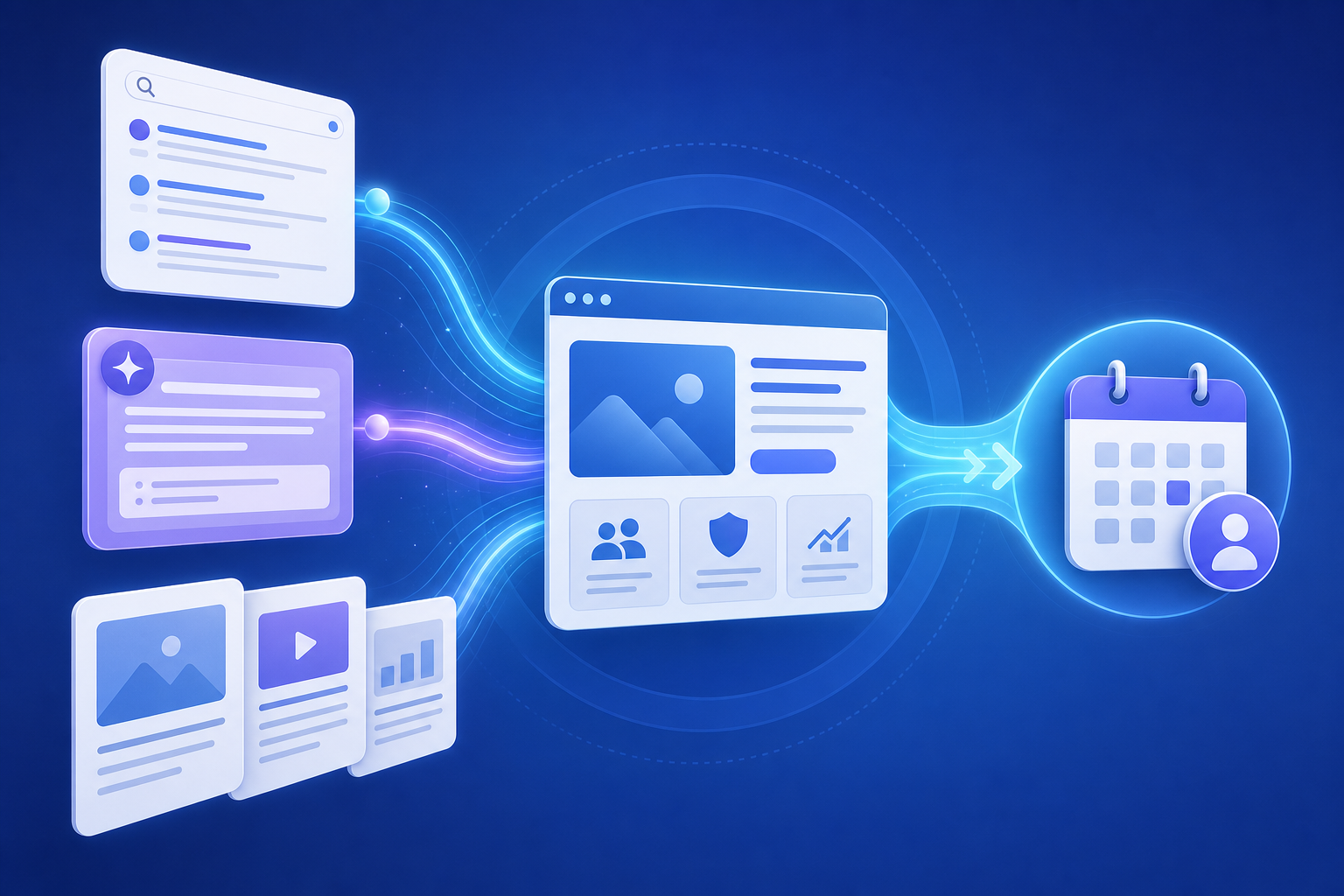
The third thing: design “consultation” as a journey, not a button
The consultation entry points on many websites are too crude.
A Contact button in the top right. A form at the bottom. And that’s it.
But B2B consultation is not impulse buying.
Before submitting a form, customers usually ask themselves:
- Does this company understand my industry?
- Have they done similar projects before?
- What happens after the consultation?
- What do I need to prepare?
- Will sales keep chasing me?
- Is this service roughly suitable for me?
If no one answers these questions, the customer leaves.
So the consultation page needs to be designed carefully.
What should a better consultation page include?
| Module | Purpose |
|---|---|
| A one-sentence explanation of who the consultation is for | Screen first; don’t accept everyone indiscriminately |
| Common consultation scenarios | Help customers see where they fit |
| How you will assess their needs | Reduce uncertainty |
| Booking form / calendar | Lower the cost of taking action |
| Case studies or customer types | Build trust |
| FAQ | Address concerns |
| Lightweight form fields | Don’t ask too much upfront |
Leadfeeder also mentions in its article on B2B website lead generation that website lead generation is an ongoing optimization process; you need to clarify the customer journey, create landing pages for different buyer personas, and design forms and CTAs well.
This is critical.
Consultation is not a button. Consultation is a deliberately designed trust transition.
If you want your website to bring in more consultation leads, do not just ask, “Where should the button go?”
Ask instead:
Before the customer sees this button, how convinced are they already?
The fourth thing: use AI to speed up content and page iteration
B2B websites age easily.
The product changes, the service changes, more case studies are added, customer questions change, and search keywords change too. But the website is still stuck where it was two years ago.
This is why many corporate websites do not generate leads.
Not because the website looks bad.
But because it no longer answers today’s buyer questions.
This is where the advantage of an AI-powered website lies: it makes updating pages and content much easier.
For example, companies can complete the following faster:
- Launch new service pages
- Launch new industry pages
- Organize new case study pages
- Update FAQs
- Optimize SEO titles and descriptions
- Create A/B versions of landing pages
- Optimize consultation page copy
- Continuously publish content articles
But one honest point needs to be made here:
AI cannot understand your business for you. It should help you express your business faster, more clearly, and in a way that is better suited for growth.
So We0 AI’s capabilities are not just about automatic generation. They also include manually organizing brand information, planning the website structure, optimizing page copy, completing launch, setting up foundational SEO/GEO configurations, monitoring data, and continuously providing growth recommendations.
This combination is very important for B2B.
Because the hardest part of a B2B website is not “creating a page.”
The hardest part is:
Explaining a complex business clearly, building trust, and designing the next step.
The fifth thing: look at the data, then keep improving
If no one looks at the data after a website goes live, then it is basically a one-time delivery.
But lead growth is not a one-time delivery.
You need to know:
- Which pages bring in the most traffic?
- Which keywords bring in high-intent traffic?
- Which pages have the longest dwell time?
- Which pages have high bounce rates?
- Are the consultation buttons being clicked?
- At which step are users dropping off in the form?
- Which content is driving branded searches?
These questions determine the next round of optimization.
They also determine whether the website can evolve from “showcase” to “growth.”
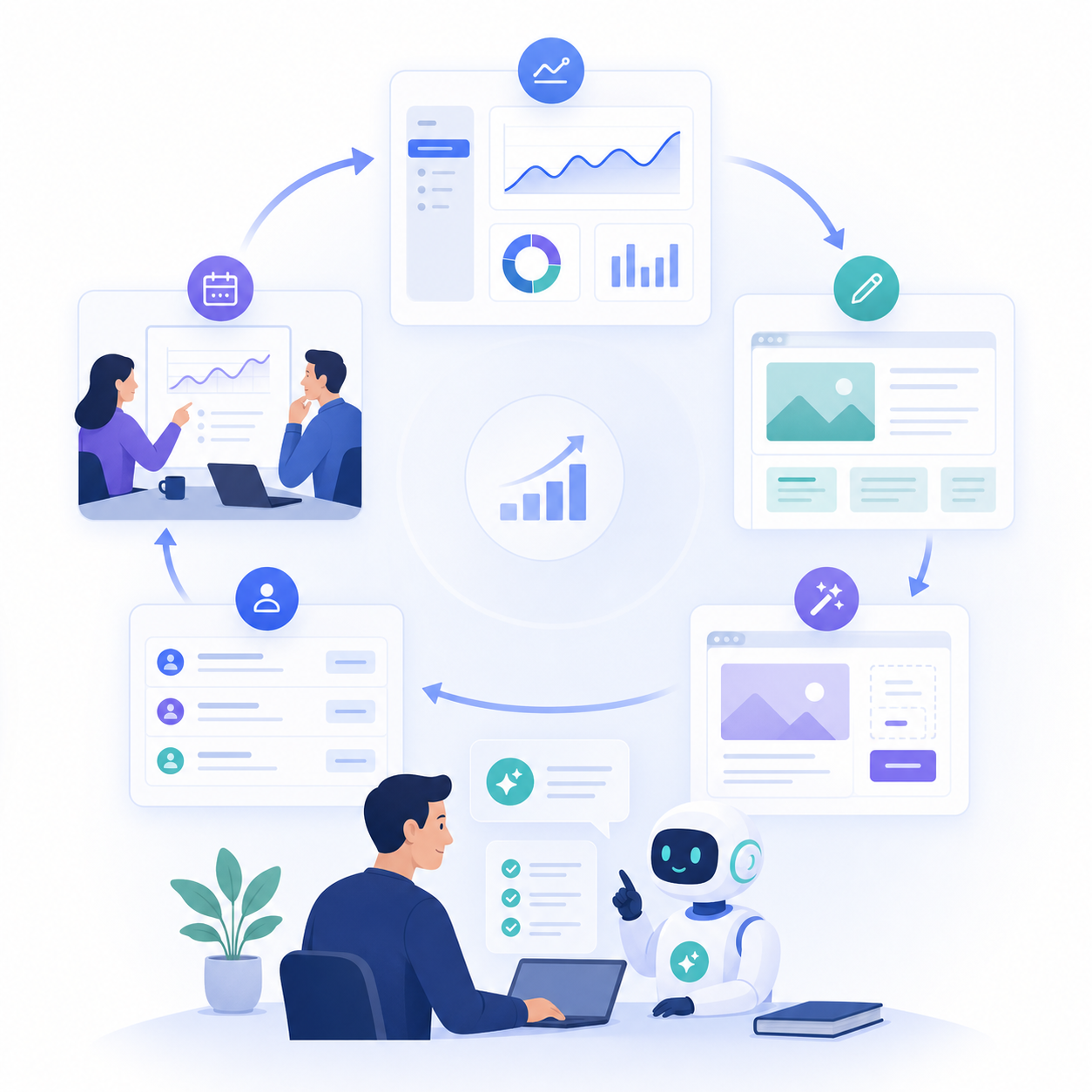
A Simple B2B Website Growth Review Framework
| Review Question | Possible Actions |
|---|---|
| Traffic but no inquiries | Optimize CTA, inquiry page, and trust signals |
| Inquiries but low quality | Adjust page positioning, form questions, and industry pages |
| Low SEO traffic | Add long-tail content, optimize titles, and strengthen internal links |
| High traffic to case study pages | Add case-study CTAs and related service entry points |
| FAQ pages frequently visited | Move key concerns upfront onto service pages |
| Traffic growth in a specific industry | Create a dedicated industry landing page |
A growth-oriented website is never truly finished. It just gets a little smarter every month.
This is also what We0 AI emphasizes: not just helping businesses “have a website,” but helping them have a website that can continuously attract traffic, generate inquiries, and win customers.
How Can B2B Businesses Get Started?
You don’t need to build a huge corporate website from day one.
A more practical approach is to first create a minimum viable growth website that can capture inquiries.
You can follow this order
- Define who your target customers are
- Identify what they search for most often and what questions they hesitate over most
- Build a clear homepage
- Create 2–3 core service/product pages
- Create 1 inquiry page
- Create 3–5 FAQ or content pages
- Add case studies, process, customer types, and trust signals
- Set up the basic SEO/GEO information
- After launch, review the data and optimize once a month
This sequence is simple, but effective.
Don’t aim for “big and comprehensive” first. Aim for “customers are willing to inquire after reading.”
We0 AI is well suited to this path.
It can help B2B companies quickly build a showcase website, and then continue driving growth through content, SEO/GEO, page optimization, and lead conversion.
What you need is not a beautiful but quiet website.
What you need is a website that helps explain your business, build trust, stay discoverable, and drive inquiries.
FAQ
1. What is an AI-powered B2B website?
An AI-powered B2B website is not simply a webpage generated by AI. A better way to understand it is this: it uses AI to improve the efficiency of website creation, content production, page optimization, SEO/GEO planning, and lead conversion, turning the website into a long-term growth asset.
2. Can an AI website really generate consultation leads?
Yes, but the prerequisite is not simply “using AI.” The prerequisite is having clear positioning, a buyer journey, content entry points, trust signals, and inquiry conversion design. The value of AI is that it helps complete these tasks faster and more consistently.
3. What are the most important pages on a B2B website?
They usually include the homepage, service pages, industry/use-case pages, case study pages, FAQ pages, comparison pages, and consultation booking pages. Different businesses can adjust this, but the core logic remains the same: explain clearly, build trust, and drive the next step.
4. What is the difference between SEO and GEO for B2B customer acquisition?
SEO focuses more on visibility in search engines, while GEO focuses more on being understandable, citable, and recommendable within AI search and generative answers. Both require clear content, logical structure, and trustworthy information.
5. What types of B2B companies is We0 AI suitable for?
It is suitable for SaaS/AI product teams, consulting firms, agencies, export trading companies, local service providers, professional service firms, independent consultants, and businesses that rely on their official website to capture inquiry leads.
Related Tools
- We0 AI: Suitable for building showcase websites and continuously improving SEO/GEO, content, and lead growth.
- Google Search Console: Used to monitor website performance in Google Search.
- Google Analytics: Used to analyze traffic sources, page performance, and user journeys.
- Calendly: Suitable for embedding booking flows on consultation pages.
- HubSpot CRM: Suitable for managing inquiry leads and customer follow-up.
Sources
- Demand Gen Report: B2B buyers initiate first contact once they’re 70% through their buying journey
- Leadfeeder: B2B website lead generation best practices
- Google Search Central: SEO Starter Guide
Friendly Links / Related Reading / Internal Link Suggestions
- AI Website Builder for B2B: Why businesses need more than just page generation
- How to Build a Consulting Website That Converts Visitors into Leads
- SEO vs GEO: What B2B websites should do with content in the age of AI search
- B2B Landing Page Checklist: A page structure that moves visitors from traffic to inquiry
- Showcase Website Growth: Why showcase websites also need ongoing operations
Ready to Build?
If your website is already live but generates almost no consultation leads, the problem may not be that “the design isn’t attractive enough.”
More likely:
Your pages are not organized around the buyer journey.
Your content does not capture search demand or AI recommendations.
Your inquiry entry point does not complete the trust transition.
We0 AI can help you rethink your website from Build -> Showcase -> Grow -> Leads, so it becomes more than just a showcase page. It becomes a growth asset that can be discovered, understood, continuously optimized, and used to generate consultation leads.
Conclusion
The value of a B2B website is shifting from “proving I exist” to “helping customers trust me faster.”
That is where the opportunity for AI-powered websites lies.
Not in making websites flashier.
Not in generating pages faster.
But in making websites clearer, more discoverable, more trustworthy, and better at driving inquiries.
For B2B companies, the best website is not the prettiest website.
It is the one that consistently brings in high-quality consultation leads.
We0 AI for B2B: How Can Businesses Use AI-Powered Websites to Generate More Leads for Consultations?
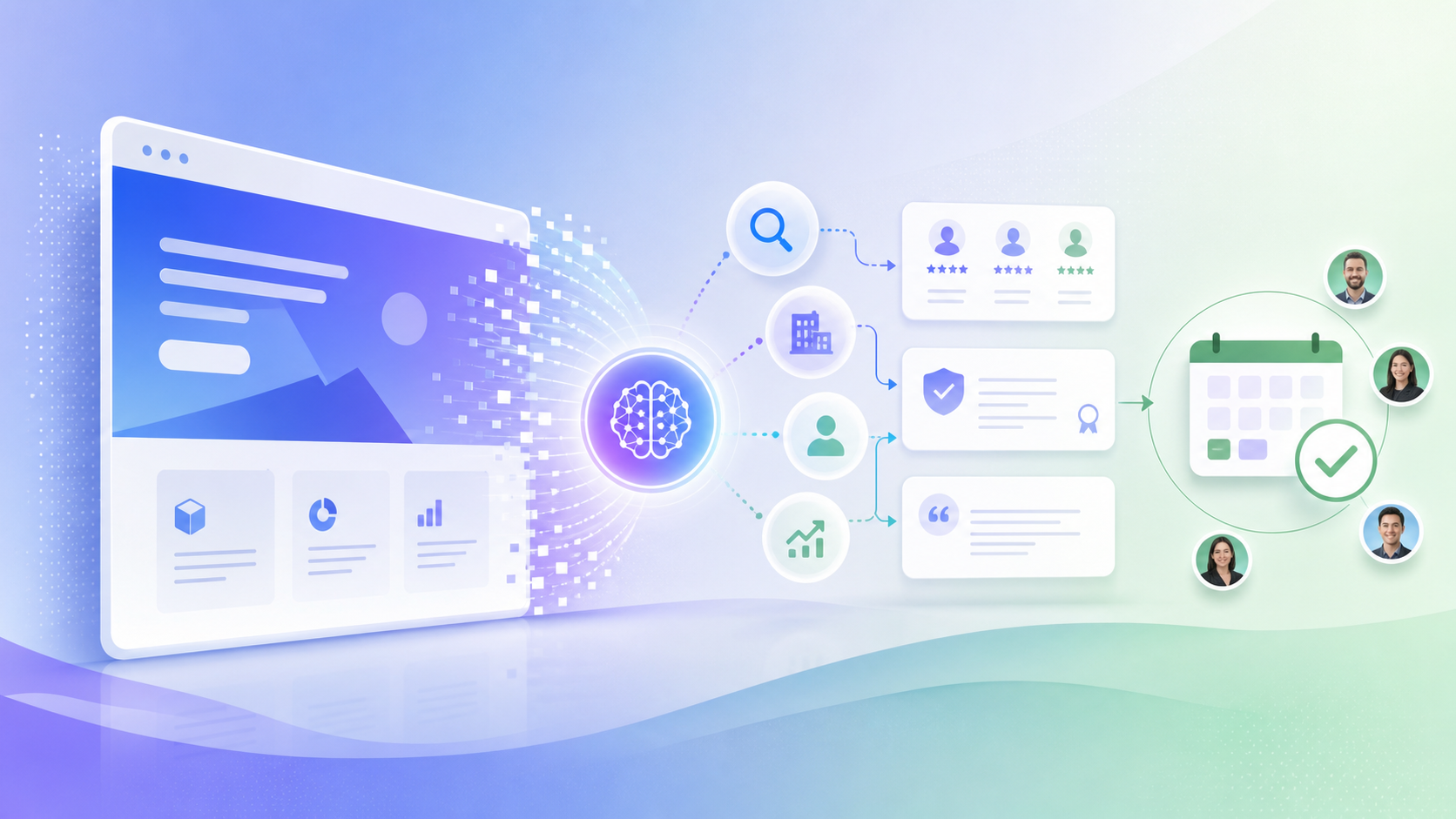
A lot of B2B companies have a website.
But honestly, many of those websites just… exist.
A visitor lands on the homepage, sees a few polished claims, some service blocks, and a “Contact Us” button. Then what? Usually, nothing.
The real question is not: do you have a website?
The real question is: is your website helping you qualify buyers, build trust, and drive consultation requests?
Especially in B2B.
B2B buyers do not book a call just because they saw a nice hero section. They search. They compare. They read case studies. They ask AI tools. They scan service pages. They quietly decide whether you look credible enough.
By the time they contact you, a big part of the buying decision has already happened.
Demand Gen Report, citing 6sense research, notes that B2B buyers are nearly 70% through the purchasing process before engaging with sellers, and 80% of first contact is initiated by buyers.
In plain English:
Before your sales team ever meets the buyer, your website has already been doing the interview.
If that website is just a static brochure, it will not generate many leads.
But if it is an AI-powered website — one that can be built, structured, discovered, optimized, and connected to consultation flows — then it becomes something else.
It becomes a long-term B2B growth asset.
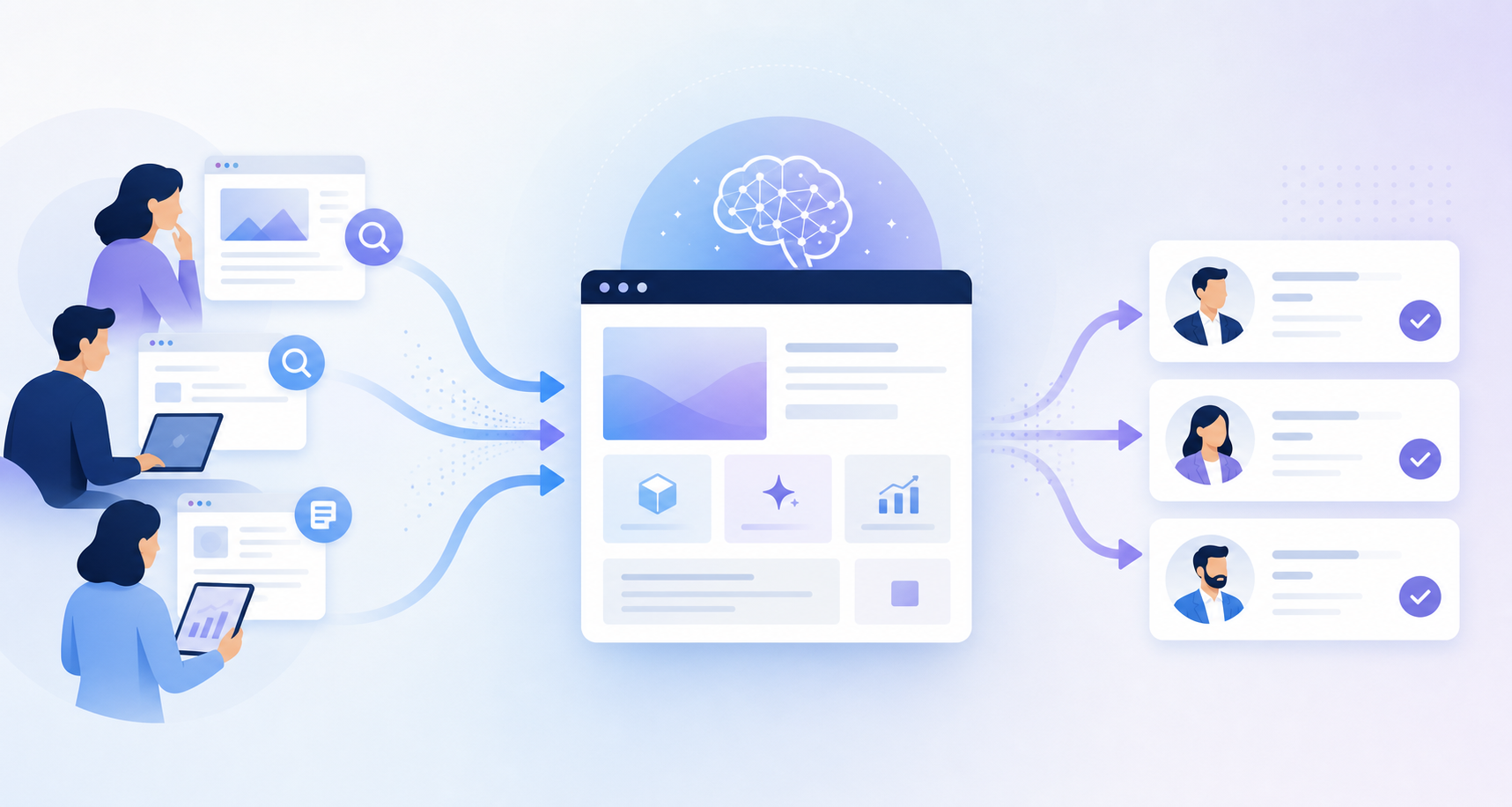
B2B lead generation no longer starts with sales follow-up
A lot of companies still think lead generation means: run ads, collect names, have sales call them, book meetings.
That model is not completely dead. But it has become heavier, more expensive, and less predictable.
Today’s B2B buyer behaves more like this:
- They search for the problem before searching for a vendor.
- They read content before talking to sales.
- They compare options before listening to a pitch.
- They form a preference before deciding whether to contact you.
So the job of a B2B website has changed.
It cannot just answer “who are we?”
It also needs to answer:
- What exact problem do you solve?
- Who are you best suited for?
- How are you different from other options?
- Do you have cases, proof, process, or results?
- If I want to talk, what should I do next?
A website that generates consultation leads is really reducing the buyer’s decision cost.
That is where We0 AI fits in.
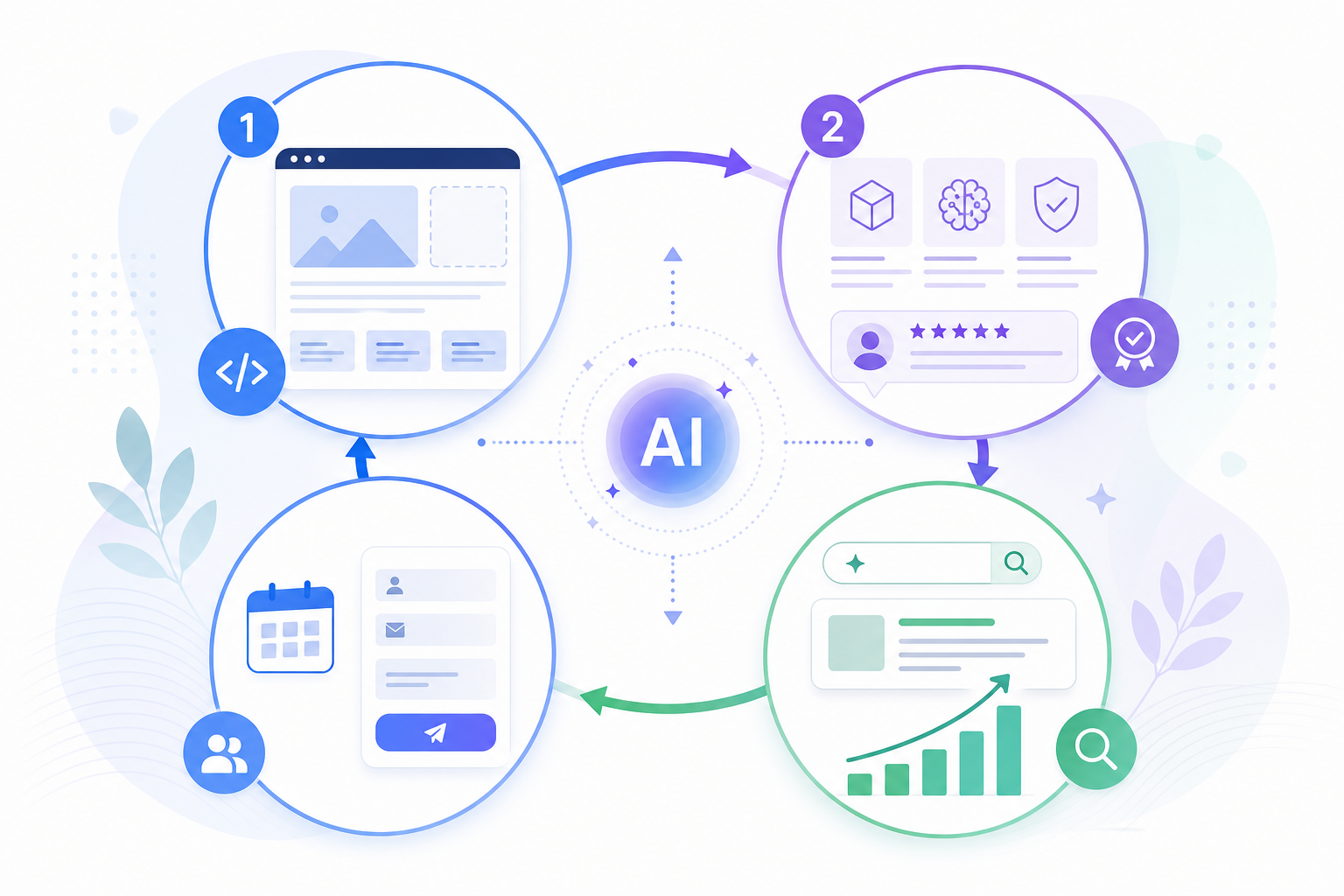
We0 AI is not just about generating a page. It is built around the growth path of a showcase website:
Build -> Showcase -> Grow -> Leads
Build the website. Showcase the business. Grow through search and AI discovery. Turn that attention into consultation leads.

What does an AI-powered website actually do for B2B?
Do not reduce an AI-powered website to “type one sentence and get a page.”
That is too shallow.
For B2B companies, the real value is not saving a few minutes dragging components around. The value is turning the website from a one-time launch project into a growth system.
| Traditional business website | AI-powered B2B growth website |
|---|---|
| Launched once, then left alone | Continuously optimized after launch |
| Homepage talks in brand slogans | Pages are built around buyer questions |
| One generic contact button | Multiple consultation paths and CTAs |
| Slow content updates | Ongoing SEO / GEO content production |
| Little visibility into visitors | Tracks pages, traffic, and lead signals |
| More like a business card | More like a lead-generation asset |
That difference matters.
A traditional website says: this company exists.
A growth website says: here is why the right buyer should talk to us.
We0 AI is closer to the second one.
It is not just an AI website builder. It connects brand information, site structure, page copy, launch support, SEO/GEO basics, content updates, traffic monitoring, growth review, and ongoing optimization.
For B2B, that matters more than “make me a page quickly.”
First: turn your website from company introduction into buyer journey
Many B2B websites are written from the company’s point of view.
The first screen says: we are leading, professional, innovative, trusted…
None of that is technically wrong.
But after reading it, the buyer still may not know whether you can solve their specific problem.
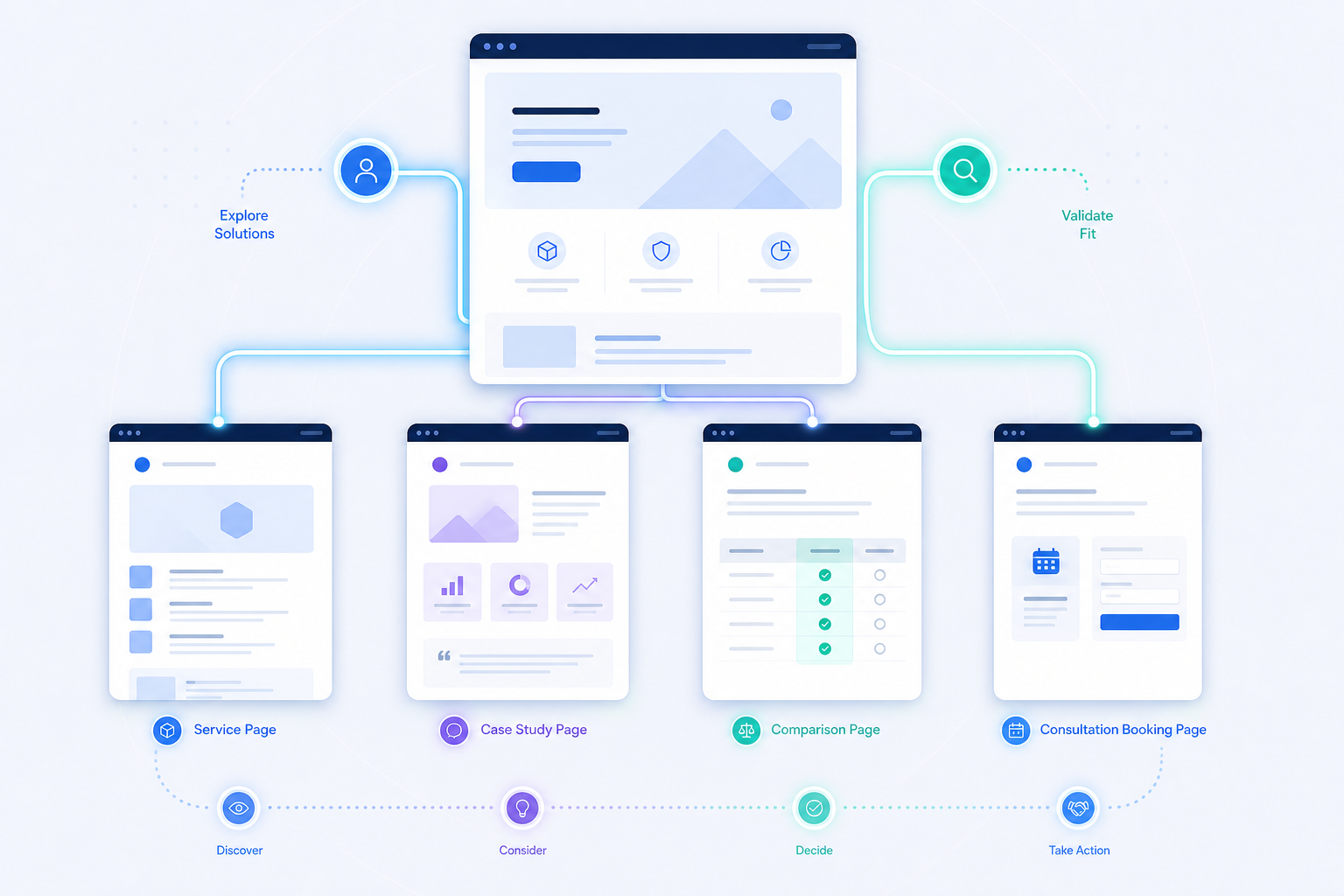
A better website is organized around the buyer journey.
A consultation-driven B2B website should include these pages
| Page | Role | Impact on consultation leads |
|---|---|---|
| Homepage | Quickly explain who you are and what problem you solve | Makes visitors want to keep reading |
| Service / product pages | Explain capabilities and use cases | Matches real buying needs |
| Industry / scenario pages | Speak to different customer segments | Improves lead quality |
| Case studies | Show process, proof, and outcomes | Builds trust |
| Comparison pages | Explain differences from alternatives | Captures high-intent search |
| FAQ page | Answer objections and buying questions | Lowers the consultation barrier |
| Consultation / booking page | Make the next step clear | Turns interest into leads |
Not every page needs to sell.
Some pages explain. Some prove. Some convert.
If every page only has the same “Contact Us” button, you should not be surprised when leads stay low. The buyer has not been convinced yet.
Second: make the website discoverable by search and AI
B2B consultation leads rarely appear out of nowhere on the homepage.
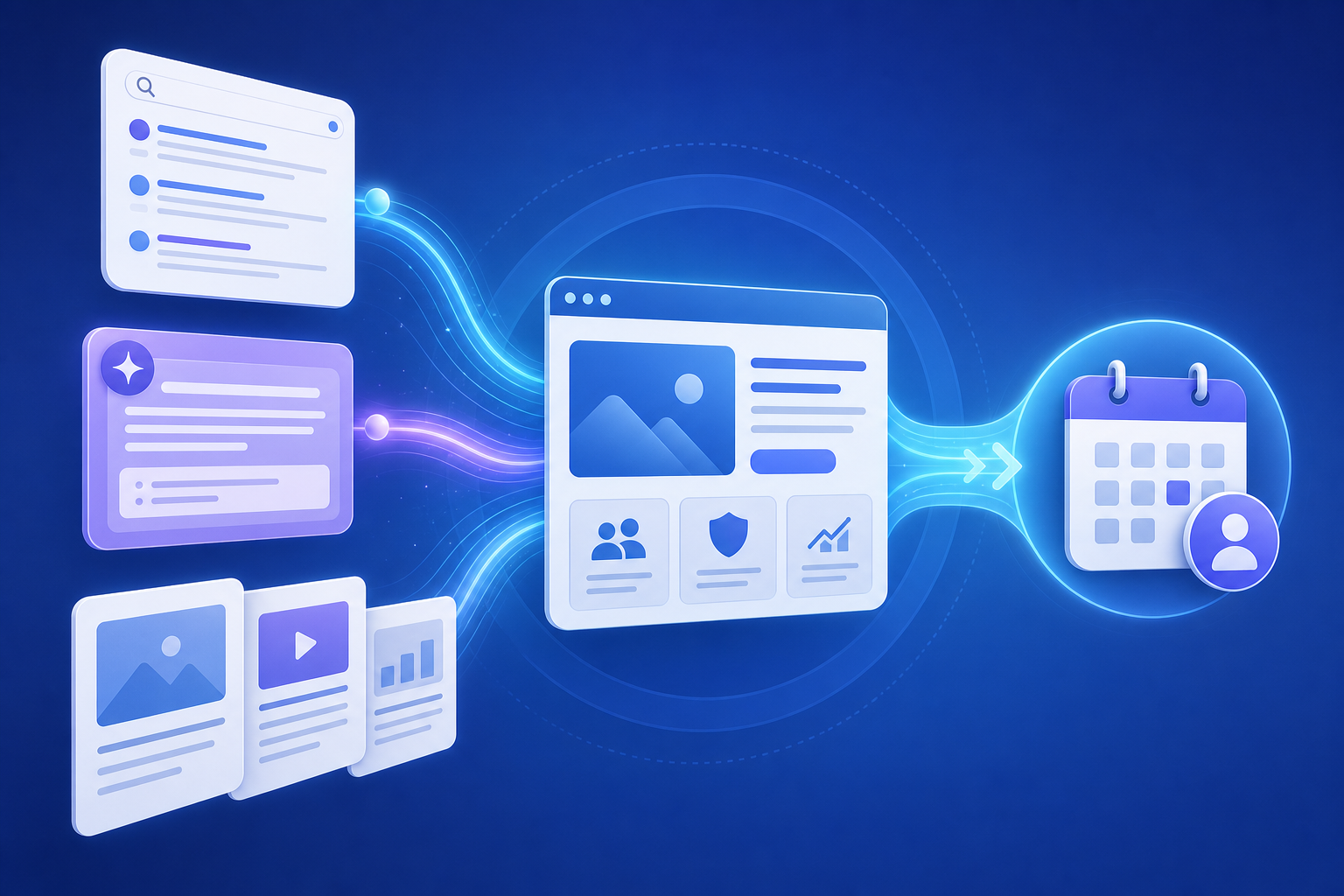
They come through many entry points:
- A Google search for a specific problem
- An AI answer mentioning a solution category
- A LinkedIn post leading to an article
- A case study that sends the visitor back to your site
- A branded search after someone hears about you
- A comparison page during vendor evaluation
That is why SEO and GEO matter.
SEO helps search engines understand you.
GEO, or Generative Engine Optimization, helps AI search, AI answers, and AI recommendation systems understand and reference your content.
But do not overcomplicate GEO.
The core idea is simple: your website content needs to be clear, specific, credible, and easy to cite.
Google Search Central’s SEO Starter Guide says SEO is about helping search engines understand your content and helping users decide whether they should visit your site.
For B2B, this becomes very practical:
| Buyer search intent | Best content to capture it |
|---|---|
| “how to improve b2b lead generation” | Guides and problem breakdowns |
| “best website for consulting business” | Scenario pages and solution pages |
| “AI website builder for B2B” | Product and comparison pages |
| “agency website consultation leads” | Industry pages and case studies |
| “how to get more consultation bookings” | Conversion articles and FAQ pages |
If your website only has a homepage and an About page, it cannot capture these searches.
No content entry points means fewer chances to be discovered.
We0 AI’s value here is not just page generation. It helps companies continuously add pages, content, and structure around real business needs.
For example:
- Service-specific pages
- Segment-specific scenario pages
- FAQ content for buyer questions
- Landing pages for consultation conversion
- Long-tail keyword layouts for SEO/GEO
- Ongoing page optimization based on traffic data
That is what a B2B website should be doing.
Third: design consultation as a path, not a button
Many websites treat consultation too casually.
A Contact button in the top right. A form in the footer. That is it.
But B2B consultation is not an impulse purchase.
Before submitting a form, buyers often ask themselves:
- Does this company understand my industry?
- Have they solved a similar problem before?
- What happens after I book a call?
- What should I prepare?
- Will I be chased by sales?
- Is this service even a good fit for me?
If those questions are not answered, the buyer leaves.
So the consultation page needs to be designed seriously.
What should a better consultation page include?
| Module | Purpose |
|---|---|
| One clear sentence about who the consultation is for | Qualify visitors early |
| Common |
consultation scenarios | Help buyers recognize themselves |
| How you evaluate the need | Reduce uncertainty |
| Booking form or calendar | Lower action friction |
| Case proof or customer types | Build trust |
| FAQ | Handle objections |
| Lightweight form fields | Avoid asking too much too soon |
Leadfeeder’s article on B2B website lead generation also emphasizes that website lead generation is an ongoing optimization process: map the customer journey, build landing pages for different buyer personas, and get forms and CTAs right.
That point is important.
Consultation is not a button. It is a designed trust transition.
If you want more consultation leads, do not only ask, “Where should the button go?”
Ask this instead:
How convinced is the buyer before they see the button?
Fourth: use AI to speed up content and page iteration
B2B websites age quickly.
Your product changes. Services change. Case studies increase. Buyer questions shift. Search keywords move. But the website often stays frozen in place from two years ago.
That is why many business websites stop generating leads.
Not because they are ugly.
But because they no longer answer the questions buyers are asking now.
This is where an AI-powered website helps: it makes page and content updates easier.
Companies can move faster on:
- New service pages
- New industry pages
- Case study pages
- FAQ updates
- SEO titles and descriptions
- A/B landing page versions
- Consultation page copy
- Ongoing blog and content publishing
But here is the honest part:
AI cannot understand your business for you. It should help you express the business faster, more clearly, and in a way that supports growth.
That is why We0 AI is not only about automation. It also includes human support for brand information, website structure, page copy, launch, SEO/GEO basics, traffic monitoring, and growth suggestions.
That combination matters in B2B.
Because the hard part is not “make a page.”
The hard part is:
Explain a complex business clearly, build trust, and design the next action.
Fifth: look at the data, then keep improving
If nobody looks at data after a website goes live, it is basically a one-time delivery.
But lead growth is not a one-time delivery.
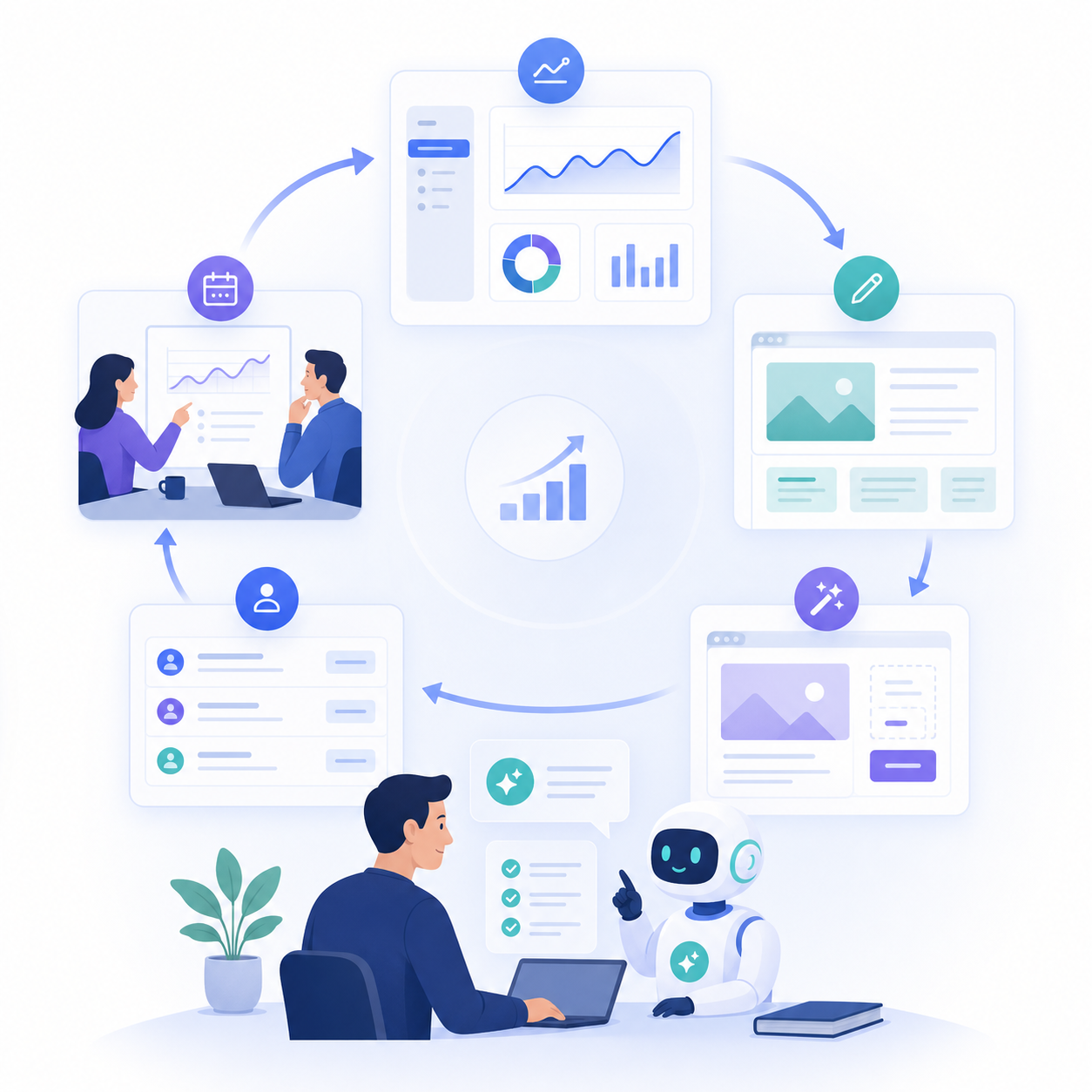
You need to know:
- Which pages bring the most visits?
- Which keywords bring high-intent traffic?
- Which pages keep visitors engaged?
- Which pages have high drop-off?
- Are consultation CTAs getting clicked?
- Where do forms lose people?
- Which content increases branded search?
Those questions determine the next round of optimization.
They also determine whether your website becomes a display asset or a growth asset.
A simple B2B website growth review framework
| Review question | Possible action |
|---|---|
| Traffic but no consultations | Improve CTA, consultation page, trust proof |
| Consultations but low |
quality | Adjust positioning, refine the questions, and expand industry pages |
| Low SEO traffic | Add long-tail content, improve titles, and add internal links |
| Case study pages get high visits | Add case-study CTAs and related service links |
| FAQ pages get frequent visits | Move key objections into service pages |
| One industry segment is growing | Build a dedicated industry landing page |
A growth website is never truly finished. It gets a little smarter every month.
That is what We0 AI is built to emphasize: not just helping a company “have a website,” but helping it build a website that can keep earning traffic, inquiries, and customers.
How can B2B companies get started?
You do not need to build a huge website on day one.
A more realistic approach is to launch a minimum viable growth website that can already capture consultation interest.
Start in this order
- Define your target customer.
- List what they search for and what they worry about.
- Build a clear homepage.
- Create 2–3 core service or product pages.
- Build one consultation page.
- Add 3–5 FAQ or content pages.
- Add case studies, process pages, customer types, and trust signals.
- Set up the SEO / GEO basics.
- Review data after launch and optimize monthly.
This order is simple. But it works.
Do not chase “big and complete” first. Chase “clear enough that the right buyer wants to talk.”
We0 AI is a good fit for this path.
It helps B2B companies build showcase websites faster, and then continue improving content, SEO/GEO, page performance, and lead conversion.
You do not need a beautiful but quiet website.
You need a website that explains your business, builds trust, gets discovered, and moves the right buyers toward consultation.
FAQ
1. What is an AI-powered B2B website?
An AI-powered B2B website is not just a page generated by AI. It uses AI to improve website creation, content production, page optimization, SEO/GEO structure, and lead conversion, so the website becomes a long-term growth asset.
2. Can an AI website really generate consultation leads?
Yes, but not simply because it uses AI. It needs clear positioning, a buyer-journey structure, content entry points, trust signals, and consultation conversion design. AI helps these actions happen faster and more consistently.
3. What pages matter most for a B2B website?
Usually: the homepage, service pages, industry or scenario pages, case studies, FAQ pages, comparison pages, and consultation booking pages. The exact mix depends on the business, but the logic stays the same: explain, prove, and guide the next step.
4. What is the difference between SEO and GEO for B2B lead generation?
SEO focuses on search engine visibility. GEO focuses on being understood, cited, and recommended by AI search and generative answer systems. Both require clear, structured, credible content.
5. Who is We0 AI best for?
We0 AI is suitable for SaaS and AI product teams, consulting firms, agencies, export businesses, local service providers, professional service companies, independent consultants, and any B2B business that wants its website to generate consultation leads.
Related Tools
- We0 AI: Build showcase websites and
support ongoing SEO/GEO, content, and lead growth.
- Google Search Console: Monitor website performance in Google Search.
- Google Analytics: Analyze traffic sources, page performance, and user journeys.
- Calendly: Add booking flows to consultation pages.
- HubSpot CRM: Manage consultation leads and follow-up.
Sources
- Demand Gen Report: B2B buyers initiate first contact once they’re 70% through their buying journey
- Leadfeeder: B2B website lead generation best practices
- Google Search Central: SEO Starter Guide
Related Reading / Internal Link Suggestions
- AI Website Builder for B2B: Why Companies Need More Than Page Generation
- How to Build a Consulting Website That Converts Visitors into Leads
- SEO vs. GEO: How B2B Websites Should Create Content in the AI Search Era
- B2B Landing Page Checklist: From Visit to Consultation
- Showcase Website Growth: Why Display Websites Still Need Continuous Operation
Ready to Build?
If your website is already live but barely generates consultation leads, the problem may not be that it isn’t visually appealing enough.
More likely:
Your pages are not structured around the buyer journey.
Your content is not capturing search traffic or AI-driven discovery.
Your consultation flow is not completing the trust-building transition.
We0 AI can help you rebuild your website around Build -> Showcase -> Grow -> Leads, turning it from just a display page into a discoverable, understandable, continuously optimized growth asset that generates consultation leads.
Conclusion
The value of a B2B website is shifting from “prove we exist” to “help buyers trust us faster.”
That is the real opportunity of AI-powered websites.
Not making pages flashier.
Not generating pages faster just for the sake of speed.
But making the website clearer, more discoverable, more credible, and better at moving buyers toward consultation.
For B2B companies, the best website is not the prettiest one.
It is the one that keeps generating qualified consultation leads.