Six Robots Build an 81,920-Brick Great Wall at WAIC 2026
At the 2026 World Artificial Intelligence Conference in Shanghai, six robots took on an unusually demanding public challenge: assembling a large Great Wall model from 81,920 miniature building blocks in 15 hours.

Six Robots Build an 81,920-Brick Great Wall at WAIC 2026
Introduction
At the 2026 World Artificial Intelligence Conference in Shanghai, six robots took on an unusually demanding public challenge: assembling a large Great Wall model from 81,920 miniature building blocks in 15 hours.
The finished structure measured approximately 3.5 meters long, 1.5 meters wide, and 1.1 meters at its highest point. Four desktop robots and two wheeled humanoid robots worked on the installation, handling everything from fine block placement to transporting and assembling larger sections.
According to the original report, the robots operated without remote control or a rigid, prewritten action script. They were expected to perceive the workspace, decide what to do next, coordinate with one another, detect placement errors, and correct mistakes as the build progressed.
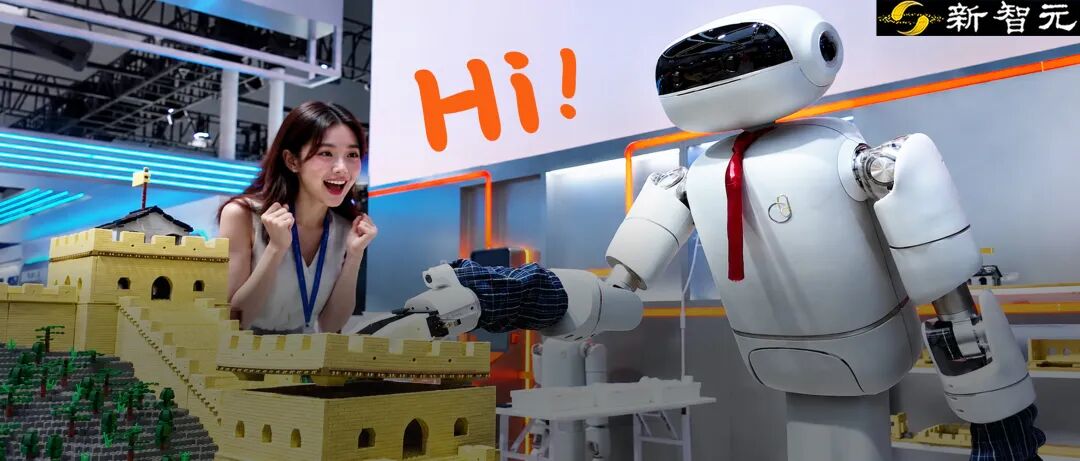
One of the robots working beside the large building-block Great Wall display.
The challenge was organized by Dexmal, also known in Chinese as Yuanli Lingji. The company presented it as a public test of whether embodied AI could move beyond short demonstrations and perform a long, precise, physically coordinated task in a real exhibition environment.
Accuracy note: Descriptions such as “world-first,” “fully autonomous,” and “industry-leading” come from Dexmal or the original report. The public demonstration and technical materials support the general setup, but the source does not provide a complete independent audit of every operational detail.
80,000 Blocks and an Unscripted Public Test
A building-block Great Wall may initially sound like a spectacle designed for an exhibition floor. Broken down into its component requirements, however, the task touches three difficult problems that often prevent robots from moving from laboratory demonstrations into real production work.
Sub-Millimeter Fine Manipulation
The blocks had to connect tightly and consistently. The robots therefore needed to perform controlled movements within a range of roughly 0.1 to 1 millimeter.
That level of precision requires several capabilities to work together:
- Accurate visual and spatial perception
- Fine motor control
- Stable actuation
- Reliable contact detection
- The ability to correct small positioning errors
The challenge was not simply to move objects from one place to another. Each block had to be aligned, pressed into position, and integrated with the surrounding structure without disrupting the pieces that had already been placed.
The original report compares the required stability with the natural tremor of a relaxed human hand, which can be on a similar scale. The practical point is straightforward: the robots had to remain both accurate and consistent over thousands of repeated actions.
Six Robots Without a Single Visible Operator
The second difficulty was coordination.
The setup included six robots with two different body types. They shared the same physical workspace and had to divide the work without colliding or repeatedly attempting the same operation.
The report says there was no human operator continuously directing the group from a central console. Instead, each robot perceived its own surroundings, made local decisions, and communicated with the others to negotiate task allocation.
Smaller and more precise operations could be assigned to the desktop robots, while the wheeled humanoid robots could handle movement, transport, and larger assembly steps.
Multi-agent coordination is common in simulation and research papers. Running heterogeneous robots together for many hours in a crowded exhibition environment is harder because communication delays, perception errors, physical obstructions, and accumulated positioning drift can affect the whole process.
Fifteen Hours of Continuous Operation
The final difficulty was duration.
A robot can look impressive when it performs a carefully selected action for a few minutes. A 15-hour task asks a different question: can the system maintain accuracy and recover from small errors as the number of actions grows?
Every block introduced another opportunity for misalignment. A small error early in the build could affect later sections, so the system needed a closed loop:
- Observe the current state.
- Select the next action.
- Execute the placement.
- Check whether the result matches the expected state.
- Correct the action when necessary.
- Continue from the updated state.
The combined test of precision, coordination, and duration was intended to show whether embodied AI could produce useful working hours rather than a short, isolated demo.
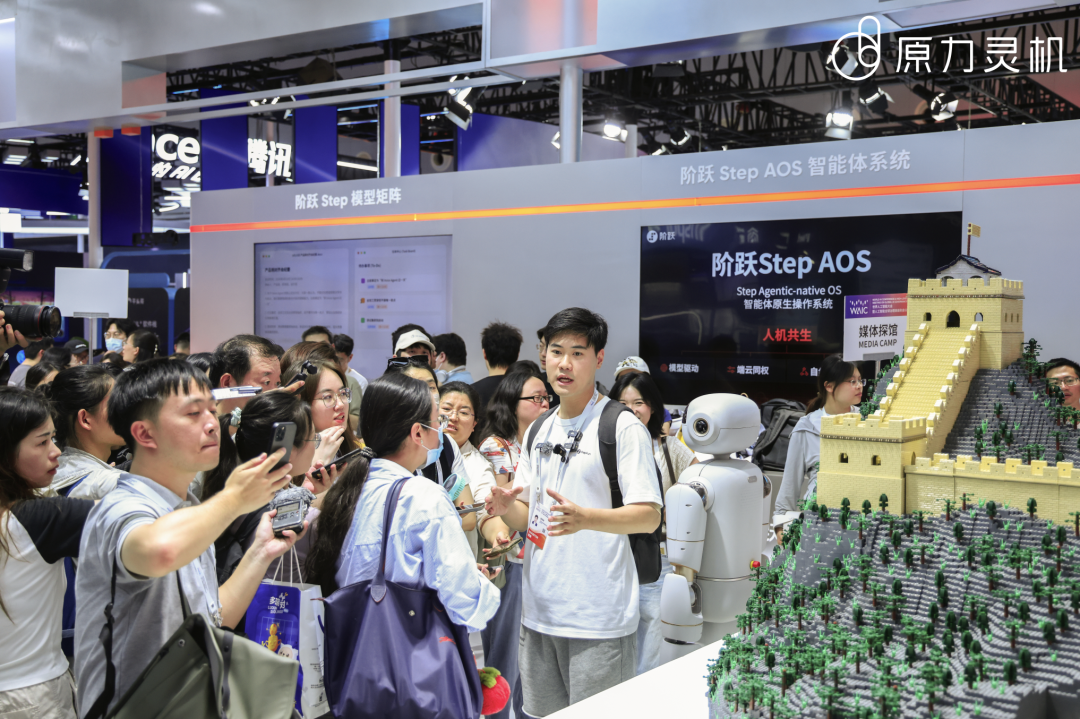
The multi-robot challenge drew a crowd at the WAIC 2026 exhibition.
The hardware used in the challenge included the Dexmal Apex, which the company describes as an embodied-native general-purpose robot. Dexmal says Apex integrates its hardware design with an embodied foundation model to support long-duration operation, fine manipulation, broader task generalization, and safe interaction around people.
The robots were the visible part of the demonstration. The underlying intelligence came from Dexmal’s latest embodied foundation model, DM0.5.
DM0.5 and the Emergence of Generalization
Dexmal introduced DM0.5 at its Action 2026 developer event earlier in July. The model is the successor to DM0 and is designed for open-world robot control rather than a fixed collection of scripted tasks.

DM0.5 is designed to generalize across open-world robotic tasks.
The official DM0.5 technical blog says the model uses a Vision-Language-Action architecture with:
- A Gemma 3 4B vision-language backbone
- A 680M-parameter Action Expert
- Continuous robot-action generation
- Multi-robot and multi-task training
- Up to 60 seconds of historical visual context
The original report describes the model as being trained on approximately 150,000 hours of multi-source data, including real-robot manipulation, first-person human activity, navigation, reconstructed environments, and general vision-language data.
Compared with DM0, the report says the data volume increased by 400% while the parameter count roughly doubled.
The more important change, however, was not simply scale. Dexmal added several mechanisms intended to help the model understand task progress, reason about the physical environment, and learn actions without copying the timing quirks of individual human operators.
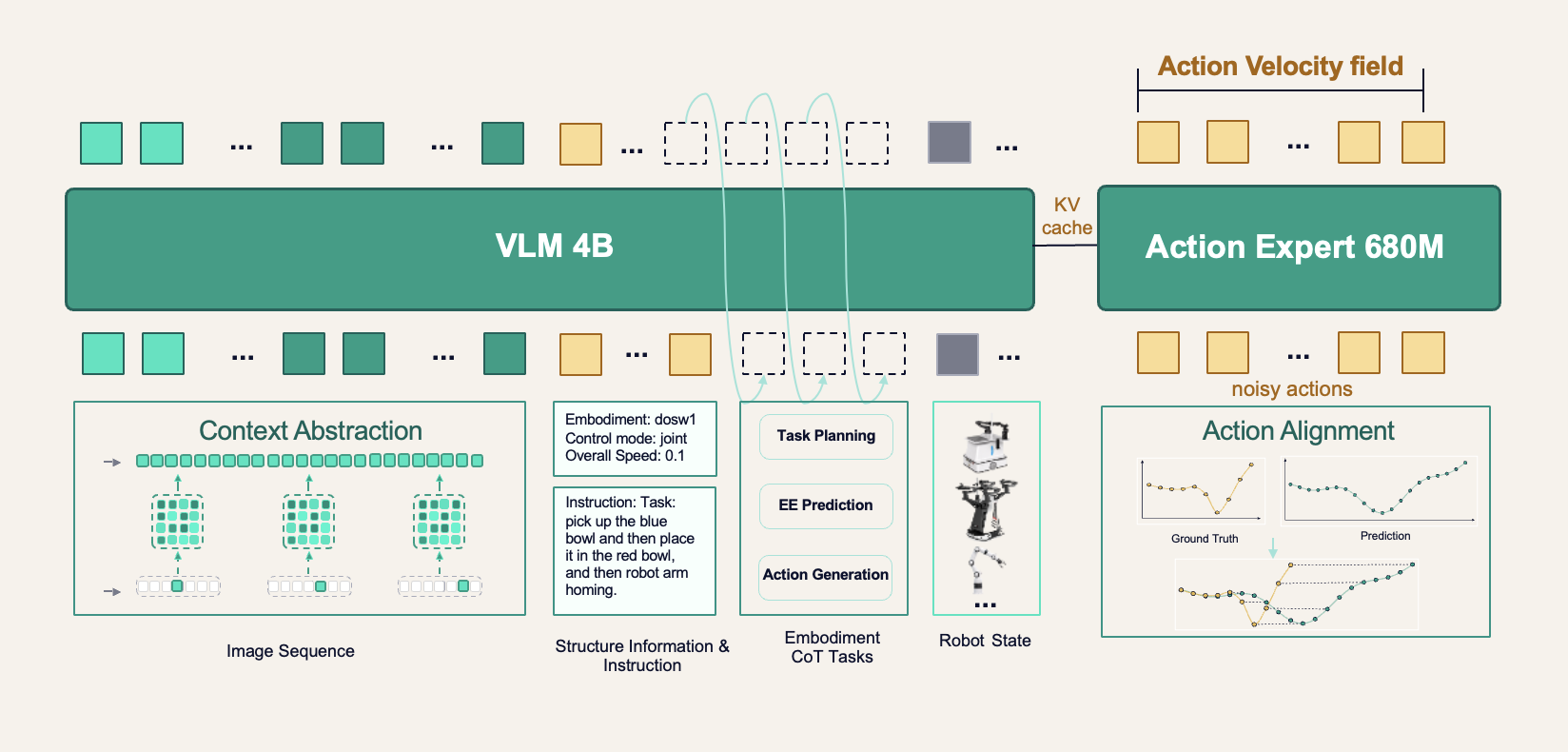
Official DM0.5 architecture showing the VLM backbone, context layer, reasoning tasks, and Action Expert.
Three New Structures That Help the Robot Understand the World
The original article focuses on three architectural additions. Each one addresses a different weakness in long-horizon embodied tasks.
Context Abstraction Layer: Up to 60 Seconds of Memory
Traditional VLA models often make decisions from the current camera frame and the current robot state. That can work for short actions, but it becomes fragile when information needed later in the task is no longer visible.
DM0.5 adds a Context Abstraction Layer that combines the current observation with selected visual information from recent history. According to Dexmal, the model can incorporate up to 60 seconds of task context.
During training, the length and availability of the history are varied. If past information is missing or unhelpful, the model is trained to fall back to the current observation rather than failing completely.
Dexmal explains this with a simple experiment: pick up a cup, wipe the area underneath it, and then return the cup to its original location.
Once the cup is lifted, its starting position disappears from the current frame. A model that only sees the present may place it back in an arbitrary location. A model with historical context can remember where the cup was before it moved.
For the Great Wall task, the same principle matters on a much larger scale. The robots need to understand what has already been assembled, how the local structure has changed, and what part of the process should happen next.
Embodied Chain of Thought: Reasoning While Acting
DM0.5 also adds 11 autoregressive reasoning tasks to robot-data training.
The model is trained to answer constrained questions using the current image, robot state, instruction, and historical context. These questions cover areas such as:
- The current stage of the task
- What has already been completed
- What should happen next
- How the environment is likely to change
- The intention behind the next action
- A semantic description of upcoming movement
This changes the training signal from action prediction alone into a combination of:
- Instruction understanding
- Temporal reasoning
- Environmental prediction
- Action generation
In practical terms, the robot is encouraged to represent why an action is appropriate, not only which motor command follows a particular image.
That is especially relevant to an 81,920-block task. The system cannot treat each placement as an isolated event. It must connect individual movements to the progress of the larger construction.
Trajectory Alignment Layer: Learning the Task, Not the Operator’s Rhythm
Most robot demonstration data is collected through human teleoperation. Different people perform the same task at different speeds, with different pauses and movement styles.
If a model is forced to align every predicted action with a fixed timestamp from the recorded demonstration, it may learn the operator’s rhythm instead of the underlying task.
DM0.5’s Trajectory Alignment Layer aligns actions by task progress rather than exact time.
Each predicted action is matched with an appropriate point in the ground-truth trajectory. The matching must move forward monotonically, so later predicted actions cannot be paired with earlier parts of the demonstration. Dynamic programming is then used to find a low-loss alignment across the full sequence.
This approach is intended to emphasize important physical events such as:
- Grasping
- Alignment
- Contact
- Pressing
- Release
The operator’s personal speed becomes less important, while the meaningful structure of the task becomes clearer.
Dexmal says this improves generalization across different demonstrators and execution speeds.
DM0.5 Results on RoboChallenge Table30 V2
The Great Wall demonstration was an open-ended public test. Dexmal has also evaluated DM0.5 on standardized robot benchmarks.
On RoboChallenge Table30 V2, the company reports:
- 43% overall success rate
- 54.42 comprehensive score
- State-of-the-art overall performance in the published comparison
Table30 V2 contains 30 real-robot manipulation tasks across four robot embodiments. The benchmark includes long-horizon memory, multi-step execution, object localization, precise pick-and-place, tool use, and bimanual coordination.
The dataset and evaluation framework are publicly documented through RoboChallenge and Hugging Face, while the Table30 V2 methodology has also been published through a CVPR 2026 workshop paper.
The results are relevant to the Great Wall challenge because both settings test whether a model can coordinate perception, task progress, fine movement, and physical execution rather than only recognizing objects or generating text instructions.
Practicing in a World Model Before Using the Real Robots
A strong base model alone was not enough for a 15-hour public demonstration.
The original report says Dexmal also used DFOL 2.0 during post-training. The framework incorporates the DW0.5 world model, allowing parts of the task to be practiced and refined in a virtual or model-generated environment before full deployment on physical hardware.
The basic idea is to let the system rehearse expensive actions internally.
Traditional robot development often relies on repeated physical trials:
- Run the robot.
- Observe the failure.
- Collect more data.
- Adjust the model.
- Repeat on the real machine.
This process is slow and costly. Real robots wear down, physical workspaces must be reset, and every failed attempt consumes engineering time.
A world model can move part of that experimentation into simulation or learned prediction. The robot policy can test possible actions, estimate likely outcomes, and improve task execution before using scarce real-machine time.
For a large construction task, this reduces the amount of trial and error that must happen in front of the audience. It also gives the team a way to rehearse sequences, study likely failure points, and reserve the real hardware for final validation.
The source does not provide a public DFOL 2.0 implementation or a detailed breakdown of how much of the Great Wall task was simulated. The description should therefore be understood as Dexmal’s explanation of its post-training process rather than an independently reproduced result.
From Building Blocks to the Hardest Part of Manufacturing
Why use more than 80,000 building blocks?
The blocks create a compact test of several capabilities that matter in flexible manufacturing:
- Sub-millimeter placement
- Repeated precision over long periods
- Handling of visually similar small parts
- Error detection and correction
- Dynamic division of labor
- Coordination across different robot types
- Stable operation in a changing physical environment
Traditional industrial robots are highly effective when a task is repetitive, standardized, and tightly controlled. They are less flexible when the position of an object changes, materials behave differently, or the correct action depends on visual judgment.
The original report argues that a remaining portion of manufacturing work still depends on people because the operations are fine-grained, non-standard, flexible, or perception-heavy. Examples include:
- Precision assembly
- Adjusting soft or fragile materials
- Repairing defects
- Inspecting first production units
- Working in confined spaces
- Handling tasks that vary from one item to the next
The exact claim that this category represents “the final 20%” of manufacturing should be treated as a framing used in the source rather than a universal industry statistic.
Still, the connection is clear. The Great Wall was a display object, but the capabilities under examination—fine manipulation, sustained operation, and multi-robot coordination—are directly relevant to flexible production lines.
How a 16-Month-Old Startup Reached the WAIC Floor
Dexmal was founded in March 2025. The original report says its core team includes former Megvii researchers and engineers, and that the company has received several rounds of investment.
Its stated mission is to build robots that are intelligent, useful, and trustworthy.
Dexmal describes its technical direction as embodied-native development. Instead of adapting a model designed mainly for internet text or images, the company trains models around the needs of robots operating in the physical world.
DM0 was its first embodied-native foundation model. DM0.5 extends that line with longer memory, stronger reasoning, more training data, multi-embodiment support, and improved open-world generalization.
The company has also developed infrastructure around the model.
Dexbotic
Dexbotic is an open-source Vision-Language-Action toolbox based on PyTorch. It provides a unified development environment for training and evaluating several VLA policies.
The framework includes:
- Common data formats
- Model implementations
- Training pipelines
- Inference services
- Support for multiple robot platforms
- Simulation and real-world evaluation tools
Dexbotic is publicly available through its official documentation and GitHub repository.
RoboChallenge
RoboChallenge is a large-scale real-robot evaluation platform co-developed with participation from Hugging Face.
It is designed to make robot-policy testing more reproducible by allowing models to be evaluated on shared physical tasks and hardware configurations.
The platform’s Table30 and Table30 V2 benchmarks cover multiple robot embodiments and practical manipulation tasks. Public datasets, papers, and evaluation resources are available through RoboChallenge and Hugging Face.
Atomix
Dexmal’s commercial application portfolio also includes Atomix, a flexible warehouse automation business.
The original report says Atomix connects storage, transportation, and picking workflows and has worked with large retail, beverage, and food-service customers. These customer and market-ranking claims come from the report and were not independently audited for this publication draft.
Together, DM0.5, Dexbotic, RoboChallenge, and Atomix represent a full-stack strategy:
- Build an embodied foundation model.
- Provide tools for training and deployment.
- Create a real-robot evaluation platform.
- Apply the technology to operational business scenarios.
The Great Wall installation was the most visible public demonstration of that stack at WAIC 2026.
What the Demonstration Actually Shows
A public robot challenge does not prove that general-purpose embodied AI is solved.
It does, however, provide a useful test of several abilities that are often evaluated separately:
- Fine control
- Long-horizon memory
- Error recovery
- Multi-robot collaboration
- Heterogeneous hardware coordination
- Continuous operation
- Real-world perception
- Task-level reasoning
The most important part of the demonstration was not the wall itself. It was the attempt to keep six physical machines working together long enough for small imperfections and coordination problems to become unavoidable.
Dexmal’s official DM0.5 materials end with the idea that the real world should eventually become the robot’s best teacher. In that vision, every attempt, success, failure, and correction becomes new information that helps the system improve.
At WAIC 2026, the robots were assembling miniature bricks. The longer-term goal is to bring the same closed-loop learning and execution process into manufacturing, logistics, service work, and other environments where tasks cannot be fully scripted in advance.
Frequently Asked Questions
How many robots took part in the Great Wall challenge?
Six robots participated: four desktop robots and two wheeled humanoid robots. They worked in the same physical area and handled different parts of the construction process.
How many building blocks were used?
The model used 81,920 miniature building blocks. The structure was approximately 3.5 meters long, 1.5 meters wide, and 1.1 meters high at its tallest point.
How long did the robot challenge last?
The planned continuous working period was 15 hours. The challenge was designed to test whether the robots could maintain precision and coordination over a long sequence of physical actions.
Were the robots remotely controlled?
The original report says the robots were not continuously remotely controlled and did not rely on a completely fixed action script. They used perception, local decision-making, communication, and error correction, although the source does not include a full independent technical audit of the operating setup.
What is DM0.5?
DM0.5 is Dexmal’s open-world Vision-Language-Action foundation model for robot control. It uses a Gemma 3 4B vision-language backbone, a 680M Action Expert, historical context modeling, embodied reasoning tasks, and trajectory alignment.
Is DM0.5 open source?
Dexmal has published the OpenDM repository under the Apache 2.0 license and released DM0.5 model resources through Hugging Face. The repository includes model weights, training and inference scripts, dataset examples, and evaluation workflows.
What is RoboChallenge Table30 V2?
Table30 V2 is a real-robot benchmark containing 30 manipulation tasks across four robot embodiments. It evaluates abilities including long-horizon memory, sequential execution, fine manipulation, tool interaction, and bimanual coordination.
Does the WAIC demonstration prove that robots can replace the remaining manual work in factories?
No. The demonstration shows progress in precision, long-duration operation, and coordination, but it does not establish that all flexible manufacturing tasks are ready for automation. Real production environments require additional safety, reliability, integration, cost, and maintenance validation.
Related Tools
- OpenDM: Dexmal’s open-source repository for DM0.5 model weights, training, inference, and deployment workflows.
- DM0.5 on Hugging Face: The official collection of DM0.5 base and fine-tuned model resources.
- Dexbotic: An open-source PyTorch toolbox for developing and evaluating Vision-Language-Action models.
- Dexbotic Documentation: Official setup, architecture, training, data, inference, and model-development guides.
- RoboChallenge: A real-robot benchmarking platform for evaluating embodied policies.
- Table30 V2 Dataset: The public dataset page for the updated 30-task real-robot benchmark.
Related Links
- Official DM0.5 Technical Blog: Dexmal’s detailed explanation of the model, data, architecture, and benchmark results.
- OpenDM GitHub Repository: The official open-source implementation and deployment documentation.
- DM0.5 Hugging Face Collection: Official model checkpoints and fine-tuned variants.
- RoboChallenge Official Website: The project site for large-scale real-robot evaluation.
- Table30 V2 CVPR 2026 Workshop Paper: The paper describing the updated real-robot benchmark.
- Dexbotic Documentation: Official documentation for the open-source VLA development framework.
- WAIC 2026 Must-See Exhibits: Shanghai’s official overview confirming the six-robot, 15-hour Great Wall exhibit.
Summary
At WAIC 2026, six Dexmal robots worked on a 15-hour challenge to assemble a Great Wall model from 81,920 miniature blocks. The task combined sub-millimeter placement, multi-robot coordination, long-horizon operation, and closed-loop error correction.
The demonstration was powered by DM0.5, Dexmal’s open-world embodied foundation model. Its key additions include up to 60 seconds of historical context, embodied reasoning tasks, and trajectory alignment that reduces the influence of differences in human teleoperation speed.
Dexmal also used world-model-based post-training and connected the demonstration to its broader stack of OpenDM, Dexbotic, RoboChallenge, and warehouse automation products. Several performance and market-position claims remain company-reported rather than independently verified.
The Great Wall was the display, but the real test was whether embodied AI could remain precise, coordinated, and useful for an entire working shift.