ShopX Explained: Model-Native Intent-to-Item Fulfillment for Agentic Shopping
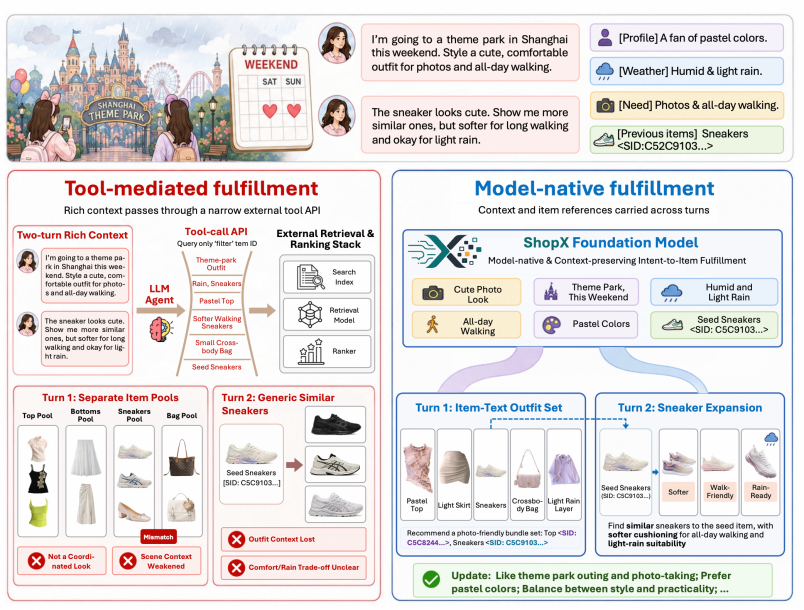
Shopping is moving away from short keyword queries and toward full expressions of intent. Instead of typing "waterproof sneakers," a user may describe an entire situation: > "I'm going to a theme park this weekend. I want an outfit that looks good in photos, stays comfortable after a full day of walking, and can handle light rain." That request contains much more than a product category. It includes a destination, visual preference, weather condition, comfort requirement, and an implied need for
ShopX: A Model-Native Foundation Model for Agentic Shopping
Introduction
Shopping is moving away from short keyword queries and toward full expressions of intent.
Instead of typing "waterproof sneakers," a user may describe an entire situation:
"I'm going to a theme park this weekend. I want an outfit that looks good in photos, stays comfortable after a full day of walking, and can handle light rain."
That request contains much more than a product category. It includes a destination, visual preference, weather condition, comfort requirement, and an implied need for several items that work together.
The difficulty increases in the next turn:
"I like these shoes. Show me similar options, but make them softer."
A useful system must remember which shoes "these" refers to, why the user liked them, and whether the replacement still fits the original theme-park scenario.
Many current AI shopping systems use a large language model to understand the request, then pass a compressed query to an external search and ranking pipeline. In that handoff, a rich request can collapse into a few keywords and filters. The ShopX team describes this problem as interface loss.
ShopX is designed to reduce that loss by giving the model a direct, structured way to work inside the product catalog. Rather than acting only as a conversational layer around search tools, the model can plan, retrieve, rank, compare, bundle, explain, and update state through product-native representations.
Background: Why Tool-Mediated Shopping Loses Context
Traditional e-commerce systems are highly optimized for retrieval and ranking. They work well when the request can be represented as a query, a set of filters, or a category-level target.
Agentic shopping creates a different problem.
The user is no longer asking for one search result. They may be asking the system to:
- Interpret a real-world situation
- Balance several soft constraints
- Remember preferences from earlier turns
- Compare alternatives
- Assemble complementary items
- Adjust only part of an existing recommendation
- Explain why the final set fits the request
A tool-mediated pipeline typically separates this process into multiple stages:
- The language model interprets the request.
- It rewrites the intent as a search query.
- A retrieval service produces candidates.
- A ranking system orders the candidates.
- The model converts the results into a conversational response.
Each stage can be strong on its own, but the interfaces between them are narrow. A nuanced trade-off such as "comfortable enough for all-day walking, but still visually distinctive" may not survive as a conventional filter. A relationship such as "similar to the previous shoe, but softer" may be reduced to generic similarity.
The problem becomes more visible over multiple turns. If each turn
Starting a new search may cause the system to lose previously accepted products, the original scenario constraints, or the reasoning behind the user’s feedback.
ShopX starts from a different assumption: the model should operate directly within a structured product space, rather than continuously translating its understanding into external search commands.
ShopX: A Model-Native Fulfillment Framework
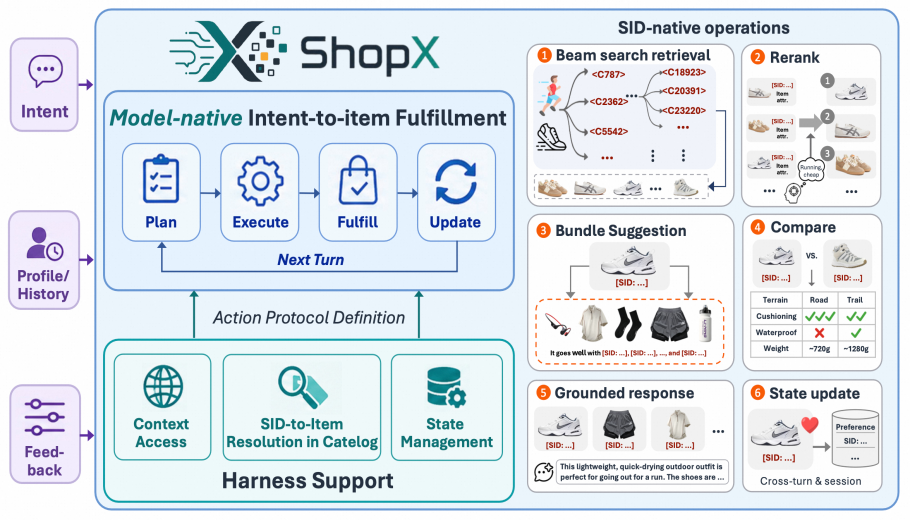
ShopX combines a central foundation model with a lightweight serving harness.
The model follows a four-step interaction loop:
- Plan — interpret the user’s intent and determine which product-space operations are needed.
- Execute — perform retrieval, ranking, comparison, expansion, or bundling operations.
- Fulfill — return grounded products along with a natural-language response.
- Update — store new states, accepted items, and preference changes for the next turn.
The serving harness exposes three core support surfaces:
- Context access for user profiles, history, and relevant behavioral signals
- Catalog grounding for mapping Semantic IDs back to real products
- State management for preserving choices and constraints across turns
Three Fulfillment Modes
The framework supports three broad shopping patterns.
Intent-to-Item Fulfillment
For a clear shopping request, ShopX translates the full intent directly into a grounded set of products.
This may involve more than retrieving a single category. A request for a complete cycling setup could require helmets, gloves, and other complementary products in one coordinated result.
Context-Augmented Personalization
When the request is vague, the model uses profile and behavioral context to infer what matters.
For example, “Find something suitable for my commute” may require clues about weather, travel method, preferred style, prior purchases, and price sensitivity.
Stateful Multi-Turn Fulfillment
When the user modifies a previous recommendation, ShopX updates the active shopping state rather than discarding the entire plan.
This allows the system to preserve accepted products and earlier constraints while changing only the part affected by new feedback.
Product-Space Operations
ShopX is not limited to producing a sequence of product IDs. The paper describes a broader set of operations:
- Semantic-ID beam-search retrieval
- Listwise ranking
- Seed-product expansion
- Similar and substitute-item retrieval
- Complementary product bundling
- Cross-category outfit or equipment composition
- Product comparison
- Interleaved text and product responses
- Clarification questions
- Preference and state updates
The goal is to make the model responsible for the complete path from user intent to a usable, catalog-grounded outcome.
Semantic IDs: Teaching the Model a Product Language
A central part of ShopX is the **Semantic
ID**, or SID.
A normal database identifier carries little meaning. It tells the system which record to retrieve, but the identifier itself does not reveal whether the item is a running shoe, a pastel jacket, a waterproof bag, or a bicycle helmet.
ShopX adds structured product tokens to the model’s vocabulary. These tokens are designed around two requirements:
- Recoverability: the SID should preserve enough information to infer useful product semantics such as category, attributes, and style.
- Operability: the representation should work naturally with autoregressive generation, allowing the model to retrieve and manipulate products through token sequences.
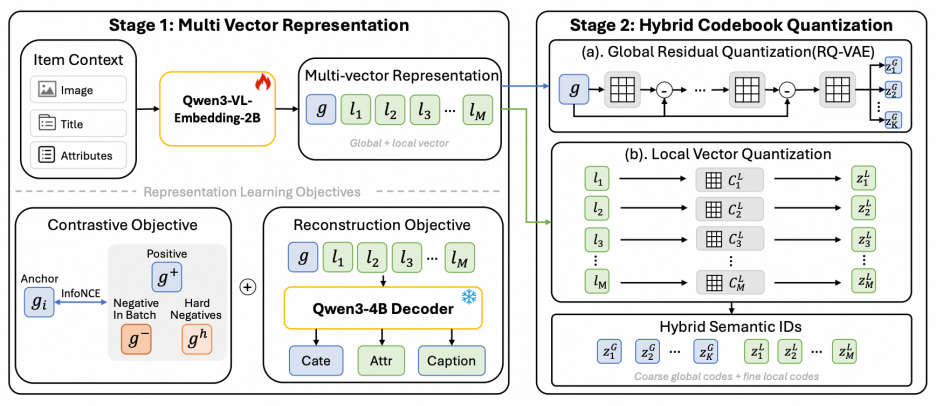
Stage 1: Multimodal Product Representation
ShopX uses Qwen3-VL-Embedding-2B to encode product information from multiple sources:
- Product images
- Titles
- Structured attributes
The representation contains:
- A global vector for coarse routing and high-level identity
- Several local vectors for fine-grained properties
Training combines equivalent-product supervision with a softened InfoNCE contrastive objective. The system also uses reconstruction signals so that the learned representation remains connected to category, attribute, and description information.
Stage 2: Hybrid Codebook Quantization
The final SID combines global and local codes:
- A two-level global prefix based on residual quantization provides stable routing.
- A four-level local suffix adds more detailed semantic distinctions.
- Each codebook contains 8,192 entries.
- The model vocabulary gains roughly 50,000 new SID tokens.
The hybrid design improves product discrimination.
| SID design metric | Global-only approach | Global + local approach |
|---|---|---|
| Average products attached to one SID | 126.5 | 13.8 |
| SID-to-description ROUGE | 25.5 | 31.5 |
Reducing the average number of products mapped to the same SID makes the representation more precise. At the same time, the improvement in description recovery suggests that the codes retain more interpretable product information.
This is important because ShopX needs SIDs to serve as more than retrieval keys. The model must reason over them, compare them, generate bundles, and connect them back to user language.
Four-Stage Training: More Than SID Prediction
The base models are Qwen3-4B and Qwen3-8B.
Training ShopX is not simply a matter of teaching Qwen3 to emit new product tokens. If the process focuses too heavily on SIDs, the model may improve at finding products while losing conversation quality, instruction following, profile extraction, ranking, or explanation ability.
The training recipe therefore proceeds in four stages.

The post-training stage also consists of two steps: the third step involves SFT fulfillment and Expert SFT training, and the fourth step is multi-teacher OPD+RL joint optimization, combining teacher preferences, rule rewards, and student updates to ultimately generate the e-commerce foundation model. This process is the core solution for the ShopX model training, corresponding to the four-stage training pipeline mentioned in the document.](https://we0-cms.oss-cn-beijing.aliyuncs.com/cms-assets/image/2026/07/72350678-1e95-4d9e-962e-648d5123ef7c-09c27f2c-4855-412d-b3d4-7f241540c536.png)
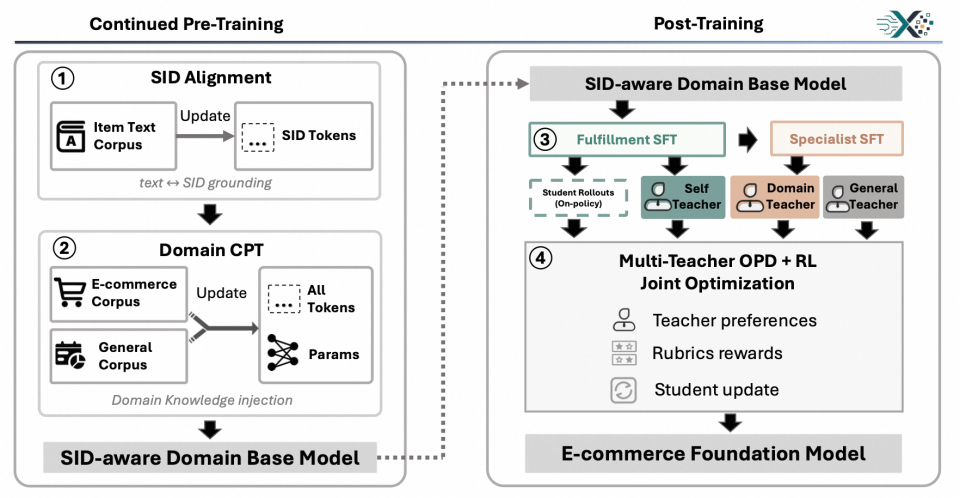
Stage 1: SID Alignment
The original model is frozen while the newly added SID embeddings are trained.
This stage establishes a two-way relationship between product text and product codes. The model learns to connect descriptions with SIDs before broader domain training begins.
The paper’s ablation study indicates that this alignment is a necessary preparation step. Skipping it weakens later continued pre-training.
Stage 2: Domain Continued Pre-Training
The next stage injects e-commerce knowledge, including:
- Catalog-to-SID relationships
- Intent-to-item mappings
- Behavior-to-item signals
- User preference understanding
- Product attributes and relationships
General-domain data is mixed into the training set to reduce catastrophic forgetting. The reported ratio is approximately 2:1 for domain data to general data, with around 114 billion tokens in total.
Stage 3: Instruction Fine-Tuning
Instruction fine-tuning converts domain knowledge into usable shopping and agent behavior.
The dataset is approximately:
- 75% general instruction data, covering instruction following, multi-turn dialogue, tool use, mathematics, and coding
- 25% e-commerce data, covering native SID fulfillment, context understanding, and shopping conversations
The high share of general data is intentional. ShopX must remain a capable language model rather than becoming a narrow product-token generator.
Stage 4: Multi-Teacher Online Distillation and Reinforcement Learning
The final stage addresses a problem the team calls the seesaw effect.
Optimizing only for SID accuracy can improve retrieval while damaging other abilities. In the reported ablation, profile extraction and ranking fell to zero after SID-only fine-tuning.
To avoid this, training samples are routed into five task families. Each family uses a different combination of teacher models and reward signals. The system jointly improves product fulfillment, dialogue, profile understanding, ranking, and explanation without forcing every capability through one reward.
The ablation results show that introducing multiple teachers and rewards can restore and improve the different dimensions without causing the same level of interference.
Experimental Results
ShopX is evaluated against three tool-mediated agent systems:
- Chat-REC
- RecMind
- InteRecAgent
All three baselines use Qwen3-8B together with Taobao’s production search service. This is an important detail: the baselines are not connected to a weak or experimental retrieval backend. They use a mature search and ranking system developed for a marketplace serving a very large user base.
Evaluation Data
The framework-level evaluation uses anonymized Taobao logs:
| Evaluation set | Number of examples |
|---|---|
| Single-turn shopping requests | 279 |
| Multi-turn shopping conversations | 80 |
The evaluation uses rubric-based LLM judging across
eight dimensions. Five of the most discriminative metrics are:
- Intent Fulfillment: whether the request is converted into a satisfactory product outcome
- Item Precision: whether the products match the requested categories
- Constraint Grounding: whether explicit requirements are followed
- Feedback Adaptation: whether later feedback changes the result without losing accepted preferences
- Cross-Turn Reference: whether references to earlier products are resolved correctly
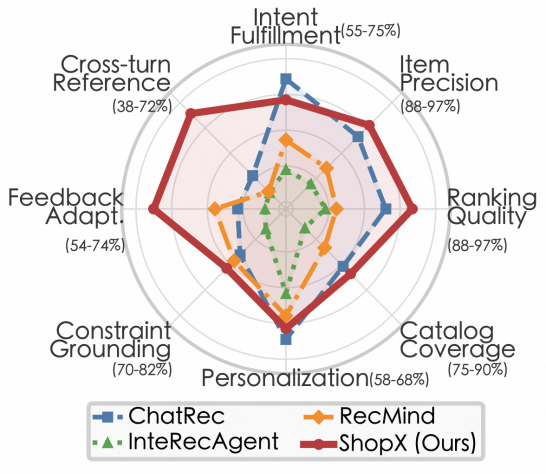
Key Framework Results
| System | Intent Fulfillment | Item Precision | Constraint Grounding | Feedback Adaptation | Cross-Turn Reference |
|---|---|---|---|---|---|
| ShopX-8B | 69.2 | 95.0 | 76.4 | 71.5 | 68.3 |
| Chat-REC | 72.2 | 94.0 | 74.8 | 59.8 | 47.5 |
| RecMind | 63.6 | 91.2 | 75.6 | 62.9 | 42.1 |
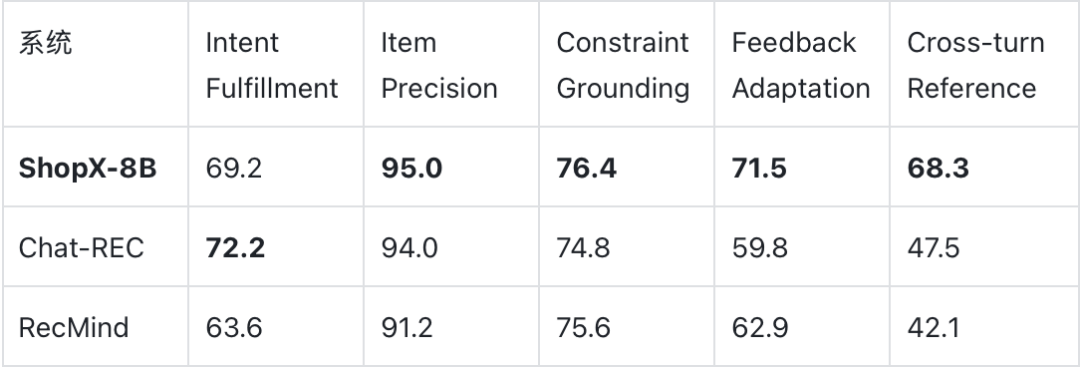
ShopX is slightly behind Chat-REC on single-turn Intent Fulfillment: 69.2 versus 72.2. This shows that a tool-mediated agent with a strong production search backend remains competitive on direct requests.
The larger advantage appears in stateful interaction:
- Feedback Adaptation is 11.7 points higher than Chat-REC.
- Cross-Turn Reference is 20.8 points higher than Chat-REC.
These are precisely the scenarios in which interface loss tends to accumulate. When the user adds feedback, refers to earlier products, or keeps several soft constraints active, model-native fulfillment preserves more of the original shopping state.
Capability-Level Analysis
Compared with the Qwen3-8B base model, ShopX improves several shopping-specific abilities.
| Capability | Qwen3-8B | ShopX | Change |
|---|---|---|---|
| Product relationship reasoning | 28.3 | 49.7 | +21.4 |
| Behavioral-sequence evidence extraction | 16.1 | 52.7 | +36.6 |
| Profile evidence extraction | 52.9 | 76.9 | +24.0 |
| Product-description recovery from SID | 10.1 | 33.2 | +23.1 |
The model also retains or improves several general capabilities:
| Benchmark | ShopX score | Change from Qwen3-8B |
|---|---|---|
| BBH | 74.1 | +0.9 |
| CMMLU | 75.8 | +1.6 |
| GSM8K | 88.6 | +0.4 |
| MBPP+ | 83.1 | +8.0 |
Some difficult general benchmarks decline:
| Benchmark | ShopX score | Change from Qwen3-8B |
|---|---|---|
| IFEval | 78.4 | -3.5 |
| MMLU-Pro | 59.3 | -3.6 |
| MATH-500 | 59.6 | -16.6 |
| GPQA-Diamond | 41.4 | -6.1 |
The results suggest that domain specialization is not free. ShopX gains large improvements in product understanding and evidence extraction while giving up some performance in difficult mathematical, scientific, and instruction-heavy tasks.
For a shopping model, this may be an acceptable trade-off, but it remains an important deployment consideration.
Case Analysis
The source report includes side-by-side examples comparing ShopX with a tool-mediated baseline.
Case 1: Single-Turn Bundle Fulfillment
The user asks for both a women’s cycling helmet and riding gloves.
A conventional agent may focus on the dominant product category and retrieve several helmets while covering gloves poorly. Each search result can be individually relevant, yet the complete shopping request remains only partially fulfilled.
ShopX plans across both categories, retrieves products for each, and returns a coordinated bundle in one turn.
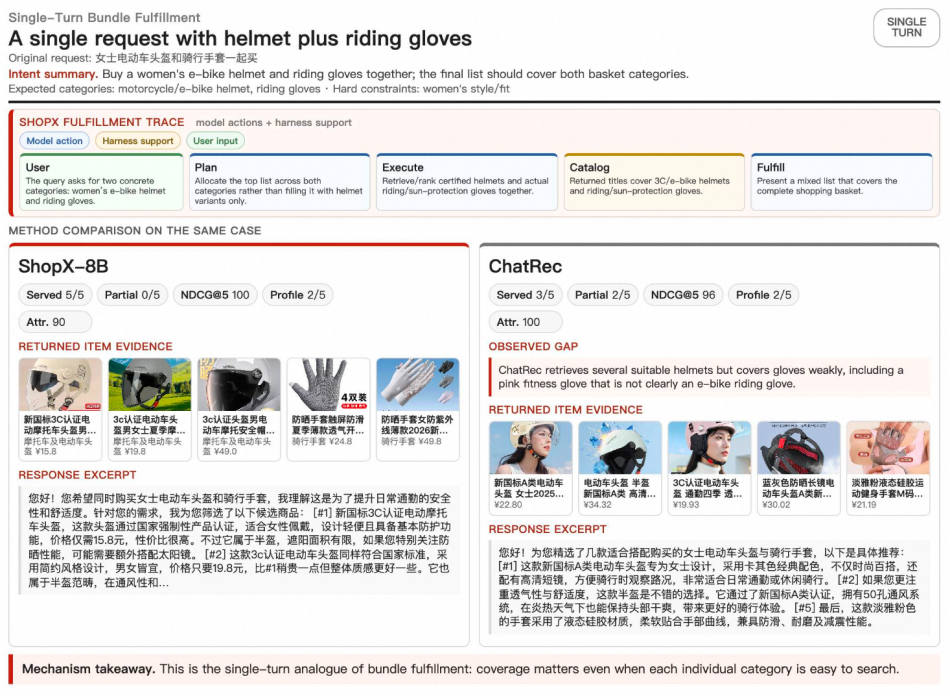
The case demonstrates an important distinction:
- Item relevance asks whether each product is individually suitable.
- Intent fulfillment asks whether the full set solves the user’s shopping task.
A list of excellent helmets does not satisfy a request for a helmet-and-glove bundle.
Case 2: Stateful Multi-Turn Shopping
In the second case, the user is looking for decorative items for a car interior.
Across several turns, the user adds style preferences and asks for changes based on earlier recommendations. A tool-mediated agent repeatedly interprets the newest request as a fresh search, eventually drifting away from the original car-interior context.
ShopX maintains the active state. It keeps the previously established scene and accepted preferences, then updates the recommendation in response to new feedback.
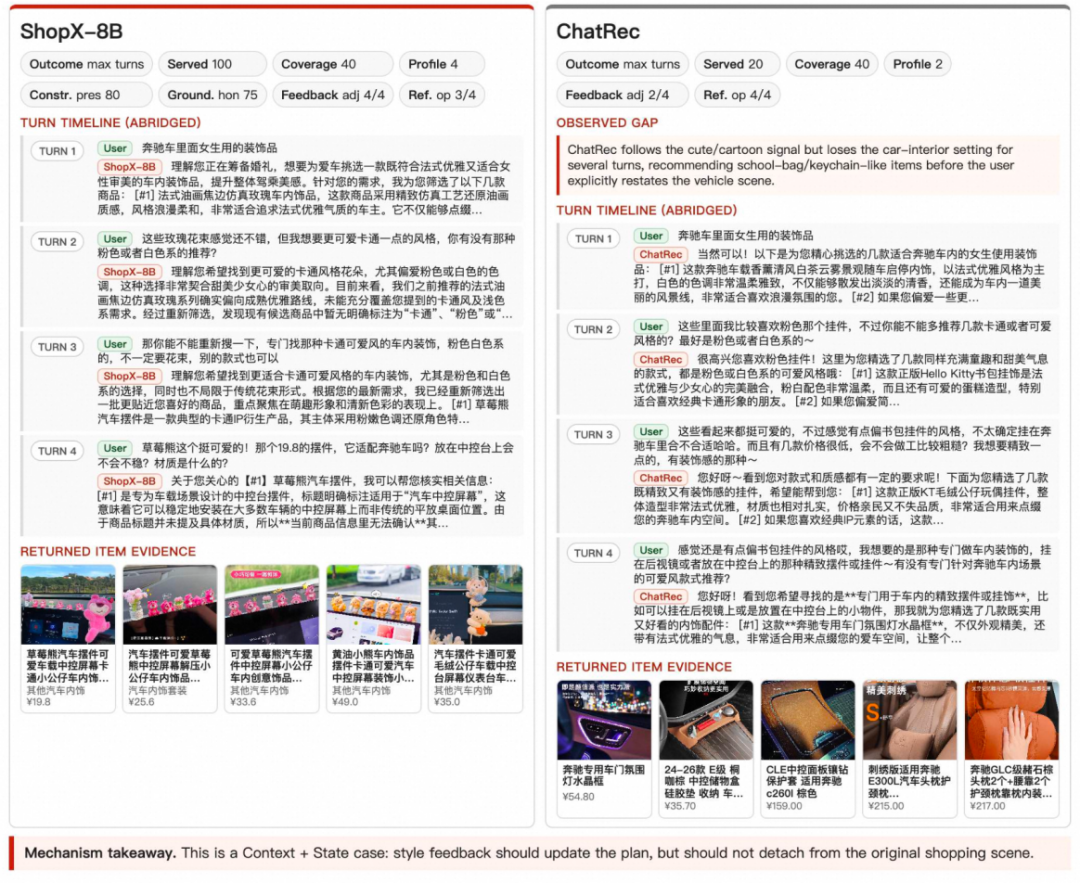
The goal is not to repeat the same products forever. It is to distinguish between constraints that should remain stable and details that the user has explicitly changed.
Why ShopX Matters for Agentic Commerce
ShopX reflects a broader shift in AI commerce.
The first generation of shopping assistants mostly added natural-language interfaces to existing search systems. The language model explained, summarized, and called tools, while the core retrieval logic remained outside the model.
ShopX moves
将更多履约流程融入模型本身。
这种设计有几个潜在优势:
- 丰富的意图无需被压缩成单个查询。
- 产品关系可以作为规划的一部分来处理。
- 可以跨品类生成组合推荐。
- 用户反馈可以更新持久化状态。
- 可以直接引用早期的推荐结果。
- 通过SID映射,响应仍然基于真实商品目录。
这也带来了新的工程要求。
一个生产系统仍然需要:
- 可靠的目录同步
- 库存和可用性检查
- 价格实时更新
- 策略和安全控制
- 针对真实用户结果的评估
- 保护用户画像和行为数据
- 监控错误的产品落地情况
- 明确区分推荐与交易权限
ShopX解决了从意图到商品的问题。它本身并不处理支付、结算、物流、退货、商家信用或代理电商的其他各个层面。
团队与研究背景
该研究来自多个团队的合作,包括淘宝和天猫的AI搜索组织、推荐与内容理解团队、阿里巴巴Token Foundry以及ROLL强化学习团队。
他们的更广泛研究领域包括:
- AI搜索与代理购物
- 自然语言意图理解
- 多轮澄清与履约
- 生成式推荐
- 产品的语义ID与多模态内容
- 多模态表征学习
- 面向购物代理的大规模强化学习
该论文于2026年6月30日提交至arXiv,标题为**“ShopX:面向代理购物的意图到商品履约的基础模型。”**
常见问题
什么是ShopX?
ShopX是一个电商基础模型,专为模型原生的意图到商品履约而设计。它将意图理解、规划、产品检索、排序、组合推荐、比较以及多轮状态更新整合在一个购物框架内。
AI购物中的接口损失是什么?
当一个详细自然语言购物请求被压缩成有限的查询、筛选条件或工具调用时,就会发生接口损失。软约束、产品关系、早期偏好以及场景上下文可能在交接过程中被削弱或丢失。
ShopX中的语义ID是什么?
语义ID是一个结构化的令牌序列,代表语言模型词汇表中的产品。ShopX设计的SID能够保留有用的产品语义,同时适用于自回归生成和产品空间操作。
ShopX使用哪个基础模型?
论文描述了基于Qwen3-4B和Qwen3-8B的ShopX变体。Qwen3提供了适应电商履约的通用语言、推理、对话和代理能力。
ShopX比传统的基于搜索的购物代理更好吗?
这取决于任务。在单轮意图履约上,Chat-REC略优于ShopX,但在反馈适应和跨轮产品引用方面,ShopX表现更好。它的最强优势体现在复杂、有状态的对话中。
ShopX能否推荐多个产品类别
together?
Yes. The framework supports bundle suggestion and cross-category composition. The paper includes an example in which the model fulfills a request for both a cycling helmet and riding gloves in one turn.
Is the ShopX model or source code publicly available?
The research paper is publicly available on arXiv. The reviewed official sources do not provide a public ShopX model checkpoint or a dedicated ShopX source-code repository, so no download link is included here.
Does ShopX complete purchases?
The paper focuses on intent-to-item fulfillment: planning, retrieving, ranking, composing, and grounding product recommendations. Payment, checkout, logistics, and after-sales execution are separate system layers.
Related Tools
- Qwen3: The open-weight foundation-model family used as the base for the ShopX 4B and 8B variants.
- Qwen3-VL-Embedding-2B: The multimodal embedding model used to encode product images, titles, and attributes.
- Qwen3-VL-Embedding GitHub: Official code and usage examples for the Qwen multimodal embedding and reranking models.
- ROLL: Alibaba’s reinforcement-learning framework for large language models and multi-turn agentic training.
- Qwen Chat: The official interface for exploring the broader Qwen model family.
Related Links
- ShopX Paper on arXiv: The official paper abstract, authors, submission history, and PDF access.
- ShopX Paper PDF: The complete technical paper with architecture, training, evaluation, and case studies.
- ShopX DOI: The persistent DOI record for the paper.
- Qwen3 Technical Overview: Official introduction to the Qwen3 model family used as ShopX’s base.
- Qwen3 GitHub Repository: Official model information, weights, and deployment resources.
- Qwen3-VL-Embedding-2B Model Card: Official specifications and examples for the product-encoding model.
- ROLL GitHub Repository: Official reinforcement-learning infrastructure from Alibaba.
Summary
ShopX is designed to close the gap between what a language model understands and what an e-commerce system can actually fulfill. It gives the model a product-native language through Semantic IDs and combines planning, retrieval, ranking, bundling, grounding, and state updates in one framework.
The evaluation shows that strong tool-mediated systems remain competitive for direct single-turn requests. ShopX’s clearer advantage appears when the shopping process becomes conversational: users provide feedback, refer to earlier products, and expect the original scenario to remain active.
Its results also show the cost of specialization. Shopping-specific abilities improve substantially, while some difficult general reasoning and mathematics benchmarks decline.
**ShopX’s central
Contribution is not simply better product search; it is a model architecture that treats shopping as a continuous intent-to-item fulfillment process.