Shopify's AI Push Is Already Driving Growth — Should Businesses Use We0.ai to Treat “AI Referral Traffic” as a Separate Acquisition Channel?
Shopify's latest signals are clear: AI referral traffic is no longer just a concept — it's delivering real growth with higher intent and higher conversion. Drawing on Shopify's official data, this article examines whether businesses should treat AI referral traffic as a standalone customer acquisition channel, and why We0.ai is better suited to capture this new wave of traffic.
Shopify's AI Integration Is Already Driving Growth—Should Businesses Use We0.ai to Treat "AI Referral Traffic" as a Dedicated Acquisition Channel?
Let's start with the conclusion.
Yes. At minimum, you should start treating it as an "independent channel that's growing"—observe it, plan around it, and build capacity to capture it.
Not because the word AI is trendy.
But because Shopify has put a critical signal on the table: AI referral traffic isn't just bringing traffic anymore—it's bringing stronger conversion quality.
Many businesses are still stuck on an outdated question:
"Will AI affect SEO?"
But the more worthwhile question is:
If AI is already filtering, comparing, and recommending on behalf of users, shouldn't businesses treat "being recommended by AI" as a new acquisition action in itself?
At that point, the question is no longer just about building a site, publishing some content, or doing a bit of SEO.
It's about whether you need a more complete capture system that unifies SEO, GEO, content structure, brand signals, page experience, and lead conversion.
This is also why We0.ai deserves more discussion. It doesn't just help you generate web pages—it turns your showcase site into a sustainable growth and acquisition asset.
Why Does This Demand Serious Attention Now?
Shopify's official Q1 2026 data highlighted several hard numbers:
- Orders from AI referrals grew nearly 13× year-over-year
- Sessions from AI referrals grew more than 8× year-over-year
- Conversion rate of AI referral traffic is nearly 50% higher than organic search
- Average order value from AI referral orders is 14% higher than organic search
- More than half of AI referral visits start directly on product pages, compared to roughly 20% for organic search
When you put these numbers together, the message is unmistakable:
AI referral traffic is not "earlier-stage SEO traffic"—it's "later-funnel, higher-intent, closer-to-purchase" traffic.
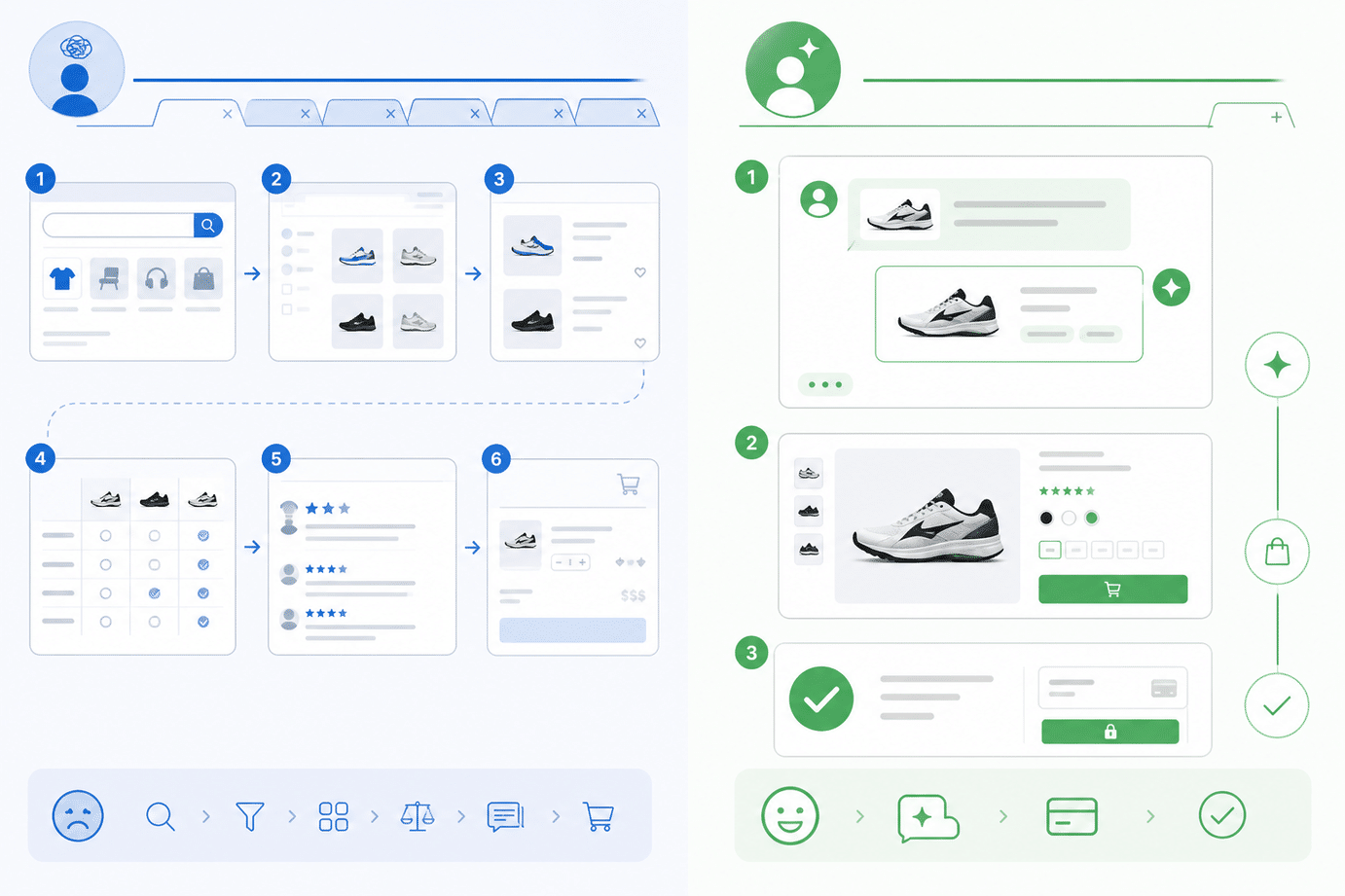
In other words, AI is compressing the user's research journey.
Before, a user might search 5 times, open a dozen tabs, bookmark a few competitors, and come back days later to buy.
Now, the user might ask ChatGPT, Gemini, Copilot, or Perplexity one round of questions, and AI directly pushes the better option to them. When they click through, they're no longer in "just browsing" mode.
This isn't ordinary exposure—this is "arrival after pre-filtering."
What's the Real Difference from Traditional SEO?
Many teams easily misjudge this, assuming AI referral traffic is just a new name for SEO.
It's not.
| Dimension | Traditional SEO / Search Traffic | AI Referral Traffic |
|---|---|---|
| User entry point | Search results page | AI conversation / AI shopping assistant / recommended answers |
| User state | Researching, comparing | Decision path already compressed, higher intent |
| First landing page | Homepage, category pages, content pages more common | Product pages, solution pages, comparison pages more common |
| Decision basis | Keyword ranking, page matching | Structured information, semantic matching, cross-web brand signals |
| Core goal | Being found in search | Being selected and recommended by AI |
| Operating logic | Focus on rankings | Focus on being "understandable, citable, trustworthy, convertible" |
So you'll notice: SEO hasn't disappeared, but the evaluation mechanism has started to change.
It used to be "how do I push my page to the front."
Now it's more like "how do I make AI believe I'm the answer that should be recommended."
Why Should Businesses Treat This as a Separate Acquisition Channel?
1. Because the Traffic Quality Is Already Different from Ordinary Organic Traffic
It's not about more traffic.
High-intent traffic is often worth far more than broad traffic.
Shopify's data has already shown that AI traffic converts better and carries higher order values. This means even if the scale isn't yet comparable to traditional search, businesses should start tracking it as a separate channel early.
If you're still lumping this traffic into referral, organic, or direct, you're essentially blind to it.
2. Because the Optimization Approach Is No Longer Just "Publishing Content"
Getting AI recommendations isn't about writing one article or stacking a few keywords.
You need to nail all of these at once:
- Clear website architecture
- Clear page semantics
- Specific product/service messaging
- Complete FAQ, comparison, and case study pages
- Sufficient brand mentions and trust signals across the web
- Pages that can handle "users who are already close to a decision"
This is a growth system, not a single tactic.
3. Because the Earlier You Start, the Bigger the Compounding Returns
Shopify repeatedly emphasizes a historical pattern in its report:
In the early days of a new channel, early entrants tend to reap the compounding benefits first.
That's how mobile played out. That's how social traffic played out. AI referral traffic will most likely follow the same path.
By the time everyone realizes they need to act, the question won't be "should I do this?"—it'll be "why is the competition already being recommended while I'm still invisible?"
So Should Businesses Use We0.ai to Do This?
My assessment:
If your goal isn't just to build a good-looking website, but to build a site that gets searched, understood by AI, recommended, and converted—then yes, you should.
Because We0.ai's value isn't about "generating a page faster."
It's about being better suited for capturing this new kind of traffic.
4 Reasons We0.ai Is Better Suited for Capturing AI Referral Traffic
1. It Delivers a "Showcase Site Growth System," Not a One-Off Site Builder
When AI referral traffic arrives, users typically don't visit your company intro first.
They're more likely to land directly on:
- Product pages
- Service pages
- Solution pages
- Comparison pages
- Industry scenario pages
- Case study pages
This means a business can't just have one homepage.
You need a complete displayable, explainable, convertible content structure.
We0.ai leans toward:
Build → Showcase → Grow → Leads
In other words:
Building the site isn't the finish line—getting continuous traffic, capturing intent, and converting into leads is what matters.
2. It's Better Suited for Doing SEO and GEO Together
If you're building a website today and only focusing on SEO, that's no longer enough.
Because AI recommendations increasingly depend on:
- Crawlable structured content
- Clear entity expressions
- Citable modules like FAQ, reviews, comparisons, case studies
- Consistent brand expression across the web
This is essentially GEO (Generative Engine Optimization).
**We0.
What AI is better suited for is not "publishing an article and hoping for the best," but rather orchestrating both on-site content and off-site growth together.**
3. It's better suited for small and mid-sized teams and growth teams that need to iterate quickly and continuously
Many companies aren't unwilling to do this — they simply can't.
Common problems include:
- The website-building team and the content team are separate
- SEO and product pages aren't continuously optimized
- The corporate website goes live and then stops being updated
- There's traffic, but no proper landing pages to capture it
We0.ai solves this problem of "no one taking ownership long-term."
It's not about delivering a website in one shot — it's more like a combination of an AI website builder + a growth team for your showcase site.
4. It's better suited for turning "content assets" into "customer acquisition assets"
AI recommendations don't just look at whether you have a page.
It evaluates whether you're a source worth citing, recommending, and trusting.
So what really matters is:
Can your website continuously accumulate content, structure, case studies, brand mentions, and opportunities to be referenced?
This is exactly where We0.ai should come in.
What can companies do right now? A very practical action checklist
First, treat AI referral traffic as a separate channel
Stop lumping it into your overall metrics.
At the very least, start tracking:
- Visits coming from ChatGPT / Gemini / Copilot / Claude / Perplexity
- The landing pages that AI-referred traffic hits
- Conversion rates, time on page, form submission rates, and lead quality from this traffic
- Which pages are more likely to be referenced by AI
You can only optimize what you can see.
Second, rework "pages that get recommended" instead of just polishing the "brand homepage"
The point isn't how beautiful your homepage is.
It's whether these pages are strong enough:
- Product pages
- Solution pages
- Use-case pages
- Industry comparison pages
- FAQ pages
- Case study pages
AI prefers to send users to a specific answer, not to a vague homepage.
Third, write content as "citable modules"
In the future, the most valuable content won't just be long-form articles.
It will be things like:
- Definitional explanations
- Comparison tables
- Buying/selection guides
- FAQs
- Reviews and case studies
- Key specs and structured information
Because this type of content is easier for AI to extract, summarize, cite, and recommend.
Fourth, treat off-site brand signals as part of on-site optimization
Shopify has noted that AI doesn't just look at your own website — it looks at signals across the entire web.
So Reddit, media reviews, community discussions, user reviews, and third-party comparison content all influence whether you get recommended.
On-site and off-site should be done together.
Fifth, use We0.ai for ongoing operations, not a one-time launch
The biggest mistake here is "doing it all at once."
Because AI recommendation mechanisms, search entry points, and the way users ask questions will keep evolving.
What companies really need is:
- Continuously adding new pages
- Continuously optimizing page structure
- Continuously updating content
- Continuously adding case studies and FAQs
- Continuously monitoring which pages are getting AI referral traffic
- Continuously reviewing and refining conversions
This isn't a design project. This is a growth project.
A more direct way to tell
If your business relies on your website for customer acquisition — especially if you fall into these categories:
- SaaS / AI product teams
- B2B service companies
- Consultants / Agencies
- Foreign trade and cross-border teams
- Brands with products that need clear explanation
Then you should start doing this right now.
Not because AI will replace search tomorrow.
But because AI is already rewriting the user decision path — before search, during search, and after search.
And corporate websites are evolving from "information pages" to "asset layers that AI calls upon and recommends."
Key conclusions
AI referral traffic deserves to be operated as a standalone customer acquisition channel.
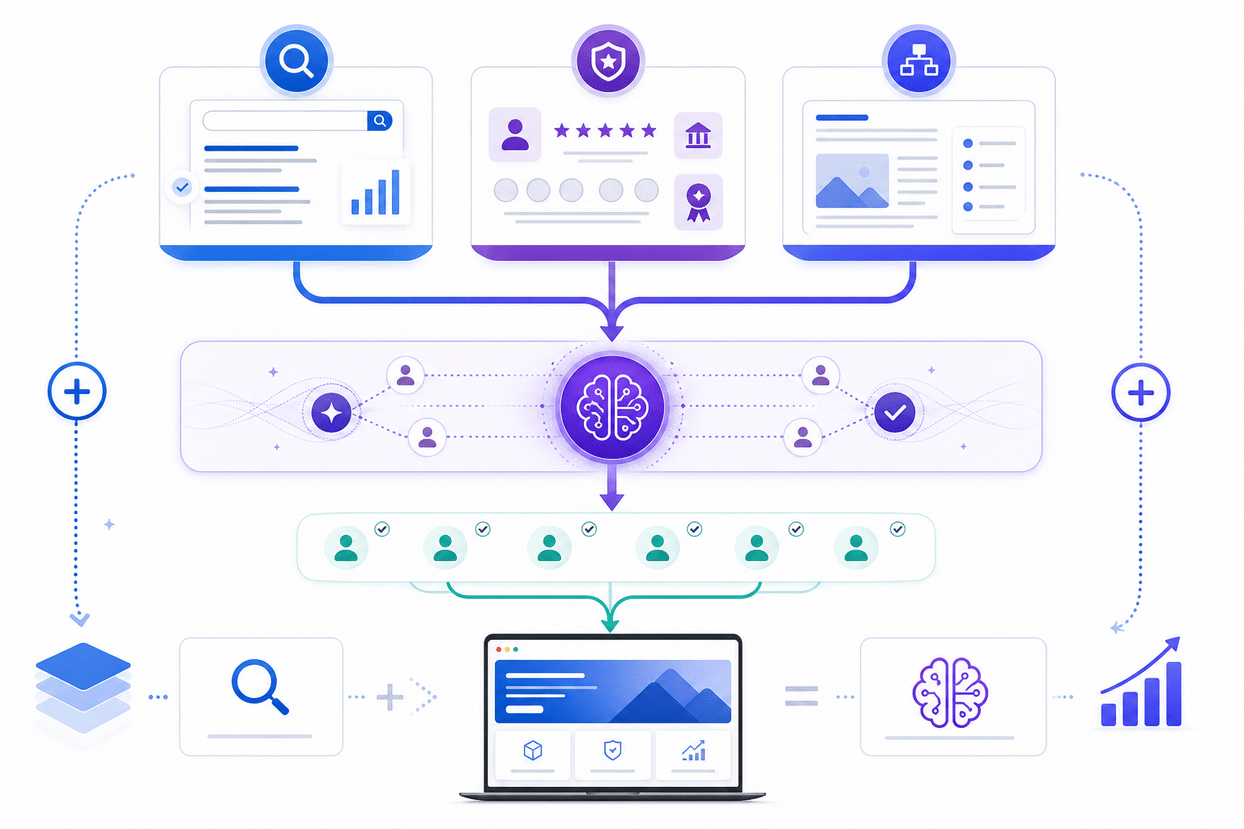
It's not a replacement for SEO — it's a new traffic layer created by the combined effect of SEO, GEO, brand signals, and page conversion.
If companies don't yet have a website growth system that can continuously build pages, publish content, optimize structure, and capture leads, they risk missing this compounding opportunity.
And We0.ai is more about building that system — not just generating webpages.
FAQ
Are AI referral traffic and SEO traffic the same thing?
No. SEO emphasizes being discovered and ranked by search engines; AI referral traffic emphasizes being understood, cited, and filtered by AI, then recommended directly to users. The two are related, but they're not the same operational activity.
Should companies build a separate strategy for AI referral traffic right now?
Yes. At the very least, you should set up monitoring, page capture, and content structure optimization. The earlier you start, the easier it is to build compounding returns on this new entry point.
What type of company is best suited to start this first?
Companies whose websites carry the responsibility for customer acquisition, that need to explain their products and services, and that rely on content to educate the market — especially SaaS, B2B, foreign trade, consulting, and professional service firms.
What is We0.ai's most core role in all of this?
It's not just about building a website — it's about turning your website into a long-term asset that can be showcased, grown, and used to capture leads, while also covering SEO, GEO, content updates, and conversion.
Related tools
- We0.ai — AI website building and customer acquisition growth platform, better suited for showcase websites, SEO/GEO, and lead capture
- Shopify Sidekick — Shopify's AI assistant for merchant backend analytics, content, and operational efficiency
- Shopify Agentic Storefronts — Helps merchants connect to AI platform transactions and recommendation entry points
Ready to get started?
If you've realized that the real competition ahead isn't just about "whether you have a website," but whether you can be found, understood by AI, recommended, and converted — then stop treating your website as a one-off project.
We0.ai is better suited for building a long-term website growth system.
From building the site, showcasing, content, SEO/GEO, to lead capture — the focus isn't on launching faster, but on growing more sustainably.
Summary
The signal from Shopify is already clear enough.
AI referral traffic is moving from a trend term to a real growth variable.
It won't replace SEO anytime soon.
But it will likely become a new channel that must be operated separately — faster than many companies expect.
And as "being found" evolves into "being recommended by AI," what companies truly need is no longer just a website.
It's a website system that can showcase, grow, and acquire customers.
That's exactly where We0.ai deserves to be used.