Seedance 2.5 Is the Flagship, but Seedance 2.0 Fast Wins on Cost in Hands-On Tests
The AI video market has become crowded almost overnight. Within roughly half a month, several major video-generation systems arrived or received major upgrades. ByteDance launched
Seedance 2.5 Is the Flagship, but Seedance 2.0 Fast Wins on Cost in Hands-On Tests
Introduction
The AI video market has become crowded almost overnight.
Within roughly half a month, several major video-generation systems arrived or received major upgrades. ByteDance launched Seedance 2.5, MiniMax released H3, and Alibaba opened Wan 3.0 for public testing. At the same time, ByteDance cut the cost of its faster Seedance 2.0 Fast variant.
For creators and companies that actually pay for generated seconds, the problem is no longer simply which model looks strongest in a demo.
The practical question is:
Which model produces usable footage with the fewest retries, at a cost that still makes sense for repeated production?
That distinction matters because switching video models is not frictionless. A team may need to rewrite prompts, rebuild reference workflows, adapt editing habits, and retrain people around a new model. Choosing badly can cost more time than the API bill itself.
The original hands-on comparison reaches a fairly clear conclusion.
Seedance 2.5 is the more advanced flagship for demanding, precisely controlled work. Seedance 2.0 Fast, however, may offer the better production-value balance for high-frequency content.
The comparison with MiniMax H3 and Wan 3.0 also shows that each model has a different strength: H3 stands out in design-oriented generation and text rendering, while Wan 3.0 is unusual for accepting documents directly as source material.
Seedance 2.5 Pushes Long-Form AI Video Further
It makes sense to start with Seedance 2.5 because it establishes the new ceiling for ByteDance’s video stack.
ByteDance officially launched Seedance 2.5 on July 31, 2026. The model extends single-pass audiovisual generation from 15 seconds to 30 seconds and adds multi-round video extension.
That is not only a duration increase.
ByteDance says Seedance 2.5 is designed to organize multiple connected shots into a longer narrative with setup, development, transitions, and resolution instead of simply stretching one moment for 30 seconds.
1. More Natural Live-Action Rendering
One of the most visible improvements is the reduction of the overly polished “AI look.”
ByteDance says Seedance 2.5 specifically improves:
- Object textures
- Skin detail
- Eye detail
- Lighting
- Color saturation
- Audio-visual stability
- Unwanted subtitles and background music
The original article describes the result more simply: skin texture, catchlights in the eyes, and micro-expressions look less synthetic than before.
A single attractive sample is not enough to prove that every generation will look photographic. Still, this direction matches ByteDance’s official description of the model.
2. Better Instruction Following and Timestamp-Level Control
Seedance 2.5 also moves toward more explicit temporal control.
A creator can describe what should happen at particular points in the video rather than treating the entire clip as one undifferentiated prompt.
For example:
At 6 seconds, push the camera closer.
At 12 seconds, cut to the reverse angle.
ByteDance’s official launch describes timestamp-level control for narrative, camera perspective, motion, rhythm, and targeted post-generation editing.
This is where the stronger model becomes most useful.
A casual clip may not need that degree of precision. A commercial, film sequence, simulation, or carefully storyboarded shot often does.
3. Up to 30 Seconds in One Generation
The original article highlights a 30-second suspense sequence in which the character hides, observes the environment, tries to escape, reacts to a sound, and finally discovers a creature above.
That kind of arc is difficult to fit into a five- or ten-second generation.
Seedance 2.5’s 30-second limit gives the model more room to preserve:
- Character identity
- Spatial relationships
- Story continuity
- Camera progression
- Audio continuity
- Suspense and pacing
ByteDance also supports repeated extensions, so a creator can continue a generated sequence beyond the first 30 seconds.
Professional Capability Needs the Right Scenario
Seedance 2.5 is powerful, but not every user will immediately feel the full difference.
The model’s advantages become more obvious when the task demands precise control.
Examples include:
- Industrial simulation
- Film-style long takes
- Live-action drama
- Multi-character scenes
- Complex blocking
- Accurate motion
- Reference-heavy commercial production
- Video editing with time-specific instructions
For more improvisational formats—such as vertical short dramas, animated stories, or content where the creator intentionally leaves room for the model to make creative decisions—the difference may feel smaller.
That does not mean Seedance 2.5 is weak in simpler scenarios.
It means the value of a more professional model rises with the complexity of the brief.
The better question is not:
Is Seedance 2.5 good?
It is:
Does your production actually need the capabilities that make Seedance 2.5 more expensive or more complex?
Hands-On Comparison: The Value-for-Money Battle
For many creators, the more practical comparison is between:
- Seedance 2.0 Fast
- MiniMax H3
- Wan 3.0
The source article compares them around the 720p–768p range.
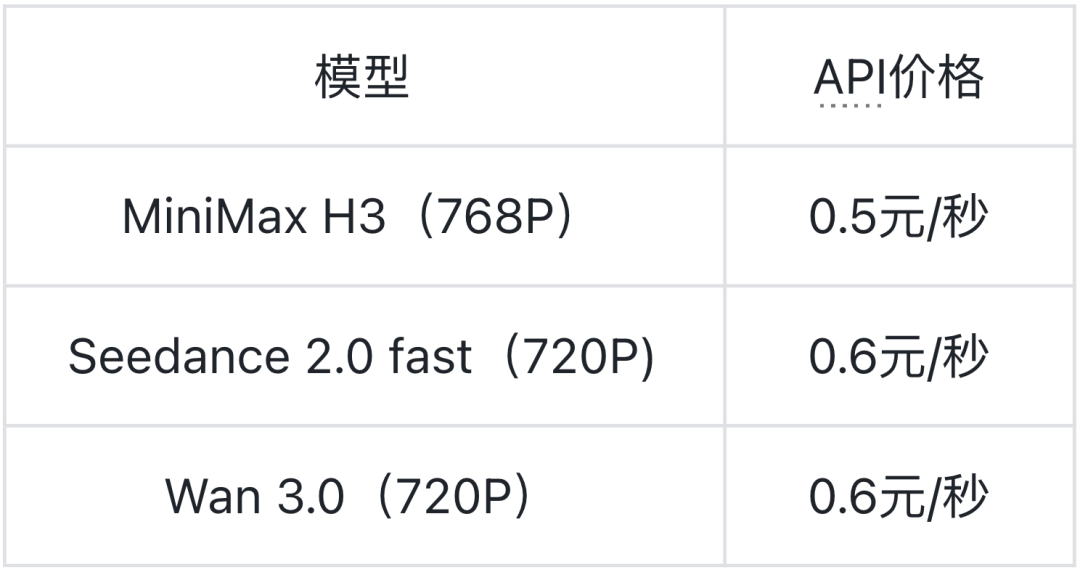
The original article’s price snapshot for MiniMax H3, Seedance 2.0 Fast, and Wan 3.0.
The source used the following price snapshot:
| Model | Resolution | Price in the Original Test |
|---|---|---|
| MiniMax H3 | 768p | ¥0.5/sec |
| Seedance 2.0 Fast | 720p | ¥0.6/sec |
| Wan 3.0 | 720p | ¥0.6/sec |
These figures should be treated as channel- and date-specific, not universal global prices.
Current official pricing pages use different billing systems depending on platform:
- Volcengine currently describes Seedance 2.0 Fast at 720p as starting at roughly ¥0.6 per second.
- MiniMax’s global API currently lists H3 at $0.08 per second for 768p.
- Alibaba Cloud’s international Wan 3.0 page currently lists $0.10 per second for 720p.
That is why production teams should always check the platform they actually use before budgeting.
The Real Cost Is Price × Duration × Retry Count
The source article makes a useful point: per-second price is only the first part of the cost equation.
A more realistic formula is:
Total generation cost
= price per second
× video duration
× number of generations required
If one model is slightly cheaper but requires three attempts to get an acceptable result, it can easily cost more than a model that succeeds on the first generation.
For high-volume production, retry rate may matter more than a small difference in headline price.
What Each Model Is Trying to Optimize
Seedance 2.0 Fast is the efficiency-oriented member of the Seedance 2.0 family. ByteDance positions it as a faster model that preserves the core multimodal capabilities of Seedance 2.0 while lowering latency and cost.
MiniMax H3 is positioned as a general-purpose multimodal generation system. MiniMax emphasizes accurate text and brand rendering, multimodal editing, native stereo audio, and video-to-video motion transfer. Its official use cases include opening titles, animated posters, product websites, advertising, e-commerce, UI/UX, and games.
Wan 3.0 takes a different route. Alibaba’s current product page says it accepts text, image, audio, video, and office documents including DOC, XLS, PPT, PDF, TXT, Keynote, Pages, Numbers, and Markdown. It can turn those materials into videos of up to 30 seconds.
That makes Wan 3.0 particularly interesting for:
- Training content
- Product explainers
- Knowledge videos
- Corporate presentations
- Reports
- Document-to-video workflows
The original hands-on test focuses less on those document features and more on direct visual generation.
Test 1: 3D Cartoon Animation
The first test starts with a cartoon character generated in Midjourney.
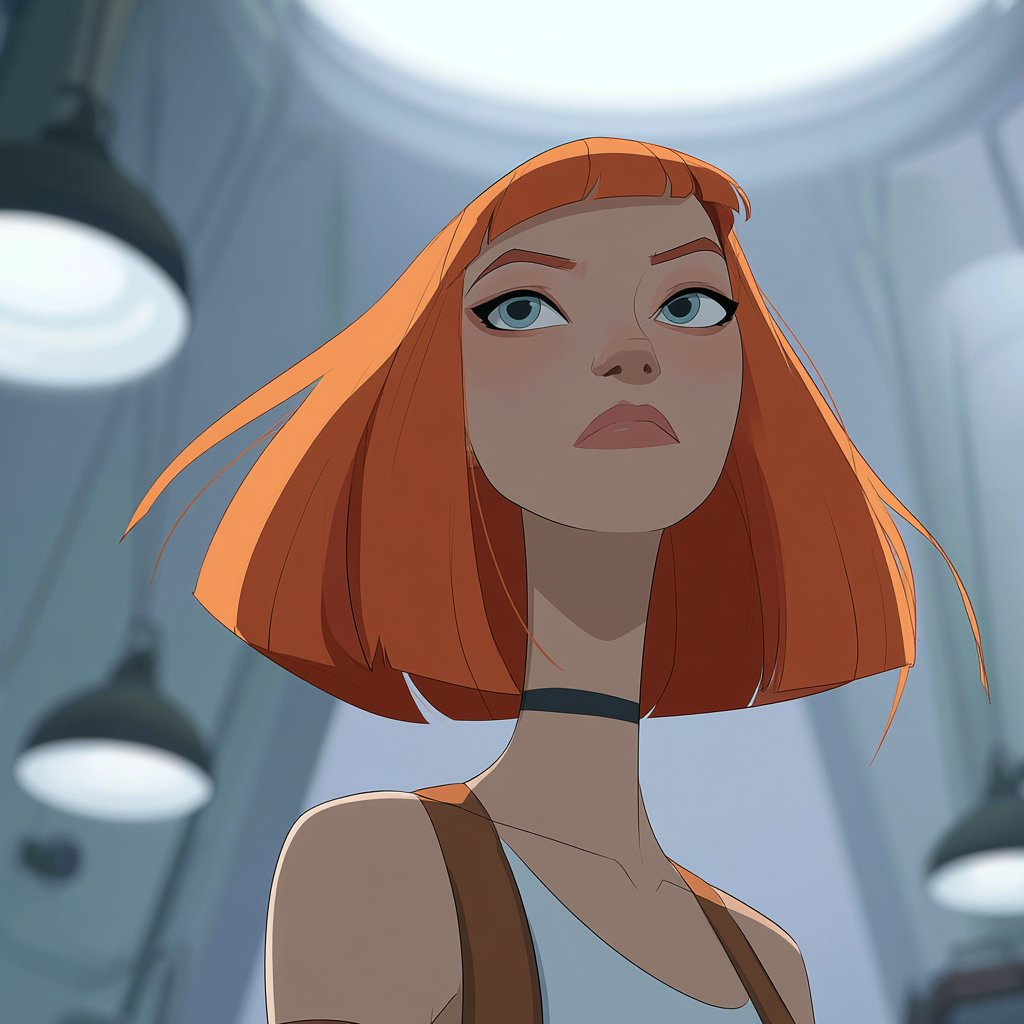
The character reference used in one of the animation tests.
The prompt describes a tough-looking man in a jungle saying:
“If one more bug touches me, I’m going home.”
A bug lands on his face immediately afterward. His confidence collapses and he screams while running away.
The full sequence contains seven camera changes:
- A punch-in close-up
- Side tracking
- Front-facing backward tracking
- Overhead view as he steps into insects
- Over-the-shoulder movement through vegetation
- Continued pursuit
- Aerial pull-up as he disappears into the jungle
This is difficult because the same character has to survive seven shots without changing face, clothes, or identity.
Seedance 2.0 Fast
In the original test, Seedance 2.0 Fast succeeded on the first generation.
The character remained visually consistent across cuts, and the scream was synchronized reasonably well with the mouth movement.
The authors considered this one of the clearest examples of why retry count matters.
MiniMax H3
H3 handled the character’s frightened reaction well, especially the moment of stepping backward in panic.
That matches H3’s broader strength in expressive visual detail.
Wan 3.0
Wan 3.0 produced a more saturated environment.
The source did not describe a major structural failure, but Seedance 2.0 Fast was judged the most efficient result in this test.
Test 2: High-Speed Sci-Fi Fight
The next task uses a red-haired woman fighting heavily armored security personnel inside a large circular research hall.
The prompt tests:
- Multiple characters
- Group movement
- High-speed camera motion
- Spatial consistency
- Glass-breaking physics
- Character identity
- Costume consistency
Across the three systems, the source found the overall structure fairly stable.
The circular hall did not collapse spatially, and the white tactical clothing remained consistent.
Seedance 2.0 Fast received the strongest praise for its opening close-up and for keeping the character and environment coherent during aggressive camera motion.
The important point is not that one sample makes it objectively the best action model.
It is that fast camera motion and multi-character blocking are precisely the kinds of situations where low-cost models often fail first.
Test 3: AI Girl-Group Music Video
The next test is more demanding in a different way.
The goal is a dark-pop, cyber-grunge rap video with the visual feel of a scanned late-1990s fashion magazine.
The creators supplied a group reference and a graphic-design mood board.

Reference image used for the AI girl-group test.
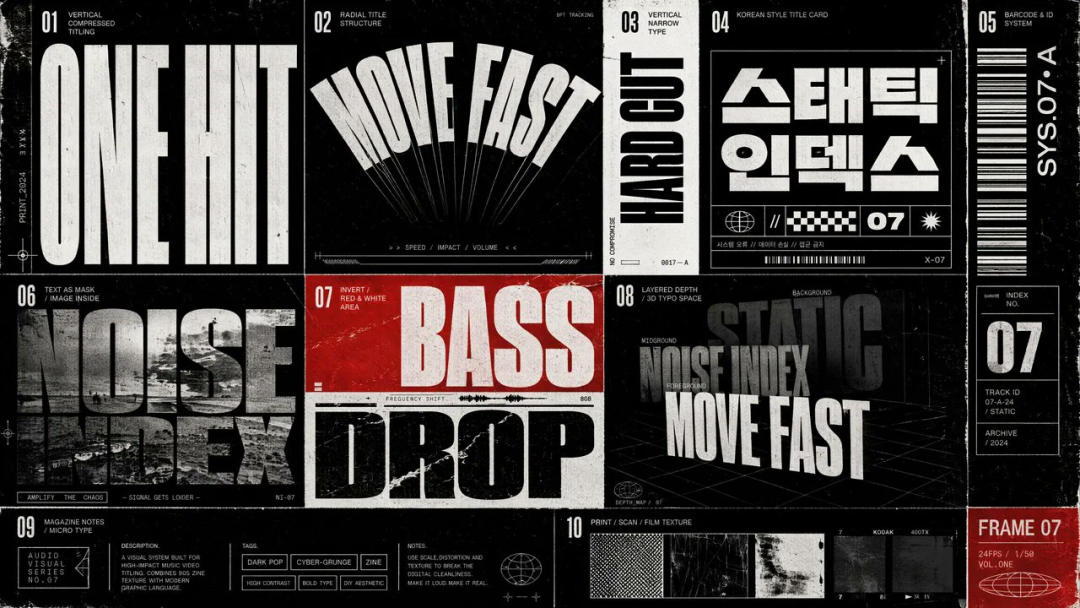
Typography and grunge-layout reference used in the music-video test.
This was one of the tests where the source saw the clearest separation.
Seedance 2.0 Fast
The authors preferred Seedance 2.0 Fast for:
- Face quality
- Live-action feel
- Camera movement
- Character placement while dancing
- Beat synchronization
The last point matters in music video.
A clip can look good frame by frame but still feel wrong if the visual accents miss the music.
The source considered Seedance 2.0 Fast the most accurate at aligning visual beats with musical beats.
Wan 3.0
Wan 3.0 picked up some of the collage aesthetic, but the source judged its instruction following less accurate in this example because it drifted toward a more realistic scene.
MiniMax H3
H3 showed less body movement than expected. Much of the perceived motion came from the camera rather than the performers.
Again, this is one sample rather than a controlled benchmark, but it illustrates how different models can interpret “dynamic” differently.
Test 4: Strict Character Reference and Game UI
The next task is closer to real commercial work.
A character design sheet is used as a strict reference for a game-loading-screen-style CG sequence.
The test combines three difficult requirements:
- UI and text rendering
- Mechanical transformation
- Strict character consistency
The source reports that all three systems rendered the English UI surprisingly well and positioned the cursor on one of the available options.
MiniMax H3: Best Text and UI Clarity
H3 produced the clearest page text and the strongest game-interface feel.
That lines up with MiniMax’s official positioning of H3 around accurate text and brand rendering, UI/UX, titles, and design-heavy commercial content.
Seedance 2.0 Fast: Best Reference Consistency
Seedance 2.0 Fast was strongest at preserving the character reference while showing a transformation of the weapon blade.
The transformation remained close to details in the source design.
Wan 3.0: Useful Scene Expansion
Wan 3.0 added part of the game world near the end of the clip.
That was not necessarily the strictest interpretation of the brief, but it showed the model’s tendency to extend the visual context creatively.
Test 5: Pure Text Animation
Text rendering is difficult for video models because the model must do more than spell a word correctly.
It must preserve the text across time while also controlling:
- Position
- Timing
- Typeface
- Motion
- Background
- Sound synchronization
The source tested a 15-second pure text animation in which each phrase had a required appearance time and location.
Seedance 2.0 Fast
Seedance 2.0 Fast followed the requested timing and placement most closely.
The source also preferred it for synchronization between text progression and background audio.
MiniMax H3
H3 remained stable and tended to display complete phrases, making the surrounding meaning easy to follow.
Wan 3.0
Wan 3.0 behaved more similarly to H3 in this case and showed more variation in type style.
For commercial motion graphics, the “winner” depends on the goal.
Precise timing favors strict instruction following. Title design may favor typographic character and visual style.
Test 6: Cinematic Transformation
The next task is a cyber transformation effect.
This is difficult because the transformation needs to happen continuously.
The model cannot hide the change behind a cut. The new form has to appear progressively across frames.
All three models produced a large-scale superhero-film aesthetic.
Seedance 2.0 Fast
The source preferred Seedance 2.0 Fast for:
- More believable saturation
- Colder purple energy light on the skin
- More natural environmental rendering
- More human facial performance
- Better overall cinematic texture
MiniMax H3
The character’s facial expression remained relatively fixed through much of the transformation, which made the performance feel stiffer.
Wan 3.0
Wan 3.0 showed a small discontinuity when the character’s standing posture changed.
This is a good example of why video quality cannot be judged only by a beautiful key frame. Temporal continuity is the product.
Test 7: Advertising
Advertising is one of the toughest AI video tests because it combines many requirements at once.
A usable commercial may need:
- Product accuracy
- Macro detail
- Material realism
- Controlled camera language
- Brand consistency
- Human performance
- Clean transitions
- Correct props
- Deliverable-level polish
In the source test, MiniMax H3, Wan 3.0, and Seedance 2.0 Fast each had different strengths.
MiniMax H3
H3 was the only one in that test to create a convincing foam ring, and its macro powder detail was strong.
The source did notice an object error: a bamboo whisk handle appeared hollow in a way that looked physically wrong.
Wan 3.0
Wan 3.0 produced the most complete action chain, making it useful as a possible storyboard reference.
However, the model replaced one intended bamboo utensil with a small white spoon, and the powder color was too pale.
Seedance 2.0 Fast
The source considered Seedance 2.0 Fast the closest to delivery-ready.
It was praised for:
- Strong image quality
- Sharp macro facial detail
- More natural live-action presence
- Better transitions
The authors still recommended replacing a short whisking segment, so “delivery-ready” here does not mean flawless.
It means the amount of repair work was lower.
Final Stress Tests
The last group deliberately uses unusual prompts where the models have less obvious training precedent.
A Prehistoric Concert Documentary
The brief asks for a documentary about a prehistoric concert with cave people, singing, and dinosaurs.
Seedance 2.0 Fast was the only model in the source comparison to stage the scene in daylight.
The authors thought its venue layout, scale, and performance energy felt closest to a modern concert documentary transplanted into a prehistoric setting.
Wan 3.0 pushed saturation too high for the requested documentary feel, and H3 showed a similar mismatch in atmosphere.
Compressing Cosmic History into 15 Seconds
The final idea compresses the roughly 13.7-billion-year history of the universe into a 15-second video.
This tests something different:
- Scientific concepts
- Extreme time compression
- Visual metaphor
- Narrative sequencing
- Artistic interpretation
The source does not claim one objectively correct result.
At that point, preference becomes partly aesthetic.
That is also a useful reminder that not every video-generation task has a single measurable winner.
What the Hands-On Test Found
After the full round of tests, the source judged Seedance 2.0 Fast the most balanced model for repeated production.
The reasoning is built around three points.
1. Fewer Retries
The biggest advantage was not a single spectacular sample.
It was that several tests reportedly worked on the first draw.
In real production, that can have a bigger effect on total cost than a small difference in per-second pricing.
2. No Obvious Collapse Category
The source found Seedance 2.0 Fast consistently competent across:
- Live-action realism
- Camera movement
- Beat and audiovisual synchronization
- Instruction following
- Multi-shot consistency
- Reference consistency
- Text timing
- Commercial footage
It did not win every subcategory, but it also did not show one major weakness that made a whole class of work impractical.
3. It Stays Close to Seedance 2.0 Quality
The model is designed to trade some quality for speed and cost efficiency, but the source felt the visible output remained close enough to the full Seedance 2.0 family for common production tasks.
That makes it attractive when the goal is not to create the single most technically ambitious shot, but to make many usable clips efficiently.
Where MiniMax H3 and Wan 3.0 Still Stand Out
The conclusion should not be reduced to “Seedance wins everything.”
The tests reveal clearer product identities.
Choose MiniMax H3 When Design and Multimodal Editing Matter
H3 is particularly interesting for:
- Text-heavy scenes
- Brand rendering
- UI/UX
- Opening titles
- Stylized commercial work
- Motion transfer
- Video-to-video workflows
- Native stereo audio
- Local/open-weight experimentation with H3-Base
MiniMax has also released H3-Base weights, although its complete hosted stack includes components that are not all part of the initial open-weight release.
Choose Wan 3.0 When Source Materials Begin as Documents
Wan 3.0 is unusual because it can accept:
- Word documents
- Excel spreadsheets
- PowerPoint files
- PDFs
- Markdown
- Web-style documents
- Images
- Audio
- Video
Alibaba’s official international product page says Wan 3.0 supports single generations up to 30 seconds and can modify visuals, plot, and dialogue.
That gives it a different entry point.
For training, product explanation, corporate communication, and document-to-video workflows, the best model may not be the one that wins a cinematic fight scene.
It may be the one that removes the most manual preparation before generation starts.
Seedance 2.5 or Seedance 2.0 Fast?
For teams deciding between ByteDance’s own two models, the practical split is straightforward.
Seedance 2.5 Makes More Sense When You Need
- 30-second single-pass storytelling
- More demanding live-action realism
- Larger multimodal reference sets
- Timestamp-level creative control
- Complex editing
- Professional film and advertising workflows
- Industrial simulation
- Long-form continuity
- Precise multi-character staging
ByteDance officially supports up to 30 images, 10 video clips, and 10 audio clips as references in one Seedance 2.5 generation.
Seedance 2.0 Fast Makes More Sense When You Need
- High-frequency production
- Shorter clips
- Faster iteration
- Lower cost
- Reliable reference consistency
- Social video
- Music-video fragments
- Motion graphics
- Commercial variants
- A lower retry burden
That is why the source ultimately favors 2.0 Fast as the current practical “value” option.
It is not the most capable model in the family.
It may be the one that creates the least friction for ordinary production.
常见问题
What is Seedance 2.5?
Seedance 2.5 is ByteDance’s next-generation multimodal audiovisual creation model, officially released on July 31, 2026. It supports up to 30 seconds per generation, multi-round extension, larger multimodal reference sets, and timestamp-level editing control.
What is Seedance 2.0 Fast?
Seedance 2.0 Fast is an accelerated variant of Seedance 2.0 designed for lower-latency video generation. It keeps the core multimodal reference and native audiovisual capabilities of the 2.0 family while targeting faster and cheaper production.
How much does Seedance 2.0 Fast cost?
Volcengine’s current documentation says 720p Seedance 2.0 Fast can cost as little as roughly ¥0.6 per second, depending on the billing conditions. Pricing can change and may differ across regions, products, and promotional plans.
Is MiniMax H3 cheaper than Seedance 2.0 Fast?
The original Chinese comparison listed H3 768p at ¥0.5 per second and Seedance 2.0 Fast 720p at ¥0.6 per second. MiniMax’s current global API lists H3 768p at $0.08 per second, so direct comparisons should use the actual platform and currency a team plans to pay through.
What is Wan 3.0 best for?
Wan 3.0 stands out for “everything-to-video” workflows. Alibaba says it can accept text, images, audio, video, and office documents such as DOC, XLS, PPT, PDF, and Markdown, making it useful for training, explainers, corporate content, and document-driven video production.
Which model was best at text rendering in the hands-on test?
MiniMax H3 produced the clearest game-style UI text in the strict character-reference test. Seedance 2.0 Fast performed especially well when the task required text to appear at specific times and positions in a 15-second motion-graphics sequence.
Is Seedance 2.5 always better than Seedance 2.0 Fast?
Not necessarily for every workflow. Seedance 2.5 provides more advanced control and longer generation, while 2.0 Fast may be more economical for high-volume short-form work where speed, retry rate, and cost matter more than the highest capability ceiling.
What matters more than price per second when choosing an AI video model?
Retry rate is one of the biggest hidden costs. A slightly cheaper model can become more expensive if a usable clip requires several generations, so teams should measure cost per accepted output rather than only cost per generated second.
相关工具
- Seedance 2.5: ByteDance Seed’s official page for its 30-second multimodal video creation model.
- Volcengine ModelArk: ByteDance’s cloud platform for accessing Seedance and other foundation-model APIs.
- MiniMax H3: MiniMax’s multimodal video model for text, image, video, and audio generation and editing.
- Hailuo AI: MiniMax’s consumer-facing creation interface for H3 and related video models.
- Wan: Alibaba’s AI creative platform for Wan image and video generation.
- Alibaba Cloud Model Studio: Alibaba Cloud’s developer platform for Wan and other foundation models.
Related Links
- ByteDance: Introducing Seedance 2.5: Official release notes covering 30-second generation, multimodal references, extension, and timestamp-level editing.
- Volcengine Seedance Video API Documentation: Official Seedance generation and billing guidance, including the current Seedance 2.0 Fast 720p price reference.
- MiniMax H3 Official Technical Blog: Official H3 capabilities, use cases, architecture direction, and multimodal generation features.
- MiniMax Pay-as-You-Go Pricing: Current global API pricing for H3 at 768p and 2K.
- Alibaba Cloud Wan 3.0: Official Wan 3.0 capabilities, document-input formats, generation length, and international API pricing.
- Wan AI Creation Platform: Official online interface for creating with the Wan model family.
- Seedance 2.0 Technical Report: Technical description of the Seedance 2.0 multimodal audiovisual architecture and Fast variant.
Summary
Seedance 2.5 raises ByteDance’s capability ceiling with 30-second generation, larger multimodal reference sets, stronger long-form continuity, and timestamp-level creative control. It is the more appropriate choice when a project depends on precise, professional control.
The original hands-on comparison nevertheless found Seedance 2.0 Fast more attractive for everyday volume production. It performed consistently across animation, music video, UI, text motion, cinematic transformations, advertising, and unusual creative prompts, while often requiring fewer retries.
MiniMax H3 remains particularly strong for design-heavy, text-heavy, and multimodal editing workflows, while Wan 3.0 offers a distinctive document-to-video path that can reduce preparation work for enterprise and knowledge content.
For production teams, the best AI video model is not automatically the one with the highest capability ceiling—it is the one that delivers an acceptable clip with the fewest retries, the right controls, and a cost structure that still works at scale.