Satya Nadella’s Warning: Don’t Let One AI Vendor Become Your Company’s Brain
Microsoft CEO Satya Nadella has a warning for companies rushing to standardize everything on one AI platform: the biggest risk may not be model quality or token prices. It may be losing control of the knowledge that makes the company itself valuable. In a July 26, 2026 interview on CNN’s *Fareed Zakaria GPS*, Nadella argued that companies should keep ownership of the data, prompts, metadata, context, memory, and orchestration layers created as employees use AI. His concern is straightforward. Th
Satya Nadella’s Warning: Don’t Let One AI Vendor Become Your Company’s Brain
Introduction
Microsoft CEO Satya Nadella has a warning for companies rushing to standardize everything on one AI platform: the biggest risk may not be model quality or token prices. It may be losing control of the knowledge that makes the company itself valuable.
In a July 26, 2026 interview on CNN’s Fareed Zakaria GPS, Nadella argued that companies should keep ownership of the data, prompts, metadata, context, memory, and orchestration layers created as employees use AI.
His concern is straightforward.
The more deeply a company integrates AI into daily work, the more information it gives the system about how the organization actually operates: how teams serve customers, how managers make trade-offs, how engineers debug products, how analysts judge risk, and how employees correct imperfect model outputs.
Over time, those interactions can become a digital record of the company’s operating knowledge.
If that record exists only inside one model provider’s proprietary product, changing providers later may mean rebuilding much more than a chatbot integration.
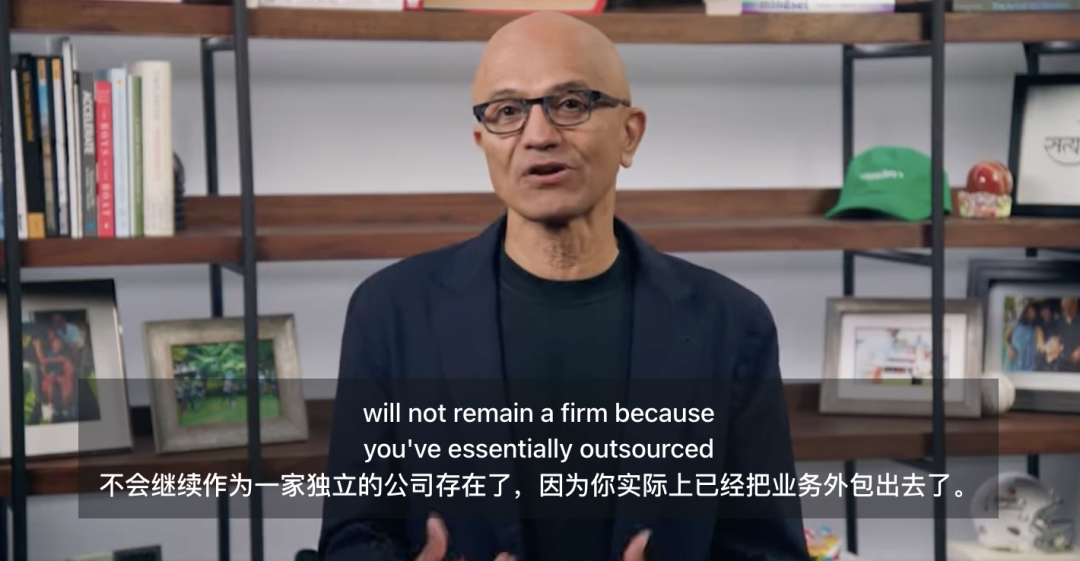
Nadella’s proposed answer is not for every company to train its own frontier foundation model.
Instead, he argues for separation.
The model should be replaceable. The company’s context, memory, metadata, agent harness, workflows, and accumulated knowledge should remain under the company’s control.
That architecture lets an organization use whichever model is strongest for a particular task without letting one provider become the only place where its institutional intelligence lives.
Betting Everything on One AI Can Mean Outsourcing Your Own Capabilities
At first glance, committing to one AI provider can look efficient.
Employees get one interface. Procurement is simpler. Security teams approve one platform. Developers build one set of integrations. The organization can standardize prompts, agents, and internal workflows around a single stack.
The problem appears gradually.
An enterprise AI system is no longer just a text box connected to a model API.
As adoption deepens, it can accumulate:
- Internal documents
- Prompt libraries
- Conversation history
- User preferences
- Long-term agent memory
- Evaluation results
- Tool permissions
- Workflow rules
- Retrieval indexes
- Human corrections
- Tool-call histories
- Business-specific instructions
- Approval patterns
- Internal terminology
- Examples of successful and failed work
None of those items alone necessarily looks like a strategic asset.
Together, they can become a highly detailed map of how a company thinks.
AI Usage Creates a New Form of Institutional Memory
Traditional organizational knowledge is spread across many places.
Some of it is written in policies, manuals, databases, and wikis. A large amount is not.
It exists in the repeated decisions employees make:
- Which customer request deserves escalation?
- What makes a sales lead genuinely qualified?
- Which engineering shortcuts are acceptable?
- How does the company respond to an unusual refund request?
- What language is acceptable for a regulated market?
- Which product defects require an immediate rollback?
- What does an experienced manager notice that a junior employee misses?
When AI systems participate in those decisions, the interaction history starts capturing parts of this tacit knowledge.
A user asks a question.
The AI retrieves information.
The employee corrects the answer.
The system calls a tool.
The user rejects one result and chooses another.
The workflow is updated.
Thousands of interactions later, the company has created a valuable training and evaluation dataset—whether it planned to or not.
The key question is who owns and can reuse that dataset.
Vendor Lock-In Is Bigger Than API Compatibility
Companies often think about AI lock-in as an API problem.
If Provider A becomes too expensive, replace its API endpoint with Provider B.
That approach works only when the model itself is the main dependency.
Modern agent systems contain many other layers.
| Layer | Example |
|---|---|
| Foundation model | OpenAI, Anthropic, Microsoft-hosted, open-weight model |
| System prompts | Enterprise rules and task instructions |
| Context | Relevant business documents and retrieved information |
| Memory | Persistent user, team, project, or customer history |
| Harness | Agent loop that plans, calls tools, retries, and evaluates |
| Tools | CRM, databases, code repositories, ERP, email, internal APIs |
| Metadata | Prompts, model choices, outputs, latency, cost, corrections |
| Evaluations | Tests that determine whether a workflow is reliable |
| Policies | Permissions, safety rules, compliance requirements |
| Observability | Logs, traces, usage metrics, and incident records |
If all of these layers are embedded in one provider’s proprietary product, changing the foundation model may require redesigning the entire stack.
That creates practical dependence.
The original provider might:
- Raise prices
- Retire a model
- Change rate limits
- Change memory behavior
- Modify agent features
- Restrict a capability
- Change regional availability
- Change data-handling policies
- Fall behind another model in a critical task
A company with a modular architecture can respond by changing the model.
A company whose memory, harness, context, and workflow logic are fused into one service may have far fewer options.
The Real Risk Is Losing the Ability to Explain How Work Gets Done
The deepest form of lock-in appears when the organization stops maintaining its own record of the reasoning and feedback surrounding AI-assisted work.
Imagine that a customer-support process has been improved over two years through thousands of AI interactions.
Employees have repeatedly corrected the system.
Those corrections have taught the workflow when to refund, when to escalate, what tone to use, what exceptions exist, and which internal teams should be involved.
If all of that learning exists only inside a proprietary agent service, migrating away may mean losing the history that made the workflow effective.
The company may still own the original documents.
It may no longer own the complete operational memory created from using them.
That is the concern behind Nadella’s warning that a company can end up outsourcing part of its thinking.
The phrase is dramatic, but the architectural issue is concrete: an enterprise needs enough control over its AI-generated knowledge to reconstruct, audit, migrate, and improve its own workflows.
The Smartest Model Can Be Rented; the Company’s “Brain” Should Stay Internal
Nadella’s proposed solution is separation between the foundation model and the enterprise-owned layers around it.
In his CNN interview, he specifically argued for keeping the harness separate from the model and keeping context and memory separate from the model.
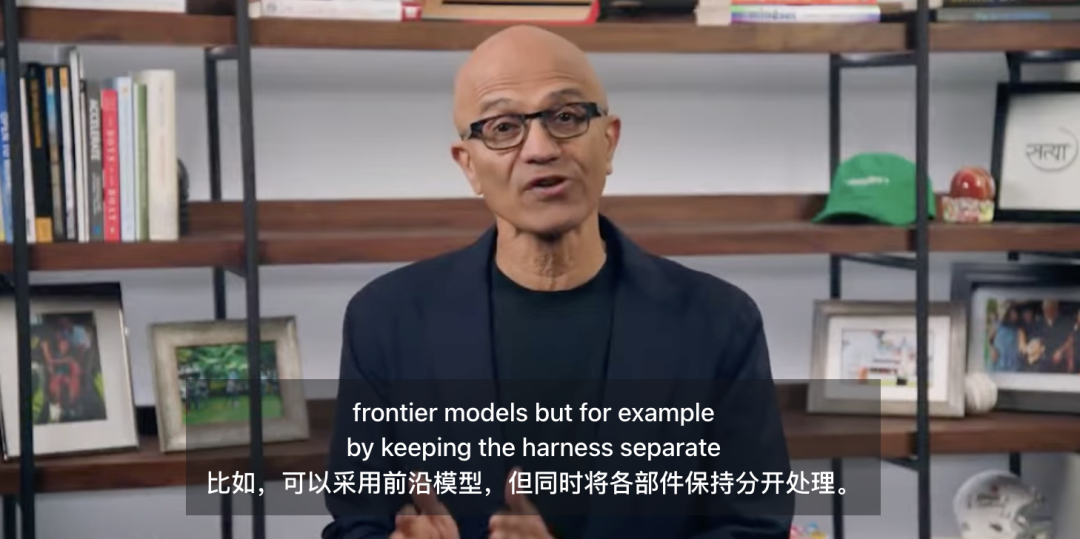
This creates a different architecture.
Instead of treating one AI provider as the complete intelligence platform, the enterprise treats foundation models as replaceable reasoning engines.
The enterprise retains control of:
- Its data
- Its prompts
- Its memory
- Its workflow state
- Its evaluation data
- Its tool layer
- Its metadata
- Its permissions
- Its business rules
- Its audit trail
The model receives only the context required for the current task.
What Nadella Means by Metadata
Metadata in an enterprise AI system can include information such as:
- What the employee asked
- Which model handled the request
- Which documents were retrieved
- Which tools were called
- Which tool arguments were used
- What result the model generated
- Whether the user accepted or rejected the result
- How the employee edited the output
- How long the task took
- What the task cost
- Whether the workflow succeeded
- Which safety or policy checks were triggered
These records can become extremely valuable.
They can be used to:
- Evaluate models
- Identify common failure modes
- Improve prompts
- Train classifiers
- Tune routing rules
- Build internal datasets
- Create domain-specific models
- Improve agent workflows
- Audit important decisions
Nadella’s point is that this learning loop should remain available to the enterprise.
If the organization retains its own interaction history, it can continue improving even as foundation models change.
Keep the Harness Independent
A harness is the software layer surrounding an AI model that turns a raw model response into an agentic workflow.
It may handle:
- Prompt construction
- Context retrieval
- Planning
- Tool selection
- Tool execution
- Memory read/write
- Retries
- Output validation
- Approval requests
- Logging
- Model routing
- Final response generation
If the harness is tightly coupled to one provider’s model, replacing the model may require replacing the complete agent.
If the harness is provider-independent, the same workflow can call different models.
For example:
- A coding task can use a strong coding model.
- A long-document task can use a model with a larger context window.
- A cheap classification task can use a small model.
- A sensitive workload can use a self-hosted open-weight model.
- A difficult planning task can be escalated to a frontier reasoning model.
The business process remains stable while the reasoning engine changes.
Multi-Model Architecture Is Becoming a Real Enterprise Pattern
This is no longer only a conceptual design.
Microsoft itself now offers infrastructure for routing among multiple AI models.
Microsoft Foundry’s model router can analyze a prompt and route it to an eligible underlying model according to quality, cost, latency, and configured model subsets.
Azure API Management’s AI Gateway can expose multiple model providers through one governed enterprise boundary. Microsoft documentation describes support for backends including Microsoft Foundry, Azure OpenAI, AWS Bedrock, Google Vertex, OpenAI, Anthropic, and custom model endpoints.
A gateway architecture can centralize:
- Authentication
- Model selection
- Provider credentials
- Token limits
- Rate limits
- Logging
- Monitoring
- Content-safety policies
- Network policies
- Cost tracking
Applications then call the enterprise-controlled gateway rather than embedding one provider directly throughout the codebase.
This does not eliminate all lock-in. The gateway itself can become infrastructure that needs to be managed and migrated.
But it moves the model choice into a layer the enterprise can control.
A Practical Enterprise AI Architecture
A vendor-neutral enterprise AI stack can be thought of as several independent layers.
Employees / Applications
          |
          v
Enterprise Agent / Harness
          |
          +------ Enterprise Memory
          |
          +------ Retrieval / Context
          |
          +------ Tools / MCP / Internal APIs
          |
          +------ Evaluations / Policies
          |
          +------ Observability / Metadata
          |
          v
AI Gateway / Model Router
     /       |        \
    v        v         v
 Model A   Model B   Internal Model
The important boundary is between enterprise knowledge and model inference.
The company’s memory, prompts, workflows, tools, and evaluation data live above the model layer.
The model can be changed without throwing away the organizational state around it.
Layer 1: Enterprise Data
Keep authoritative business information in systems the organization controls.
Examples include:
- Data warehouses
- Document repositories
- CRM systems
- Product databases
- Source-control platforms
- Internal knowledge bases
The model should retrieve what it needs rather than becoming the only persistent copy of the information.
Layer 2: Context and Retrieval
Build retrieval as an independent service.
This lets the organization change embedding models, rerankers, or generation models without rebuilding the original knowledge base.
The retrieval layer should preserve provenance so users can see which internal sources influenced an answer.
Layer 3: Memory
Separate long-term memory from the model provider’s native chat history when the memory is strategically important.
Possible memory scopes include:
- User memory
- Project memory
- Customer memory
- Agent memory
- Organizational memory
Each type should have clear retention, permission, export, and deletion rules.
Layer 4: Agent Harness
Keep business logic in a system the enterprise can inspect and version.
The harness should define:
- What tools exist
- Who can use them
- Which actions require approval
- How retries work
- What state persists
- When models can be switched
- What counts as success
This turns the agent from a vendor-specific feature into an enterprise workflow.
Layer 5: AI Gateway or Router
Place a routing layer between applications and models when multi-model flexibility matters.
The router can select a model based on:
- Task type
- Quality requirement
- Cost
- Latency
- Data residency
- Context length
- Safety requirements
- Provider availability
A gateway can also provide failover.
If one model endpoint becomes unavailable, the workflow may be able to continue with another eligible model.
Layer 6: Metadata and Evaluation
Store enough interaction metadata to understand whether the system works.
Do not retain everything indiscriminately. Privacy, security, and regulatory requirements still apply.
For appropriate workflows, useful records can include:
- Model version
- Prompt template version
- Retrieved sources
- Tool usage
- Latency
- Token use
- User feedback
- Human corrections
- Evaluation score
- Final outcome
This is the data that allows an AI system to become better over time without tying that improvement to one provider.
Why This Matters Even If One Model Is Clearly the Best Today
Enterprise architecture is built for a longer horizon than a benchmark leaderboard.
The strongest model today may not be the strongest model six months from now.
AI markets move quickly because improvements can come from:
- New pretraining
- Better reasoning
- Lower inference prices
- New context-window techniques
- New multimodal capabilities
- Better coding
- Better tool use
- Faster serving
- Open-weight releases
- Specialized domain models
A company that can change models without changing its operating system benefits from that competition.
A company that is deeply locked into one proprietary stack may not.

This is not an argument that enterprises should constantly switch models.
Frequent switching can create its own problems:
- Output inconsistency
- New evaluation work
- Security review
- Prompt incompatibility
- Different tool behavior
- New failure modes
The objective is optionality, not permanent churn.
The company should be able to change when there is a strong reason to do so.
The YC Token Offer Shows Why Startups Worry About Platform Dependence
The source article connects Nadella’s warning to an earlier debate in the startup community.
In May 2026, OpenAI CEO Sam Altman offered $2 million worth of OpenAI tokens to each startup in the current Y Combinator batch in exchange for equity.
TechCrunch reported that the investment would use an uncapped SAFE and convert during a later priced financing round.
The offer is attractive for an AI startup.
Model inference can be one of the company’s largest early expenses. Receiving a large token allocation allows a team to build and test products without spending the same amount of cash.
It also creates obvious questions about strategic dependence.
Investor Jason Calacanis publicly warned founders that a platform provider might gain visibility into what startups are building and later compete with them.
That concern is not evidence that OpenAI would actually copy a particular company’s product.
It is a general platform-risk argument: the more central one infrastructure provider becomes to a business, the more important it is to understand what data the provider receives and what switching would cost.
The OpenAI Offer Is Separate From YC’s Standard Deal
Y Combinator’s own standard investment remains separate.
YC currently describes its standard deal as a $500,000 investment, consisting of:
- $125,000 for a fixed 7% equity stake
- $375,000 through an uncapped SAFE with an MFN provision
The OpenAI token arrangement reported by TechCrunch is an additional offer, not a replacement for YC’s standard financing.
For founders, the strategic question is therefore not simply whether free or subsidized inference is valuable.
It is whether taking the benefit changes the startup’s architecture in a way that makes future independence harder.
Enterprise AI Knowledge Is Becoming a New Strategic Asset
Historically, a company’s advantage often lived in people and processes.
Experienced employees knew how to solve unusual problems. Managers understood which exceptions mattered. Sales teams knew which signals indicated real buyer intent. Engineers remembered why an apparently strange architectural decision had been made years earlier.
AI systems are starting to encode parts of that accumulated judgment into machine-readable artifacts.
Those artifacts include:
- Prompt libraries
- Agent instructions
- Context stores
- Evaluation suites
- Human-feedback data
- Tool-use traces
- Decision logs
- Agent memories
- Fine-tuning data
- Workflow definitions
This is not the same as saying that AI has captured the entire intelligence of an organization.
A large amount of expertise still lives in people, culture, relationships, and tacit judgment.
But the machine-readable portion is growing.
That makes ownership and portability more important.
The Model Is Increasingly a Commodity Layer
Frontier models remain expensive and technically difficult to build.
For most enterprises, training one from scratch makes no economic sense.
What is changing is that companies have more choices.
Microsoft Foundry, for example, provides access to models from Microsoft, OpenAI, Meta, DeepSeek, and other providers. Enterprise gateways can also route to models hosted through other clouds or directly by third parties.
The model can therefore be treated more like a specialized infrastructure component.
The durable company-specific value sits elsewhere:
- Proprietary data
- Workflow knowledge
- Internal feedback
- Evaluations
- Business rules
- Memory
- Customer context
- Organizational decisions
Those layers are what allow a general model to behave like the company’s AI.
A Migration Test Every Enterprise Should Run
A useful way to measure AI lock-in is to ask a simple question:
If our primary model provider disappeared tomorrow, what would we lose?
The answer should be documented.
1. Model Access
Could the application point to another model endpoint?
If yes, how much code would change?
2. Prompts
Are system prompts and agent instructions stored in the enterprise’s own repositories?
Can they be exported and versioned?
3. Context
Are source documents and retrieval indexes under company control?
Would changing the model require rebuilding the knowledge layer?
4. Memory
Can long-term memory be exported?
Does the organization understand its schema?
Is the memory interoperable with another agent system?
5. Tools
Are tool integrations built through portable APIs or a standard such as MCP?
Or are critical workflows available only inside one provider’s proprietary agent product?
6. Metadata
Does the company retain its own interaction logs and model-evaluation results?
Can it compare two providers using historical tasks?
7. Evaluations
Can another model be tested against the same acceptance criteria?
Without a reusable evaluation set, changing models becomes a subjective migration exercise.
8. Identity and Permissions
Are business permissions enforced by the enterprise systems themselves?
A model migration should not require reconstructing the company’s authorization model.
9. Compliance
Can the company explain where data traveled, which model processed it, and what was retained?
Multi-model flexibility is useful only if governance remains intact.
10. Operational Failover
What happens when the primary provider is unavailable?
Can critical workflows degrade gracefully?
A migration exercise often reveals dependencies that architecture diagrams miss.
Multi-Model Does Not Mean Sending Every Prompt Everywhere
Avoiding vendor lock-in does not require sending data to many model providers at once.
That would create unnecessary privacy and security exposure.
A controlled multi-model strategy should use routing rules.
For example:
| Workload | Possible Routing Strategy |
|---|---|
| Low-risk classification | Small low-cost hosted model |
| Complex coding | Strong coding model |
| Long-document analysis | Long-context model |
| Sensitive internal data | Private or self-hosted model |
| High-stakes decision support | Approved model plus human review |
| Provider outage | Pre-approved failover model |
The company still needs a data-governance policy defining which models are allowed to process which information.
Model choice should remain flexible.
Data handling should remain strict.
The Architecture Has Its Own Trade-Offs
Nadella’s proposal sounds attractive, but separating every layer adds engineering work.
A multi-model system may need:
- Compatibility testing
- Prompt normalization
- Provider-specific adapters
- Evaluation infrastructure
- Cost tracking
- Routing policies
- Unified observability
- Security review for several vendors
- Data-residency controls
- Model-specific fallback logic
A small company may reasonably choose one provider at first.
The important thing is to avoid unnecessary lock-in.
A startup does not need to build a complex internal AI platform before product-market fit.
It can still:
- Store prompts in its own repository
- Keep source data outside the model provider
- Maintain a portable memory schema
- Abstract model calls behind one internal interface
- Log model versions
- Preserve evaluation datasets
Those relatively simple decisions can make future migration much easier.
The Strategic Question Is Who Owns the Learning Loop
The most valuable part of enterprise AI may not be the model itself.
It may be the feedback loop created when employees use the model.
A company asks questions.
The model answers.
Employees correct it.
Tools are called.
Results are measured.
Better workflows emerge.
If the organization owns that loop, it can move the accumulated learning from one model generation to the next.
If the loop belongs entirely to a provider, the company may find that its AI system improved while its own portable capabilities did not.
This is why Nadella’s warning is more significant than a simple recommendation to use multiple vendors.
It is a recommendation about where enterprise intelligence should live.
The model can be rented.
The organization should keep the context that makes the model useful.
常见问题
What did Satya Nadella say about relying on one AI model?
In his July 26, 2026 interview with Fareed Zakaria, Nadella argued that companies should not give a single AI provider control over their data, metadata, context, memory, and agent harness. He warned that a company without control of those layers risks outsourcing part of its own thinking.
Does Nadella think companies should build their own foundation models?
Not necessarily. His proposal is to separate enterprise-owned context, memory, metadata, and orchestration from the model, allowing companies to use multiple frontier or open-weight models while preserving their own knowledge.
What is an AI agent harness?
A harness is the software layer around a model that manages prompts, tools, context, memory, planning, retries, permissions, evaluation, and execution. Keeping it separate from one model provider can make the business workflow more portable.
What is an AI gateway?
An AI gateway is a controlled layer between enterprise applications and model providers. It can centralize authentication, routing, rate limits, monitoring, policies, model selection, and provider credentials.
Why should an enterprise keep AI metadata?
AI metadata can reveal which prompts were used, what information was retrieved, which tools were called, how users corrected outputs, and whether tasks succeeded. That history can be used for evaluation, workflow improvement, model routing, or future internal training.
Does a multi-model architecture eliminate vendor lock-in?
No. It reduces dependence at the model layer, but the gateway, vector database, memory system, agent framework, or cloud platform can each create new forms of lock-in. Portability needs to be considered across the entire stack.
What was OpenAI’s offer to Y Combinator startups?
TechCrunch reported in May 2026 that OpenAI offered $2 million worth of tokens to each startup in the current YC batch in exchange for equity through an uncapped SAFE. The arrangement was separate from YC’s standard $500,000 investment deal.
Should a small startup build a multi-model platform immediately?
Usually not. Early teams can start with one provider while keeping model calls abstracted, prompts versioned, data under their own control, and evaluations portable. Those choices preserve future options without adding unnecessary infrastructure.
相关工具
- Microsoft Foundry: Microsoft’s platform for discovering, evaluating, deploying, and operating multiple AI models.
- Microsoft Foundry Model Router: A routing layer that selects eligible models according to quality, cost, and configured policies.
- Azure API Management AI Gateway: A managed gateway for governing access to multiple AI models and MCP tools.
- Model Context Protocol: An open protocol for connecting AI applications to tools and data sources through a standardized interface.
- OpenTelemetry: An open observability framework useful for collecting traces, metrics, and logs across AI application infrastructure.
- Y Combinator SAFE: YC’s official resources for the Simple Agreement for Future Equity financing structure.
Related Links
- Fareed Zakaria GPS Interview with Satya Nadella: The July 26, 2026 interview in which Nadella discusses the risks and benefits of enterprise AI.
- TechCrunch: Satya Nadella on One-AI Dependence: Reporting on Nadella’s recommendation to separate enterprise context, memory, and harnesses from foundation models.
- Microsoft Foundry Model Router: Official documentation for Microsoft’s multi-model routing system.
- Azure AI Gateway Overview: Official documentation for governing multiple AI models and tools through one enterprise endpoint.
- Unified Model API in Azure API Management: Microsoft documentation on presenting multiple model backends behind one client-facing API.
- TechCrunch: OpenAI’s $2M Token Offer to YC Startups: Reporting on OpenAI’s token-for-equity offer to the 2026 YC cohort.
- Y Combinator Standard Deal: YC’s official explanation of its $500,000 standard investment structure.
Summary
Satya Nadella’s warning is not simply that companies should subscribe to several AI models. His deeper point is that enterprises should avoid placing their accumulated context, memory, metadata, agent logic, and operating knowledge inside a system they cannot independently preserve or migrate.
A modular architecture keeps the enterprise’s knowledge layer separate from the model layer. Models can then be selected for coding, long-context work, low-cost tasks, sensitive workloads, or failover without rebuilding the company’s complete AI operating system.
That flexibility adds engineering complexity, but even small teams can preserve future options by owning their data, prompts, memory schema, evaluations, and model interface from the beginning.
The frontier model can be rented. The learning loop that explains how your company works should remain yours.