After Ryanair Deploys Gemini to 35,000 Employees, How Can B2B Enterprises Use We0.ai to Turn Internal SOPs into Customer-Searchable Knowledge Bases?
Ryanair's integration of Gemini into the daily workflows of 35,000 employees shows that enterprise AI is shifting from being a 'tool' to becoming a 'workflow gateway.' B2B companies can use We0.ai to turn internal SOPs into customer-searchable, self-service, and conversion-driven knowledge bases.
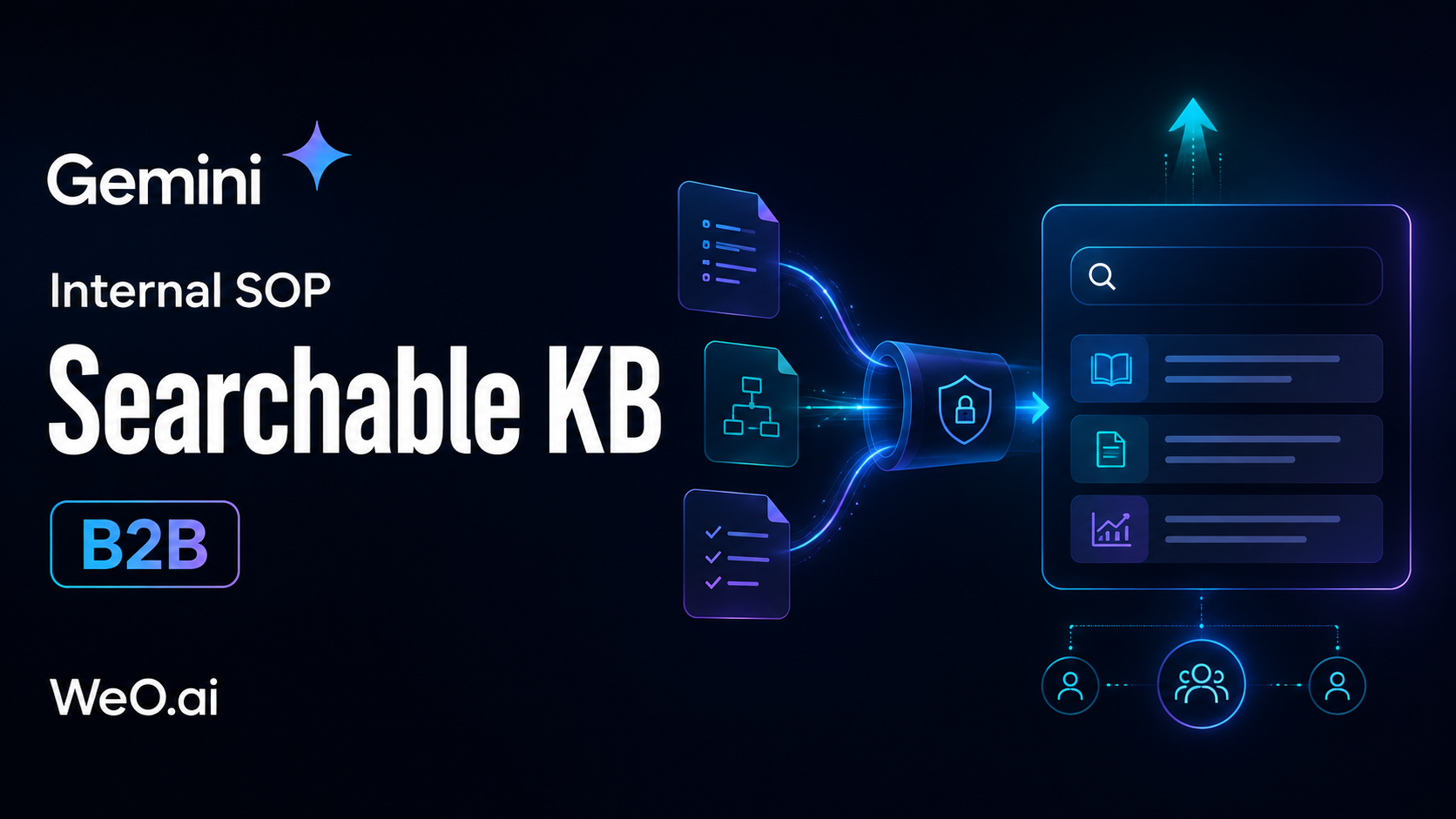
Ryanair's Move: What B2B Should Really Learn Isn't "Adopting AI"
According to public reports, Ryanair is rolling out Google's Gemini capabilities to 35,000 employees. On the surface, this looks like an airline upgrading with AI.
But I'd rather frame it differently: companies are starting to treat AI as an "internal knowledge distribution system."
Not just letting a few people try it.
Not just building a demo page.
But getting frontline staff, operations, customer support, sales, and management all working within the same AI and knowledge ecosystem.
This raises a very practical question:
If internal SOPs have already been AI-fied, why do customers still see scattered FAQs, outdated documents, and neglected help centers?
B2B companies often don't lack SOPs.
The problem is that SOPs are too numerous, too scattered, and too internalized.
They live in Notion, sit on Drive, are buried in Confluence, or even exist only in the heads of long-time employees.
The result:
- Employees can't find them internally
- Customers can't search them either
- Sales teams tell inconsistent stories
- Support answers vary wildly
- SEO has nothing to crawl
This is exactly where We0.ai can step in.
From "Internal SOPs" to a "Customer-Searchable Knowledge Base": The Gap Isn't Writing—It's Structure
Many people assume that turning SOPs into a knowledge base means simply moving documents out.
It doesn't work that way.
The real challenge lies in these three steps:
| Step | Old Approach | Better Approach |
|---|---|---|
| 1. Organize | Documents sit untouched | Restructure SOPs by topic, scenario, and role |
| 2. Generate | Tell everything in one long article | Break into searchable, citable small entries |
| 3. Publish | Internal-only access | Turn into content assets customers can access |
Internal SOPs aren't impossible to make public—they've simply never been productized.
For example:
- Refund procedures
- Invoicing rules
- Launch checklists
- Pre-delivery confirmation items
- Common error troubleshooting
- Post-sales response SLAs
- Service boundary definitions
If this content exists only as internal documents, it serves only employees.
But if you rewrite it into customer-friendly pages, it simultaneously serves:
Search, trust, conversion, and reduced support costs.
That's the value of a knowledge base—it's not just about saving support hours.
It's about making content actually work.
Why Many B2B Knowledge Bases End Up Dying from "Looking Like They Have Content"
The problem usually isn't content volume—it's content relationships.
Many enterprise knowledge bases look like this:
- They have articles
- They have a table of contents
- They have a search bar
- But searches still return fragments
The reason is simple: they're organized around "internal departments" rather than "customer problems."
Customers don't ask:
- How does your marketing team define its process?
- How is your delivery team structured?
Customers only ask:
- When can I start using this?
- How do I enable this feature?
- What do I do if something goes wrong?
- Can I get a refund?
- Do you have case studies?
- How are you different from competitors?
So, a knowledge base that drives conversion isn't an internal document repository.
It should function more like a "search-first content front-end."
This is where We0.ai's value goes beyond simply "building you a webpage."
It's about helping you reorganize content into an asset that can be searched, cited, and closed on.

What We0.ai Is Better Suited For: Not Ordinary Pages, but Showcase-Grade Knowledge Assets
If you just want a documentation page, there are plenty of tools.
But if you want to turn your knowledge base into a lead-generation gateway, that changes everything.
We0.ai is better suited for these scenarios:
- Product knowledge base: Feature guides, usage tutorials, API docs, troubleshooting
- Service knowledge base: Service boundaries, delivery processes, after-sales policies, SLAs
- Sales knowledge base: Case studies, comparison pages, FAQs, procurement guides
- Content knowledge base: Industry glossaries, problem breakdowns, solution collections, long-tail keyword pages
The focus isn't "building a website."
It's building something that keeps growing.
Build -> Showcase -> Grow -> Leads
This chain matters:
- Build: Turn knowledge into structured pages
- Showcase: Let customers instantly understand what you do
- Grow: Let these pages capture SEO / GEO / AI-recommended traffic
- Leads: Turn searchers into consultations, trials, inquiries, and orders
A More Practical Approach: Break SOPs Directly into 4 Page Layers
If you want to start now, don't try to build a "comprehensive knowledge base" right away.
Start with 4 layers.
1) Master Entry Page
Collect all high-frequency questions into one hub page.
For example:
- Accounts & Permissions
- Subscriptions & Billing
- Feature Usage
- Troubleshooting
- Services & Delivery
2) Scenario Pages
Organize by real customer behavior.
For example:
- How to get started on day one
- How invoicing works
- How to contact support
- What to check before a version upgrade
3) Question Pages
Give each question its own page, with titles that mimic search queries.
For example:
- "How to reset your password"
- "Why did my payment fail"
- "What's the difference between SOPs and workflows"
4) Conversion Pages
Connect your strongest knowledge base content to product pages, case studies, and contact pages.
Don't let users leave without taking action.
A knowledge base isn't the endpoint. It's part of the conversion path.
A Content Restructuring Approach That Works for B2B
You can rewrite internal SOPs into these content types:
- How-to: How to do something
- Troubleshooting: What to do when something goes wrong
- Comparison: How you differ from alternatives
- Policy: What the rules are
- Checklist: Pre-launch checklists
- Template: Directly reusable templates
This way, internal materials stop being just internal materials.
They become things customers actually click on when searching.
And this is especially well-suited for SEO.
Because customers rarely search for "brand names"—they search for very specific problems.
Long-tail keywords are where knowledge bases win the most traffic.
We0.ai's Role Here: Not Writing Documents for You, but Turning Documents into Assets
Many teams get stuck because they have content but no structure.
They have SOPs but no front-end.
They have knowledge but no gateway.
They have answers but no search.
We0.ai's value is precisely in connecting these three things:
- Making content organizable
- Making pages publishable
- Making pages searchable
- Making search-driven traffic convertible
If you're a B2B company, SaaS team, service provider, or consultancy, this is especially relevant.
Because you already have a wealth of high-frequency questions.
They've just been scattered across departments.
What you need to do now isn't pile on more documents.
It's to re-orchestrate this content into a knowledge base that is searchable, understandable, and conversion-ready for customers.
Conclusion: In the AI Era, the Most Valuable Thing Isn't More Content—It's Better Content Organization
Cases like Ryanair remind us of one thing:
The next step for enterprise AI isn't just efficiency—it's knowledge flow.
If internal SOPs only circulate internally, their value stays limited.
But once they're organized into a customer-searchable knowledge base, they start serving:
- Experience
- Support
- Sales
- SEO
- Conversion
This is why We0.ai shouldn't be understood as just another website builder.
It's more like a content asset platform that connects showcase, growth, and customer acquisition.
FAQ
1. Why should B2B companies turn internal SOPs into customer knowledge bases?
Because many of the questions customers care about are already covered in SOPs. Making them public and structured lowers support costs and captures search traffic.
2. Won't internal SOPs be unsuitable for public release?
Sensitive information should of course be removed. But processes, rules, usage guides, and common questions can largely be rewritten into customer-readable content.
3. What's the difference between a knowledge base and an FAQ?
FAQs are shorter and more fragmented; a knowledge base is more systematic and can support search, case studies, tutorials, comparisons, and conversions.
4. What type of knowledge base is We0.ai best suited for?
It's best suited for showcase-oriented, SEO-oriented, and conversion-oriented knowledge bases, such as product help centers, service description pages, case study sites, and long-tail question pages.
5. How do you determine whether a knowledge base is valuable?
Look at three metrics: search traffic, time on page, and whether it generates inquiries or trials.
Related Tools
Ready to get started?
If you already have SOPs, FAQs, service descriptions, and delivery processes, but they're still just "internal documents," it's time to turn them into content assets that can actually be searched, accessed, and generate leads.
This is exactly what We0.ai is built for.
Summary
AI isn't just helping companies work faster.
It's also forcing companies to reorganize their knowledge.
Those who can turn internal SOPs into content customers can find will be better positioned to turn "information" into "trust," and "trust" into "leads."