BAAI RoboBrain Orca: A Multimodal World Representation Model
RoboBrain Orca explores a shift from predicting isolated outputs to modeling world-state transitions. Instead of treating language, images, and actions as separate targets, it tries to learn a shared latent world representation that can support multiple readout interfaces. The article explains Orca’s learning setup, including continuous video, event annotations, and VQA data. It also walks through the three main readouts: text reasoning, future-state image prediction, and robot action generation. The most important idea is not that Orca has completed world modeling. It is that Orca offers a testable route for building and evaluating a latent world model across language, vision, and action. **In short: Orca is an early attempt to make AI understand state change before it generates words, images, or actions.**
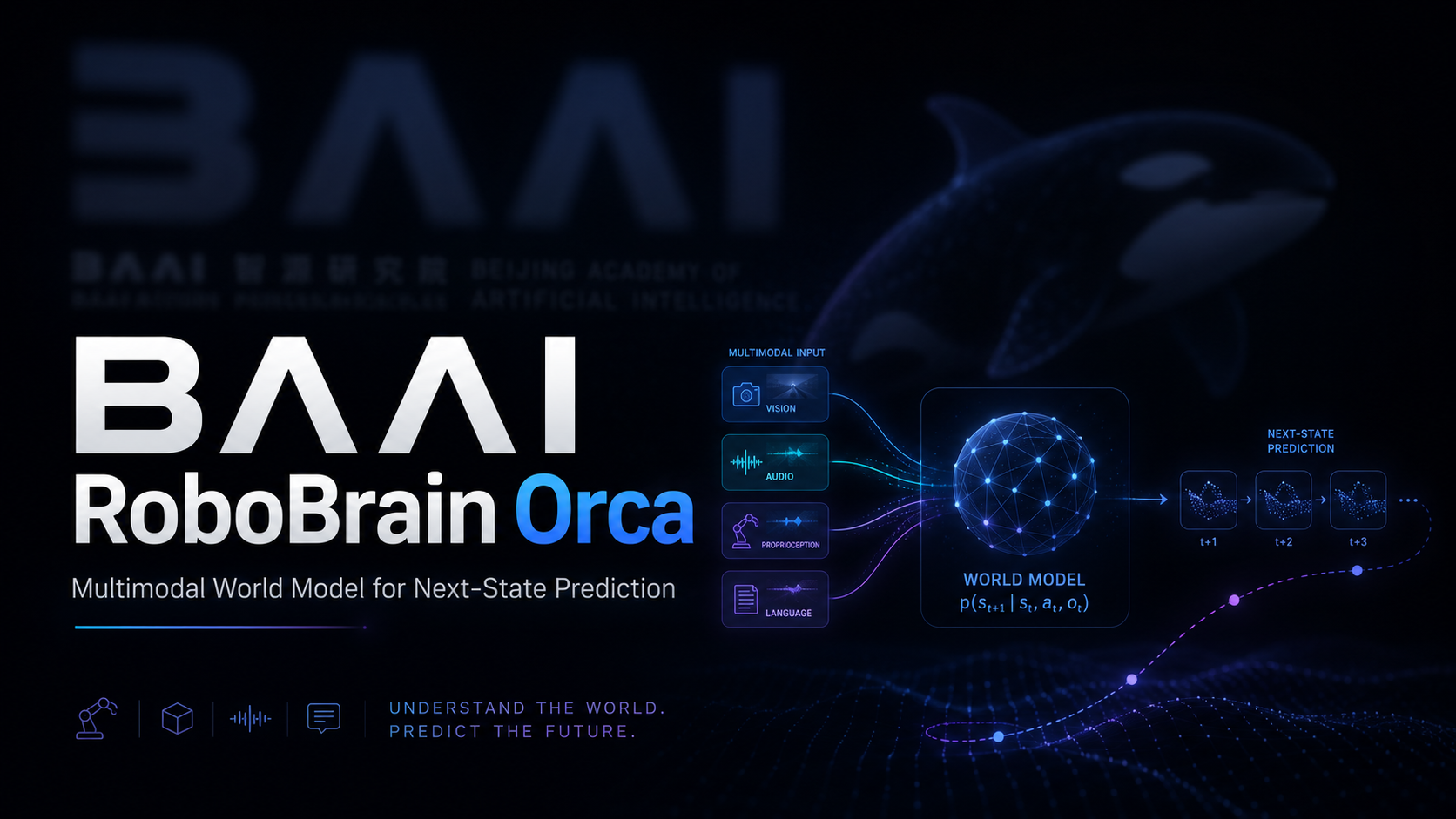
BAAI RoboBrain Orca: A Multimodal World Representation Model
Introduction
Modern AI systems can already do many impressive things. A language model can answer questions and write code. An image or video model can generate realistic visual content. A robot model can learn to grab, place, or move objects.
But these abilities often come from separate prediction targets. A language model predicts the next token. A video model predicts the next frame. A robotics policy predicts the next action. Each target is useful, but it still leaves a deeper question: does the model understand how the world itself changes?
BAAI’s RoboBrain Orca project, introduced in the technical report “Orca: The World is in Your Mind,” explores this problem from the perspective of world representation. Orca is not positioned as just a stronger chatbot, a prettier image generator, or a direct imitation-learning policy for robots. Its core idea is more foundational: learn a shared latent representation of world states first, then read that representation out into language understanding, image prediction, and action generation.
Project Background
The original article starts from a simple but important observation: AI can generate outputs, but output generation is not the same as world understanding.
For example:
- If a cup is knocked over, can the model infer that water may spill?
- If a robot fails its first grasp attempt, does the model know the object is still in the scene?
- If a cooking video moves from washing vegetables to cutting vegetables, does the model understand this as event progression rather than only visual change?
- After an action happens, can the model track how objects, relations, and task progress have changed?
These questions point to a broader goal. A useful world model should not only predict an external output. It should build an internal representation of world state and state transition.
Orca’s project page and technical report describe this as a shift from Next X Prediction to Next State Prediction. Instead of separately predicting the next token, next frame, or next action, Orca tries to learn how a world state evolves under natural dynamics, event conditions, and task intentions.
Project homepage: https://orca-wm.github.io
Technical report: https://arxiv.org/abs/2606.30534
Research Community Response
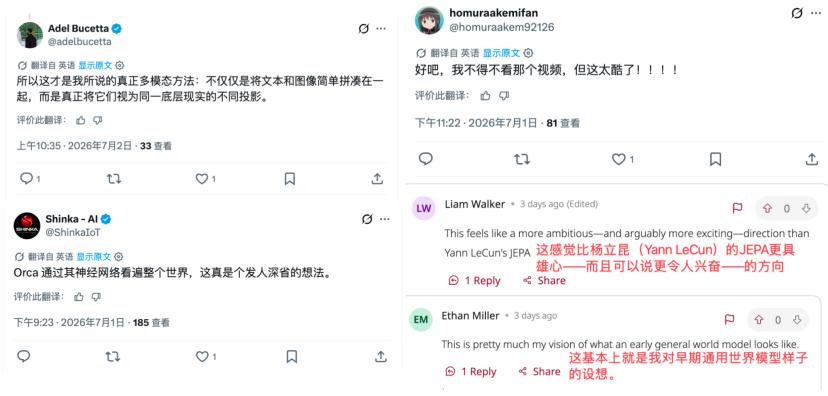
After the release, Orca drew attention from research communities interested in world models, multimodal representation, and embodied intelligence. The discussion focused less on whether Orca can generate visually attractive outputs, and more on its attempt to connect text, images, video, and action as different projections of the same underlying world.
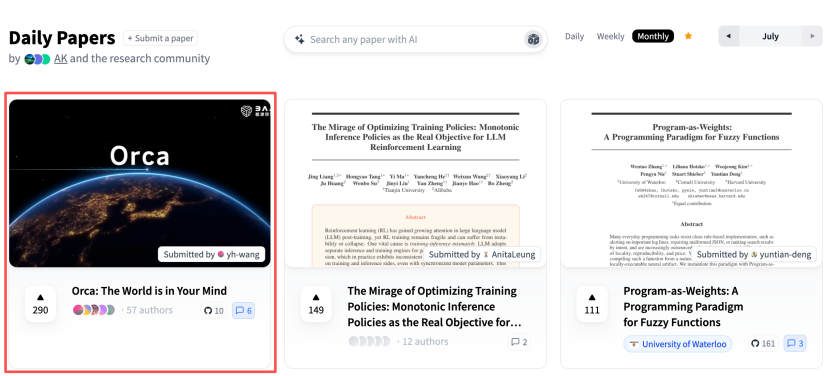
The paper also appeared on Hugging Face Papers, where it received visible community attention. This matters because world models are increasingly being evaluated not only by output quality, but also by whether their learned representations can transfer across tasks.
From Next X Prediction to Next State Prediction
Over the past few years, many AI breakthroughs can be described as forms of “predict the next X.”
Language models predict the next token, which gives them writing, reasoning, dialogue, and coding abilities. Video models predict or synthesize future frames, which helps them create more coherent motion. Embodied models often predict the next action, allowing robots to perform manipulation tasks.
Orca argues that this is not enough for agents that must operate in the real world. Language, images, and actions are only different interfaces to the world. The deeper target is the world state itself.
In Orca’s framing, Next State Prediction means learning an internal state representation that can support physically and semantically consistent transitions. That state is not identical to a sentence, an image, or an action trajectory. It is closer to a compressed latent representation of the world.
Once such a representation is learned, different readout modules can use it in different ways:
- A language readout can explain or reason about the state.
- An image readout can predict a plausible future visual state.
- An action readout can help a robot choose what to do next.
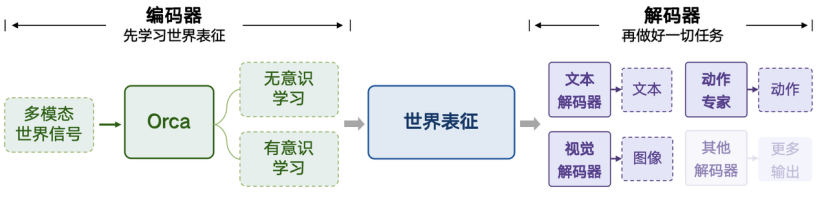
This is why the project uses the phrase “The World is in Your Mind.” The world is not treated as disconnected tokens, frames, and action labels. It is modeled as a latent space that can be read out through multiple modalities.
What Does RoboBrain Orca Try to Teach the Model First?
If a robot is compared to a child, many current approaches are like sending the child directly to a workbench and asking it to repeat a specific task until it becomes good at that task.
Orca follows a different order. Before teaching a robot exactly how to act, it tries to give the model a more general education about world changes.
That includes basic regularities such as:
- objects can fall;
- liquids can flow;
- occlusion does not mean disappearance;
- contact can change object positions;
- events have temporal order;
- task progress changes as the environment changes.
The motivation is straightforward. If a model first learns how world states change, then a smaller amount of action data may be enough to connect that representation to robot control. This could reduce training cost and improve generalization.
Two Learning Modes and Three Training Signals
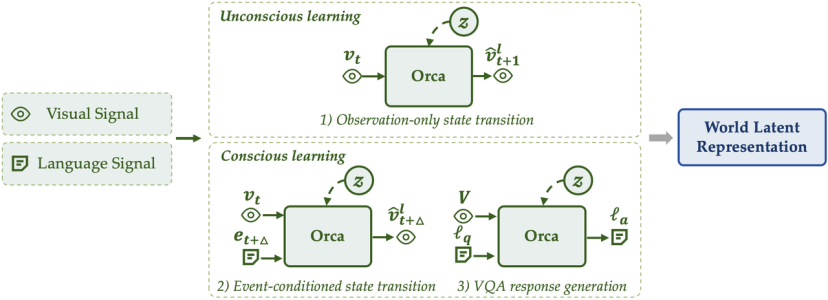
Orca uses two complementary learning modes: unconscious learning and conscious learning.
Unconscious learning captures dense natural transitions from continuous observations. The model watches how scenes, objects, occlusion, contact, and movement evolve without needing action labels or explicit task instructions.
Conscious learning adds semantic structure. It uses event descriptions, language, and VQA-style supervision so the model can connect visual changes with human concepts, instructions, and causal meaning.
Together, these learning modes are supported by three major signal types.
1. Continuous Video for Natural State Transitions
The first signal is continuous real-world video. This gives the model dense experience of natural state changes, such as object motion, scene evolution, contact effects, and occlusion.
This type of learning does not require the model to know the task goal in advance. It is closer to passive observation: the model learns how the world changes by watching the world change.
2. Event Data for Semantic State Transitions
The second signal is event-level organization. Real-world processes are not just isolated frames. People naturally describe them as events: washing vegetables before cutting them, opening a faucet before water changes the state of food, or moving a hand before an object changes position.
Event supervision helps Orca learn meaningful state transitions under specific semantic conditions.
3. VQA and Language Supervision for Reasoning and Expression
The third signal is language-based understanding. Language is not the final goal of Orca, but it is an important interface between world states and human intent.
VQA supervision helps align visual states, event structure, and natural language. In other words, the model should not only notice that something changed, but also describe and reason about why the change matters.
World-Learning Data Scale
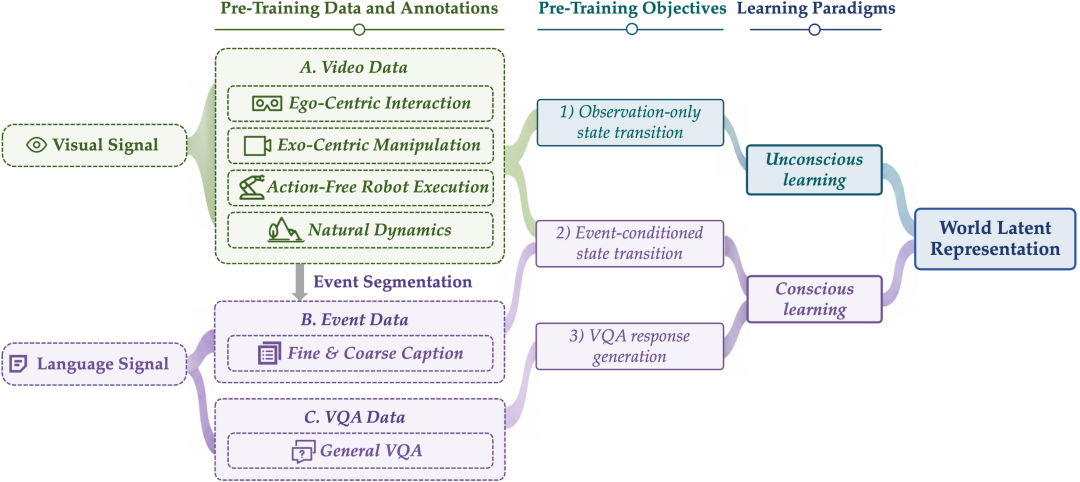
To support world-state learning, Orca uses a large-scale world-learning data inventory. The original article and the official project page describe the following resources.
| Resource Type | Scale | Role in Learning |
|---|---|---|
| Continuous video | About 125K hours | Dense observation of natural state transitions |
| Event annotations | About 160M events | Semantic supervision for meaningful state transitions |
| VQA examples | About 11.5M examples | Language alignment and question-conditioned state understanding |
These data sources cover egocentric interaction, exocentric manipulation, robot execution videos, natural dynamic scenes, event-level transitions, and general visual question answering.
The important point is that Orca is not trained only on robot trajectories or only on visual question answering. It tries to learn a broader latent world space from multiple kinds of real-world signals.
Scaling Behavior: Can the World Latent Keep Improving?
A world representation is useful only if it can be tested and improved. Orca’s experiments therefore ask two core questions.
- Does the learning paradigm scale with data and model size?
- Does a better world representation improve downstream performance?
The scaling results suggest that as pre-training data increases, loss continues to decrease for both the 0.8B and 4B models. The 4B model also reaches a lower loss level than the 0.8B model.
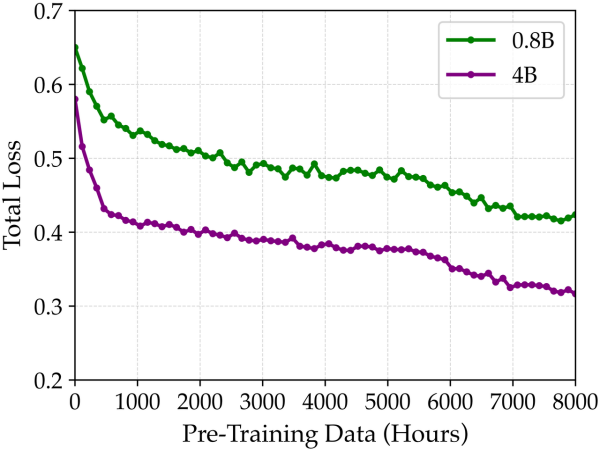
This supports the idea that next-state prediction is not only a small-scale trick. It appears to be a scalable world-learning objective, at least within the tested range.
How Orca Tests Whether the Latent Is Useful
The key test is not whether Orca can invent a nice-sounding concept. The test is whether the learned latent can support real downstream tasks.
Orca freezes the pre-trained backbone and attaches lightweight readout modules for three directions:
- Text readout for language understanding and reasoning;
- Image readout for future-state visual prediction;
- Action readout for robot control and embodied task execution.
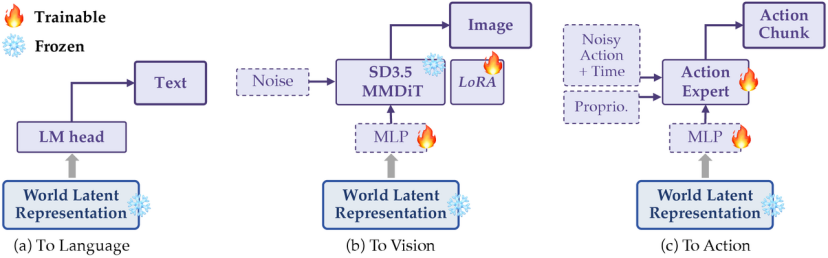
This design matters because the frozen backbone prevents downstream modules from simply relearning everything from scratch. If different readouts can extract language, image, and action abilities from the same frozen latent, then the latent representation itself is likely carrying useful world-state information.
The downstream results also improve as pre-training scales.
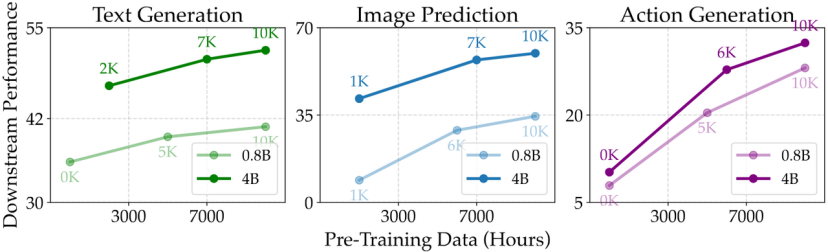
Text Readout: Stronger on Questions About World Change
In text generation and VQA tasks, Orca is compared with several visual language models and world models, including V-JEPA, Emu3, Qwen3.5, Gemma, MiniCPM-V, and DeepSeek-VL2.
The reported results show that Orca’s 4B model performs strongly among similar-size models, especially on questions involving temporal reasoning, state transition, and dynamic motion.
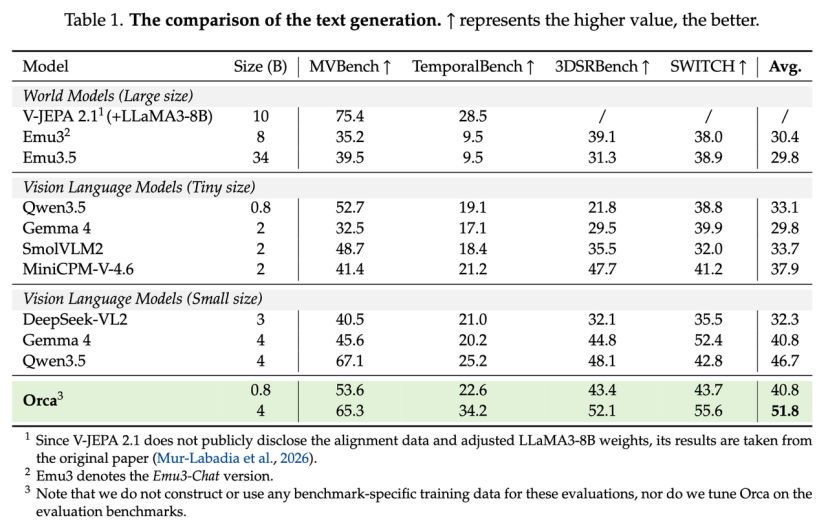
A simplified capability breakdown from the article is shown below.
| Capability Dimension | Qwen3.5-4B | Orca-4B | Orca Advantage |
|---|---|---|---|
| State transition | 51.86 | 64.13 | +12.27% |
| Commonsense reasoning | 57.76 | 62.95 | +5.19% |
| Spatial relations | 54.68 | 55.25 | +0.57% |
| Dynamic motion | 57.03 | 65.55 | +8.52% |

This pattern is important. Orca’s advantage is not only about recognizing objects in a static scene. The larger gains appear in categories closer to world dynamics: how a state changes, how events unfold, and how motion affects the scene.
For a world model, this is more meaningful than ordinary image understanding alone. The real world is not a collection of still pictures. It is a changing system.
Image Readout: Predicting a Reasonable Future State
Orca’s image readout is not presented as a standard image generation feature. It is used as a way to test whether the model can predict a plausible next visual state after an interaction.
This differs from ordinary image generation. A typical image generator may create something visually appealing, but still break the actual constraints of the scene. It might add objects that were not there, remove the robot embodiment, ignore the instruction, or follow a stereotype rather than the current state.
For example, if a prompt mentions a red balloon, a normal generator may draw a fully inflated red balloon regardless of the real balloon state. A world-state predictor should instead reason from the current scene and the interaction condition.
On the PRICE real-world interaction benchmark, Orca is evaluated against image generation baselines such as FLUX and OmniGen2. The goal is not only visual quality, but whether the predicted future state respects scene layout, object relations, robot embodiment, and physical constraints.
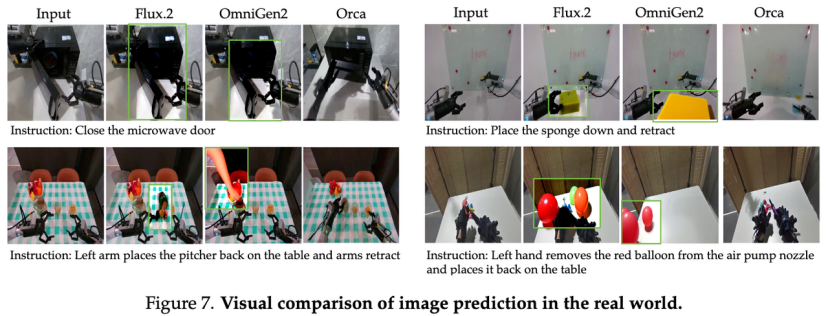
In this context, image prediction becomes a visible probe of world understanding. The question is not “Can the model draw a nice picture?” The question is “Does the model know what this scene should become after the described interaction?”
Action Readout: Helping Robots Generalize Without Action Pre-Training
One of Orca’s most interesting experiments is the action readout for real robots.
During pre-training, Orca does not use action-labeled robot trajectories. It does not first memorize how a specific arm should move. Instead, it learns world-state changes from videos, events, and language.
For downstream action tasks, the researchers freeze the Orca backbone and attach a DiT-style Action Expert trained from scratch. Each task uses a small amount of in-domain trajectory data, and the model is then evaluated in out-of-distribution dual-arm manipulation settings.
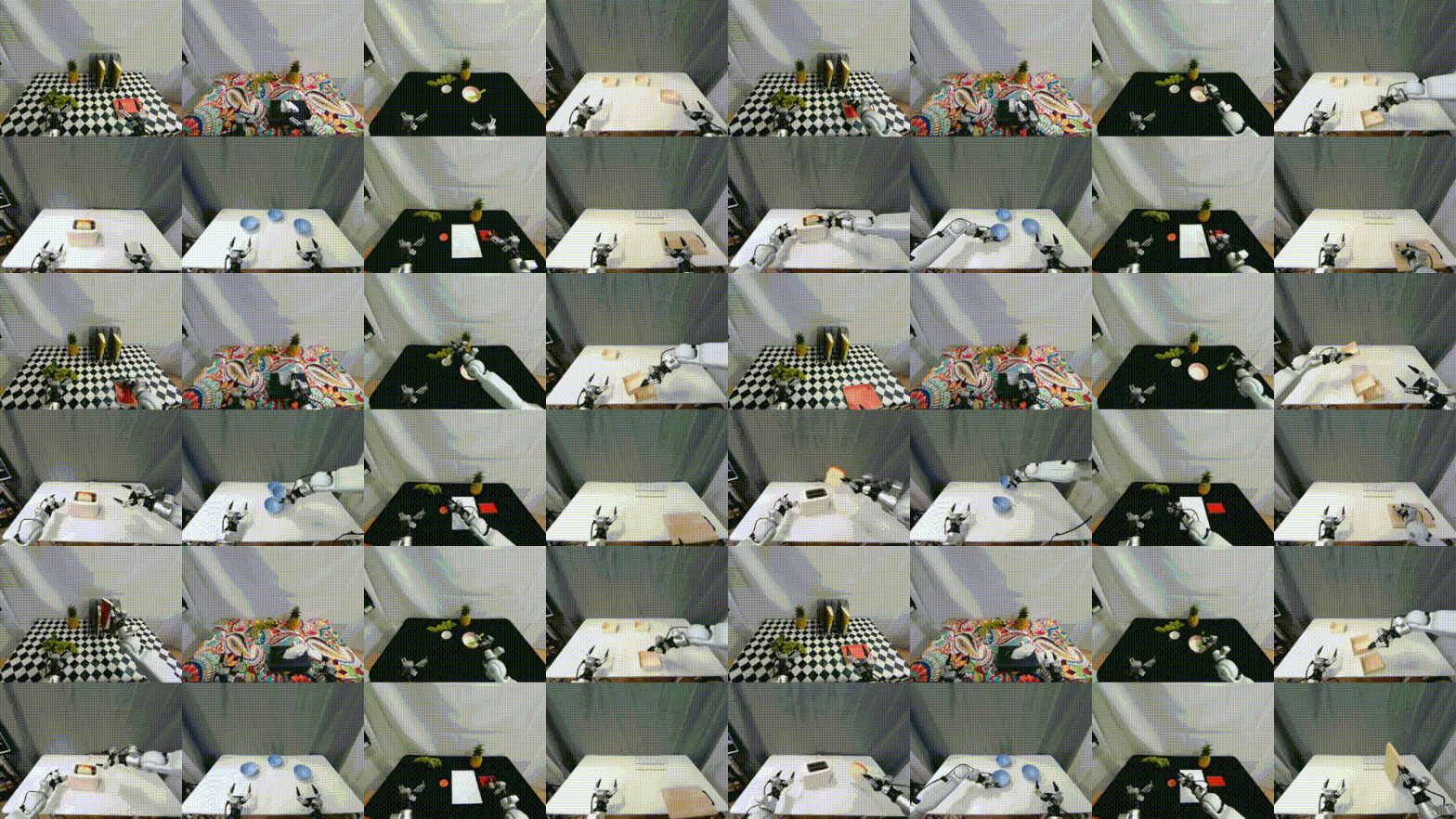
The reported action-generation comparison shows that Orca improves overall task advancement and recovery behavior compared with several baselines.
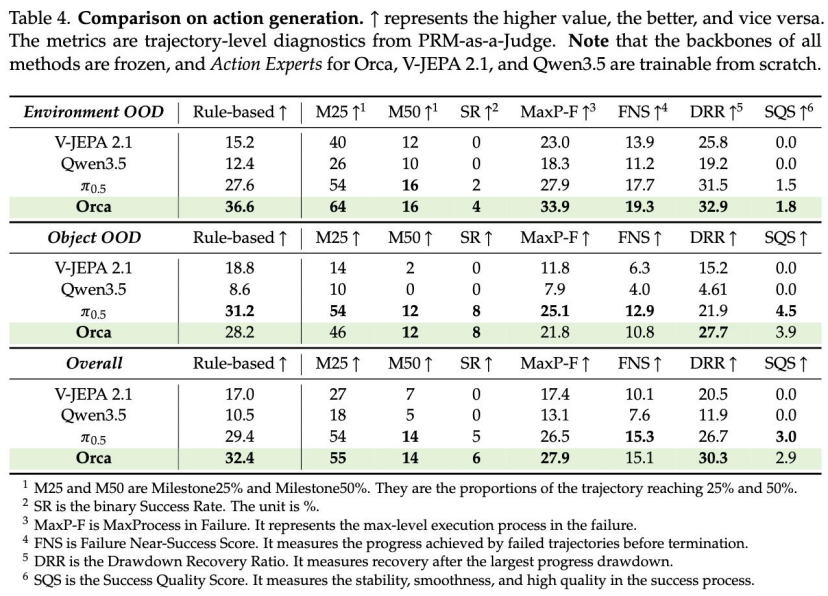
A simplified overall comparison is shown below.
| Model | Rule-based ↑ | M25 ↑ | M50 ↑ | SR ↑ | MaxP-F ↑ | FNS ↑ | DRR ↑ | SQS ↑ |
|---|---|---|---|---|---|---|---|---|
| V-JEPA 2.1 | 17.0 | 27 | 7 | 0 | 17.4 | 10.1 | 20.5 | 0.0 |
| Qwen3.5 | 10.5 | 18 | 5 | 0 | 13.1 | 7.6 | 11.9 | 0.0 |
| π₀.₅ | 29.4 | 54 | 14 | 5 | 26.5 | 15.3 | 26.7 | 3.0 |
| Orca | 32.4 | 55 | 14 | 6 | 27.9 | 15.1 | 30.3 | 2.9 |
The recovery examples are especially relevant. In real robotics, the first attempt often fails. A system that only maps observations to memorized actions may get stuck after a disturbance. A system with stronger world-state representation has a better chance of noticing that the task is unfinished, the object still exists, and the current state still has a path toward the goal.
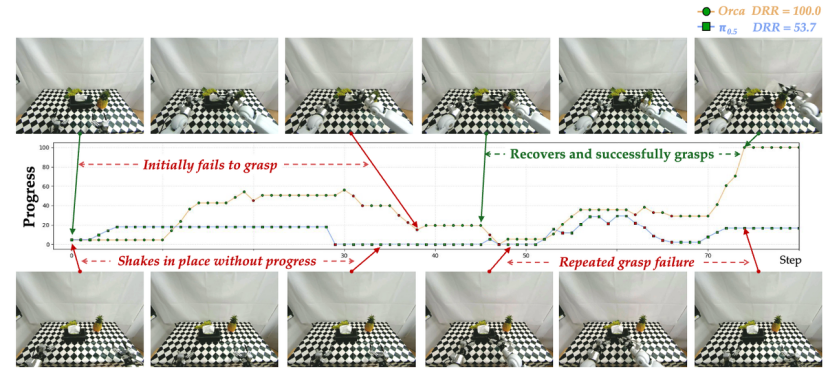
This is the practical value of learning world state before action. Orca does not argue that action data is unnecessary. Instead, it changes the learning order: first learn scalable world dynamics, then connect that representation to robot action with a smaller amount of task-specific data.
Why the Three Training Objectives Matter Together
The article also discusses ablation experiments. The researchers remove different training objectives and observe how text, image, and action readouts change.
The result is that the three objectives play different roles.
- VQA supervision preserves the language interface and semantic alignment.
- Continuous video supports dense natural dynamics and is especially important for action readout.
- Event-conditioned learning connects language, event structure, and visual state transition, which helps image prediction follow instructions.
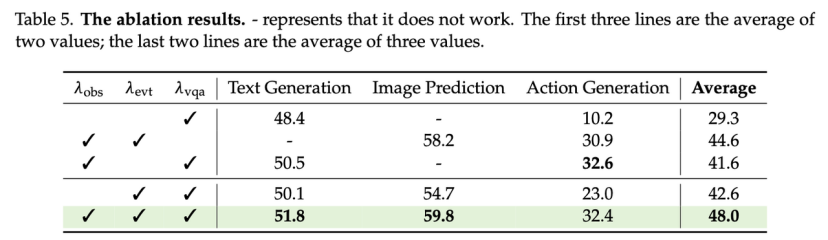
The main lesson is that a world representation is not produced by one supervision signal alone. It is shaped by multiple constraints: natural change, semantic events, language reasoning, and state transition.
Infrastructure Optimization: FlagScale Acceleration
The article also mentions system-level training improvements based on BAAI’s FlagScale framework. The team reports upgrades around FSDP2, chunked cross-entropy loss, and forward/backward prefetching.
On an H100 cluster, these changes reportedly increase training throughput from the StarVLA baseline of 0.66 samples/sec/GPU to 2.91 samples/sec/GPU, a 4.4x acceleration.
This part is important because world-model training depends heavily on scale. If the training system cannot efficiently handle large video, event, and multimodal supervision pipelines, the modeling idea becomes hard to test in practice.
What Orca Means for World Models
Orca is still an early version. The technical report and project materials describe several limitations.
Current Orca mainly relies on visual and language signals. It does not yet fully cover touch, force, sound, proprioception, and other physical modalities that would matter for richer world modeling. The current approach also still depends partly on existing visual encoders and multimodal representation spaces.
The model scale and data scale are early compared with the long-term ambition of general world foundation models. Image prediction, action generalization, and evaluation methods for world modeling also need more work.
Still, Orca’s value is not in claiming that world modeling is solved. Its value is that it offers a concrete route:
- Learn a unified world state from scalable multimodal signals.
- Freeze that world-state backbone.
- Read it out into language, image, and action tasks.
- Use downstream performance to test whether the latent is actually useful.
If this direction continues to improve, it could matter beyond robotics. Many domains involve state, intervention, and transition: physical systems, biology, environmental modeling, scientific experiments, and agentic decision-making.
The larger question is whether future AI systems can first build an internal, stable, transferable model of the world before generating answers, images, or actions.
That is the core idea behind Orca: The World is in Your Mind.
FAQ
What is BAAI RoboBrain Orca?
BAAI RoboBrain Orca is an early world foundation model project focused on next-state prediction. It learns a latent world representation from multimodal signals and uses lightweight readout modules for language, image prediction, and action generation.
What does “Next State Prediction” mean?
Next State Prediction means predicting how the underlying world state changes, not only predicting the next token, frame, or action. The goal is to model state transitions in a way that can support reasoning, visual prediction, and embodied control.
Is Orca mainly a language model, an image model, or a robot model?
Orca is not limited to one of those categories. It learns a shared world latent first, then uses different readouts for language, vision, and action. This is why it is described as a multimodal world model rather than a single-purpose model.
What data does Orca use for pre-training?
Orca uses large-scale world-learning resources, including about 125K hours of video, 160M event annotations, and 11.5M VQA examples. These signals help the model learn natural dynamics, event-conditioned transitions, and language-aligned understanding.
Why does Orca freeze the backbone during downstream readout training?
Freezing the backbone makes the evaluation cleaner. If lightweight readout modules can perform well while the backbone stays frozen, it suggests that the useful information is already present in the learned world latent rather than being relearned from scratch downstream.
Can Orca control robots directly?
In the reported action experiments, Orca’s frozen world latent is connected to a trainable action expert for robot tasks. It is not simply a direct plug-and-play robot controller, but the results suggest that world-state pre-training can help downstream robotic generalization.
Is Orca production-ready?
The available materials present Orca as an early research direction, not a finished production system. The project still needs broader physical modalities, stronger evaluation methods, larger-scale training, and released checkpoints or inference code for wider reproduction.
Where can I read the official Orca materials?
The best starting points are the official Orca project page, the arXiv technical report, the GitHub repository, and the Hugging Face paper page. These sources provide the most direct references for the model design, data, evaluation, and citation.
Related Tools
- Orca Project Page: Official project page for the Orca world foundation model.
- Orca GitHub Repository: Official repository for project information, figures, and future code or checkpoint releases.
- arXiv: Official technical report page for “Orca: The World is in Your Mind.”
- Hugging Face Papers: Community paper page for discussion, collections, and paper tracking.
- FlagScale: BAAI-related large-model training toolkit referenced in the infrastructure optimization section.
- PyTorch FSDP fully_shard: Official PyTorch documentation for the FSDP2-style sharding API.
Related Links
- Orca Official Project Page: Main project site with the model overview, data, evaluation, and citation.
- Orca arXiv Technical Report: Research paper for the Orca world foundation model.
- Orca GitHub Repository: Official repository containing the project README and release roadmap.
- Orca on Hugging Face Papers: Community page for the Orca paper on Hugging Face.
- FlagScale GitHub Repository: Training toolkit related to the infrastructure optimization described in the article.
- PyTorch FSDP fully_shard Documentation: Official reference for fully sharded distributed training APIs.
Summary
RoboBrain Orca explores a shift from predicting isolated outputs to modeling world-state transitions. Instead of treating language, images, and actions as separate targets, it tries to learn a shared latent world representation that can support multiple readout interfaces.
The article explains Orca’s learning setup, including continuous video, event annotations, and VQA data. It also walks through the three main readouts: text reasoning, future-state image prediction, and robot action generation.
The most important idea is not that Orca has completed world modeling. It is that Orca offers a testable route for building and evaluating a latent world model across language, vision, and action.
In short: Orca is an early attempt to make AI understand state change before it generates words, images, or actions.