Qingcheng.ai Builds a Token “Super Grid” at WAIC 2026 and Claims 75% Lower DeepSeek Deployment Costs
At WAIC 2026, model companies filled the exhibition halls with parameter counts, while infrastructure providers displayed increasingly large compute clusters. At the Qingcheng.ai booth, however, the main attraction was not a single model or server. It was a complete diagram showing how Tokens could be produced, routed, distributed, measured, and governed across the full AI Agent lifecycle. Qingcheng.ai calls the model **Token “Front Shop, Back Factory”**. The framework combines three layers: 1.
Qingcheng.ai Builds a Token “Super Grid” at WAIC 2026 and Claims 75% Lower DeepSeek Deployment Costs
Introduction
At WAIC 2026, model companies filled the exhibition halls with parameter counts, while infrastructure providers displayed increasingly large compute clusters. At the Qingcheng.ai booth, however, the main attraction was not a single model or server.
It was a complete diagram showing how Tokens could be produced, routed, distributed, measured, and governed across the full AI Agent lifecycle.
Qingcheng.ai calls the model Token “Front Shop, Back Factory”. The framework combines three layers:
- A back-end Token production layer
- A middle routing and service layer
- An Agent application and governance layer
The company presents the architecture as an AI-era equivalent of a power system. Compute hardware and inference software act as the power plant, AI Ping functions as the grid, and Agent tools become the devices consuming the electricity.
The Qingcheng.ai booth presented a full Token production, routing, and governance workflow.
According to the original report, the system is intended to address three recurring problems: unstable model APIs, poor utilization of heterogeneous domestic accelerators, and the lack of clear Token accounting across large Agent deployments.
The Token Bottleneck Before Large-Scale Agent Adoption
As AI Agents move from demonstrations into production, one user request can trigger many model calls.
An Agent may need to retrieve files, search databases, invoke tools, generate code, evaluate results, revise its plan, and call another Agent. The visible response is only the final step. Underneath it, the system may consume a large number of Tokens across several services.
The original article identifies three infrastructure problems that become more serious as these workflows expand.
Unstable Token Supply
Model API capacity can fluctuate during periods of high demand.
The same request may return quickly at one moment and become slow or unavailable later. A brief delay may be acceptable in a casual chat, but it can interrupt a multi-step Agent workflow in which every later action depends on the previous response.
Enterprise systems therefore need more than access to a model. They need predictable latency, throughput, reliability, and output quality.
Domestic Accelerators Can Be Difficult to Use Efficiently
Many organizations have purchased a mix of domestic GPUs, NPUs, and intelligent-computing servers. The hardware may be available, but deploying large models efficiently across it remains difficult.
Popular inference frameworks such as vLLM were initially optimized around the NVIDIA and CUDA ecosystem. They can support a growing range of devices, but adapting every feature and optimization to a different accelerator architecture still requires substantial engineering work.
Qingcheng.ai argues that a native inference engine and a hardware-aware software stack can extract more usable Token output from these clusters.
Agent Spending Is Difficult to Trace
When a company operates several Agents, a monthly model bill does not always show which workflow created the cost.
A single Agent may call several models, use multiple providers, launch subagents, and run for hours. Without detailed tracing, organizations may struggle to answer basic questions:
- Which Agent consumed the Tokens?
- Which model and provider did it call?
- Which tool or step created the largest cost?
- Did one workflow exceed its expected budget?
- Could the request have been routed to a cheaper service?
Qingcheng.ai positions its three-layer system as a way to connect production, distribution, application, and accounting in one infrastructure stack.
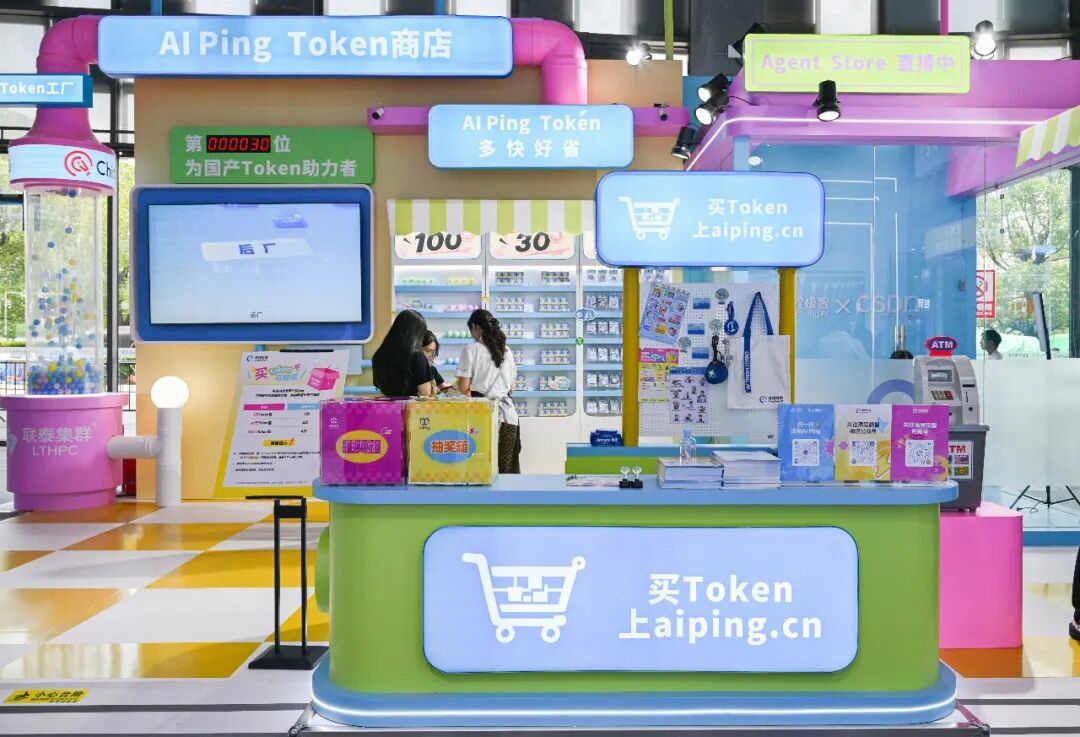
The exhibition blueprint mapped the flow from underlying compute to Agent applications.
The Three-Layer “Front Shop, Back Factory” Architecture
The architecture is built around a simple industrial analogy.
The back factory produces Tokens from computing hardware. The shop aggregates and routes Token services. The application nodes distribute Agents and control how Tokens are consumed.
Qingcheng.ai’s architecture connects Token production, service routing, and Agent governance.
The three layers are designed to work together rather than as isolated products.
Back Factory: The Token Production Layer
The back factory is responsible for converting physical compute into standardized model inference capacity.
Its main components are:
- Hardware and computing partners
- The Chitu inference engine
- The Bagualu intelligent software stack
Qingcheng.ai compares this layer to a power plant. The goal is to generate as many stable, usable Tokens as possible from the available hardware while reducing deployment complexity.
Chitu: A Production-Oriented Inference Engine
Chitu is Qingcheng.ai’s open-source high-performance inference framework.
The official repository describes it as a production-oriented engine focused on efficiency, flexibility, and availability. It supports deployment from CPUs and single accelerators to larger clusters, with optimized support for several domestic hardware platforms.
The project also supports models including DeepSeek, Qwen, GLM, and Kimi, as well as standard OpenAI-compatible HTTP interfaces.
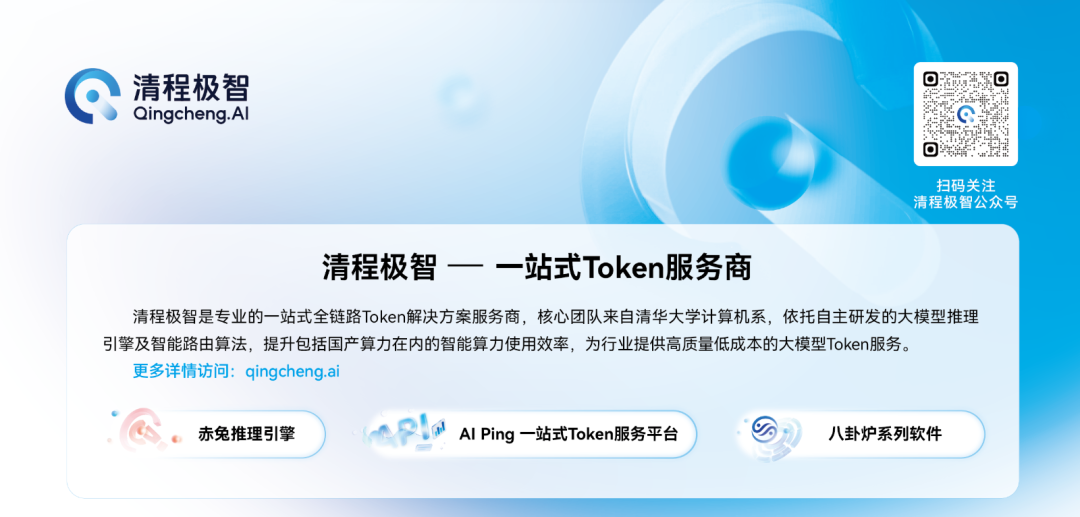
Chitu is used to improve large-model inference across heterogeneous compute platforms.
Qingcheng.ai argues that adapting a framework designed around one hardware ecosystem can resemble using the wrong tool for the job. The company’s analogy is that an oven built for bread can be modified to steam buns, but a purpose-built steamer may use the available heat more effectively.
The comparison is simplified, but the engineering issue is real. Accelerator architectures differ in memory, communication, operators, numerical formats, compilation, and scheduling behavior.
Chitu includes hardware-specific optimization and low-precision inference support, including FP4 and FP8 configurations.
The 75% DeepSeek Cost Claim
The original report states that an FP4 deployment of a DeepSeek model reduced the required hardware footprint from four machines to one.
In that specific configuration, reducing the machine count from four to one represents a 75% reduction in the number of machines required. The article translates that reduction into a 75% cost saving.
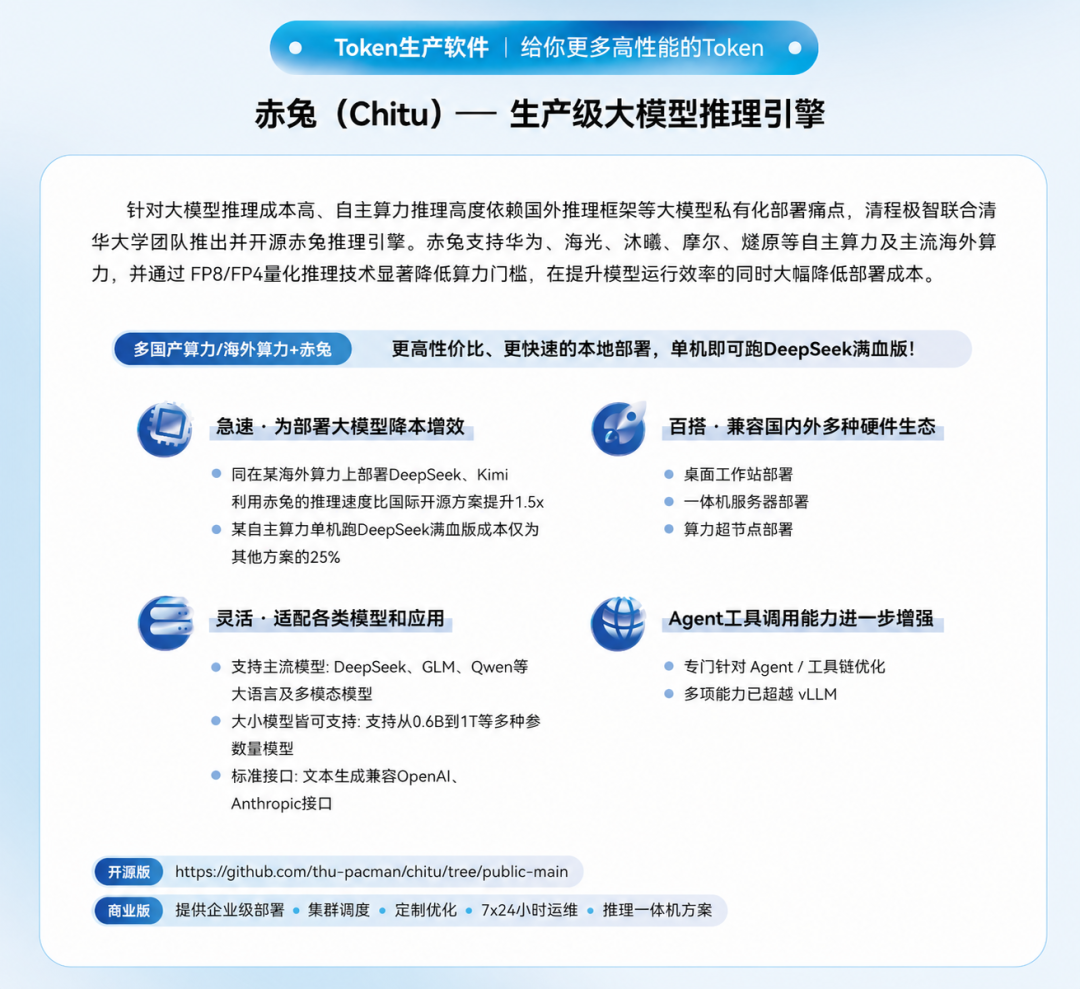
The report attributes a four-machine-to-one-machine DeepSeek deployment to FP4 optimization.
This result should not be interpreted as a universal guarantee that every DeepSeek deployment will cost 75% less.
Actual savings depend on factors such as:
- The selected DeepSeek model and quantization
- Accelerator type and memory capacity
- Server configuration
- Context length
- Batch size and concurrency
- Latency targets
- Accuracy requirements
- Software version
- Power and operational costs
The open-source Chitu repository also notes that performance results can vary with hardware, software, and test load.
Bagualu: Hiding Infrastructure Complexity
Bagualu is Qingcheng.ai’s software stack for model training, inference, deployment, scheduling, and operations.
The company presents it as a way to package difficult infrastructure work into a more manageable enterprise platform.
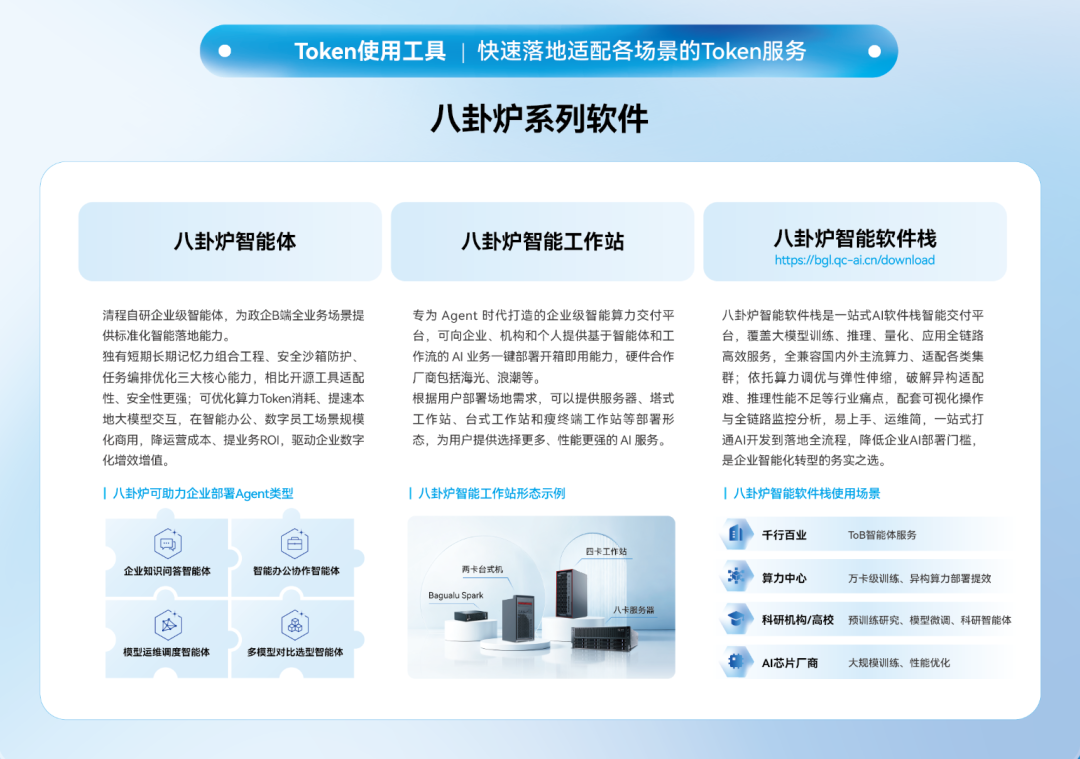
Bagualu sits above heterogeneous hardware and provides deployment and operational tooling.
Bagualu is designed to reduce the amount of manual work required for:
- Cluster resource management
- Model and application deployment
- Distributed training
- Inference optimization
- Performance evaluation
- Application delivery
- Monitoring and operations
Qingcheng.ai has also worked with Inspur Information on a jointly optimized MetaBrain Bagualu appliance. In a published Qwen3-32B test, the partners reported up to a 14.45× improvement in total inference throughput after Chitu optimization and approximately a 10× end-to-end improvement after full-stack tuning.
Those figures come from the companies’ own test environment and are not equivalent to the DeepSeek FP4 case described at WAIC.
Heterogeneous Cluster Optimization
The back-factory layer is intended to manage more than one type of accelerator.
One strategy mentioned in the original report is separating prefill and decode workloads.
During prefill, the system processes the input prompt and builds the model’s internal cache. During decoding, it generates output Tokens one step at a time. These stages have different memory, bandwidth, and computing characteristics.
A heterogeneous cluster can assign each stage to the hardware that handles it most efficiently. This is sometimes called prefill-decode disaggregation.
The goal is not simply to make every accelerator behave identically. It is to give different hardware the part of the workload that best matches its strengths.
Shop: AI Ping as a Token Routing Hub
Once Tokens have been produced, applications still need a stable way to obtain them.
The middle layer is AI Ping, Qingcheng.ai’s model-service evaluation and API routing platform.
AI Ping monitors model services continuously and provides a unified interface across multiple providers.
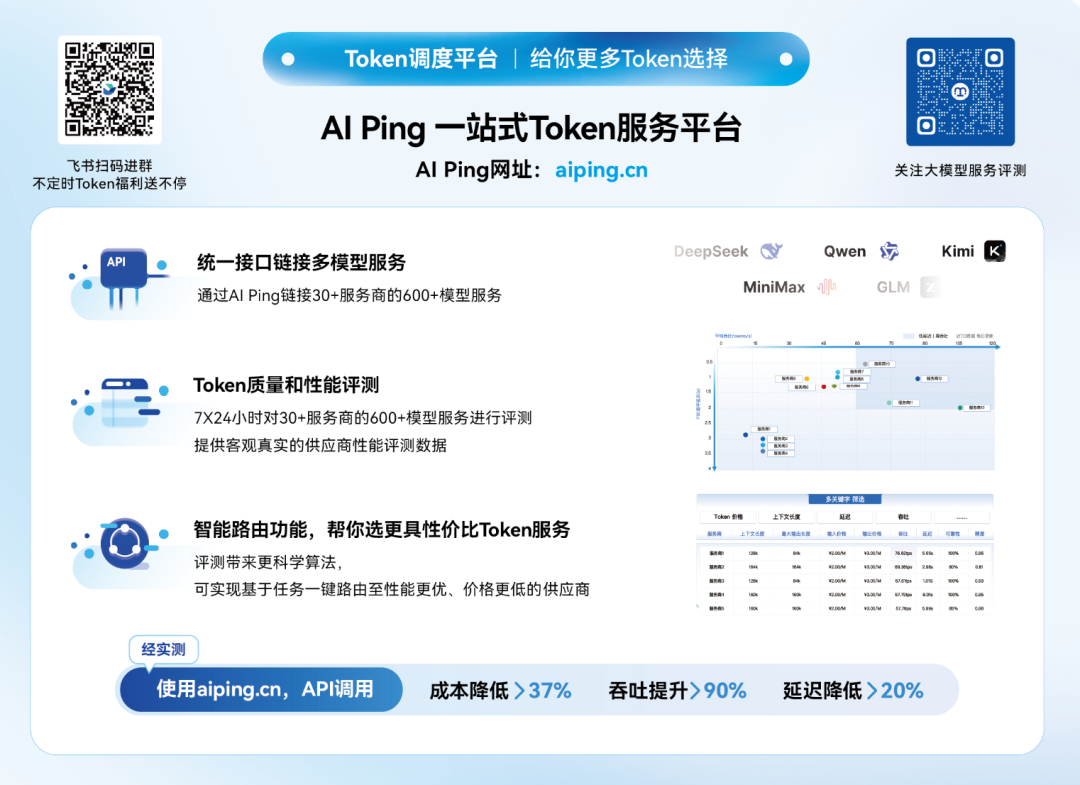
AI Ping evaluates model APIs and routes requests across service providers.
The original report states that AI Ping monitors:
- More than 30 service providers
- More than 600 model-service interfaces
- Latency
- Throughput
- Reliability
- Cache hit rates
- Token quality
- Pricing and service availability
The platform is designed to reduce the need for developers to create accounts, manage separate API formats, and manually compare every provider.
A user can prioritize goals such as:
- Lower cost
- Faster responses
- Higher reliability
- Better output quality
If no preference is provided, AI Ping can use its routing logic to select an available service.
Dynamic Routing During Service Congestion
A static integration sends every request to the same provider until a developer changes the configuration.
Dynamic routing works differently. If one provider becomes slow or unavailable, the routing layer can direct later requests to another service that currently performs better.
This can be useful for Agent workloads because a single interruption may break a longer task.
The platform’s intended feedback loop works like this:
- AI Ping continuously measures service quality.
- Routing decisions use the latest measurements.
- Real customer traffic provides additional performance data.
- The new data improves future evaluation and routing.
Qingcheng.ai says that the unified API allows smaller teams to access routing and monitoring capabilities that would otherwise require an internal platform team.
The company has separately reported average improvements in cost, throughput, and latency through AI Ping. Those percentages are platform-reported results and will vary with the selected models, providers, traffic pattern, and routing policy.
Application Nodes: Agent Store and ATM
The final layer focuses on how Agents are distributed and how their Token use is governed.
Its two components are:
- Agent Store
- ATM, or Agent Token Manager
Agent Store
The Agent Store is described as a distribution and reuse layer for general-purpose and industry-specific Agents.
Its purpose is to connect Agent developers with organizations that need deployable workflows, while giving those Agents access to the broader Token infrastructure.
The original report compares it to an appliance marketplace connected to a shared power grid.
Public documentation about Agent Store pricing, review standards, deployment formats, and commercial terms was limited at the time this file was prepared.
ATM: Agent Token Manager
ATM stands for Agent Token Manager.
Qingcheng.ai introduced it at WAIC 2026 as a local Token-management and governance tool for multi-Agent systems.
The tool is intended to provide:
- Unified management of API credentials
- Token usage tracking
- Cost allocation
- Spending limits
- Provider switching and recovery
- Multi-Agent resource isolation
- Alerts for unexpected usage
- Local or privacy-aware monitoring
The original article says ATM can observe Agent activity through mechanisms such as behavior hooks, local file scanning, and a privacy gateway.
In practical terms, ATM functions like an electricity meter for AI workloads. It aims to connect a Token charge to the Agent, action, model, and tool that created it.
This is closely related to FinOps, the discipline of measuring and controlling cloud spending. In an Agent system, the challenge is more detailed because one business workflow can include many nested model calls.
A useful Agent cost record may need to capture:
- The originating user or workflow
- The Agent and subagent involved
- The selected model
- Input and output Token counts
- Tools called during the task
- Provider pricing
- Retries and failed calls
- Total cost and duration
Qingcheng.ai positions ATM as a Token-focused FinOps layer for this new type of workload.
Why Qingcheng.ai Emphasizes Neutrality
The original article argues that neutrality is one of Qingcheng.ai’s main advantages.
Large cloud and hardware companies naturally have incentives to prioritize their own platforms, partners, or investments. An organization operating a mixed cluster may therefore prefer an independent software provider that supports several competing accelerators and service vendors.
Qingcheng.ai says it does not bind its platform to a single chip provider.
That approach is reflected in Chitu’s support for several hardware environments and in AI Ping’s multi-provider routing model.
Neutrality is still a claim that must be evaluated in practice. Customers should review:
- Supported hardware and software versions
- Routing rules
- Commercial partnerships
- Benchmark methodology
- Data-retention policies
- Provider selection options
- Failure and fallback behavior
The company’s technical background is another part of its positioning.
Qingcheng.ai was founded in December 2023, and its core team came from the Institute of High Performance Computing at Tsinghua University’s Department of Computer Science and Technology. The company says the team has worked on performance evaluation and optimization for supercomputing and intelligent-computing centers.
Turning Domestic Compute into an Exportable Token Service
Qingcheng.ai also describes Token services as a possible route for domestic computing capacity to reach overseas users.
The logic is that a developer does not need to know which accelerator generated the response. The developer purchases a model API and receives Tokens.
If domestic hardware can serve a competitive model reliably and efficiently, its output can be sold through a unified API without requiring the overseas customer to deploy or learn the underlying hardware stack.
Qingcheng.ai presents Token services as a way to distribute domestic computing capacity globally.
The original report says overseas development traffic is often highest from 10 p.m. to 8 a.m. China time.
That creates a possible utilization opportunity. Capacity that would otherwise be less active during domestic off-peak hours can serve users in other time zones.
The workflow described in the article is:
- Domestic accelerators generate Tokens through Chitu.
- AI Ping measures service quality and routes requests.
- Partners distribute the service to overseas developers.
- Users consume the model through a standard API.
This does not eliminate the normal requirements of international service delivery. Providers still need to address latency, compliance, data governance, model licensing, billing, support, and regional availability.
Building Roads for the Agent Economy
The most visible products at an AI exhibition are often models and applications.
Infrastructure receives less attention because much of its work happens below the user interface. It determines whether a model can run reliably, whether an Agent can finish a task, and whether the final cost is understandable.
Qingcheng.ai’s “Front Shop, Back Factory” concept connects three questions:
- How are Tokens produced efficiently?
- How are they routed reliably?
- How are they consumed and governed by Agents?
The back factory combines hardware, Chitu, and Bagualu. The shop uses AI Ping to evaluate and route model services. The application nodes use Agent Store and ATM to distribute Agents and manage their Token usage.
The electrical-grid analogy is not a technical standard, but it gives enterprises a practical way to understand the full stack.
Instead of treating every model API, accelerator cluster, and Agent as an isolated product, the architecture treats them as connected parts of a Token supply chain.
常见问题
What is Qingcheng.ai’s Token “Front Shop, Back Factory” architecture?
It is a three-layer AI infrastructure model covering Token production, API routing, and Agent applications. The back factory uses compute hardware, Chitu, and Bagualu; the middle layer uses AI Ping; and the application layer includes Agent Store and ATM.
What is the Chitu inference engine?
Chitu is an open-source, production-oriented large-model inference framework. It supports several domestic and international accelerator platforms, multiple deployment sizes, low-precision inference, and OpenAI-compatible HTTP interfaces.
Did Chitu reduce every DeepSeek deployment cost by 75%?
No universal 75% guarantee was published. The source describes a specific FP4 deployment in which the machine requirement fell from four servers to one, which corresponds to a 75% reduction in machine count for that configuration.
Can Chitu be deployed with Docker?
Yes. The official Chitu repository provides Dockerfiles for several hardware environments, including Ascend, Hygon, and MetaX configurations, as well as general installation and deployment documentation.
What is AI Ping used for?
AI Ping monitors and compares model API services, then routes requests according to goals such as cost, speed, reliability, or quality. It provides a unified API across multiple service providers.
What is Agent Token Manager?
Agent Token Manager, or ATM, is Qingcheng.ai’s Token governance tool for Agent systems. It is intended to track usage, allocate costs, manage credentials, set limits, isolate workloads, and alert teams to unexpected consumption.
Is Bagualu an inference engine?
Bagualu is a broader software stack rather than only an inference engine. It covers areas such as training, inference deployment, scheduling, monitoring, application delivery, and cluster operations, while Chitu handles the core model-inference layer.
Is the “75% lower cost” result independently verified?
The result is presented by Qingcheng.ai and the original report. The specific deployment details required for independent reproduction were not fully provided, so readers should test the software on their own model, hardware, and workload.
相关工具
- Chitu: An open-source production-grade inference framework for large language models and heterogeneous hardware.
- AI Ping: A model-service evaluation and intelligent API routing platform operated by Qingcheng.ai.
- Bagualu: Qingcheng.ai’s software stack for model training, inference, deployment, and cluster operations.
- vLLM: A widely used open-source engine for high-throughput large-model serving.
- SGLang: An open-source serving framework for language and multimodal models.
- DeepSeek: The official platform for the DeepSeek model family discussed in the deployment example.
- OpenAI API Specification: The API format that many model-serving engines use for application compatibility.
Related Links
- Qingcheng.ai Official Website: Official product and company information for Chitu, Bagualu, and AI Ping.
- Chitu GitHub Repository: Source code, Dockerfiles, supported models, releases, benchmarks, and deployment documentation.
- Chitu Product Page: Qingcheng.ai’s overview of supported hardware, models, interfaces, and performance claims.
- Bagualu Product Page: Official information about the training and infrastructure software stack.
- AI Ping: The official model evaluation and unified API routing platform.
- Science and Technology Daily Report: An independent report covering Qingcheng.ai’s full-chain Token solution and AI Ping metrics.
- Inspur MetaBrain Bagualu Appliance: Published test details for the jointly optimized Chitu and Bagualu enterprise appliance.
Summary
At WAIC 2026, Qingcheng.ai presented a three-layer Token infrastructure designed to connect model inference, API routing, Agent distribution, and cost governance.
The back-factory layer uses Chitu and Bagualu to improve model deployment on heterogeneous computing hardware. In one company-reported FP4 DeepSeek configuration, the required machine count fell from four to one, which was presented as a 75% cost reduction.
AI Ping forms the middle routing layer, while Agent Store and ATM cover Agent distribution and Token FinOps. Together, the products are intended to make Token supply more stable, measurable, and independent of a single hardware or API provider.
The core idea is simple: AI Agents need more than models—they need an infrastructure layer that can produce, route, measure, and control every Token they consume.