Pudu Robotics at WAIC 2026: How “One Brain, Multiple Embodiments” Turns Deployment Data into Physical AI
The embodied-AI industry is becoming more practical. A robot that walks, gestures, or performs one carefully prepared demonstration can attract attention. The harder question is whether it can work for months in restaurants, hotels, factories, warehouses, shopping centers, and other unpredictable environments—and become more capable through that work. Pudu Robotics used WAIC 2026 to frame its answer around a simple strategic idea: > The next stage of robotics will be decided not only by the body of a robot, but by the intelligence system that can learn from real deployments and transfer that experience across many bodies. The company calls this architecture “One Brain, Multiple Embodiments.” Its foundation-model layer, PuduFM 1.0, is intended to help robots reason about physical consequences, connect navigation with manipulation, and learn through a combination of simulation and real-world feedback. Its agent platform, PuduAgent, packages planning, memory, execution, reusable skills, a
Pudu Robotics at WAIC 2026: How “One Brain, Multiple Embodiments” Turns Deployment Data into Physical AI
Introduction
The embodied-AI industry is becoming more practical.
A robot that walks, gestures, or performs one carefully prepared demonstration can attract attention. The harder question is whether it can work for months in restaurants, hotels, factories, warehouses, shopping centers, and other unpredictable environments—and become more capable through that work.
Pudu Robotics used WAIC 2026 to frame its answer around a simple strategic idea:
The next stage of robotics will be decided not only by the body of a robot, but by the intelligence system that can learn from real deployments and transfer that experience across many bodies.
The company calls this architecture “One Brain, Multiple Embodiments.”
Its foundation-model layer, PuduFM 1.0, is intended to help robots reason about physical consequences, connect navigation with manipulation, and learn through a combination of simulation and real-world feedback.
Its agent platform, PuduAgent, packages planning, memory, execution, reusable skills, and safety controls into a system that can coordinate different robot forms.
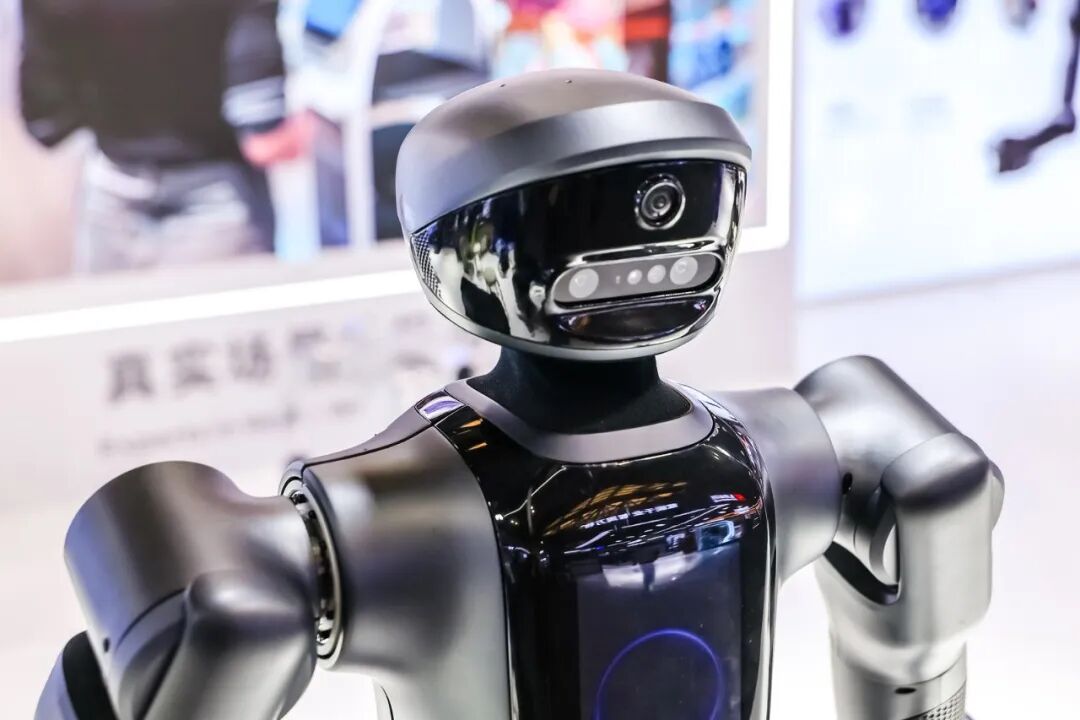
At WAIC, the industrial semi-humanoid PUDU D7 became one of the most visible hardware examples of that strategy.
From Market Leadership to the Next Robotics Competition
Pudu entered WAIC with a large installed base in commercial service robotics.
The company says that a Frost & Sullivan independent market study ranked Pudu first in four categories:
- Global commercial service robot revenue.
- Global commercial service robot shipments.
- Global commercial cleaning robot revenue.
- Overseas market share among Chinese commercial service robot companies.
Pudu also reports that it has shipped more than 130,000 robots globally. Its official materials describe deployments across more than 80 countries and regions, while its WAIC presentation cited coverage across 85 countries and regions.
These robots operate in sectors including:
- Food service.
- Hospitality.
- Retail.
- Manufacturing.
- Warehousing.
- Commercial cleaning.
- Property management.
- Healthcare.
- Entertainment and sport.
- Education.
- Public services.
Deployment at this scale is commercially meaningful, but Pudu’s embodied-AI argument goes further.
Every robot working in a real location encounters physical variations that are difficult to reproduce completely in a laboratory:
- Different floor materials.
- Moving people and equipment.
- Changing lighting.
- Narrow passages.
- Unexpected obstacles.
- Objects with different weights, shapes, and surface properties.
- Human interventions.
- Failed actions.
- Long-tail operational conditions.
For an embodied-AI company, those interactions can become training material.
The next competitive advantage may therefore come from combining hardware distribution with a system that converts operational experience into reusable intelligence.
More Than 130,000 Robots on the Front Line
Language models can learn from large collections of text, code, images, and video. Robots face a different data problem.
A robot must understand not only what an object is, but also:
- Whether it can reach the object.
- How the object may move.
- How much force an action requires.
- Whether the floor is slippery.
- Whether a planned path remains safe.
- What will happen after the robot pushes, lifts, tilts, or releases something.
- How the environment has changed since the task began.
These capabilities are difficult to acquire from a limited number of curated demonstrations.
Robots need experience from real work, but getting into real work requires a level of maturity that is itself difficult to achieve without real data.
That creates a familiar chicken-and-egg problem:
Without large-scale deployment, a company lacks diverse physical-world data. Without diverse physical-world data, it is harder to improve the robot enough for large-scale deployment.
Commercial service robots provide one way to break this cycle.
Pudu spent years placing delivery, cleaning, and industrial robots into routine business environments. Those systems did not begin as general-purpose embodied agents, but their deployment created a large channel for collecting operational signals.
Pudu says its fleet now produces annually:
| Data category | Company-reported annual volume |
|---|---|
| Real-world navigation data | 36.5 million hours |
| Real-world manipulation data | 15.8 million hours |
The company says its manipulation data is collected through an “unobtrusive data collection” mode during normal operation.
The value is not only the number of hours. Much of this material comes from the robot’s own perspective and can include real depth, scale, motion, lighting, and interaction conditions.
That first-person physical context is difficult to replace with internet video alone.
The Physical-AI Data Flywheel
Pudu’s long-term model can be described as a data flywheel:
- More robots enter commercial environments.
- The robots encounter more tasks and edge cases.
- Operational data and human interventions are captured.
- Models are trained or refined using that experience.
- The improved models support more tasks and environments.
- Better capability enables additional deployment.
- The larger deployment base produces more data.
This is different from treating a robot as a finished appliance.
In the traditional model, a company sells hardware with a fixed set of capabilities. Each completed task creates value for the customer, but the experience may remain local to that device and that installation.
In a physical-agent model, an individual task can also contribute to a broader learning system. A navigation failure in a warehouse, a difficult cleaning condition in a shopping center, or a manipulation correction in an industrial setting may help improve future behavior across the fleet.
That does not happen automatically.
Raw logs are not the same as useful model context. The data must be:
- Selected.
- Cleaned.
- Labeled or structured.
- Connected to outcomes.
- Filtered for privacy and security requirements.
- Balanced across scenarios.
- Converted into training or evaluation examples.
- Replayed in a controlled system.
- Validated before being returned to production robots.
A large fleet creates the opportunity for a data moat. The quality of the data pipeline determines whether that opportunity becomes a real capability advantage.
Why Real-World Data Alone Is Not Enough
Physical mistakes are expensive.
A language model can generate a wrong paragraph and try again almost immediately. A robot’s failed action can consume time, damage equipment, interrupt business operations, or create a safety risk.
Real-world training therefore cannot scale through unrestricted trial and error.
Pudu’s answer is a dual-space evolution flywheel that combines simulation and reality.
The Virtual Loop
A high-fidelity world simulator allows the system to generate and test large numbers of trajectories without exposing real people or equipment to every failure.
The simulator can create:
- Normal successful task sequences.
- Collisions.
- Slipping.
- Unstable loads.
- Changes in object shape.
- Center-of-mass shifts.
- Unusual obstacle arrangements.
- Rare or dangerous operating conditions.
Pudu says it uses a Diffusion Transformer architecture to generate diverse trajectories in the simulated environment.
The Real-World Loop
The real environment supplies the details that simulation cannot fully reproduce.
Human-in-the-loop feedback can record:
- Where the robot required intervention.
- What the operator changed.
- Which route or grip succeeded.
- How the physical environment differed from the simulation.
- Which safety boundary was reached.
- Whether the task outcome was acceptable.
The two loops serve different purposes:
- Simulation expands the number and variety of attempts.
- Reality calibrates the model against actual physical consequences.
The effectiveness of this method depends on simulation fidelity and the quality of the transfer between virtual and physical systems. A model that succeeds in simulation can still fail in the real world because of sensor noise, mechanical wear, imperfect geometry, latency, or unmodeled human behavior.
When Robots Begin to Transfer Experience
Historically, different robot forms were often developed as separate systems.
A delivery robot, cleaning machine, industrial mobile base, robot arm, humanoid, and quadruped may use different sensors, joints, control frequencies, payloads, and operating constraints.
This led to an inefficient pattern:
- One robot body, one model.
- One environment, one training process.
- One task, one collection campaign.
When the hardware changed, much of the work started again.
Teams rebuilt environments, recorded demonstrations, trained specialized policies, and wrote new integration logic. Data collected for one robot was difficult to reuse on another.
Pudu’s “One Brain, Multiple Embodiments” strategy attempts to move beyond that pattern.
The goal is not to make every body identical. The goal is to create a shared intelligence layer that understands common physical concepts, while leaving each robot’s hardware-specific controller to handle its own joints, sensors, and limits.
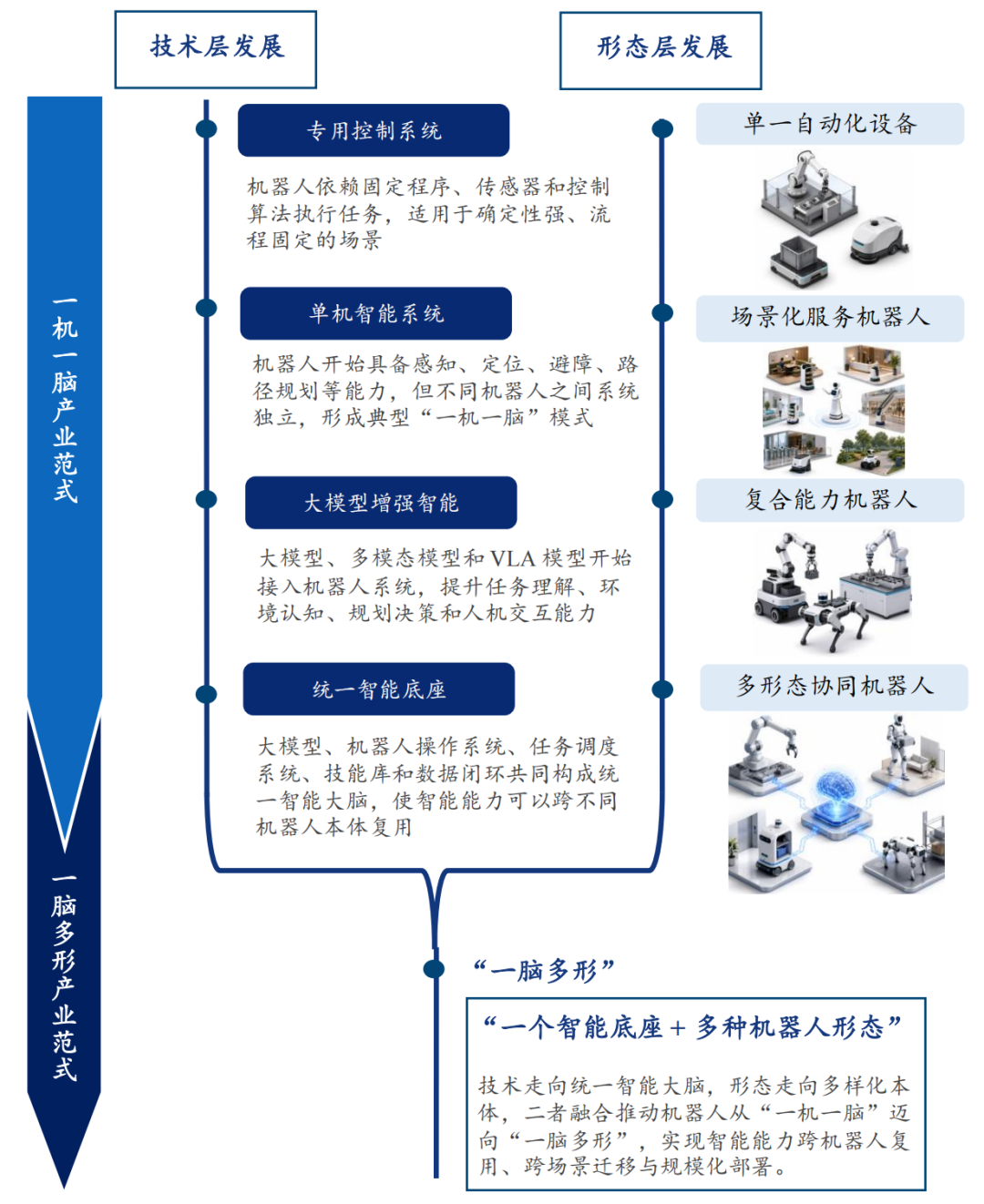
The shared concepts may include:
- Spatial relationships.
- Object affordances.
- Physical causality.
- Navigation intent.
- Manipulation intent.
- Task planning.
- Safety constraints.
- Common skill definitions.
- Memory of successful and failed strategies.
If the architecture works as intended, a lesson learned by one robot form can shorten the adaptation process for another.
Pudu says that, with its world-model training and a small amount of real correction data, a new task can be adapted with around 50 expert demonstrations. This is a company-reported result and should be evaluated per task, robot form, and deployment environment.
The larger point is the shift from memorizing a fixed action sequence to learning physical relationships that can be reused.
PuduFM 1.0: The Shared Physical-Intelligence Foundation
PuduFM 1.0 is the foundation-model layer behind the strategy.
Pudu presents it as a continuously evolving embodied-intelligence model designed to address three problems:
- The separation between navigation and manipulation.
- The lack of physical intuition.
- Models and datasets isolated by robot form.
The architecture centers on three technical elements.
Physical Intuition Model: Predicting Physical Consequences
The Physical Intuition Model, or PIM, is intended to help the robot predict what may happen before it acts.
A human does this constantly.
When picking up a wet glass, a person may automatically use a more careful grip. When moving a tall load, a person considers balance. When stepping onto a slippery surface, a person adjusts speed and force.
A traditional perception system may identify the glass or floor but still lack a model of the physical consequence.
Pudu says PIM uses a causal-attention Transformer architecture and models object motion and physical interaction in latent space.
Rather than concentrating only on dense pixel prediction, it attempts to represent dynamics such as:
- Gravity.
- Friction.
- Deformation.
- Center-of-mass movement.
- Reachability.
- Collision risk.
- Action validity.
The robot’s current position, pose, and proposed action can be evaluated before execution.
In practical terms, PIM is intended to address the problem of a robot that can see an object but does not understand what its planned action will do to it.
Multimodal VLA: Connecting Language, Vision, Navigation, and Action
The second element is a multimodal Vision-Language-Action system.
Many earlier robot stacks separated:
- Visual perception.
- Natural-language understanding.
- Navigation.
- Arm control.
- Grasping.
- Safety logic.
A task could therefore fail between modules.
The robot might understand the instruction and reach the correct location but fail to turn that understanding into a stable manipulation sequence.
PuduFM’s VLA layer is intended to place language, vision, movement, and manipulation inside a unified representation.
PIM’s physical prediction is then incorporated into the action process.
The resulting sequence is conceptually:
- Understand the task.
- Interpret the environment.
- Evaluate physical constraints.
- Plan navigation and manipulation together.
- Generate a coherent action sequence.
- Use feedback to correct execution.
This combined approach is meant to reduce the gap between “getting there” and “doing the job.”
World Model: A Scalable Virtual Training Ground
The third element is the world simulator that drives the virtual side of the learning loop.
Pudu says the simulator is constructed using operating data gathered across many commercial environments.
It generates both standard and adversarial trajectories, creating examples that would be expensive, rare, or unsafe to collect repeatedly in the real world.
The world model supports PIM and VLA by providing large numbers of controlled physical scenarios.
The process can be summarized as:
| Stage | Purpose |
|---|---|
| Pre-training | Build broad visual, language, video, and physical commonsense |
| Simulated reinforcement | Practice decisions and actions at scale in virtual environments |
| Real-world fine-tuning | Correct the model using physical deployment and human feedback |
The system is not simply “simulation first, deployment later.”
Pudu describes it as a continuous loop in which real data improves simulation, and simulation helps prepare the model for the next set of physical tasks.
PUDU D7 as a Hardware Carrier
PUDU D7 made its first offline public appearance at WAIC 2026.
Pudu positions D7 as an industrial-grade semi-humanoid robot for environments such as manufacturing, retail, and logistics.
Its wheeled lower body is designed for stable and efficient movement, while the upper body provides two arms for manipulation.
This form reflects a practical compromise.
A fully bipedal humanoid may be useful where stairs and human-like mobility are essential, but wheels can offer better efficiency and stability on the flat floors common in warehouses, stores, and factories.
Pudu’s official WAIC materials say D7 supports payloads of up to 14 kilograms and is designed for extended industrial operation.
The strategic importance of D7 is not only its body.
It is presented as one of several embodiments that can use the same broader PuduFM and PuduAgent intelligence stack.
That makes it a test of whether experience can move across Pudu’s existing service, cleaning, and industrial fleet into more general manipulation systems.
The Top-Level Architecture: One Brain, Multiple Embodiments
A robot foundation model becomes more valuable when it can support more than one machine.
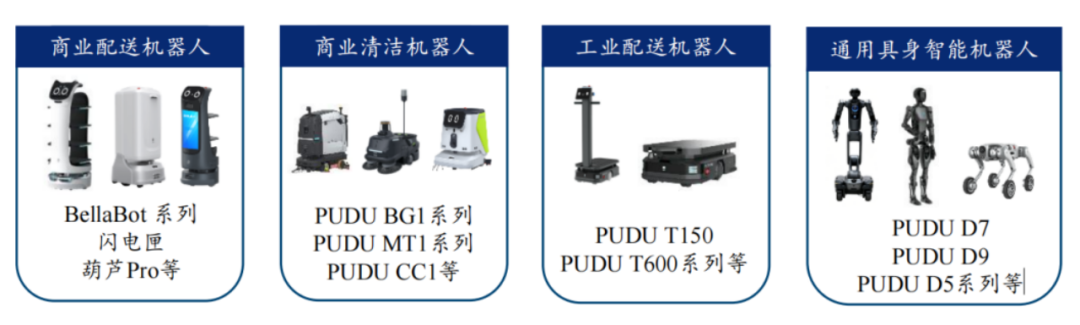
Pudu’s portfolio includes four broad categories:
- Service delivery robots.
- Commercial cleaning robots.
- Industrial delivery robots.
- General embodied-intelligence robots.
Within those categories are specialized mobile robots, semi-humanoids, humanoids, and quadruped systems.
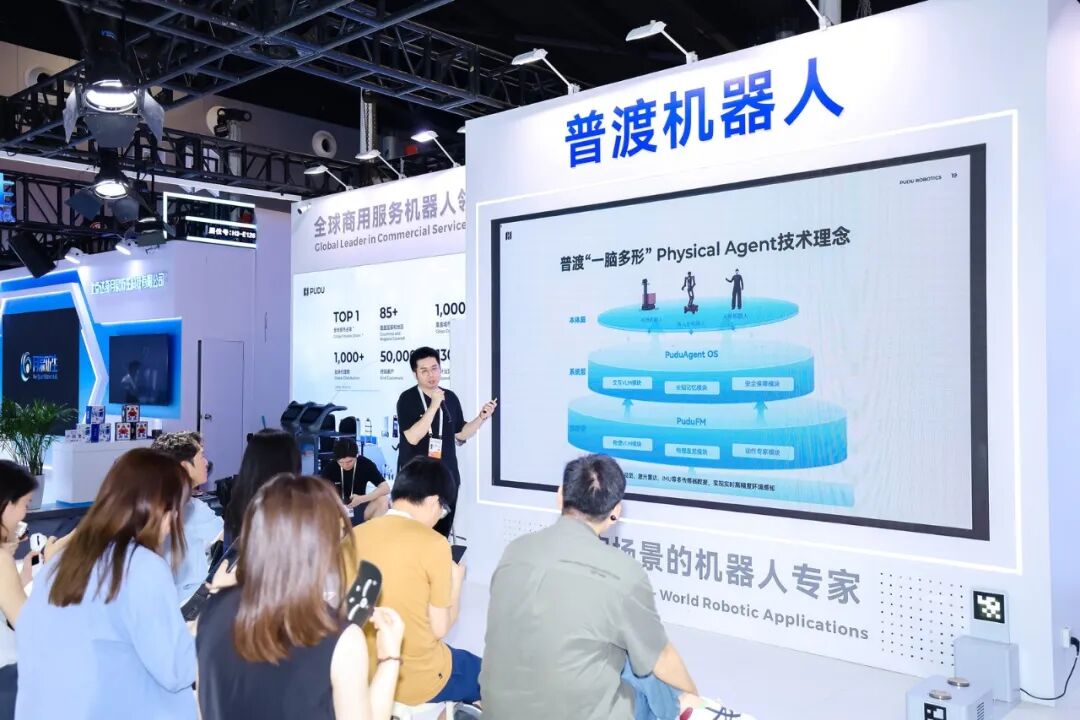
The “One Brain, Multiple Embodiments” architecture separates the system into three layers:
Physical Agent = Embodiment + System + Skills
Embodiment
The embodiment is the physical machine:
- Sensors.
- Wheels or legs.
- Arms.
- Joints.
- Payload.
- Battery.
- End effectors.
- Mechanical safety limits.
Different bodies remain optimized for different jobs.
System
The system coordinates the robot over time:
- Task understanding.
- Planning.
- Memory.
- Execution.
- Scheduling.
- Multi-robot coordination.
- Tool and resource management.
This is the role Pudu assigns to PuduAgent.
Skills
Skills are reusable capabilities such as:
- Navigation.
- Obstacle avoidance.
- Grasping.
- Human interaction.
- Object delivery.
- Cleaning routines.
- Industrial transport.
- Multi-robot collaboration.
PuduFM provides the shared physical-intelligence foundation behind these capabilities, while PuduAgent turns them into operational workflows.
PuduAgent: An Operating Platform for Physical Agents
If PuduFM is the shared physical brain, PuduAgent is the layer that manages how that intelligence is used.
Pudu describes PuduAgent as a general embodied-agent platform for the physical world.
It contains three major parts:
- PuduAgent OS.
- PuduAgent Skills.
- PuduAgent Safety.
PuduAgent OS
The operating layer contains three core components.
Agent Core
Agent Core interprets the current environment and task, then plans what the robot should do.
Its responsibilities may include:
- Understanding goals.
- Breaking work into steps.
- Selecting skills.
- Updating the plan after new observations.
- Coordinating navigation and manipulation.
- Managing task-level decisions.
Agent Memory
Agent Memory records useful information from the task process.
For a physical robot, memory involves more than saving text.
It may need to preserve:
- The current environment state.
- Recent actions.
- Locations already visited.
- Human instructions.
- Successful strategies.
- Failed attempts.
- Changes caused by the robot.
- Long-running task progress.
Persistent memory helps the robot avoid repeating the same mistake and maintain its goal across a longer operation.
Agent Runner
Agent Runner turns high-level decisions into real-time execution.
Planning can happen at a relatively abstract level, but motors and sensors operate continuously and require low-latency control.
The runner acts as the bridge between the plan and the robot’s hardware-specific execution system.
PuduAgent Skills
PuduAgent Skills abstracts common capabilities into a standardized library.
Without this layer, each robot form may require a separate implementation for functions that are conceptually similar.
A standardized skill can describe the intent and interface of an action while allowing each embodiment to execute it according to its own hardware.
Examples include:
- Move to a location.
- Avoid an obstacle.
- Pick up an object.
- Place an object.
- Ask a person for confirmation.
- Wait for a human to clear the path.
- Coordinate with another robot.
- Stop safely.
- Return to a charging station.
This does not mean that one identical low-level controller runs on every robot.
A humanoid arm and a mobile delivery base still require different control logic. The reusable layer is the task definition, planning interface, safety contract, and learned physical experience.
PuduAgent Safety
Safety becomes more important as robots operate for longer periods with less direct supervision.
Before executing an action, the system may need to determine:
- Whether the action is physically possible.
- Whether the path remains clear.
- Whether a person has entered the operating area.
- Whether the load is stable.
- Whether the robot should slow down.
- Whether the environment has changed.
- Whether the task should be paused or stopped.
PuduAgent Safety is presented as a guardrail layer that predicts potential risk and adjusts or blocks actions when necessary.
This is essential for commercial deployment.
A robot does not create value by completing one impressive demonstration. It creates value by performing repetitive work reliably while keeping failure rates, interventions, and safety incidents within acceptable limits.
What Pudu Is Really Competing For
At first glance, the robotics market appears to be a competition over hardware:
- Better arms.
- More agile legs.
- Higher payload.
- Longer battery life.
- Lower price.
- More human-like movement.
Those factors still matter.
Pudu’s WAIC message suggests that the next layer of competition will also involve four less visible assets.
1. Access to Real Physical Data
Companies with large fleets can observe a wider range of environments and edge cases.
2. The Ability to Govern That Data
Unstructured logs do not automatically improve a model. Data quality, privacy, labeling, and evaluation determine whether the experience is useful.
3. Transfer Across Robot Forms
A learning system becomes more scalable when experience from one body or task can reduce the work required for another.
4. A Reliable Agent Platform
A foundation model alone is not enough. Robots need memory, execution, skills, safety, scheduling, and operational controls.
The company that integrates these layers effectively may be able to turn every deployment into an input for the next generation of products.
Commercial Scale and Capital
Pudu’s strategy is supported by significant commercial deployment and new financing.
In April 2026, the company announced that it had raised nearly $150 million**, bringing its valuation above **$1.5 billion and cumulative funding above $300 million.
At the time of that announcement, Pudu reported more than 120,000 units shipped and a 23% share of the global commercial service robotics market based on an earlier Frost & Sullivan study.
By the PuduFM and WAIC announcements, the company was reporting more than 130,000 units.
The funding can support work across:
- Embodied-AI research.
- Hardware development.
- Data infrastructure.
- Simulation.
- Global sales and service.
- Manufacturing.
- New robot forms.
- Agent-platform development.
Capital and shipment volume do not guarantee that a general physical-agent architecture will succeed.
They do give Pudu two important resources: a large deployment base and the ability to invest in the systems required to learn from it.
Remaining Technical Questions
The “One Brain, Multiple Embodiments” direction is compelling, but several difficult questions remain.
How Much Experience Really Transfers?
A lesson from a cleaning robot may improve shared navigation or obstacle understanding, but it may not directly teach a humanoid arm how to manipulate a deformable object.
Transfer quality must be evaluated by skill, environment, and embodiment.
How Is Data Quality Controlled?
A large fleet can produce enormous amounts of repetitive, noisy, incomplete, or biased data.
The useful metric is not total hours alone. It is how much validated and diverse training signal those hours produce.
How Are Privacy and Security Managed?
Robots operating in public and commercial environments may capture sensitive visual, spatial, or operational information.
Data governance must include consent, retention, access control, anonymization, regional regulation, and cybersecurity.
How Close Is Simulation to Reality?
A world model can expand training, but the simulation-to-reality gap remains one of robotics’ central challenges.
Models must be tested against physical hardware under real operating conditions.
Can Safety Scale with Autonomy?
As robots handle longer and more complex tasks, the number of possible failure paths increases.
Safety systems need deterministic controls, hardware protections, monitoring, rollback, and human escalation—not only model-level reasoning.
Can the Economics Work?
Customers ultimately care about total operational value:
- Purchase or lease cost.
- Deployment effort.
- Maintenance.
- Reliability.
- Labor saved.
- Downtime.
- Service coverage.
- Integration cost.
- Return on investment.
A technically advanced robot must still outperform simpler automation on the economics of a real task.
One More Thing: Work Creates Reusable Experience
When robots begin to work at scale, the most valuable output may not be the number of completed deliveries, cleaning routes, or transport jobs.
It may be the reusable physical experience created by those tasks.
Pudu’s strategy links four layers:
- A large commercial fleet.
- A simulation-and-reality data flywheel.
- PuduFM as a shared physical-intelligence foundation.
- PuduAgent as the operational layer across multiple embodiments.
PUDU D7 brings that strategy into a more general industrial robot form, but the larger bet is architectural.
Pudu is trying to turn a product portfolio into a learning ecosystem.
The long-term competition will not be won solely by the robot that performs the most impressive isolated action. It will be shaped by which system can learn safely from the largest number of useful physical interactions, transfer that learning across machines, and deliver reliable economic value in real environments.
FAQ
What is PuduFM 1.0?
PuduFM 1.0 is Pudu Robotics’ embodied-intelligence foundation model. It combines a Physical Intuition Model, multimodal Vision-Language-Action alignment, and a simulation-to-reality training loop to support navigation, manipulation, and physical reasoning across different robot forms.
What is PuduAgent?
PuduAgent is Pudu’s general embodied-agent platform for operating robots in the physical world. It includes an operating layer for planning, memory, and execution, a reusable skill library, and safety controls.
What does “One Brain, Multiple Embodiments” mean?
It means that several types of robots share a common intelligence foundation instead of being developed as completely isolated systems. Each body keeps its own hardware-specific control, while higher-level physical understanding, planning, memory, and skills can be reused.
How many robots has Pudu Robotics deployed?
Pudu says it has shipped more than 130,000 robots globally. Its official materials describe service across more than 80 countries and regions, while its WAIC 2026 presentation cited 85 countries and regions.
What is the PUDU D7?
PUDU D7 is an industrial-grade semi-humanoid robot with a wheeled mobile base and two arms. Pudu positions it for industrial, retail, and logistics tasks and presents it as one hardware embodiment of the PuduFM and PuduAgent architecture.
What is the Physical Intuition Model?
The Physical Intuition Model, or PIM, is intended to predict the physical result of a proposed robot action. Pudu says it models dynamics such as motion, friction, deformation, balance, and collision risk in latent space before execution.
Why does Pudu use both simulation and real-world data?
Simulation allows the system to generate large numbers of normal and adversarial trajectories without repeatedly risking real equipment or people. Real-world operation provides authentic feedback that helps calibrate the simulator and correct the model.
Is Pudu’s market leadership independently verified?
Pudu cites Frost & Sullivan market studies that rank the company first in several commercial-service-robot categories. Those rankings are reported here as the findings of the cited study; the underlying full market dataset was not independently reproduced in this article.
Related Tools
- PUDU Open Platform: Official developer platform for integrating Pudu robots with applications and business systems.
- Pudu Robotics Support Academy: Official manuals, deployment information, and product-support resources.
- PuduFM 1.0: Pudu’s physical-intuition-driven foundation model for multiple robot embodiments.
- PuduAgent: Pudu’s platform for planning, memory, execution, reusable skills, and safety.
- PUDU D7 and WAIC 2026: Official information on the semi-humanoid robot and its role in Pudu’s embodied-AI stack.
- Pudu Robotics Product Portfolio: Official information on delivery, cleaning, industrial, and embodied-AI robots.
Related Links
- Pudu Robotics at WAIC 2026: Official announcement covering PUDU D7 and the “One Brain, Multiple Embodiments” strategy.
- PuduFM 1.0 Technical Introduction: Official explanation of PIM, VLA alignment, the world simulator, training stages, and the data flywheel.
- PuduAgent Launch: Official overview of the embodied-agent platform and its operating architecture.
- Pudu Robotics Funding Announcement: Official information on the April 2026 financing round and company valuation.
- Pudu Robotics News and Insights: Current official announcements, product releases, deployments, and partnerships.
- PUDU Open Platform: Official integration and development portal for Pudu robot systems.
Summary
Pudu Robotics used WAIC 2026 to present a strategy that extends beyond individual robot products. Its installed commercial fleet supplies real-world experience, while simulation increases the number and variety of training scenarios.
PuduFM 1.0 is intended to provide shared physical reasoning across robot forms. PuduAgent adds planning, memory, execution, reusable skills, and safety controls. PUDU D7 shows how that stack can be applied to a semi-humanoid industrial platform.
The strategy still faces difficult questions around data quality, transfer across bodies, simulation fidelity, privacy, safety, and commercial return. Its central idea is nevertheless clear.
The next robotics advantage may come from building not just more capable machines, but a shared intelligence system that learns from every machine already at work.