OpenMontage: The AI Video Production System That Keeps Trending on GitHub
OpenMontage became popular because it addresses a real problem in AI video creation: most tools only solve one part of the process, while a finished video needs research, scriptwriting, assets, voice, subtitles, editing, rendering, and review. Its core idea is to let an AI coding assistant orchestrate the whole workflow through structured pipelines, tools, and skills. That makes it feel less like a single AI video tool and more like an automated production system. It is not the easiest tool for non-technical users, but for developers and AI workflow builders, it is worth watching closely. **The main takeaway: OpenMontage shows where AI video is heading — from isolated generation tools to agent-driven production pipelines.**
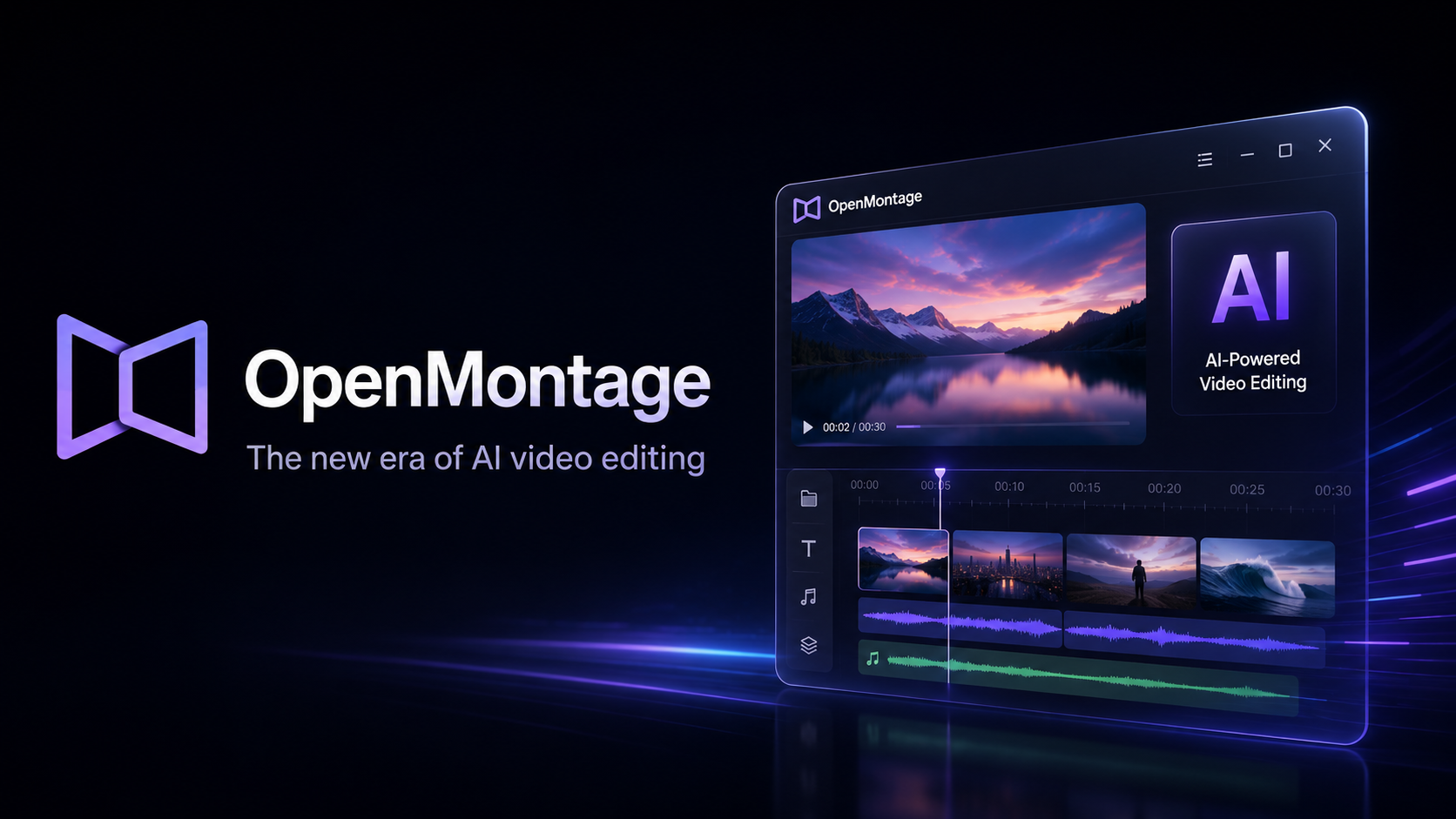
OpenMontage: The AI Video Production System That Keeps Trending on GitHub
Introduction
OpenMontage recently became one of the most talked-about AI projects on GitHub. According to the original BAAI article, it quickly collected over 15,000 stars in just a few days and even reached the top of GitHub Trending.
What made it stand out was not simply that it generates video. Many tools can already do that. The interesting part is that OpenMontage treats video creation as a full production workflow: research, scriptwriting, storyboarding, asset generation, voice, subtitles, editing, rendering, and quality checks can all be organized through an agent-driven pipeline.
In plain words, it tries to turn an AI coding assistant into a small video production team.
Source Note
This article is based on the BAAI article: 持续霸榜Github的是一个AI视频剪辑项目, which cites QbitAI / 量子位 as the original source. Technical details were cross-checked with the official OpenMontage GitHub repository.
Images kept below are screenshots that directly support the article content, such as GitHub trending status, project overview, tool architecture, compatibility, and install steps. Meme images, social CTA graphics, comments, QR codes, and unrelated decorative images were not included.
OpenMontage, the AI Video Production System Trending on GitHub
OpenMontage is not a new foundation model from a large AI lab. It is an open-source, agentic video production system.
The reason it attracted so much attention is simple: instead of asking users to jump between separate tools for scriptwriting, stock footage, voice generation, subtitles, editing, and rendering, it tries to connect the whole video-making process into one automated workflow.
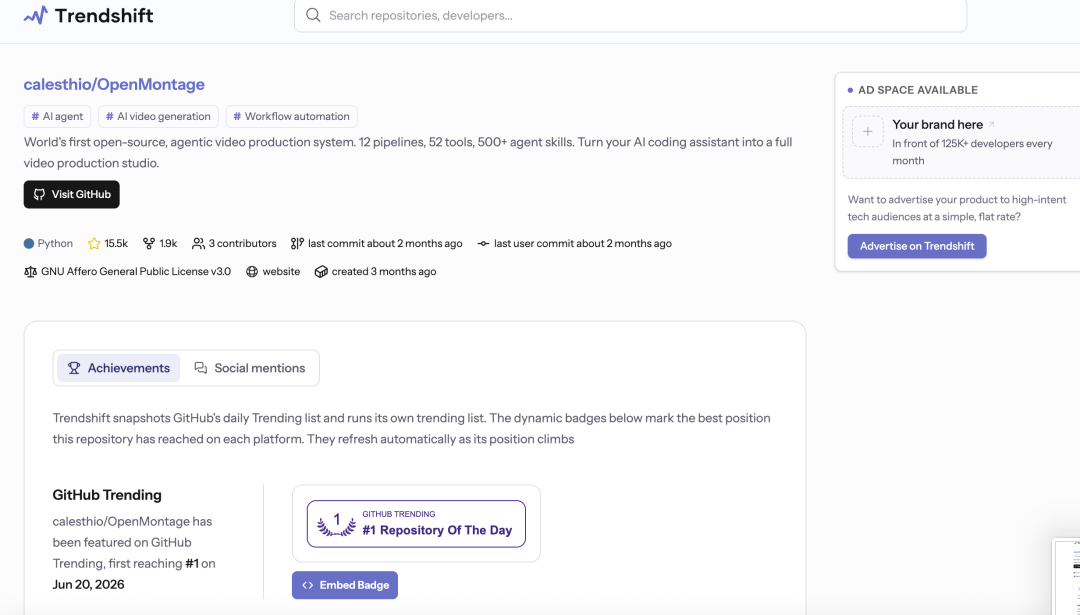
For anyone who has edited videos before, this pain point is easy to understand. A short video can still require many separate steps: finding clips, writing a script, recording or generating voice, aligning subtitles, choosing background music, assembling a timeline, exporting, and checking the result.
OpenMontage aims to reduce that back-and-forth. You describe the video you want in an AI coding assistant such as Claude Code, Cursor, GitHub Copilot, Codex, or Windsurf. The agent then reads the project instructions, chooses the right pipeline, calls the available tools, and moves the production forward.

The project describes itself as the first open-source, agentic video production system. Its goal is not just to create isolated clips, but to coordinate a full video production process from idea to finished output.
Why OpenMontage Feels Different From a Normal AI Video Tool
Many AI video products solve one piece of the process. One tool generates visuals. Another creates narration. Another handles subtitles. Another renders the final composition.
OpenMontage takes a more workflow-first approach. It does not only optimize one step. It breaks the whole production chain into reusable parts that an AI agent can understand and run.
According to the project description, OpenMontage includes:
| Capability | What It Covers |
|---|---|
| 12 production pipelines | Explainers, talking heads, screen demos, cinematic trailers, animations, podcasts, localization, documentary montages, and more |
| 52 production tools | Video generation, image generation, text-to-speech, music, audio mixing, subtitles, enhancement, and analysis |
| 400+ agent skills | Production skills, pipeline directors, creative methods, quality checklists, and technical knowledge packs |
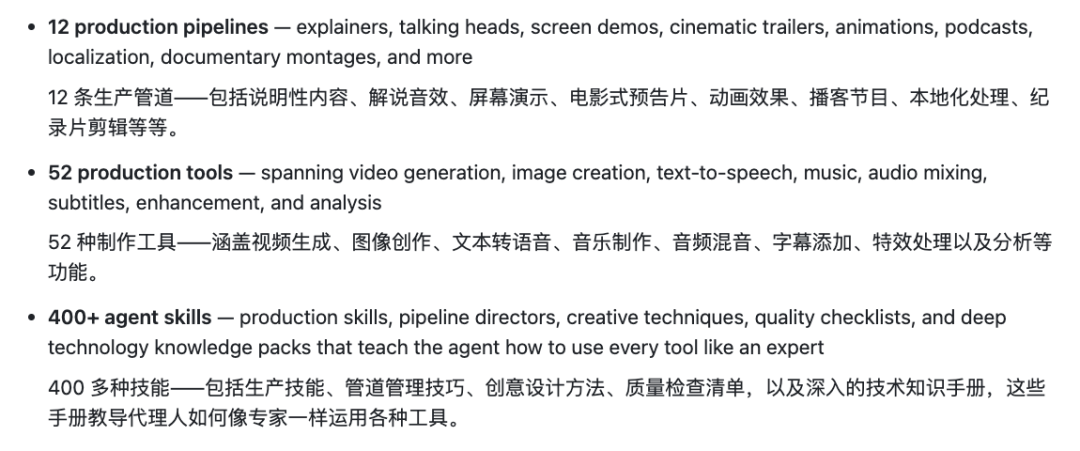
That is why it is better to think of OpenMontage as a production system rather than a simple editing tool.
It can help with topic research, script generation, scene planning, asset collection, voiceover, subtitles, editing, composition, and final rendering. The agent decides what to do next based on the selected pipeline and the tools available in the local environment or through configured APIs.
AI Coding Assistants Become the Production Operators
A key idea behind OpenMontage is that your AI coding assistant acts as the orchestrator.
Instead of a fixed app interface where every action must be clicked manually, the assistant reads files, understands instructions, executes Python tools, and follows project-specific skills. This is why the project works naturally with AI coding tools that can inspect a repository and run code.

The repository includes dedicated instruction files for several AI coding assistants:
| AI Coding Assistant | Configuration / Instruction File |
|---|---|
| Claude Code | CLAUDE.md |
| Cursor | CURSOR.md and .cursor/rules/ |
| GitHub Copilot | COPILOT.md and .github/copilot-instructions.md |
| Codex | CODEX.md |
| Windsurf | .windsurfrules |
This makes the project feel closer to an agent workspace than a traditional video editor. The AI assistant is not just chatting. It is reading the project structure, selecting pipelines, calling tools, tracking decisions, and handing creative checkpoints back to the user.
It Is Not Limited to Pure AI-Generated Video
Another important point is that OpenMontage is not limited to “AI-generated video” in the narrow sense.
It can generate visuals, but it can also use real footage from open or free media sources. The original article mentions sources such as Archive.org, NASA, Wikimedia, Pexels, and Unsplash. In that workflow, OpenMontage builds a searchable corpus of real footage, retrieves relevant clips, and edits them into a timeline.
That makes it useful for more than animated clips. It can also support documentary-style montages, explainers, product videos, social clips, and footage-led edits.
The official repository also shows several demo directions, including animated shorts, cinematic trailers, product ads, and documentary montages. For example, one product-ad-style demo combines AI-generated images, TTS narration, automatically sourced royalty-free music, word-level subtitles through WhisperX, and Remotion-based composition.
Core Running Logic: Agent-Driven Architecture
Behind the scenes, OpenMontage uses an agent-first architecture.
The project is organized around a layered structure. Each layer answers a different question:
| Layer | Role | Main Question |
|---|---|---|
| Tool layer | Provides executable capabilities and orchestration definitions | What exists? |
| Skill layer | Explains how OpenMontage expects those tools to be used | How should it be used? |
| Agent skill layer | Adds deeper technical knowledge and production guidance | How does it work in detail? |
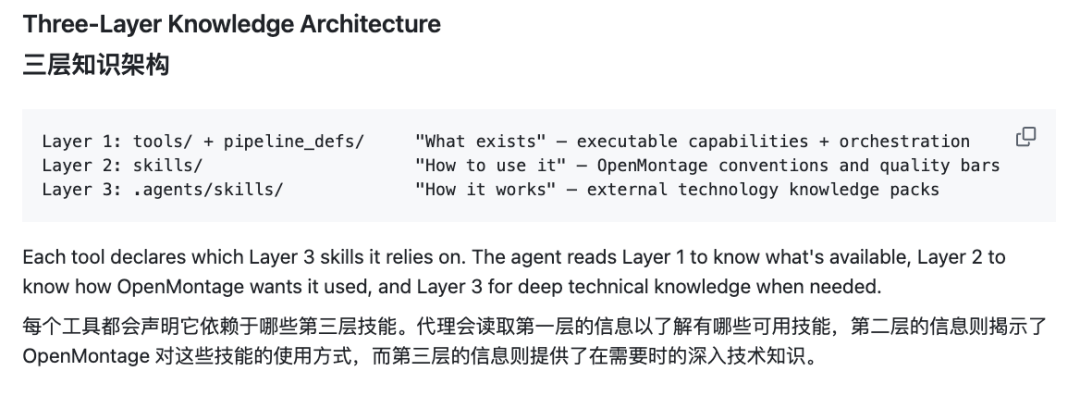
In other words, the tool layer gives the agent raw capabilities. The skill layer turns those capabilities into reusable methods. The agent layer then decides how to assemble everything into a complete production process.
A typical pipeline follows this kind of flow:
research -> proposal -> script -> scene_plan -> assets -> edit -> compose
Each stage has its own director skill. The agent reads those instructions, uses the available tools, checks progress, saves state, and asks for approval at creative decision points.
This is the main difference from a single prompt-to-video tool. OpenMontage does not try to hide the process. It makes the process structured, inspectable, and repeatable.
How the Pipeline Works in Practice
When the user gives a request, OpenMontage does not simply produce a video immediately.
A more typical flow looks like this:
- The user describes the video idea in an AI coding assistant.
- The agent reads the pipeline manifest and project instructions.
- It chooses the right production pipeline for the request.
- It performs research or planning when needed.
- It creates a script and scene plan.
- It selects or generates assets such as footage, images, voice, music, and captions.
- It edits and composes the final output.
- It runs validation and review checks before presenting the result.
The official project also emphasizes creative gates. That means the user can approve or reject important creative choices before the system continues too far into production.
This matters because video work can get expensive or time-consuming if the wrong assets are generated too early. A structured approval process helps avoid wasted runs.
Deployment and Quick Start
The original article notes that deploying OpenMontage is not especially difficult: clone the GitHub project, install the required dependencies, configure the needed services in .env, and then run the workflow from the command line or through an AI coding assistant.
The official repository lists these basic prerequisites:
| Requirement | Notes |
|---|---|
| Python 3.10+ | Required for the Python-based toolchain |
| FFmpeg | Used for video and audio processing |
| Node.js 18+ | Required for the Remotion composer workflow |
| AI coding assistant | Claude Code, Cursor, Copilot, Windsurf, Codex, or another assistant that can read files and run code |
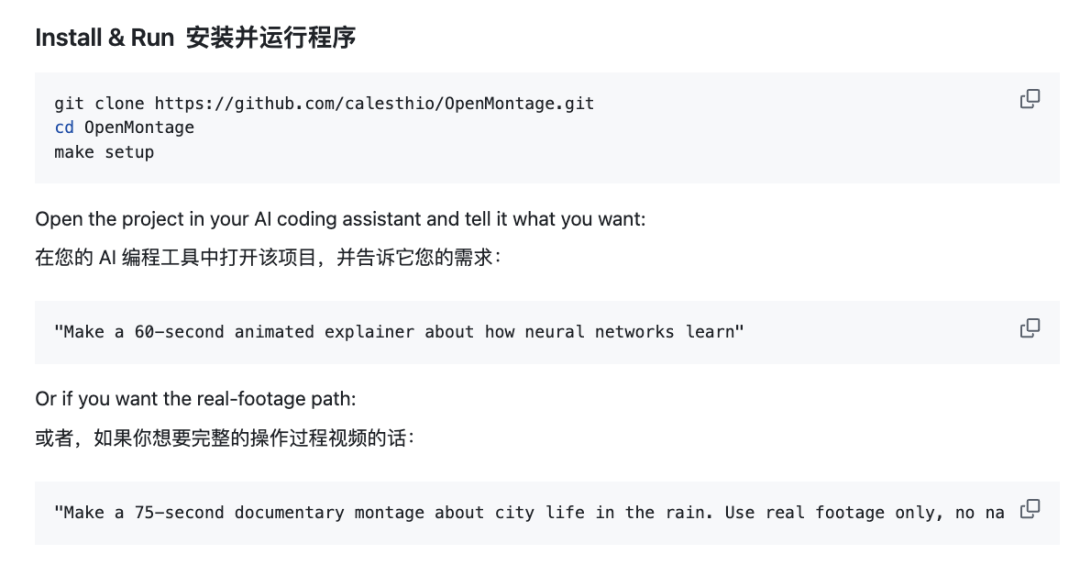
Basic install command:
git clone https://github.com/calesthio/OpenMontage.git
cd OpenMontage
make setup
After setup, open the project in your AI coding assistant and describe what you want to create.
Example prompt for an animated explainer:
Make a 60-second animated explainer about how neural networks learn
Example prompt for a real-footage documentary path:
Make a 75-second documentary montage about city life in the rain. Use real footage only, no narration, elegiac tone, with music.
OpenMontage can then research the topic, create a plan, gather or generate assets, handle voice and subtitles, and render the final video, depending on which tools and API keys are available.
Optional API Keys and Provider Setup
OpenMontage can run with local or free tools, but API keys unlock more providers.
The official .env examples include optional keys for image generation, video generation, stock media, music, voice, and other providers. The idea is not that every key is required. Instead, you add the services you already have access to.
Example .env structure:
# Image + video gateway
FAL_KEY=your-key

# Free stock media
PEXELS_API_KEY=your-key
PIXABAY_API_KEY=your-key
UNSPLASH_ACCESS_KEY=your-key

# Music
SUNO_API_KEY=your-key

# Voice and images
ELEVENLABS_API_KEY=your-key
OPENAI_API_KEY=your-key
XAI_API_KEY=your-key
GOOGLE_API_KEY=your-key

# More video providers
HEYGEN_API_KEY=your-key
RUNWAY_API_KEY=your-key
If you have a GPU and want to try local video generation, the official repository also provides a GPU install path:
make install-gpu
Then you can enable local video generation in .env:
VIDEO_GEN_LOCAL_ENABLED=true
VIDEO_GEN_LOCAL_MODEL=wan2.1-1.3b
The exact model choice depends on your hardware and what the repository currently supports. For production use, always check the official README before changing model or provider settings.
Why It Became Popular
OpenMontage is not popular only because it connects to AI video models. The bigger reason is that it turns video creation into something agents can coordinate.
The article makes a useful point: in the last few years, tools like Claude Code, Cursor, Codex, and GitHub Copilot have changed how people use coding assistants. They are no longer just autocomplete tools. They can read files, follow instructions, and operate inside a project.
OpenMontage applies that same idea to video production.
Instead of forcing users to learn every single video model, subtitle tool, TTS provider, stock site, and rendering engine separately, it tries to make the workflow itself programmable. That is the part that feels new.
For creators, this means fewer manual handoffs between tools. For developers, it means the entire production process can be inspected, extended, and version-controlled like a software project.
What to Keep in Mind
OpenMontage is still a technical open-source project, not a one-click consumer video app.
You need to be comfortable with GitHub, local setup, dependencies, .env files, and command-line workflows. You also need to understand that output quality depends heavily on the providers, prompts, available assets, and the pipeline selected by the agent.
That said, the direction is clear: video generation is moving from isolated model outputs toward complete production systems.
OpenMontage is one of the most visible examples of that shift.
FAQ
What is OpenMontage?
OpenMontage is an open-source, agentic video production system. It lets an AI coding assistant coordinate research, scripting, asset generation, editing, subtitles, rendering, and review through structured production pipelines.
Is OpenMontage just another AI video generator?
No. A typical AI video generator turns a prompt into a clip. OpenMontage focuses on the full production process, so it can combine scripts, real footage, AI-generated assets, narration, subtitles, music, and rendering into one workflow.
Can OpenMontage use real footage instead of only AI-generated images?
Yes. The project supports real-footage workflows using open or free media sources such as Archive.org, NASA, Wikimedia, Pexels, and Unsplash. This makes it useful for documentary-style videos and stock-footage montages.
What tools are needed to run OpenMontage?
The basic setup requires Python 3.10+, FFmpeg, Node.js 18+, and an AI coding assistant that can read files and run code. Extra API keys are optional, but they unlock more providers for video, image, voice, music, and stock media.
Which AI coding assistants can work with OpenMontage?
The repository includes instruction files for Claude Code, Cursor, GitHub Copilot, Codex, and Windsurf. In general, any coding assistant that can inspect project files and execute Python code may be able to work with the system.
Can OpenMontage run without paid API keys?
Yes, some workflows can run with local or free tools after setup. However, advanced video generation, premium TTS, music generation, or certain provider-based workflows may require API keys.
Is OpenMontage suitable for production use?
It is promising, but it is still a developer-oriented open-source workflow. For serious production use, test the pipeline, check output quality, control costs, and review provider licensing before publishing the final video.
Related Tools
- OpenMontage: The official open-source repository for the agentic video production system.
- Claude Code: Anthropic’s coding assistant, one of the agent environments supported by OpenMontage instruction files.
- Cursor: An AI code editor that can work with project files and repository-level instructions.
- GitHub Copilot: GitHub’s AI coding assistant, supported through OpenMontage’s Copilot instruction files.
- Remotion: A React-based video rendering framework used for programmatic video composition.
- FFmpeg: A widely used multimedia framework for audio and video processing.
- fal.ai: A platform for running generative media models that can be used in AI image and video workflows.
- Pexels API: A source of free stock photos and videos that can support footage-based workflows.
Related Links
- OpenMontage GitHub Repository: Official project repository with source code, setup instructions, and documentation.
- OpenMontage Agent Guide: Guide for how agents should work inside the OpenMontage project.
- OpenMontage Prompt Gallery: Tested prompts and example directions for different production workflows.
- OpenMontage Chinese README: Chinese-language README for users who prefer the localized documentation.
- Remotion Documentation: Official Remotion docs for building and rendering videos with code.
- FFmpeg Documentation: Official documentation for FFmpeg commands, libraries, and usage.
- Pexels API Documentation: Official API docs for retrieving stock photos and videos.
- Unsplash Developers: Official developer portal for accessing Unsplash images through API workflows.
Summary
OpenMontage became popular because it addresses a real problem in AI video creation: most tools only solve one part of the process, while a finished video needs research, scriptwriting, assets, voice, subtitles, editing, rendering, and review.
Its core idea is to let an AI coding assistant orchestrate the whole workflow through structured pipelines, tools, and skills. That makes it feel less like a single AI video tool and more like an automated production system.
It is not the easiest tool for non-technical users, but for developers and AI workflow builders, it is worth watching closely.
The main takeaway: OpenMontage shows where AI video is heading — from isolated generation tools to agent-driven production pipelines.