OpenAI Reaches 1 Billion Active Users as Astra Emerges as Its Next Major AI Model
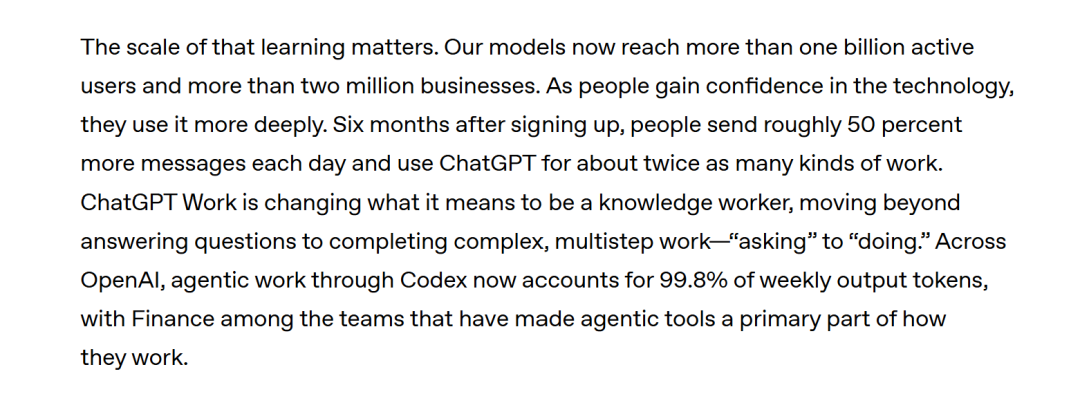
OpenAI has crossed another major adoption milestone. The company now says its models reach more than one billion active users and more than two million businesses . The figure was
OpenAI Reaches 1 Billion Active Users as Astra Emerges as Its Next Major AI Model
Introduction
OpenAI has crossed another major adoption milestone.
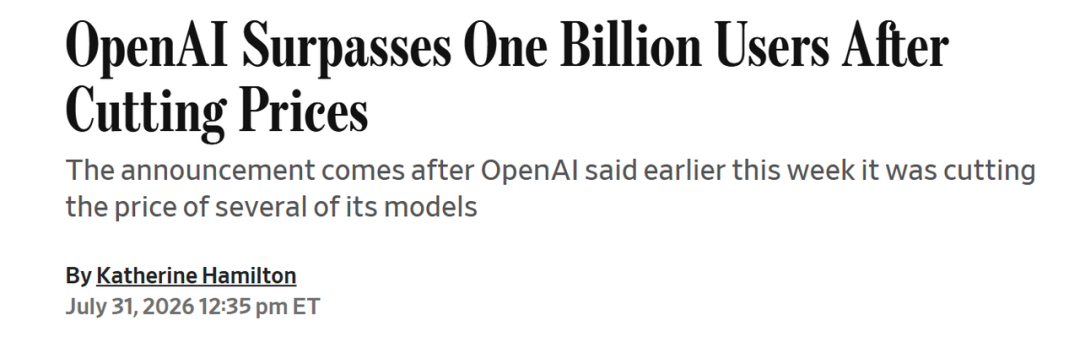
The company now says its models reach more than one billion active users and more than two million businesses. The figure was disclosed in OpenAI’s July 31, 2026 strategy post and independently covered by The Wall Street Journal.
At almost the same time, OpenAI reduced the API prices of GPT-5.6 Terra and Luna, while reports began circulating about a new model family tentatively called Astra.
The original Chinese report described Astra as a possible GPT-6 and treated several of its capabilities as leaks or rumors. The situation changed shortly afterward.
OpenAI has now officially identified Astra as its “next major model” and published ten new results in mathematics and theoretical computer science produced by an internal version of the system.
Several important questions remain unanswered:
- OpenAI has not said whether Astra will be released as GPT-6.
- The company has not confirmed a public release date.
- Multi-agent, long-running task capabilities were reported by The Information but have not yet been fully documented by OpenAI.
- Claims about model size, memory, personalization, and an August launch remain unverified.
- Two experimental DesignArena model names, Zinc and Magnesium, have not been officially identified by OpenAI.
This article separates what OpenAI has confirmed from what remains reported or speculative.
OpenAI Now Reaches More Than One Billion Active Users
OpenAI announced the milestone in a broader post explaining how it connects infrastructure, models, developer platforms, and products.
The company’s current figures are:
| Adoption Metric | OpenAI-Reported Figure |
|---|---|
| Active users reached by OpenAI models | More than 1 billion |
| Businesses using OpenAI models | More than 2 million |
| Growth in daily messages after six months of use | Roughly 50% |
| Growth in the variety of work after six months | About 2× |
| Share of OpenAI’s weekly output tokens attributed to Codex agentic work | 99.8% |
These are company-reported product metrics rather than independently audited financial or audience measurements.
OpenAI uses the figures to support a broader argument: greater usage produces more customer feedback, reveals where AI creates value, and helps the company decide where to improve models and add infrastructure.
The user milestone is historically significant for generative AI.
Reaching one billion users places OpenAI’s products in the adoption range previously associated with the world’s largest consumer technology platforms.
However, “OpenAI models reach more than one billion active users” should not automatically be interpreted as one billion direct paid ChatGPT subscribers.
The total can include people accessing OpenAI systems across products, business deployments, integrations, APIs, partners, and supported platforms.
The Milestone Followed Major GPT-5.6 Price Cuts
OpenAI announced the one-billion-user figure shortly after reducing the prices of two GPT-5.6 models.
Beginning July 30, 2026, the company listed the following standard API rates:
| Model | Input per 1M Tokens | Output per 1M Tokens | Reported Price Change |
|---|---|---|---|
| GPT-5.6 Luna | $0.20 | $1.20 | 80% reduction |
| GPT-5.6 Terra | $2.00 | $12.00 | 20% reduction |
| GPT-5.6 Sol | Unchanged | Unchanged | No base-price reduction |
OpenAI says Luna is its fastest and most affordable model in the family, while Terra is positioned as the balanced model for everyday work.
The official pricing documentation contains separate rates for:
- Standard processing.
- Batch processing.
- Flex processing.
- Fast mode.
- Short and long context.
- Cached input and cache writes.
Production users should therefore check the complete pricing page rather than relying only on a headline input and output rate.
Did the Price Cut Cause OpenAI to Reach One Billion Users?
The two events happened close together, but the public evidence does not establish a direct one-day causal relationship.
OpenAI’s user base was already approaching one billion before the July 30 changes. In March 2026, the company said it expected to become the fastest platform to reach one billion weekly active users.
The more accurate interpretation is:
- Lower prices are part of OpenAI’s strategy for expanding usage.
- The one-billion milestone reflects adoption accumulated over time.
- The price reduction may support future growth, but it did not create the entire user base overnight.
The Wall Street Journal also noted the trade-off behind aggressive pricing.
Lower costs can make more AI workloads economically viable, but they can also put pressure on margins at a time when OpenAI is spending heavily on models and infrastructure.
Lower Prices Are Part of a Larger Efficiency Strategy
OpenAI says the GPT-5.6 reductions came from efficiency improvements rather than simply a temporary promotion.
Its stated strategy is to improve both model capability and the cost of delivering that capability.
This creates a feedback loop:
- More capable models help engineers find optimizations.
- Optimizations reduce inference cost.
- Lower prices make additional workloads affordable.
- More usage generates revenue and real-world feedback.
- The company uses that information to improve the next generation.
Competition is also part of the context.
OpenAI is competing with Anthropic, Google, DeepSeek, Moonshot AI, Z.ai, and a growing open-weight ecosystem on several dimensions at once:
- Intelligence.
- Coding.
- Long-running agents.
- Speed.
- API price.
- Context length.
- Enterprise support.
- Developer tools.
- Infrastructure availability.
The result is a market where model quality can no longer be separated from the economics of running the model.
Astra Appears: OpenAI’s Next Major Model
The second major story is Astra.
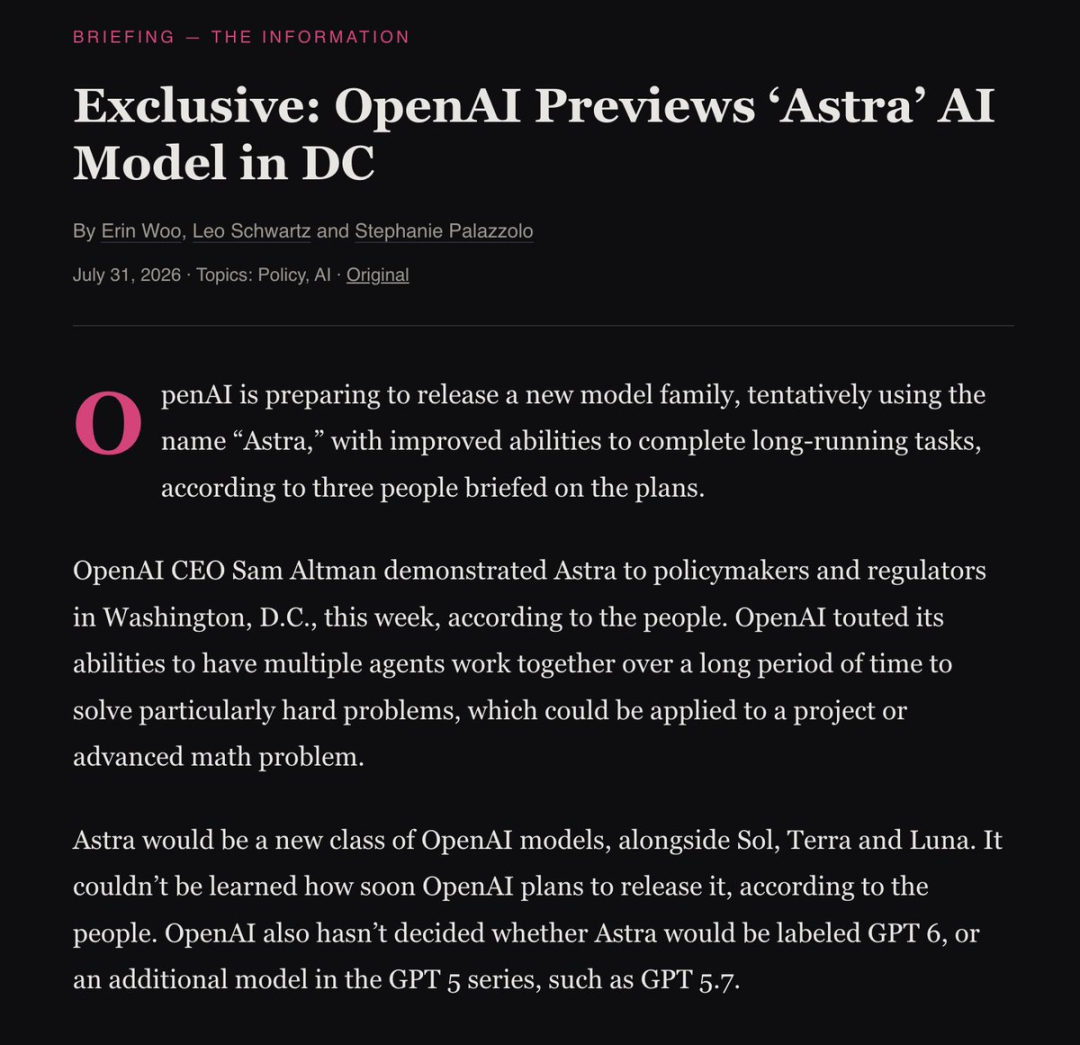
On July 31, The Information reported that OpenAI was preparing a new model family tentatively using that name.
The report said Sam Altman had demonstrated Astra to policymakers and regulators in Washington, D.C.
The initial coverage described Astra as a system designed for:
- Long-running tasks.
- Multiple agents working together.
- Difficult projects that may take extended periods.
- Advanced mathematical problems.
At the time, OpenAI had not publicly confirmed the model.
That is no longer the case.
On August 1, OpenAI published a research announcement explicitly referring to an internal version of Astra as:
“our next major model.”
That official wording confirms that Astra is real and occupies a significant place in OpenAI’s roadmap.
It does not confirm the final commercial name, release date, API configuration, or consumer availability.
Astra Is Reportedly Designed for Long-Running Multi-Agent Work
The Information’s reporting says Astra can coordinate multiple agents over long periods to solve unusually difficult tasks.
This is an important shift from a familiar chat workflow.
A conventional interaction looks like:
User question
→ one model response
A long-running multi-agent system can look more like:
User goal
→ planner
→ specialized agents
→ tool use
→ intermediate reviews
→ error correction
→ verification
→ final result
Different agents may take on different roles:
- Research.
- Planning.
- Coding.
- Mathematical exploration.
- Verification.
- Critique.
- Project coordination.
The main value is not simply running more copies of the same model.
The system must manage shared state, divide work, detect conflicts, merge useful results, recover from failure, and stop when the task is complete.
Why Long-Running Tasks Are Difficult
Long-horizon AI work introduces several engineering problems:
- Context can become too large.
- Early mistakes can compound.
- Agents may duplicate work.
- Intermediate assumptions may go unverified.
- Tool failures can interrupt the process.
- Costs can rise with every additional step.
- The system may continue working after useful progress has stopped.
- Security risks increase when agents have access to external tools.
A successful multi-agent system therefore needs more than a stronger base model.
It also needs a capable harness: the orchestration, memory, tools, permissions, evaluators, and recovery logic around the models.
The Information’s long-running multi-agent description remains a media report. OpenAI’s mathematics announcement confirms the Astra model, but it does not yet publish a complete technical architecture for its multi-agent operation.
Astra Has Now Produced Ten New Mathematics Results
The strongest official evidence about Astra comes from OpenAI’s mathematics announcement.
OpenAI says an internal version of Astra produced new results for ten problems that had seen no progress on their main result for at least a decade, and in most cases much longer.
The areas include:
- High-dimensional geometry.
- Coding theory.
- Arithmetic circuit complexity.
- Group theory.
- Operator algebras.
- Quantum complexity.
- Lattice cryptography.
- Extremal combinatorics.
OpenAI says the model generated the mathematical results, humans prepared the arguments into manuscripts with help from the same model, and Astra then formalized each argument into a Lean certificate.
The company is also releasing model-generated narrations of the reasoning process.
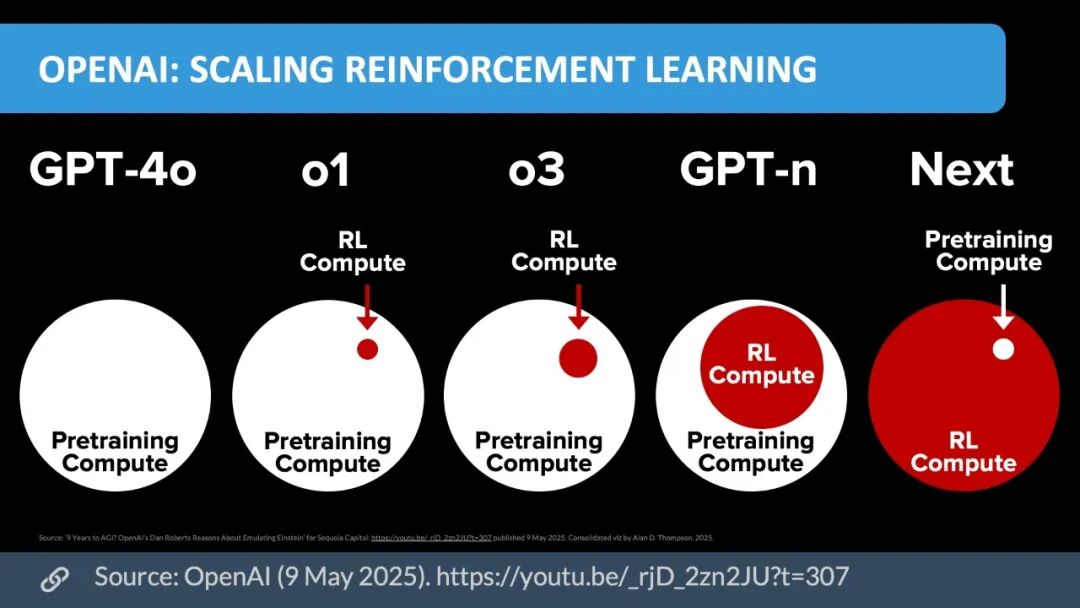
The Ten Published Results
OpenAI lists the following areas of progress:
| Area | OpenAI’s Description of the Result |
|---|---|
| High-dimensional sphere packing | New upper bounds down to the Cohn–Elkies threshold |
| Binary and spherical codes | Exponentially improved bounds |
| Non-sofic groups | A construction establishing the existence of non-sofic groups |
| Operator algebras | A result related to Connes-style rigidity questions |
| Arithmetic circuit complexity | New lower-bound progress |
| Quantum complexity | Progress involving quantum parallel repetition |
| Lattice cryptography | New hardness results for the closest vector problem |
| Discrete geometry | Progress on Ehrhart-type volume questions |
| Ramsey theory | A result involving multicolor Ramsey numbers |
| Extremal combinatorics | New results for long-standing extremal problems |
OpenAI says the token usage required to find the ten successful solutions would cost roughly $2,000 at GPT-5.6 Sol API rates.
That figure does not necessarily represent the complete cost of the research program.
It may not include:
- Problems attempted without a successful result.
- Human mathematician time.
- Training and evaluation infrastructure.
- Verification and manuscript preparation.
- The cost of developing Astra itself.
It is best understood as OpenAI’s estimate for the successful solution-generation tokens.
Lean Certificates Improve Verifiability, but Peer Review Still Matters
Lean is an interactive theorem prover.
A Lean certificate can verify that each formal step follows from accepted definitions and prior steps.
That is much stronger evidence than a model merely stating that it solved a problem.
Formal verification still has limits.
Humans must confirm that:
- The formal statement matches the intended mathematical question.
- The definitions encode the right assumptions.
- The result has not been framed in a misleading way.
- The broader mathematical significance is accurately represented.
- The manuscripts are understandable and useful to the field.
OpenAI’s publication is therefore a major technical claim with machine-checkable support, but the slower process of expert review, replication, and use by other researchers remains important.
Is Astra GPT-6 or GPT-5.7?
OpenAI has not announced a final name.
The Information reported that the company had not decided whether Astra would become:
- GPT-6.
- A later GPT-5-series model such as GPT-5.7.
- A separate model family.
OpenAI’s own research post avoids the version question and calls Astra its “next major model.”
That wording confirms importance without committing to a commercial label.
Why Model Numbers Are Not a Reliable Capability Measure
A whole-number upgrade often creates an expectation of a major generational leap.
A decimal upgrade suggests a more incremental release.
Those expectations are marketing conventions, not technical standards.
The final name may depend on:
- Benchmark gains.
- Product positioning.
- Architecture.
- Safety review.
- Infrastructure readiness.
- Competitive timing.
- Whether Astra is a single model or a coordinated model system.
Until OpenAI announces the release, describing Astra as GPT-6 is speculation.
A more accurate title is:
OpenAI’s unreleased Astra model, a possible GPT-6 or GPT-5.7.
Claims About Astra’s Size, Memory, and Personalization Remain Unverified
The original article included a social-media summary claiming that Astra or GPT-6 may be:
- Much stronger than current frontier models.
- Roughly twice the scale of GPT-5.6 Sol.
- Capable of major discoveries across science.
- Highly coordinated with other models.
- Better at long-term memory and personalization.
- Planned for an August launch.
The author of the social-media post explicitly said the claims had not been independently verified.
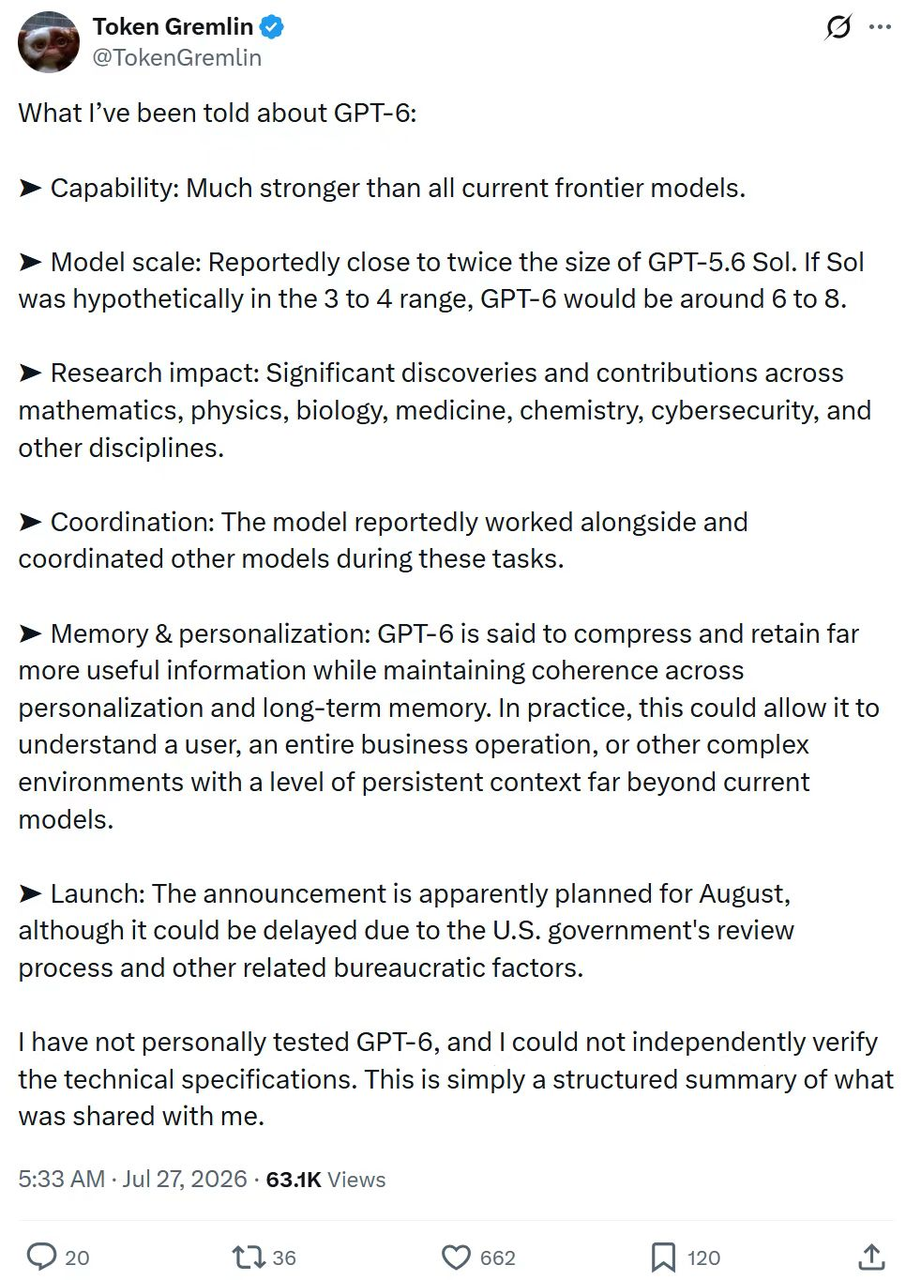
Only part of that summary now has official support:
- Astra exists.
- OpenAI calls it its next major model.
- An internal version produced ten new mathematics and theoretical computer science results.
OpenAI has not publicly confirmed:
- A parameter count.
- A comparison showing twice the scale of Sol.
- A final GPT-6 name.
- A release in August.
- A specific memory architecture.
- A personalization system.
- Performance across every scientific discipline listed in the rumor.
These details should remain clearly labeled as unverified.
The Washington Demonstration Took Place in a Changing Policy Environment
The Information reported that Altman showed Astra to policymakers and regulators in Washington.
The original Chinese article interpreted this as an attempt to position Astra for a new federal model-approval framework.
Public U.S. policy documents support the broader context but not every detail of that interpretation.
The U.S. government has recently expanded its focus on:
- National-security review of advanced AI.
- Testing, evaluation, validation, and verification.
- Federal procurement of frontier models.
- Cybersecurity.
- Deployment on government and defense systems.
- Coordination with private AI companies.
The Wall Street Journal previously reported that access to GPT-5.6 was initially limited after discussions with the U.S. government over security concerns.
White House directives from June 2026 also emphasize rigorous security and functionality evaluation for AI systems used in the national-security enterprise.
However, no public official source reviewed for this article confirms that:
- A new universal federal model-approval program was finalized that weekend.
- Astra is guaranteed to be the first model approved.
- OpenAI’s demonstration automatically creates a compliance clearance.
The safer conclusion is that Astra was previewed during a period of unusually close interaction between frontier-model companies and the U.S. government.
Demonstrating Astra in Washington Serves Several Purposes
A closed demonstration can help OpenAI:
Explain the Capability Before Release
Long-running multi-agent systems are difficult to evaluate from a benchmark table alone.
A live demonstration can show how agents divide and verify work.
Discuss Security Controls
Government officials may want to understand:
- Tool permissions.
- Cyber capabilities.
- Model autonomy.
- Monitoring.
- Failure modes.
- Access restrictions.
- Incident response.
Build Trust Before a More Capable Release
Recent incidents involving autonomous cyber agents have increased scrutiny of frontier models.
Demonstrating controls before release can reduce uncertainty.
Support Government and Scientific Partnerships
OpenAI is expanding its work with U.S. laboratories, academic researchers, and national-science programs.
Astra’s mathematical results fit that positioning.
These are plausible strategic reasons, not confirmed private motives.
Zinc and Magnesium Appeared in DesignArena
The final section of the original article focuses on two mysterious model names:
- Zinc
- Magnesium
Users reported seeing them in DesignArena’s Game Dev category.
A screenshot shows Magnesium describing itself as an OpenAI assistant operating as a game-development agent.
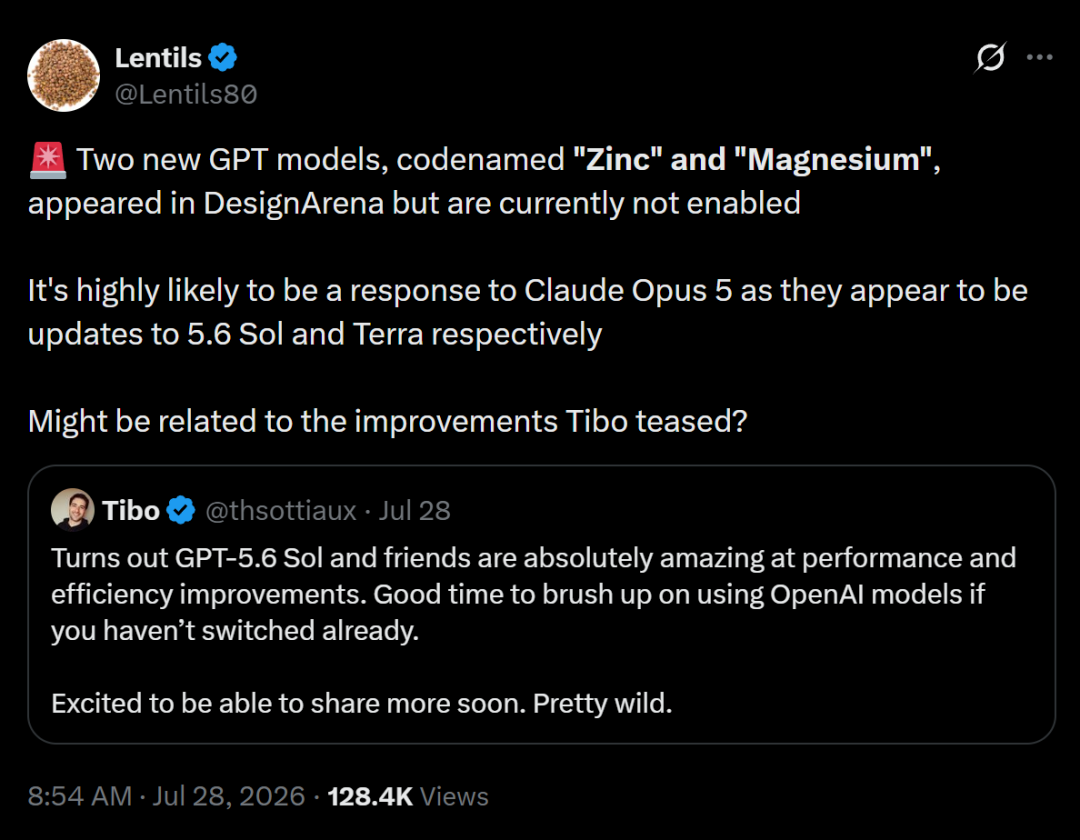
Another source screenshot reports that the models were briefly enabled for game-development testing, with early results described as unimpressive.
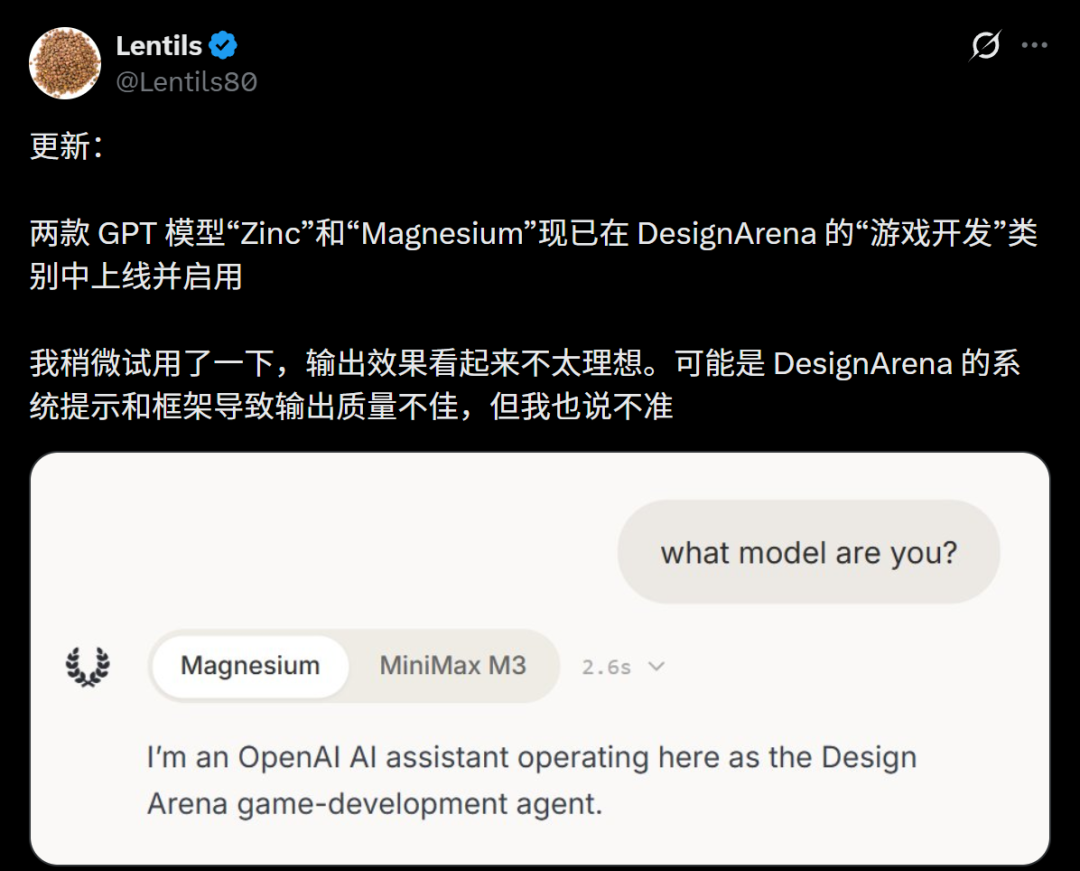
OpenAI has not officially announced either model name.
It is therefore not confirmed whether they are:
- New GPT-5.6 variants.
- Internal routing names.
- Evaluation aliases.
- Experimental harnesses.
- Updated Sol or Terra checkpoints.
- Models from a different provider displayed under test labels.
DesignArena’s public model directory currently lists official GPT-5.6 Sol, Terra, and Luna entries, but the reviewed public pages do not provide an official permanent model page for Zinc or Magnesium.
Why Game Development Is a Useful Agent Benchmark
The source correctly notes that game development is different from a short coding quiz.
An agentic game-development test may require a model to:
- Create several files.
- Maintain project structure.
- Use a framework or engine.
- Interpret error logs.
- Modify code after failures.
- Produce assets or interfaces.
- Keep gameplay logic coherent.
- Run and inspect the result.
Performance depends on more than the foundation model.
It also depends on:
- The system prompt.
- Tool access.
- Runtime.
- Scaffold or harness.
- Retry policy.
- Context management.
- Test environment.
- Time and token budget.
A weak result in one arena does not prove that the underlying model is weak.
It may reveal that the model, tools, and orchestration are poorly matched to that specific task.
The Next Competition Is End-to-End Completion
The common thread between Astra and the DesignArena experiments is a move away from single-turn intelligence.
The next frontier is not only answering a difficult question.
It is finishing a difficult project.
That can involve:
- Understanding an ambiguous goal.
- Breaking it into parts.
- Assigning work.
- Using tools.
- Reviewing intermediate output.
- Correcting errors.
- Verifying the result.
- Maintaining progress over hours or days.
Astra’s reported multi-agent design points in this direction.
OpenAI’s official mathematics release provides a real example of an unreleased model producing complex results that were then prepared and formally verified.
The remaining question is how reliably the same approach can work outside carefully selected research settings.
What Is Confirmed and What Is Still Uncertain
| Claim | Current Status |
|---|---|
| OpenAI reaches more than 1 billion active users | Officially confirmed |
| More than 2 million businesses use OpenAI models | Officially confirmed |
| GPT-5.6 Luna price fell 80% | Officially confirmed |
| GPT-5.6 Terra price fell 20% | Officially confirmed |
| Astra is a real OpenAI model | Officially confirmed |
| Astra is OpenAI’s “next major model” | Officially confirmed |
| Astra produced ten new math and theoretical CS results | Officially confirmed by OpenAI |
| Results include Lean certificates | Officially confirmed |
| Astra coordinates multiple agents for long-running tasks | Reported by The Information |
| Sam Altman previewed Astra in Washington | Reported by The Information |
| Astra will be called GPT-6 | Not confirmed |
| Astra will be called GPT-5.7 | Not confirmed |
| Astra is twice the scale of Sol | Not confirmed |
| Astra launches in August | Not confirmed |
| Zinc and Magnesium are official new OpenAI models | Not confirmed |
| One-day price cuts directly caused the 1B-user milestone | Not established |
常见问题
How many active users does OpenAI have?
OpenAI says its models now reach more than one billion active users and more than two million businesses. The company has not published a complete breakdown showing how those users are distributed across ChatGPT, APIs, partners, and other products.
What is OpenAI Astra?
Astra is an unreleased model that OpenAI officially describes as its next major model. An internal version produced ten new results in mathematics and theoretical computer science.
Is Astra GPT-6?
OpenAI has not confirmed that name. The Information reported that the company had considered whether to call it GPT-6, GPT-5.7, or position it as another model family.
What did Astra solve?
OpenAI published ten new results across areas including sphere packing, coding theory, non-sofic groups, operator algebras, quantum complexity, lattice cryptography, and combinatorics. The arguments were converted into manuscripts and formalized with Lean certificates.
Does Astra use multiple AI agents?
The Information reports that OpenAI demonstrated multiple agents working together over long periods. OpenAI has not yet published a full technical description of Astra’s multi-agent architecture.
What are the new GPT-5.6 Luna and Terra prices?
OpenAI’s July 30 announcement lists Luna at $0.20 per million standard input tokens and $1.20 per million output tokens, and Terra at $2.00 input and $12.00 output. Other processing modes and long-context rates differ.
Are Zinc and Magnesium new OpenAI models?
They appeared as experimental names in DesignArena screenshots, but OpenAI has not announced them. Their provider identity, architecture, and relationship to GPT-5.6 remain unconfirmed.
Did OpenAI’s price cuts create one billion users overnight?
No evidence supports that interpretation. The milestone reflects adoption accumulated over time, while lower prices are part of OpenAI’s strategy for expanding future usage.
相关工具
- ChatGPT: OpenAI’s main consumer and workplace interface for its current model family.
- OpenAI API: The official platform for integrating GPT models, tools, agents, and multimodal capabilities.
- Codex: OpenAI’s agentic software-engineering product for long-running coding and repository tasks.
- Lean: An interactive theorem prover used to formally verify Astra’s published mathematical arguments.
- DesignArena: A crowdsourced benchmark that compares AI systems across visual and agentic design tasks.
- OpenAI Academy: OpenAI’s official educational hub for developers, researchers, and organizations.
Related Links
- OpenAI: Building Abundant Intelligence: The official source for the one-billion-user and two-million-business figures.
- OpenAI GPT-5.6 Price Reduction: The official July 30 announcement for the Terra and Luna price cuts.
- OpenAI API Pricing: Current official rates for GPT-5.6 and other OpenAI models across processing modes.
- OpenAI: Ten Advances in Mathematics: OpenAI’s official confirmation of Astra and the ten published research results.
- The Information: OpenAI Previews Astra in Washington: The original report on Astra’s long-running multi-agent capabilities and Washington demonstration.
- Wall Street Journal: OpenAI Surpasses One Billion Users: Independent reporting on the adoption milestone and price changes.
- DesignArena Methodology: Documentation explaining the prompts, categories, and evaluation approach used by DesignArena.
Summary
OpenAI now says its models reach more than one billion active users and two million businesses. The milestone arrived alongside major price cuts for GPT-5.6 Luna and Terra, although the public evidence does not show that one day of lower prices directly created the user milestone.
The larger technical development is Astra. What began as a reported secret model is now officially acknowledged by OpenAI as its next major model. An internal version produced ten new mathematics and theoretical computer science results, with manuscripts and machine-checkable Lean certificates.
The final commercial identity remains unresolved. OpenAI has not announced whether Astra will become GPT-6, GPT-5.7, or something else, and several widely repeated claims about its scale, memory, personalization, and release timing remain unverified.
Experimental Zinc and Magnesium labels also appeared in DesignArena, but OpenAI has not confirmed what they are.
The clearest change is that frontier-model competition is moving from single answers toward systems that can coordinate tools and agents long enough to complete complex research and engineering projects.