OpenAI Presence Brings Production-Ready AI Agents to Customer Service
AI customer service has become one of the clearest commercial applications for enterprise agents.
OpenAI Presence Brings Production-Ready AI Agents to Customer Service
Introduction
AI customer service has become one of the clearest commercial applications for enterprise agents. A support agent can search approved knowledge, verify a customer, inspect account information, apply company policy, take a permitted action, and transfer the conversation to a person when the situation exceeds its authority.
The difficult part is no longer producing a convincing demo. Enterprises need agents that remain accurate after policies change, customer behavior shifts, new products launch, and edge cases appear in production.
OpenAI entered this deployment layer directly on July 22, 2026 with OpenAI Presence, an enterprise product for launching trusted voice and chat agents across customer-facing and internal workflows.
Presence is more than access to a model API. It combines model reasoning with company knowledge, standard operating procedures, permissions, guardrails, simulations, evaluations, escalation rules, approved actions, and an ongoing improvement process powered by Codex.
OpenAI has already deployed the system on its own English-language support line. The company says Presence now resolves 75% of incoming issues without human assistance and has met or exceeded the benchmarks used to evaluate frontline human-support quality.
Presence Starts with One Specific Job
Presence is built around a deliberately narrow deployment model.
Each agent begins with one defined job, such as:
- Resolving billing issues
- Supporting an insurance claim
- Handling an employee IT request
- Answering customer questions
- Performing an approved account action
- Escalating a high-risk case to a person
The agent receives only the knowledge and system access required for that job.
A billing agent should not automatically have access to insurance claims. An IT support agent does not need unrestricted access to finance systems. A customer-facing agent should not be able to perform a sensitive action simply because it can describe that action.
For every deployment, the company defines:
- What the agent is responsible for
- Which knowledge sources it may use
- Which systems it may access
- Which actions it may take directly
- Which actions require approval
- Which situations must be escalated
- How success and failure will be evaluated
This job-scoped approach reduces the number of decisions the agent must make and limits the damage that can occur when it misunderstands a request.
A Presence Agent Can Complete Multi-Step Work
Presence supports real-time experiences through voice and chat.
A customer-service workflow may include several stages rather than one generated answer:
- Understand the customer’s intent.
- Verify the customer when required.
- Retrieve the relevant account context.
- Consult the applicable policy or SOP.
- Use an approved tool.
- Complete a permitted action.
- Confirm the outcome.
- Transfer the conversation when the issue remains unresolved or requires human judgment.
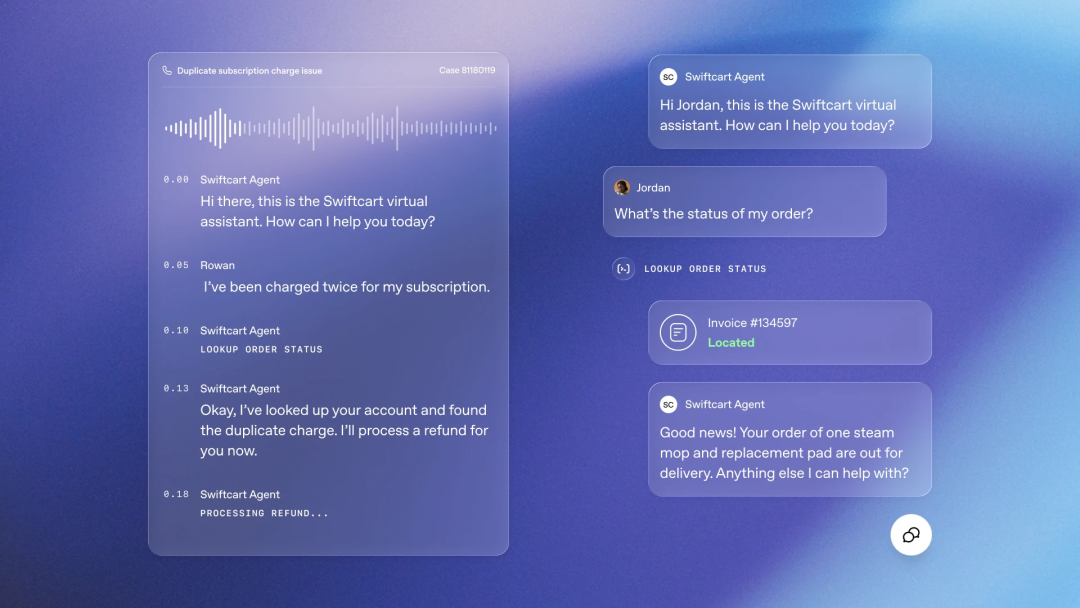
For example, an agent handling a duplicate charge may need to identify the relevant transaction, confirm that the request matches the refund policy, submit an approved refund, and explain what happens next.
The agent is not given unrestricted freedom. The organization defines the policy boundaries, required approvals, and escalation conditions before the workflow reaches production.
Guardrails, Simulations, and Evaluations Before Launch
A production agent must be tested against more than the easiest customer questions.
Presence includes simulations and graders that can evaluate whether the agent:
- Reached the correct outcome
- Followed the company’s policy
- Used tools correctly
- Requested approval when necessary
- Escalated at the right time
- Stayed within its permitted scope
- Handled unusual or higher-risk scenarios safely
These evaluations can include common requests, edge cases, ambiguous situations, policy conflicts, and interactions designed to test the guardrails.
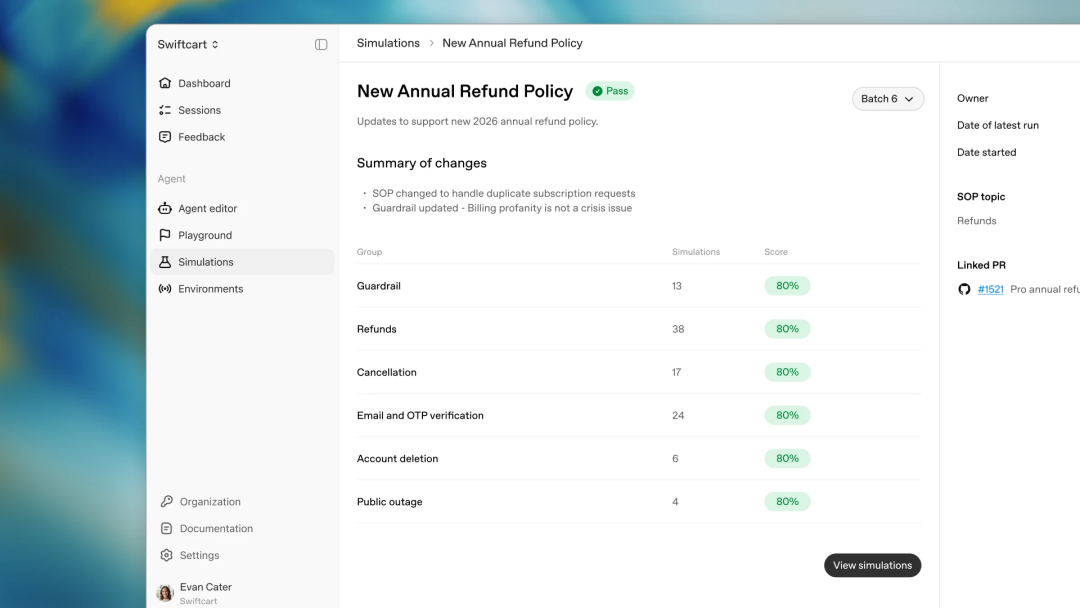
The simulation workflow shown above evaluates an updated annual refund policy across groups such as guardrails, refunds, cancellations, verification, account deletion, and public outages.
This type of testing matters because a model can produce a fluent answer while still choosing the wrong tool, violating an approval rule, or applying an outdated policy.
A reliable deployment therefore needs both language quality and operational correctness.
Codex Continues Improving the Agent After Launch
Testing does not end when the agent enters production.
Real conversations reveal problems that were not fully represented in the original evaluation set. Customers phrase requests in unexpected ways, products change, policies are updated, and new failure patterns appear.
Presence uses production sessions, escalations, and quality signals to identify weak areas.
Codex, using the Presence plugin, can investigate these signals and propose updates. A team can then:
- Review the production evidence
- Inspect the proposed change
- Test the updated version against simulations and graders
- Compare it with the production version
- Approve a controlled rollout
The update is not automatically pushed into production merely because Codex suggested it. The company retains control over testing and approval.
OpenAI says this improvement loop reduced human handoffs on its support line by 15 percentage points in ten days.
That figure is different from the 75% resolution rate. The resolution rate describes the current share of inbound issues handled without human assistance, while the 15-point result describes the improvement achieved during a specific ten-day optimization period.
Production Analytics Show Where the Agent Needs Attention
A production agent needs observable performance data.
Relevant metrics can include:
- Resolution rate
- Escalation rate
- Response accuracy
- Voice-experience quality
- Response latency
- Customer intent
- Authentication success
- Tool-execution success
- Policy compliance
- Performance by task type
- Failure and cancellation patterns
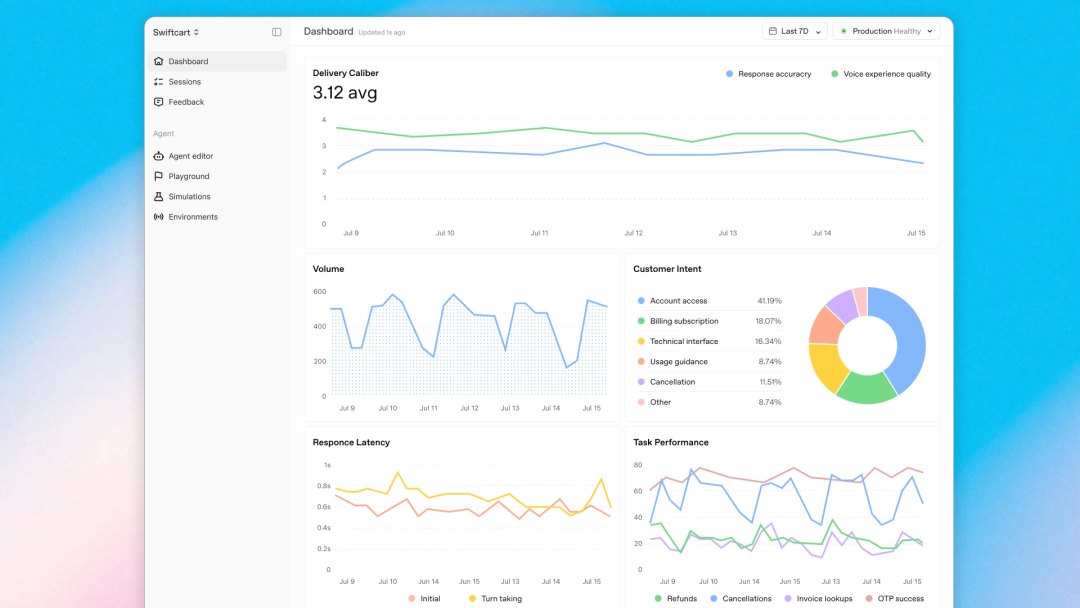
A single average can hide important problems. An agent may perform well on invoice lookups while failing regularly on cancellations, refunds, or account-access cases.
Breaking performance down by intent and workflow makes the improvement process more useful. The team can update the affected policy, tool, prompt, knowledge source, or evaluation rather than changing the entire agent without evidence.
OpenAI Tested Presence on Its Own Support Line
OpenAI’s English-language phone support channel at 1-888-GPT-0090 is the main public proof point for Presence.
The company says the agent can:
- Handle open-ended requests
- Verify callers
- Use account context
- Take approved actions
- Escalate when necessary
Within weeks, the system met or exceeded OpenAI’s human-support quality benchmarks and began resolving 75% of incoming issues without human assistance.
This internal deployment gives OpenAI a production environment in which it can measure call quality, resolution, escalation, latency, tool use, and policy adherence.
It is still a vendor-reported result. Enterprises evaluating Presence should ask how the measurement was defined, which call categories were included, what counted as a resolution, how repeated contacts were handled, and how the automated result compared with customer satisfaction.
The published figure is encouraging, but each organization will need its own evaluation set and acceptance criteria.
Early Enterprise Design Partners
OpenAI also named several organizations exploring Presence:
| Organization | Reported Use Case |
|---|---|
| BBVA Mexico | Voice support for everyday banking needs |
| SoftBank | Natural Japanese-language customer conversations |
| IAG | Customer support during high-demand events such as severe weather |
These examples cover different languages, industries, and risk levels.
Banking support may involve identity verification and tightly controlled actions. Telecommunications requires natural conversations at scale. Insurance support during severe weather must handle demand spikes while applying policy and escalation rules consistently.
OpenAI describes these organizations as design partners or companies exploring Presence, not as evidence that every workflow has already reached full production.
Presence Enters a Fast-Growing AI Customer Service Market
The customer-service AI market is expanding quickly, although market estimates vary depending on the definition used.
Polaris Market Research estimated the dedicated AI for customer service market at:
| Metric | Estimate |
|---|---|
| 2024 market size | $12.10 billion |
| 2025 market size | $15.12 billion |
| 2034 forecast | $117.87 billion |
| 2025–2034 CAGR | 25.6% |
Fortune Business Insights uses the broader category of contact center software and estimated:
| Metric | Estimate |
|---|---|
| 2025 market size | $63.88 billion |
| 2026 market size | $77.82 billion |
| 2034 forecast | $263.75 billion |
| 2026–2034 CAGR | 16.5% |
The two estimates should not be compared as though they measure the same product category. One focuses on AI for customer service, while the other includes the wider contact-center software market.
Both suggest that the application and deployment layer around customer interactions represents a much larger commercial opportunity than model inference alone.
OpenAI Is Moving Closer to the Application Layer
For years, enterprise software companies could use OpenAI models as one component inside their own customer-service products.
Presence moves OpenAI closer to the end customer.
Instead of only supplying model access, OpenAI is now offering a deployed product that includes:
- Workflow design
- System integration
- Permissions
- Policies
- Guardrails
- Simulations
- Evaluations
- Production monitoring
- Codex-assisted improvement
- Forward Deployed Engineer support
This brings OpenAI into a market already served by mature platforms such as:
- Salesforce Agentforce
- Zendesk AI Agents
- Intercom Fin
- ServiceNow AI Agents
- NiCE and Cognigy
The competitive relationship is not always simple. OpenAI may compete with a software vendor in one deal, supply models or APIs to it in another, and work alongside an integrator in a third.
The broader shift is clear: the economic value is moving from raw model access toward complete systems that can perform business work reliably.
Pricing Models Across the Existing Market
Competitors already use several commercial models.
| Product | Public Pricing Approach |
|---|---|
| Salesforce Agentforce | Conversation pricing is listed at $2 per conversation, with other options including Flex Credits and user licensing |
| Intercom Fin | $0.99 per standard outcome for chat and email in the current published pricing |
| Zendesk AI Agents | Outcome-based pricing tied to successful automated resolutions and value tiers |
| OpenAI Presence | No public list price announced |
Pricing definitions are not identical.
A “conversation,” “outcome,” “resolution,” “action,” and “credit” may be measured differently. Buyers should compare total cost using their actual support volume, handoff rate, channel mix, tool use, integration work, and human-review requirements.
Presence is currently a deployed enterprise product rather than a self-serve software subscription, so its total cost may also include engineering, integration, evaluation, and operational support.
Presence Extends the OpenAI Deployment Company Strategy
In May 2026, OpenAI announced the OpenAI Deployment Company, a business focused on helping organizations redesign and deploy critical workflows around frontier AI.
OpenAI also agreed to acquire applied-AI consulting and engineering company Tomoro, which was expected to add approximately 150 Forward Deployed Engineers and deployment specialists.
The Deployment Company was launched with more than $4 billion of initial investment and a group of global investment, consulting, and systems-integration partners.
Presence can be understood as a productized extension of that strategy.
The Deployment Company provides engineering and organizational support for complex enterprise adoption. Presence packages a repeatable pattern for one of the strongest near-term use cases: trusted voice and chat agents.
Availability Is Limited and Not Self-Serve
Presence is available to eligible enterprise customers through a limited general availability program.
Deployments are currently led by:
- OpenAI Forward Deployed Engineers
- Select global systems integrators
Presence is not yet available as a self-serve product.
Organizations interested in the product must contact their OpenAI account team.
OpenAI has not publicly announced:
- Standard list pricing
- A self-serve launch date
- Complete geographic availability
- Minimum contract size
- A public implementation timeline
- Support for third-party foundation models inside Presence
OpenAI says it will continue supporting voice customers that use frontier models through the OpenAI API. Presence therefore does not replace the API route for teams that want to build and operate their own voice applications.
How an Enterprise Presence Deployment Works
Based on OpenAI’s official product description, a typical deployment follows this sequence.
1. Select a High-Value Workflow
Choose a specific job with measurable value and a clear boundary.
A narrow workflow is easier to test, govern, and improve than an agent with a vague instruction to “handle customer service.”
2. Connect Knowledge and Systems
Identify the approved information and business systems required to complete the job.
Access should be limited to what the agent actually needs.
3. Define Policies and Permissions
Document what the agent may do, when approval is required, and when a person must take over.
4. Build Evaluations and Simulations
Test normal requests, edge cases, high-risk scenarios, tool use, policy compliance, and escalation behavior.
5. Launch with Monitoring
Measure outcomes, quality, latency, escalations, and performance by task category.
6. Improve Through Controlled Updates
Use production signals and Codex-generated proposals to identify gaps, test changes, and roll out approved updates.
This process is closer to operating a business system than deploying a traditional FAQ chatbot.
What Enterprises Should Evaluate Before Buying
A strong product demonstration is not enough for a production decision.
Enterprise buyers should examine several areas.
Resolution Definition
Ask what counts as an independently resolved issue.
Does the metric require customer confirmation? Is a successful handoff counted? Are repeated contacts included?
Policy Control
Confirm how policies are represented, tested, versioned, and approved.
Tool Security
Review authentication, authorization, audit logs, least-privilege access, and approval requirements for consequential actions.
Human Escalation
Test whether the system escalates too often, too late, or to the wrong team.
Evaluation Coverage
Ask how the evaluation set was built and whether it includes real historical cases, rare failures, adversarial inputs, and policy changes.
Data Governance
Review data retention, regional requirements, privacy controls, access management, and integration boundaries.
Operational Ownership
Clarify who owns the agent after launch, how changes are approved, and what happens when OpenAI’s deployment team is no longer embedded.
Economics
Calculate the complete cost, including deployment engineering, systems integration, model use, human review, support, and ongoing maintenance.
The Main Scaling Question Is Deployment Capacity
Presence has strong early evidence from OpenAI’s own support channel, but it remains service-intensive.
Every deployment currently involves Forward Deployed Engineers or selected systems integrators. That approach is appropriate for high-value and higher-risk workflows, but it can limit how quickly the product reaches a broad market.
The next phase will depend on whether OpenAI can turn repeated deployment knowledge into:
- Reusable templates
- Standard integrations
- Easier policy configuration
- Self-serve simulation tools
- Faster evaluation creation
- Repeatable governance controls
- Lower implementation effort
This is an inference from the current delivery model, not a launch commitment from OpenAI.
The important milestones to watch are public pricing, wider availability, implementation time, customer case studies, and a possible self-serve version.
常见问题
What is OpenAI Presence?
OpenAI Presence is an enterprise product for deploying voice and chat agents across customer and internal workflows. It combines model reasoning with policies, guardrails, approved actions, simulations, evaluations, escalation rules, and a Codex-powered improvement loop.
Is OpenAI Presence a chatbot builder?
It is broader than a basic chatbot builder. Presence is designed for agents that can use company systems, perform approved actions, follow operational policies, and transfer work to people when necessary.
How effective is Presence on OpenAI’s support line?
OpenAI says Presence resolves 75% of inbound issues on its English-language support line without human assistance. The company also says the system met or exceeded its frontline human-support quality benchmarks.
How does Codex improve a Presence agent?
Codex investigates production sessions, escalation data, and quality signals to identify weak areas and propose updates. Teams can test those updates against the production version and approve a controlled rollout.
Is OpenAI Presence available as self-serve software?
No. Presence is currently offered through limited general availability to eligible enterprise customers, with deployments led by OpenAI Forward Deployed Engineers and selected systems integrators.
How much does OpenAI Presence cost?
OpenAI has not published standard list pricing. Interested organizations need to contact their OpenAI account team and evaluate the full deployment and operating cost.
Does Presence support both voice and chat?
Yes. OpenAI says Presence is currently available for real-time voice and chat experiences, including customer support, outbound sales, and higher-risk internal workflows.
Does Presence replace the OpenAI Realtime API?
No. OpenAI says it will continue supporting voice customers through access to frontier models in the OpenAI API. Presence is a more complete deployed enterprise product with governance, evaluation, integration, and operational support.
相关工具
- OpenAI Presence: OpenAI’s deployed enterprise product for trusted voice and chat agents.
- OpenAI Codex: The coding and agent system used in Presence’s production-improvement workflow.
- OpenAI API: The developer platform for building custom AI applications, including real-time voice experiences.
- Salesforce Agentforce: Salesforce’s platform for building and deploying customer and employee agents.
- Zendesk AI Agents: Customer-service agents designed to resolve multi-step issues across channels.
- Intercom Fin: Intercom’s outcome-priced AI agent for customer service and related workflows.
Related Links
- Introducing OpenAI Presence: The official product announcement, performance figures, design-partner examples, trust model, and availability details.
- OpenAI Deployment Company: OpenAI’s strategy for embedding deployment specialists in enterprise transformation projects.
- OpenAI Business: Official information about OpenAI products and services for organizations.
- Salesforce Agentforce Pricing: Current public pricing models for Agentforce conversations, credits, and licenses.
- Intercom Pricing: Current outcome-based pricing for Fin and Intercom plans.
- Zendesk AI Agents: Official product and outcome-pricing information for Zendesk’s customer-service agents.
- AI for Customer Service Market: Market estimates for the dedicated AI customer-service category.
Summary
OpenAI Presence moves OpenAI beyond model access and into the enterprise deployment layer. It gives companies a structured way to launch voice and chat agents with narrow responsibilities, controlled permissions, simulations, evaluations, approved actions, human escalation, and continuous improvement.
The strongest early evidence comes from OpenAI’s own support line, where the company reports a 75% independent resolution rate and a 15-percentage-point reduction in human handoffs during a ten-day Codex-powered improvement cycle.
Presence also places OpenAI closer to a customer-service software market already served by Salesforce, Zendesk, Intercom, ServiceNow, NiCE, and other established vendors. Its biggest open questions are public pricing, wider availability, implementation capacity, and the timing of a self-serve product.
Presence is not simply an AI support bot; it is OpenAI’s attempt to package the full system required to keep an enterprise agent useful, governed, measurable, and improvable after launch.