NVIDIA’s \$500 Billion AI Compute Financing Plan: How GPU Infrastructure Becomes an Asset Class
NVIDIA is trying to change how the AI industry pays for compute. On August 10, 2026, the company announced strategic partnerships with Apollo, BlackRock, Blackstone, Brookfield, Go
NVIDIA’s $500 Billion AI Compute Financing Plan: How GPU Infrastructure Becomes an Asset Class
Introduction
NVIDIA is trying to change how the AI industry pays for compute.
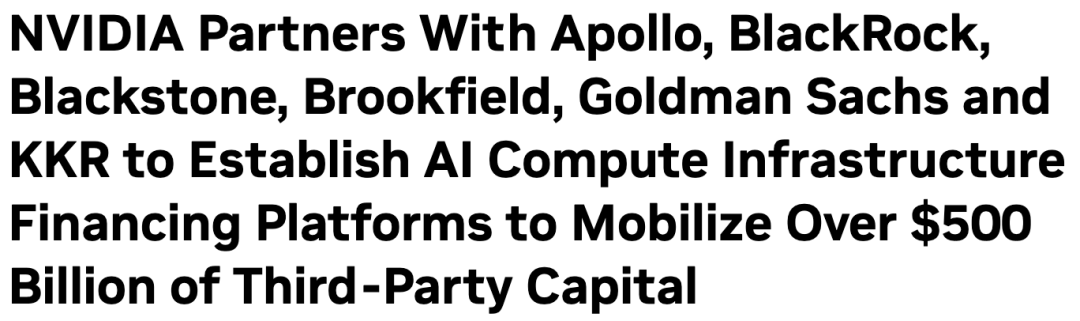
On August 10, 2026, the company announced strategic partnerships with Apollo, BlackRock, Blackstone, Brookfield, Goldman Sachs, and KKR to establish independent compute-financing platforms for NVIDIA-based AI infrastructure.
The target is enormous: the platforms are designed to mobilize more than $500 billion of third-party capital over time.
That number needs careful wording.
NVIDIA has not raised a single $500 billion fund, and the six institutions have not publicly committed fixed individual amounts. The parties have signed memorandums of understanding, while final agreements, project terms, deployment schedules, and actual capital commitments are still to be determined.
The idea is broader than simply offering customers a loan to buy GPUs.
NVIDIA wants AI factories—the complete stack of accelerators, networking, systems software, AI frameworks, and infrastructure around them—to be financed more like productive infrastructure. Instead of every AI lab, enterprise, or cloud provider paying the full upfront cost from its own balance sheet, long-term institutional capital could own or finance the assets while customers pay for access to the compute.
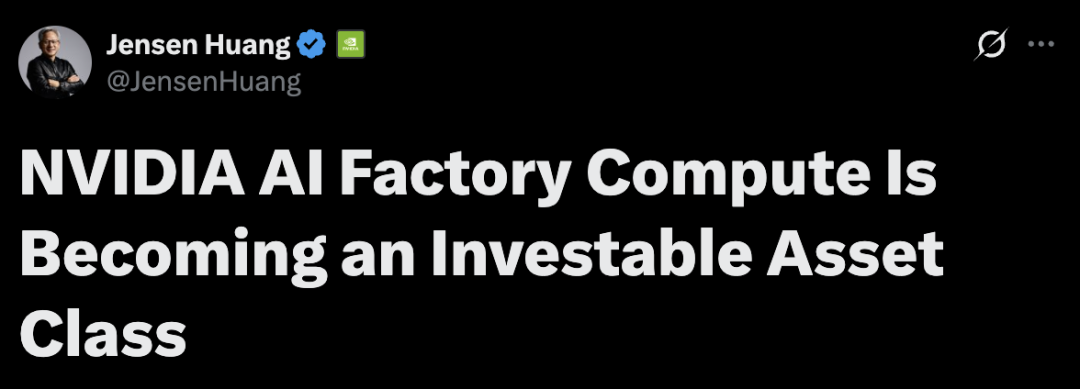
Jensen Huang’s argument is simple: in AI, compute creates revenue, so compute infrastructure can be underwritten as a productive asset rather than treated only as a rapidly depreciating technology purchase.
NVIDIA Wants Wall Street to Finance AI Factories
For the past two years, one of the biggest barriers to scaling AI has been capital.
Frontier AI labs need larger clusters to train and serve stronger models. Enterprises want to move more workloads into AI. Cloud and neocloud providers are racing to add capacity.
The hardware is expensive, and the expense does not stop at the GPU.
A modern AI factory can require:
- Accelerators
- High-speed networking
- Storage
- Power distribution
- Liquid cooling
- Buildings
- Land
- Grid interconnection
- Systems software
- Operations
- Long-term capacity commitments
Big technology companies can fund much of this spending from cash flow and public debt markets.
Smaller AI companies and infrastructure operators often cannot.
NVIDIA’s financing initiative is designed to bring a much larger pool of private and institutional capital into that gap.
Under the announced structure, the six financial groups would create dedicated pools of capital and independently evaluate projects involving NVIDIA-based AI infrastructure.
NVIDIA supplies the technology platform and ecosystem.
The financiers supply underwriting, capital, infrastructure expertise, and capital-markets access.
The company says the target customers include:
- Frontier AI labs
- AI-native startups
- Large enterprises
- AI cloud providers
- Governments and national AI programs
The result could make expensive compute available to organizations that have strong demand but cannot—or do not want to—fund the entire infrastructure purchase upfront.
This Is Closer to Infrastructure Finance Than a Consumer Installment Plan
Calling the idea “buying GPUs on a mortgage” is catchy, but the actual structure is closer to infrastructure and equipment finance.
A simplified arrangement might look like this:
Institutional capital
        ↓
Financing vehicle / infrastructure owner
        ↓
NVIDIA-based AI factory
        ↓
Long-term compute user
        ↓
Usage or lease-like cash flow
        ↓
Debt service / investor return
The user of the compute does not necessarily need to own every GPU directly.
The financial institution evaluates whether the project can generate enough durable cash flow to justify the investment.
That evaluation can include:
- Customer credit quality
- Contract length
- Compute utilization
- Expected rental revenue
- Model demand
- Power cost
- Hardware life
- Residual value
- Redeployment options
The model resembles familiar asset-finance businesses in which an expensive productive asset is owned or financed by one party and used by another.
Aircraft leasing is one obvious analogy.
An airline does not always buy every aircraft with cash. A lessor can own the plane and collect payments over a long period while retaining value in the physical asset.
AI compute could follow a similar financial pattern, although the depreciation behavior of GPUs is very different from aircraft.
Why NVIDIA Thinks Compute Can Be an Investable Asset Class
Jensen Huang published a separate explanation on August 11 arguing that NVIDIA AI-factory compute has the qualities investors look for in infrastructure.
His case rests on four main points.
1. The Asset Produces Revenue
AI infrastructure is not idle equipment.
It can be used for training, inference, fine-tuning, scientific computing, agent workloads, media generation, robotics, and other paid services.
If the capacity stays utilized, the equipment produces recurring cash flow.
2. The Architecture Serves Many Workloads
NVIDIA argues that its infrastructure is not tied to one model.
The same GPU cluster can serve language, vision, speech, biology, physical AI, robotics, and high-performance computing.
That makes the hardware easier to redeploy if one customer or workload changes.
3. CUDA Expands the Pool of Potential Users
NVIDIA’s software ecosystem matters to the financing thesis because hardware is more valuable when many customers can use it.
CUDA is widely supported across clouds, frameworks, applications, and enterprise environments.
That creates a deeper secondary market for capacity.
4. Software Can Extend the Useful Economic Life
Huang argues that continuous CUDA optimization allows installed hardware to deliver better economics over time.
Software cannot stop physical aging or make an old GPU identical to a new architecture, but it can improve utilization, kernel performance, framework support, and the range of workloads that remain economically viable.
The $500 Billion Figure Is a Target, Not Money Already Raised
This distinction is central to understanding the announcement.
NVIDIA says the financing platforms are designed to mobilize more than $500 billion of aggregate third-party capital over time.
The company explicitly says the figure is:
- Not NVIDIA revenue
- Not one single fund
- Not a commitment to one customer
Reuters reported that NVIDIA had not disclosed individual commitments from the six financial firms, detailed financing terms, or a timetable for deployment.
The current agreement is based on memorandums of understanding.
Final agreements still need to be negotiated.
That means headlines saying NVIDIA “raised $500 billion” overstate what has happened.
A more accurate description is that NVIDIA and six major financial institutions are building platforms whose stated long-term target is to channel more than $500 billion into AI infrastructure projects.
How Much Risk Will NVIDIA Take?
NVIDIA is trying to answer one obvious concern: if the company sells the GPUs and also guarantees the financing, is Wall Street really taking independent risk?
Huang says the capital providers will underwrite each project independently.
They are expected to examine the customer, utilization, cash flow, demand, and residual value themselves.
NVIDIA may provide a residual-value support mechanism of up to 25% of an opportunity, assessed case by case.
That should not be described as NVIDIA guaranteeing 25% of the entire $500 billion platform.
The mechanism is limited, project-specific, and related to residual asset value.
In a maximum theoretical scenario, 25% of $500 billion would equal $125 billion, which explains why that figure appeared in reporting. But actual NVIDIA exposure will depend on which projects receive support and how each arrangement is structured.
NVIDIA says its goal is to unlock independent capital while keeping its own risk disciplined.
Why Wall Street Is Interested
The six partners are not simply technology investors.
They are among the world’s largest managers of infrastructure, private credit, insurance capital, pensions, and long-duration assets.
AI infrastructure gives them a new place to put that capital.
A large compute project can potentially provide:
- Contracted payments
- Long-duration usage revenue
- Physical collateral
- Residual-value recovery
- Infrastructure-like cash flows
- Exposure to AI growth without buying equity in an AI lab
For institutions managing pension or insurance money, the appeal is different from venture capital.
They do not necessarily need a startup to become a hundred-billion-dollar company.
They need predictable returns from a productive asset with measurable utilization and recoverable value.
That is why converting compute into something that can be modeled, financed, and resold could matter as much as the size of the first deals.
The Anthropic Deal Shows What This Kind of Financing Can Look Like
The source article points to Anthropic as an example of how AI infrastructure finance is already evolving.
In June 2026, Apollo and Blackstone backed a roughly $35 billion expansion of Anthropic’s compute capacity involving custom AI chips and infrastructure linked to Broadcom and Google.
The structure used private capital to finance compute infrastructure rather than requiring Anthropic to purchase all of the hardware directly with its own cash.
Public reporting described a special-purpose structure in which debt is backed by lease-like payments, with Broadcom providing residual-value support on senior portions of the financing.

The details are not identical to NVIDIA’s new platform.
But the economic principle is similar:
Capital provider buys or finances compute
        ↓
AI company uses the compute
        ↓
Long-term payments service the financing
        ↓
Hardware retains some recoverable value
NVIDIA’s new initiative attempts to turn what has been negotiated deal by deal into a repeatable financing channel across a much broader customer base.
The Bigger Shift: AI Infrastructure Can Tap Institutional Capital
The deeper significance of the financing plan is not simply moving one expense off one customer’s balance sheet.
If AI compute is accepted as a mainstream infrastructure asset, the potential capital base becomes much larger than the cash reserves of technology companies.
Possible capital sources include:
- Pension funds
- Insurance companies
- Infrastructure funds
- Sovereign wealth funds
- Private-credit funds
- Asset-backed debt investors
- Banks and capital-market investors
Those investors already finance airports, utilities, telecom towers, pipelines, logistics facilities, aircraft, real estate, and data centers.
NVIDIA wants AI factories to enter the same conversation.
For that to work, however, investors need a credible answer to several questions:
- How long will the hardware remain useful?
- How quickly will a new GPU generation reduce the value of the old one?
- Can the hardware be moved to another operator?
- Will customers keep paying for the capacity?
- What is the realistic resale value after several years?
- How much of the economics comes from NVIDIA software rather than the chip itself?
The financing platform can provide a structure, but it cannot remove those risks.
The Market Reaction Exposed the Other Side of the Bet
The announcement was not greeted with uncomplicated enthusiasm.
NVIDIA shares fell roughly 2.9% on August 10 as investors weighed the financing plan alongside broader market pressure.
Several of the participating alternative-asset managers rose that day.
The contrast fed a familiar concern around AI infrastructure: circular financing.
The concern works like this:
- A chip company wants customers to buy more infrastructure.
- Customers need financing to afford the infrastructure.
- Capital providers finance the purchase.
- The chip company receives hardware revenue.
- If the customer later struggles, the financing structure may depend on the same hardware retaining value.
In its most aggressive form, vendor financing can make demand look stronger while risk accumulates elsewhere in the system.
NVIDIA directly addressed that criticism in Huang’s August 11 article.
The company argues that this initiative is different because the six capital providers are independent and will make their own underwriting decisions rather than simply taking NVIDIA’s word that every project is financeable.
That distinction is important, but the concern will not disappear until investors can see how individual projects are structured and how much risk NVIDIA ultimately retains.
Why GPUs Are Not the Same as Aircraft
The aircraft analogy helps explain the financing structure, but it breaks down when discussing depreciation.
An aircraft primarily loses value through age, hours, cycles, maintenance condition, and market demand.
A GPU can lose value very quickly because a new architecture changes the economics of compute.
If a newer accelerator delivers more performance per watt, more memory, better networking, or lower token cost, an older card may become less attractive even if it still works perfectly.
That technological-obsolescence risk is probably the hardest part of treating GPUs as long-duration collateral.
A five-year financing model needs to estimate the value of a chip several product cycles into the future.
That is difficult in an industry where new accelerators arrive rapidly and model architectures can change the most valuable workload mix.
NVIDIA’s Answer Is CUDA, Fungibility, and Redeployment
Huang’s response is that NVIDIA compute is not a single-purpose appliance.
A GPU that is no longer ideal for training the newest frontier model can still be used for:
- Fine-tuning
- Inference
- Smaller models
- Enterprise workloads
- Scientific computing
- Rendering
- Simulation
- Batch processing
- Regional cloud capacity
The breadth of the CUDA ecosystem increases the number of potential secondary users.
That matters to a lender because a financed asset is safer when it can be transferred to another customer.
NVIDIA also argues that software improvements continue to increase the productivity of installed hardware.
The asset may become less competitive than a new GPU, but it does not necessarily become worthless.
The A100 Is NVIDIA’s Favorite Example
NVIDIA introduced the A100 in 2020.
Six years later, Huang says it remains in active commercial use for training, fine-tuning, inference, and high-performance computing.
Customers continue to make multi-year capacity commitments involving the architecture.
For NVIDIA, that is evidence that a data-center GPU can have an economic life much longer than the product-release cycle might suggest.
It also supports the argument that a financing model does not need an older GPU to remain the fastest chip in the market.
It only needs the GPU to remain productive enough that someone will continue paying to use it.
H100 Rental Prices Strengthen NVIDIA’s Case
The source article also highlights rental-price data cited by Huang from SemiAnalysis.
According to NVIDIA’s August 11 article, one-year H100 rental pricing increased from roughly $1.70 per GPU-hour in October 2025** to approximately **$2.35 per GPU-hour in March 2026.
Cross-provider on-demand median pricing rose from around $2.00 per GPU-hour in October 2025** to about **$2.70 in June 2026.
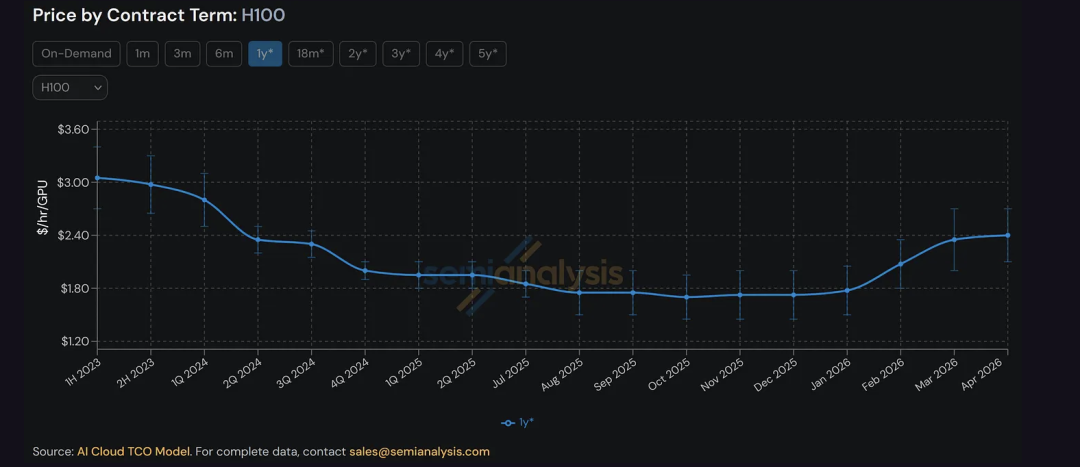
For lenders, stable or rising rental prices support the idea that older installed GPUs can continue generating cash flow even after newer products reach the market.
For buyers, however, historical rental pricing should not be treated as a guarantee of future residual value.
GPU supply, power availability, model efficiency, competitive hardware, inference demand, and new architectures can all change the economics quickly.
What Has Actually Been Agreed So Far
The current stage is still preliminary.
NVIDIA has signed memorandums of understanding with the six financial institutions.
The company has not publicly disclosed:
- A finalized master financing agreement
- The amount each institution will provide
- The first funded project
- The first customer
- A deployment timetable for the full target
- Standard interest rates
- Standard lease terms
- A universal residual-value formula
Each financing opportunity is expected to be evaluated individually.
That means the eventual platform may look less like one standardized global mortgage product and more like a repeatable set of financing structures applied to different customers and data-center projects.
The 25% Support Mechanism Is Not Automatic
Another detail worth repeating is the residual-value mechanism.
NVIDIA says that in some cases it may provide support for up to 25% of an opportunity.
It is not automatic.
It is not a promise that every GPU will retain 25% of its purchase price.
It is not a blanket guarantee covering the entire $500 billion ambition.
The support is supposed to be assessed project by project and complement independent underwriting by the financiers.
That design is clearly intended to reduce the impression that NVIDIA is simply financing its own sales.
Whether investors accept that distinction will depend on the real contracts.
Who Could Benefit Most
The financing platforms appear most useful for customers that have strong compute demand but weaker access to inexpensive capital than hyperscale technology companies.
Frontier AI Labs
Labs can expand training and inference capacity without tying up as much equity capital in hardware.
AI Cloud Providers
Neocloud and GPU-cloud operators can add capacity faster when hardware financing is available against long-term customer demand.
Large Enterprises
Companies building private AI factories may prefer a financed or usage-linked structure instead of a very large upfront capital purchase.
Governments
National AI programs can use infrastructure finance to accelerate sovereign compute projects without relying exclusively on annual technology budgets.
The strongest projects will probably be those with long-term contracts, high utilization, strong customers, and a clear secondary market for the hardware.
What Could Go Wrong
The initiative also creates several risks.
1. Hardware Depreciates Faster Than Expected
A new accelerator could sharply reduce the economic value of the financed generation.
2. Utilization Falls
A data center built for expected AI demand may run below capacity, weakening the cash flow used to service financing.
3. Customers Fail
Some frontier labs and AI clouds are growing quickly but remain capital-intensive and may not have investment-grade credit profiles.
4. Power Delays Reduce Revenue
GPUs do not produce revenue if a data center cannot obtain electricity, networking, cooling, or final regulatory approvals.
5. AI Efficiency Improves Faster Than Demand
If models require much less compute for the same output, installed capacity could face pressure even if AI adoption continues to grow.
6. Circular Financing Becomes Too Large
If technology suppliers, customers, financiers, and residual-value guarantees become too intertwined, losses in one part of the ecosystem can move quickly through the rest.
Why This Matters for AI Pricing
The source article ends by connecting the financing system to the price users eventually pay for AI.
That connection is real, although indirect.
The cost of a model includes more than research and engineering.
It also reflects the cost of:
- GPUs
- Power
- Networking
- Datacenter construction
- Financing
- Depreciation
- Operations
If infrastructure can be financed at lower rates and kept highly utilized for longer periods, the cost per unit of compute can fall.
That can make training larger models cheaper, but it can also make inference and AI subscriptions cheaper over time.
The opposite is also possible.
If the market overbuilds, hardware depreciates faster than expected, or financing losses increase, the cost of capital for future AI infrastructure can rise.
Wall Street is therefore becoming part of the AI product stack even though end users never see it in the interface.
The Rules of the Compute Business Are Changing
NVIDIA is no longer operating only as a chip supplier.
It provides accelerators, networking, software, reference designs, AI-factory architecture, ecosystem standards, and now a framework for bringing large pools of external capital into the buildout.
That changes the competitive question.
The AI race is still about model capability, but it is increasingly also about who can build usable compute at the lowest cost, finance it efficiently, keep it full, and preserve value across multiple hardware generations.
NVIDIA’s $500 billion target is essentially a bet that its ecosystem is durable enough for Wall Street to treat compute as long-lived productive infrastructure.
The next few years will test the most important assumption in that thesis: how much will today’s GPUs still be worth after several more generations arrive?
常见问题
Did NVIDIA raise $500 billion in cash?
No. NVIDIA and six financial institutions have signed memorandums of understanding to create financing platforms designed to mobilize more than $500 billion of third-party capital over time. Individual commitments, final agreements, and the deployment schedule have not been publicly disclosed.
Which financial institutions are working with NVIDIA?
The announced partners are Apollo, BlackRock, Blackstone, Brookfield, Goldman Sachs, and KKR. The firms are expected to independently underwrite AI-infrastructure opportunities rather than simply fund every NVIDIA customer automatically.
Does this mean companies can buy NVIDIA GPUs on installment plans?
Not in the consumer-finance sense. The initiative is closer to equipment, infrastructure, private-credit, and leasing structures in which capital providers finance AI factories and customers pay for long-term access or usage.
Is NVIDIA guaranteeing the financing?
NVIDIA says it may provide a residual-value support mechanism for up to 25% of some opportunities, assessed case by case. That is not a blanket guarantee of 25% of the $500 billion target.
Why would investors treat GPUs as infrastructure assets?
Investors can evaluate the recurring revenue produced by compute, the depth of the customer market, utilization, contract length, and residual value. NVIDIA argues that CUDA, broad workload support, and redeployability make its hardware more durable and liquid than a single-purpose technology asset.
What is the biggest risk in financing GPUs for several years?
Technology obsolescence is the central risk. A new accelerator can reduce the economic value of an older generation much faster than physical wear would reduce the value of traditional infrastructure equipment.
Are old NVIDIA GPUs still commercially useful?
Yes. NVIDIA points to the A100, introduced in 2020, as an example of hardware that remains in commercial use years later for training, inference, fine-tuning, and HPC. That does not guarantee the same residual-value pattern for every future GPU generation.
Could this financing make AI cheaper for users?
Potentially. Lower financing costs, higher utilization, and longer productive hardware life can reduce the cost per unit of compute. The final price of AI services still depends on model efficiency, competition, energy, software, demand, and many other factors.
相关工具
- NVIDIA DSX: NVIDIA’s platform for designing, simulating, deploying, and operating AI factories.
- NVIDIA AI Factories: NVIDIA’s infrastructure architecture for large-scale AI compute facilities.
- CUDA Toolkit: NVIDIA’s GPU programming platform and software ecosystem, central to the company’s residual-value argument.
- NVIDIA AI Enterprise: NVIDIA’s supported enterprise software platform for deploying and managing AI workloads.
- NVIDIA DGX Cloud Lepton: A platform connecting developers to GPU compute across multiple cloud providers.
Related Links
- NVIDIA $500B Compute Financing Announcement: Official announcement of the six partnerships, MOUs, and long-term capital target.
- Jensen Huang: AI Factory Compute as an Investable Asset Class: NVIDIA’s detailed explanation of residual value, CUDA, A100 longevity, H100 rental prices, and the 25% support mechanism.
- Reuters: NVIDIA Partners With Wall Street on $500B AI Financing: Independent reporting on the announcement, capital target, and undisclosed terms.
- Reuters: Apollo and Blackstone Back Anthropic’s $35B Compute Expansion: Background on a major private-capital AI-compute financing precedent.
- NVIDIA DSX: Official documentation for NVIDIA’s AI factory-scale infrastructure platform.
- NVIDIA CUDA Toolkit: Official CUDA developer platform referenced in NVIDIA’s case for long-lived compute economics.
- NVIDIA AI Enterprise: Official documentation for NVIDIA’s production AI software stack.
Summary
NVIDIA has signed MOUs with Apollo, BlackRock, Blackstone, Brookfield, Goldman Sachs, and KKR to create independent financing platforms designed to mobilize more than $500 billion for AI infrastructure over time.
The project is not a completed $500 billion fundraising round. It is a framework for turning NVIDIA-based AI factories into assets that long-term capital providers can finance, lease, underwrite, and potentially resell.
The central question is residual value. NVIDIA believes CUDA, broad workload support, redeployability, A100 longevity, and strong H100 rental economics can make GPU infrastructure durable enough for infrastructure-style finance. Investors still face rapid hardware obsolescence, utilization, customer-credit, power, and circular-financing risks.
If Wall Street accepts compute as a long-lived productive asset, the next phase of the AI race may depend as much on financing and residual value as on raw model performance.