Multi-Platform AI Optimization: How Brands Build Visibility Across AI Search, Communities, Video, and Answer Engines
AI search visibility is no longer about one platform. Learn how brands can optimize across Google AI Overviews, ChatGPT, Perplexity, YouTube, Reddit, LinkedIn, and owned websites — and turn multi-platform visibility into leads with We0 AI.
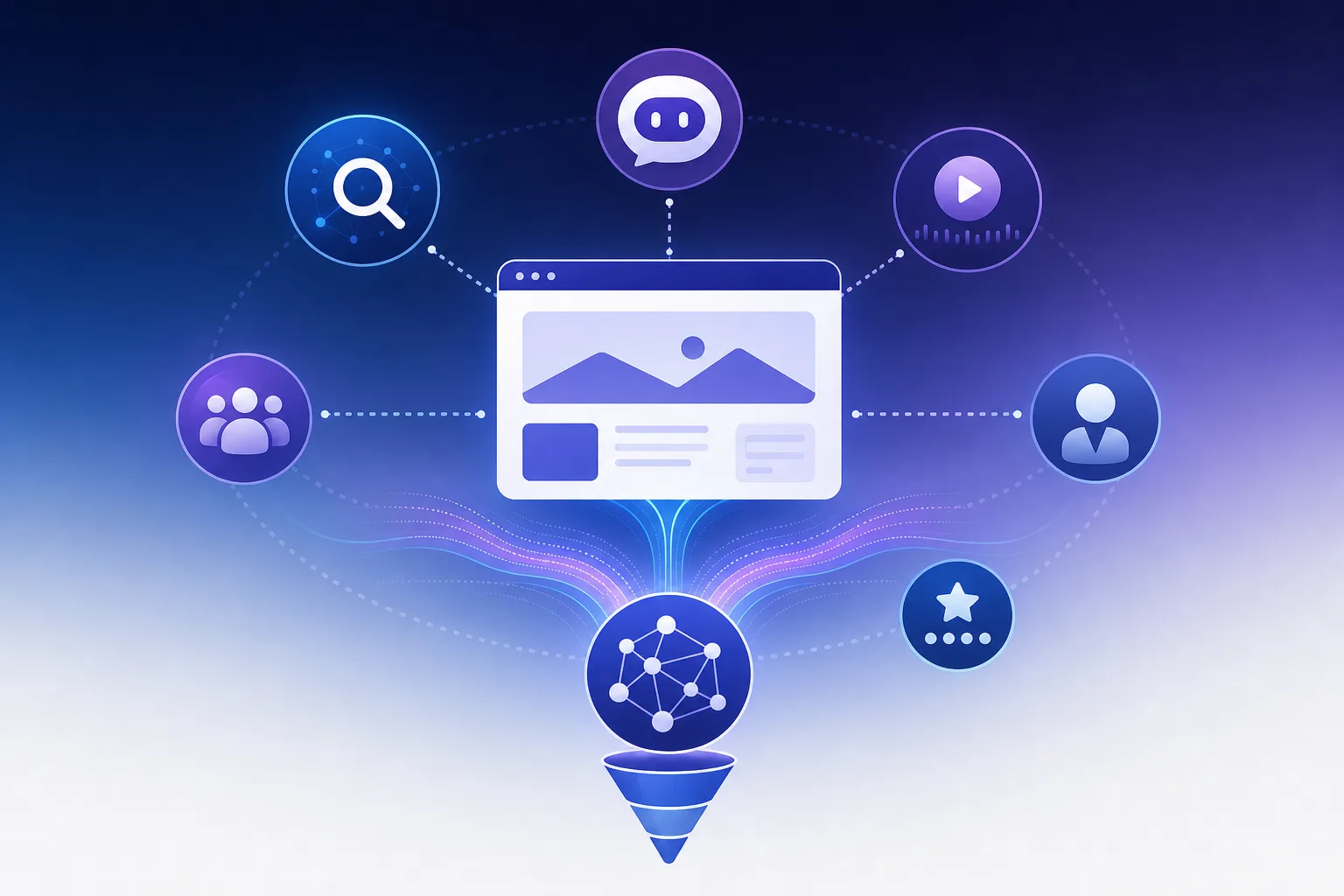
Search growth used to have one obvious battlefield: Google.
Rank higher. Get clicks. Bring users to the website. Convert them there.
Simple. Clear. Easy to report.
Now, the path is messier.
A user may see an answer in Google AI Overviews. They may ask ChatGPT directly. They may use Perplexity for cited explanations, YouTube for reviews, Reddit for real discussion, LinkedIn for founder opinions — and only then search your brand and visit your website.
Sometimes, they never click from search at all.
But they were already influenced.
So here is the realistic judgment:
In the AI search era, optimizing for one platform is no longer enough.
You are optimizing for a multi-platform discovery network.
That is Multi-Platform AI Optimization.
It is not posting everywhere.
It is not chasing every trend on every platform.
It means making your brand, product, cases, point of view, and trust signals appear consistently across the places AI systems read, users reference, and search experiences aggregate.
The short version: the future of GEO is not single-point ranking. It is distributed visibility.
GEO, or Generative Engine Optimization, is often understood as:
How do I get my content to appear in AI answers?
That is not wrong.
But it is too narrow.
Different AI platforms cite and retrieve information differently.
Profound’s analysis of citation patterns across ChatGPT, Google AI Overviews, and Perplexity found clear differences in preferred sources. ChatGPT leans more toward Wikipedia, G2, Forbes, and other authoritative knowledge or media sources. Google AI Overviews shows a more mixed pattern, citing Reddit, YouTube, Quora, LinkedIn, and others. Perplexity is also highly sensitive to Reddit, YouTube, Gartner, G2, and other community or professional sources.
In other words:
Doing well on Google does not mean you will be mentioned in ChatGPT. Writing clearly on your website does not guarantee Perplexity will cite you.
That is the core tension behind multi-platform AI optimization.
The old questions were:
Old question | New question |
|---|---|
Where do my keywords rank? | Which AI platforms mention my brand? |
Does my website get traffic? | Where do users first discover me? |
Is my content indexed? | Do different platforms understand me correctly? |
Do I have enough backlinks? | Does the external context support my positioning? |
What is my conversion rate? | Does multi-platform influence eventually turn into leads? |
The future competition is not only about rankings. It is about how understandable your brand is across different AI and content platforms.
Why single-platform optimization is not enough
Because the user journey is fragmented.
A B2B buyer looking for website and lead generation solutions might do this:
Search “best AI website builder for SaaS” on Google
Read the AI Overview summary
Watch product reviews on YouTube
Check Reddit for real user complaints
Ask ChatGPT “which website builder is good for SEO and lead generation?”
Read founder or consultant opinions on LinkedIn
Finally search the brand name and visit the website
No single touchpoint controls the whole journey.
Every platform shapes the user’s judgment.
Google’s official guide to optimizing for generative AI features also emphasizes that AI search still depends on foundational SEO, crawlable content, non-commodity content, clear structure, images, video, and people-first content. In other words, technical and content fundamentals still matter.
But AI platforms understand brands through a wider web environment.
So you should not only ask:
Is my website optimized?
You also need to ask:
Is my brand described consistently across AI, search, community, video, professional networks, and third-party pages?
What does Multi-Platform AI Optimization actually optimize?
It does not mean opening ten accounts and posting every day.
That will only exhaust the team.
It optimizes five things.
1. Brand clarity: keep the brand semantics consistent
Different platforms can use different formats.
But the core positioning cannot drift.
You cannot say you are an AI website builder on your website, a landing page tool on LinkedIn, a no-code design tool in directories, and almost an SEO agency in customer stories.
That confuses both AI systems and users.
You need stable brand semantics:
who you are
who you serve
what problem you solve
what category you belong to
how you differ from alternatives
The first step of multi-platform optimization is not publishing more. It is saying the same true thing clearly.
2. Content depth: your website needs citation-worthy content
The website is still the hub.
It is not the only entry point, but it is the home base for brand information.
At minimum, you need:
homepage: clear positioning in one sentence
product/service pages: use cases and outcomes
case studies: proof that you have done the work
FAQ: real search questions and buying doubts
comparison pages: clear differences
methodology articles: your point of view
About page: trust and entity information
If your website is thin, external platforms will struggle to build a stable understanding of your brand.
3. Platform fit: different platforms need different content forms
The same idea should not be copied unchanged everywhere.
Platform/context | Better content format |
|---|---|
Google AI Overviews | Clear structure, FAQ, guides, crawlable pages |
ChatGPT | Authoritative sources, encyclopedic explanation, media/directory/review signals |
Perplexity | Cited deep content, community discussions, professional sources |
YouTube | Tutorials, reviews, case breakdowns, comparison videos |
Reddit / communities | Real experience, problem solving, non-promotional discussion |
Founder POV, industry judgment, short frameworks | |
G2 / Product Hunt / directories | Category positioning, reviews, use cases, alternatives |
Multi-platform does not mean copy-paste. It means the same brand core appears in different formats across different contexts.
4. Proof distribution: trust signals need to live outside your website too
AI platforms do not only look at what you say about yourself.
They also look at what others say.
That is why case studies, reviews, customer stories, partner mentions, media coverage, community discussion, and tool lists matter.
This is where earned media, E-E-A-T, and GEO connect.
Your trust evidence should not only sit on your website. It should also appear in credible external contexts.
5. Lead capture: all influence needs somewhere to return
Multi-platform visibility without lead capture is just noise.
A user may discover you on YouTube, get convinced on Reddit, see your name in ChatGPT, and finally search your brand.
At that moment, your website must be ready.
If the website has no clear CTA, case studies, service boundaries, or contact path, multi-platform visibility leaks away.
Showcase websites become the central node of multi-platform AI optimization
Many people think the center of multi-platform optimization is content distribution.
It is not.
The center should be a credible, clear, operable showcase website.
External platforms help with discovery and validation. The website handles trust, explanation, conversion, and lead capture.
This is where We0 AI fits.
We0 AI is not just an AI website builder, and not a “one prompt, one page” tool. It is closer to a showcase website growth team plus an AI website platform, helping you turn your website into the hub for multi-platform AI visibility.
The core loop remains:
Build -> Showcase -> Grow -> Leads
We0 loop | Meaning in Multi-Platform AI Optimization |
|---|---|
Build | Build a crawlable website with unified brand information and clear structure |
Showcase | Present products, services, cases, portfolio, FAQ, proof, and differentiation |
Grow | Continue SEO/GEO, content publishing, internal and external content layout, and data monitoring |
Leads | Convert influence from AI, search, video, community, and social into leads |
Multi-platform AI optimization does not make the website less important. It makes the website the destination for all platform signals.
A practical framework for Multi-Platform AI Optimization
If you do not know where to begin, start in this order.
Step 1: Define your core brand description
Write three versions:
One-sentence version: for users
Category version: for search and AI systems
Comparison version: to explain how you differ from alternatives
For example, We0 AI can be described like this:
One-sentence version: We0 AI helps you build a showcase website that can grow and generate leads.
Category version: We0 AI is an AI website building and growth platform for showcase websites.
Comparison version: Unlike simple page builders, We0 AI supports website launch, SEO/GEO, content growth, data monitoring, and lead generation.
This step sounds basic.
But it shapes how every platform describes you.
Step 2: Build the core website pages
Do not rush into distribution.
First, make sure the website can receive users and AI systems.
Core pages include:
Page | Role |
|---|---|
Homepage | Unified positioning and first impression |
Product/service pages | Explain what problem you solve |
Case studies | Provide real experience and proof |
FAQ | Cover long-tail questions and buying hesitation |
Comparison pages | Help users understand differences |
Content hub | Build methodology and search traffic |
About | Strengthen trust and entity information |
Contact/CTA | Capture leads |
Step 3: Turn one idea into multiple platform versions
Do not reinvent content for every platform.
Start with one core idea, then adapt it.
Example:
Core idea: A showcase website is not a digital business card. It is a long-term lead generation asset.
You can turn it into:
Website article: full explanation of how showcase websites support SEO/GEO and leads
LinkedIn: founder short POV
YouTube: case breakdown video
Reddit: answer to “are AI website builders good for SEO?”
FAQ: what businesses are showcase websites best for?
Comparison page: showcase website vs landing page
PR/media: industry POV article
That is multi-platform content efficiency. Not writing more, but repurposing one strong idea into the right formats.
Step 4: Build credible touchpoints on key external platforms
You do not need every platform.
Choose based on where your target users pay attention.
If you are SaaS, your priority may be Google, ChatGPT, Perplexity, G2, Product Hunt, LinkedIn, YouTube, and Reddit.
If you are a local service business, it may be Google Business Profile, Maps, Yelp, local directories, YouTube, and community forums.
If you are an export business, it may be Google, B2B directories, YouTube, LinkedIn, multilingual website pages, and industry media.
Multi-platform does not mean all-platform. It means the platforms your audience actually uses.
Step 5: Monitor brand performance inside AI and platform contexts
Check these questions regularly:
How does ChatGPT describe your brand?
Does Perplexity cite your content?
Does Google AI Overview show your pages or external mentions?
Are there real discussions on YouTube, Reddit, or LinkedIn?
When someone searches your brand, do the results look credible?
Are directory categories accurate?
Which platforms bring users back to the website?
Which pages generate leads?
This is not a one-time task.
It should become part of monthly review.
Common mistakes: Multi-platform AI optimization is not this
Mistake 1: Posting everywhere
Posting everywhere is not optimization.
If every platform gets low-quality content, you only create noise.
Multi-platform optimization is about consistent signals, not content volume.
Mistake 2: Rewriting every page for AI
Google has said you do not need to rewrite content in a special way just for generative AI search. What matters more is valuable, non-commodity, people-first content and clear technical structure.
So don’t turn GEO into superstition.
Mistake 3: Only optimizing the website and ignoring external context
The website matters, but AI looks at the broader web environment.
If there are no external mentions, reviews, discussions, or citations, the signal is thin.
Mistake 4: Only measuring clicks, not influence
AI search and community platforms are often zero-click or delayed-click.
A user may see you in an AI answer today and search your brand three days later.
So track branded search, direct visits, lead quality, and AI mentions — not just single-session clicks.
Mistake 5: Telling a different story on every platform
This is the most dangerous one.
Platforms can differ.
The story should not drift.
Users and AI systems both need stable brand memory.
How We0 AI helps with Multi-Platform AI Optimization
We0 AI is not here to “post more content for you.”
It helps you build a website growth system that can be recognized, understood, cited, and converted across multiple platforms.
Need | How We0 AI supports it |
|---|---|
Brand messaging is messy | Clarifies brand information, site structure, and core copy |
Website is too thin | Builds homepage, product pages, case pages, FAQ, and content hub |
SEO/GEO feels unclear | Sets up foundations, keyword/question layout, and content planning |
External platforms have nowhere to land | Turns the website into a credible destination for all external touchpoints |
Content cannot continue | Supports ongoing content production and publishing, plus external content layout |
Performance is unclear | Monitors visits, branded search, page performance, and lead quality |
No one reviews growth | Provides growth suggestions and monthly optimization directions |
This is the difference between We0 AI and ordinary AI website builders.
A normal tool helps you generate a page.
We0 AI helps you build:
A launch-ready, operable, continuously growing showcase website that can support multi-platform AI visibility.
FAQ
1. What is Multi-Platform AI Optimization?
Multi-Platform AI Optimization means a brand does not optimize for only one search entry point. Instead, it builds consistent, credible, citable brand signals across Google AI Overviews, ChatGPT, Perplexity, YouTube, Reddit, LinkedIn, directories, and its own website.
2. How is it related to GEO?
GEO focuses on visibility and citation inside generative AI search. Multi-Platform AI Optimization is a more practical version of GEO because different AI platforms reference different sources, so brands need to be correctly understood across multiple relevant contexts.
3. Is the website still important?
Yes. The website is the center for brand information, product explanation, cases, FAQ, CTA, and lead capture. Multi-platform optimization does not weaken the website. It makes the website the destination for external signals.
4. Do small teams need to optimize every platform?
No. Small teams should prioritize the platforms their target users actually use. For SaaS, that may include Google, ChatGPT, Perplexity, LinkedIn, G2, Product Hunt, YouTube, and Reddit.
5. How does We0 AI help with multi-platform AI optimization?
We0 AI helps build showcase websites, unify brand messaging, plan core pages and content hubs, set up SEO/GEO, publish content continuously, monitor data, and turn influence from AI, search, communities, and social platforms into leads.