MoWorld Explained: The Real-Time NPU World Model Pushing World Models Toward Industry Use
MoWorld shows how world models may move from impressive demos toward deployable infrastructure. Its key claim is not only better generation quality, but real-time interaction at more than 50 FPS on domestic NPU hardware. The article explains MoWorld’s data engine, training and inference optimizations, low-cost deployment direction, and practical use cases across games, robotics, film production, digital twins, and 3D reconstruction. The model’s code and public service access are still marked as coming soon, so production adoption should wait for more public testing, documentation, and deployment details. **The main takeaway: MoWorld matters because it treats the world model as an interactive, deployable spatial engine, not just another video generator.**
MoWorld Explained: The Real-Time NPU World Model Pushing World Models Toward Industry Use
Introduction
Over the past year, world models have become one of the most discussed ideas in the AI industry. A real world model is not just a system that keeps generating video frames. It should understand space, predict the next state of the world, and respond to control signals in real time.
That real-time part matters. For robotics, autonomous driving, games, and interactive entertainment, anything below a smooth frame rate quickly feels limited. In practice, more than 30 FPS is usually the baseline for a fluid interactive experience.
That is also where most existing world models struggle.
Moxin Technology, a company focused on 4D world models and industrial deployment, has now released MoWorld together with partners including Zhejiang University academician Yunhe Pan and Huawei. The team describes MoWorld as a full-stack real-time interactive world model built on domestic NPU infrastructure.
According to the original report and the MoWorld project page, MoWorld reaches more than 50 FPS during inference, while deployment cost is reported to be only about 30% of a comparable GPU-based solution. A technical report is already available, while weights, code, and public NPU-based service access are marked as coming soon.
Project homepage: MoWorld
Why Have World Models Struggled to Become Real Time?
Compared with ordinary video generation models, the biggest difference in a world model is real-time interaction.
For a long time, world models stayed closer to research demos than production systems. The main question was no longer just whether the model could generate visually impressive content. The harder question became whether it could support real-time control, stable deployment, and a cost structure that makes industry use realistic.
MoWorld was released against that background. The Moxin team, together with Huawei as a strategic investor and collaborator, spent nearly a year working through key engineering problems around world-model deployment.
MoWorld takes an initial frame, text, and camera trajectory as conditions. It then generates future world states that match the current scene and control input. With continuous controls similar to W/A/S/D movement, users can interact with the generated world as it unfolds. On domestic NPU hardware, the system reaches more than 50 FPS and keeps inference cost low through system-level design.
For the First Time, a World Model Brings Cost Down
For world models, generation quality is only the first step. What decides whether the technology can actually be deployed is training cost, inference efficiency, and real-time interactivity.
MoWorld optimizes the full pipeline: data construction, model training, distillation, and system deployment. The goal is not only to improve model capability, but also to make the model easier to run in real engineering settings.
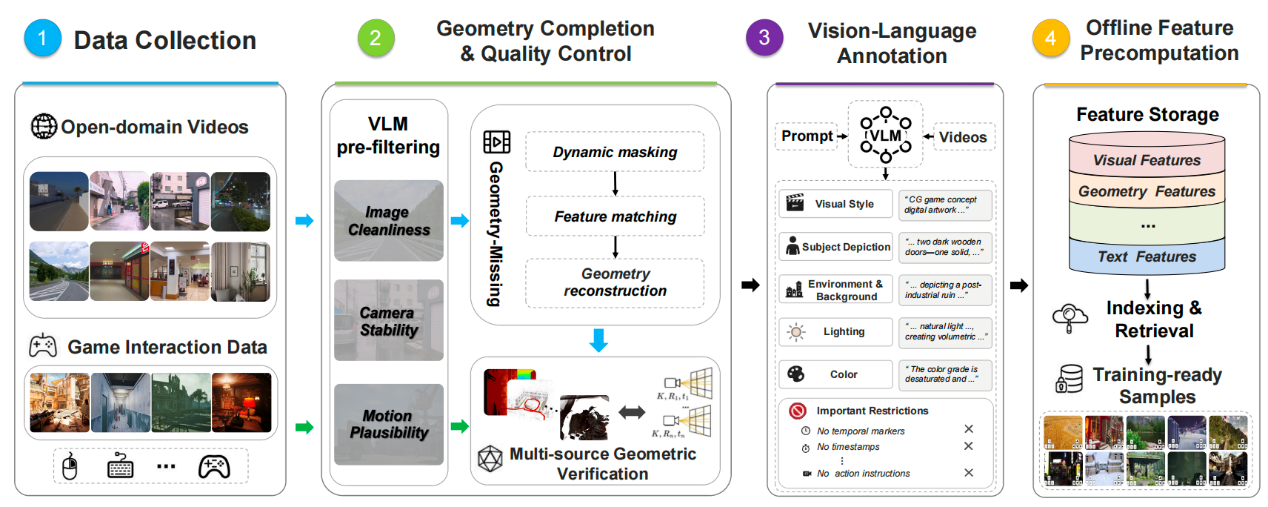
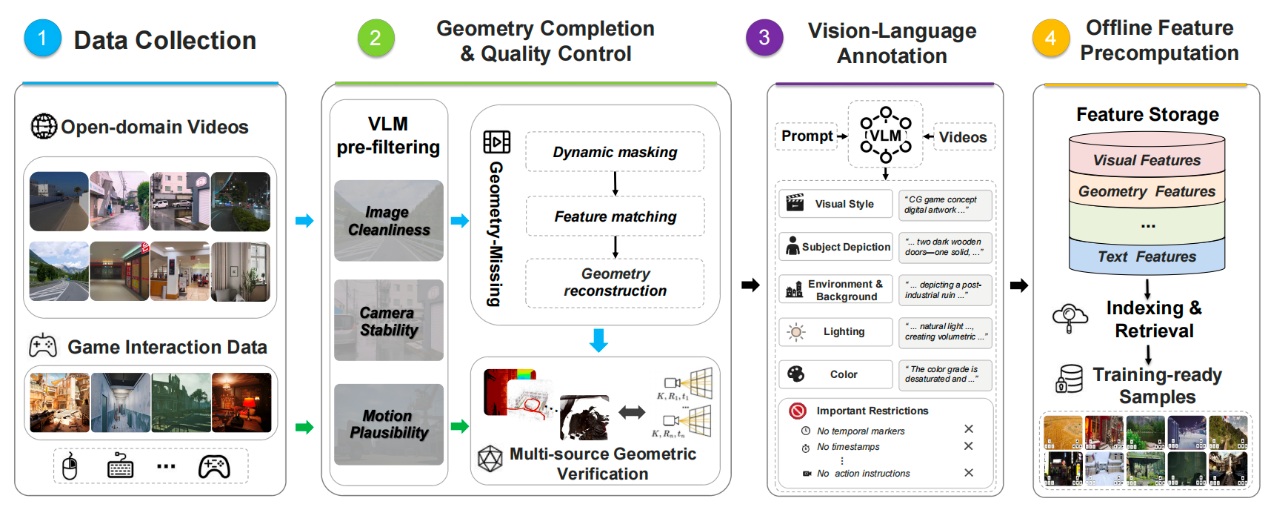
The first key piece is data. Unlike standard video generation models, world models cannot rely only on videos and text. They also need camera trajectories, spatial depth, and other 3D information. Raw internet videos are not enough.
To solve this, MoWorld builds on years of 3D and 4D modeling research. The team created a scalable data production and governance system. Through quality filters such as geometric consistency, trajectory precision, and multi-view stability, the system improves the training corpus and gives the model a more reliable basis for learning spatial rules. This also helps reduce the overall training burden.
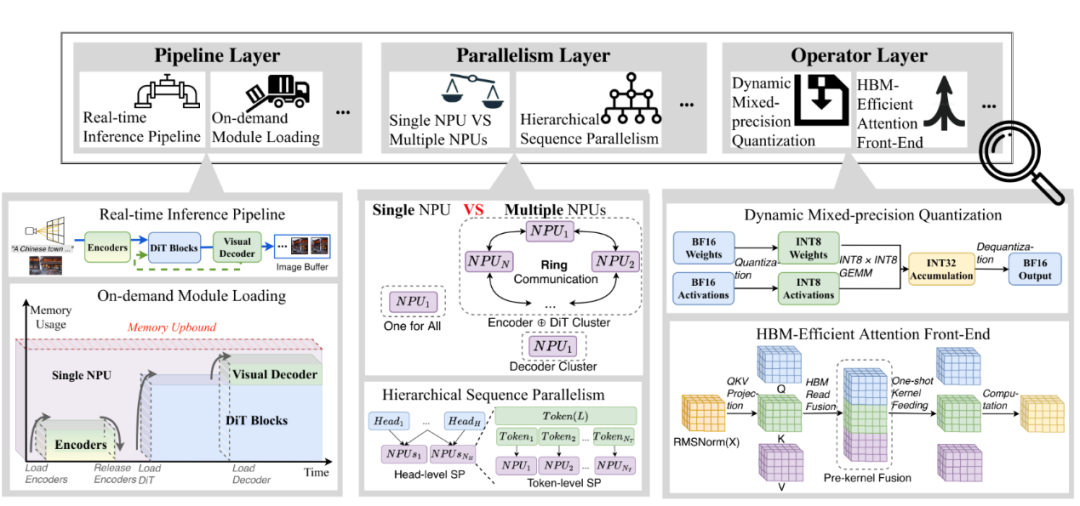
To make the world model deployable in real time, MoWorld then optimizes three stages: training, distillation, and inference.
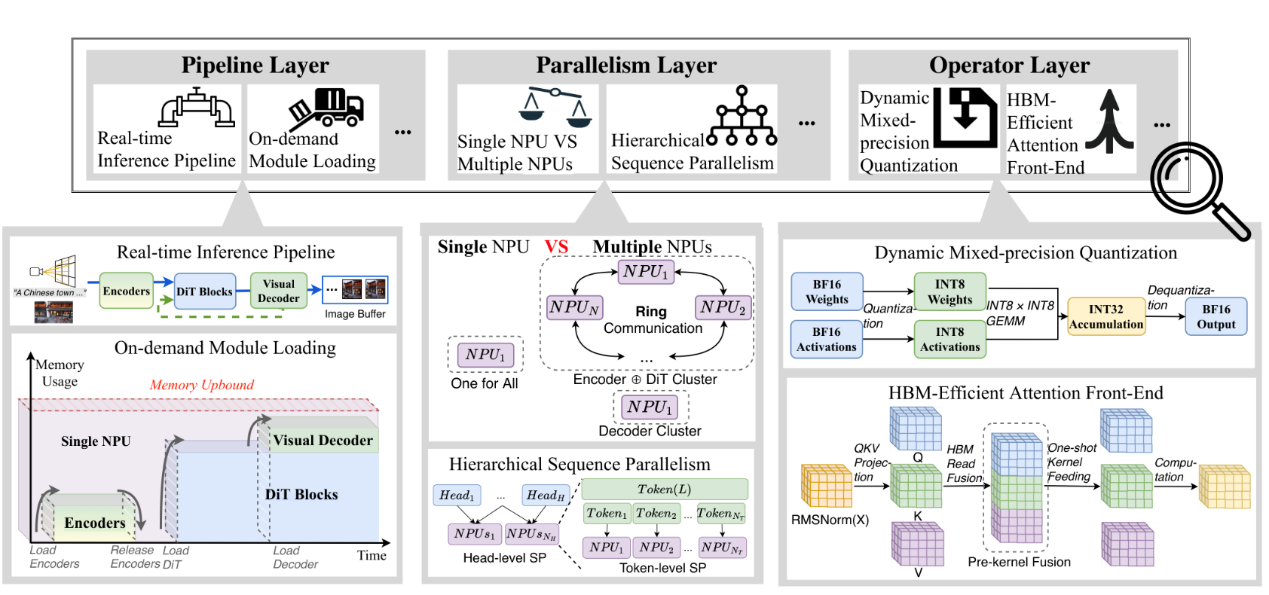
During training, the system is designed around the characteristics of domestic NPU hardware. It introduces ultra-dense attention parallelism and long-sequence token parallelism to reduce memory pressure when training on very long videos. According to the original report, this enables long-horizon training and inference up to 2,000 frames.
During inference, MoWorld uses pipeline execution, hierarchical sequence parallelism, and dynamic mixed-precision quantization. These system optimizations allow a 14B-parameter MoE world model to reach up to 50 FPS on a domestic NPU platform. The reported inference cost is only about 30% of a comparable GPU solution.
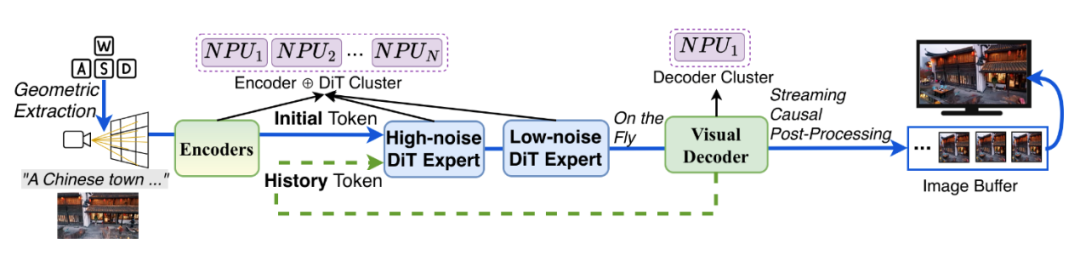
From high-quality data engine construction to long-sequence training and low-cost real-time deployment, MoWorld moves world models from “can generate” toward “can interact and can be deployed.” For large-scale industrial use, that shift is the real point.
MoWorld is expected to open services to the public through domestic NPU supernodes.
MoWorld Leads Industrial Applications for Domestic World Models
With real-time interactive world-model capability, MoWorld is moving from technical validation toward a broader spatial intelligence infrastructure for multiple industries.
In these scenarios, the model is not only a video generator. It works more like a controllable spatial simulation engine, giving industries a way to generate interactive, explorable, and economically deployable scenes.
Games and Interactive Entertainment: Real-Time Control and Free Exploration
MoWorld supports full six-degree-of-freedom camera control. Users can move through generated scenes with W/A/S/D and mouse-style controls, creating an experience closer to cinematic or game-level roaming.
The generated scenes are realistic and high-definition. The original article notes support for 1080p and higher resolutions.
It also covers a wide range of styles, including natural landscapes, anime-style scenes, game environments, and animated content.
Embodied Intelligence and Autonomous Driving: Virtual Training and Real Verification
World models are becoming a bridge between generative AI and embodied intelligence.
MoWorld can provide robots and autonomous driving systems with a low-cost, high-fidelity digital training ground. In this role, it becomes more than a visual generator. It offers a simulator where AI systems can learn how to interact with physical environments before entering the real world.
For autonomous driving teams, this kind of world simulation could provide large amounts of high-precision environment data at a lower cost than many traditional simulation pipelines.
Film Production: Director-Level Camera Movement and Real-Time Previsualization
Traditional film previsualization and storyboard rendering can take a long time.
MoWorld allows creators to adjust viewpoint, preview shots in real time, and edit camera movement inside a generated virtual world. Smooth camera control is especially important here, because film workflows often require directors to test angles, motion, and visual rhythm before production.
Digital Twins and 3D Reconstruction: Spatial Reconstruction with Higher Consistency
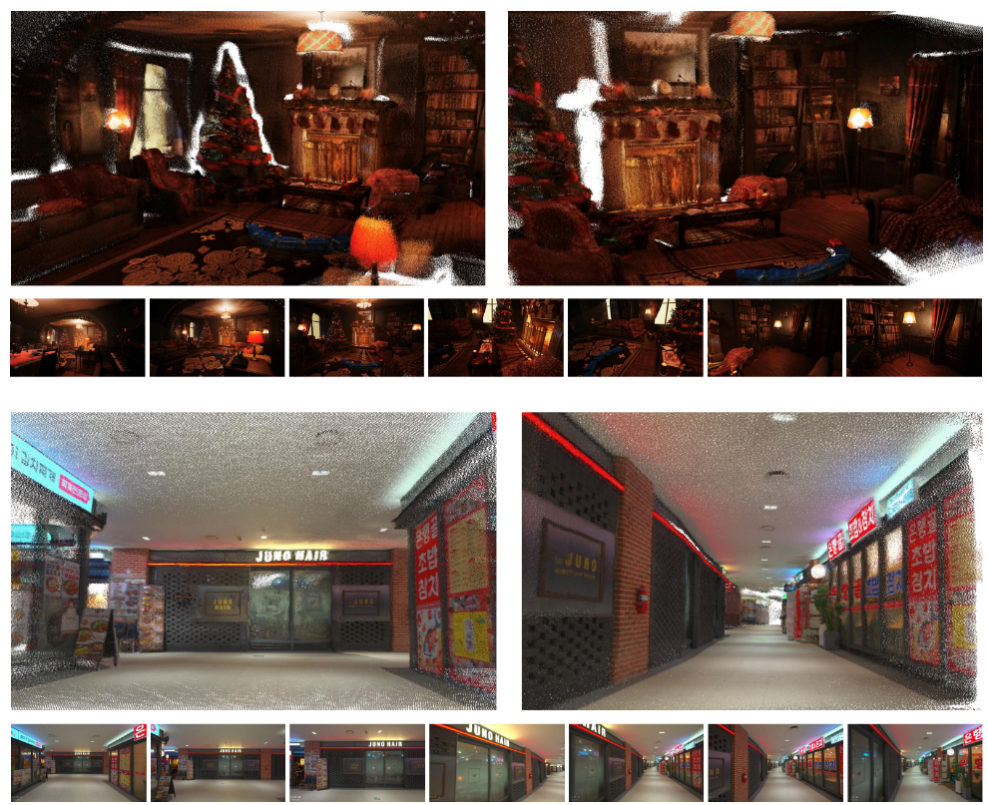
MoWorld’s generated videos are reported to have strong geometric consistency, making them useful for indoor 3D reconstruction.
According to the original report, the model stands out because of high reconstruction accuracy, stable structure, and consistent spatial layout. These qualities are important for digital twins, architectural visualization, virtual showrooms, immersive games, and other 3D spatial applications.
Hundreds of Millions of Dollars for Moxin: Who Will Define the Next Generation of Spatial Intelligence?
The competitive landscape for large language models and video generation models is already relatively clear. World models are different. The field is still young, and there is no widely accepted global leader yet.
Engineering paths are still being tested. Industry standards are also not fully formed.
For domestic AI teams, that creates a rare window. The starting-line gap is not as large as in some older AI infrastructure markets. Teams still have a chance not only to compete, but also to help define the technical standards for the next generation of spatial intelligence.
MoWorld’s answer to that opportunity is clear: it claims a full training-and-inference stack running on domestic NPU infrastructure, real-time interactive inference above 50 FPS, and inference cost reduced to around 30% of a comparable GPU solution.
Capital moved before the industry reached full consensus. Moxin Technology recently completed a funding round worth hundreds of millions of dollars, with participation from leading dollar funds, national strategic reserve funds, and multiple industrial investors.
Earlier, Moxin had also received investment from Huawei’s Hubble Investment and Lenovo’s LeFund-backed capital platform.
The window will not stay open forever. The next question is who will set the standards for world models and spatial intelligence.
FAQ
What is MoWorld?
MoWorld is a real-time interactive world model developed by Moxin Technology and collaborators. It is designed to generate future world states from an initial frame, text, and camera trajectory, while allowing continuous user control.
Why is 50 FPS important for a world model?
A world model used for interaction needs to respond quickly enough for users or AI agents to control it smoothly. More than 30 FPS is commonly treated as a baseline for fluid interaction, and MoWorld reports inference above 50 FPS on domestic NPU infrastructure.
Is MoWorld only a video generation model?
No. The original article positions MoWorld as a controllable spatial simulation engine, not just a video generator. Its key value is real-time interaction, camera control, spatial consistency, and potential use in robotics, games, film previsualization, and digital twins.
What hardware does MoWorld target?
MoWorld is designed around domestic NPU deployment. The project page describes it as a cost-efficient NPU stack and says it is built for high-frame-rate, low-cost, continuously controllable video world generation.
Is MoWorld open source?
The MoWorld project page lists the code as “Coming Soon.” The original article also says weights and code are expected to be opened soon, but they were not publicly available at the time this article was prepared.
What is the reported cost advantage of MoWorld?
The original article says MoWorld’s deployment cost is only about 30% of a comparable GPU solution. The arXiv paper describes MoWorld as reducing average inference cost to around 30%–50% of existing world models in practical settings.
What industries could use MoWorld?
Potential use cases include games, interactive entertainment, robotics, autonomous driving, film previsualization, digital twins, architectural visualization, virtual showrooms, and 3D reconstruction.
Related Tools
- MoWorld: The official project page for the real-time interactive world model.
- arXiv: A preprint platform where the MoWorld technical paper is available.
- GitHub Pages: The hosting system used for the public MoWorld project website.
Related Links
- MoWorld Official Project Page: Official overview of the model, architecture, results, and application scenarios.
- MoWorld: A Flash World Model on arXiv: The official arXiv abstract page for the MoWorld technical paper.
- MoWorld arXiv HTML Version: A web-readable version of the technical paper.
- MoWorld Technical Report PDF: The project’s linked technical report PDF.
- Official MoWorld Data Engine Figure: The official architecture image used when the original BAAI image could not be loaded.
- Official MoWorld Real-Time Inference Figure: The official image explaining MoWorld’s inference optimization architecture.
Summary
MoWorld shows how world models may move from impressive demos toward deployable infrastructure. Its key claim is not only better generation quality, but real-time interaction at more than 50 FPS on domestic NPU hardware.
The article explains MoWorld’s data engine, training and inference optimizations, low-cost deployment direction, and practical use cases across games, robotics, film production, digital twins, and 3D reconstruction.
The model’s code and public service access are still marked as coming soon, so production adoption should wait for more public testing, documentation, and deployment details.
The main takeaway: MoWorld matters because it treats the world model as an interactive, deployable spatial engine, not just another video generator.