Meta AI Can Now Read Emails, Calendars, and Build Slides: How to Turn Internal Company Materials into We0.ai Website Content?
Many companies share a strange state: plenty of materials, but an empty website. Customer questions sit in emails, project timelines live in calendars, proposals are in Slides, product information is in documents, and real cases are buried in meeting notes.
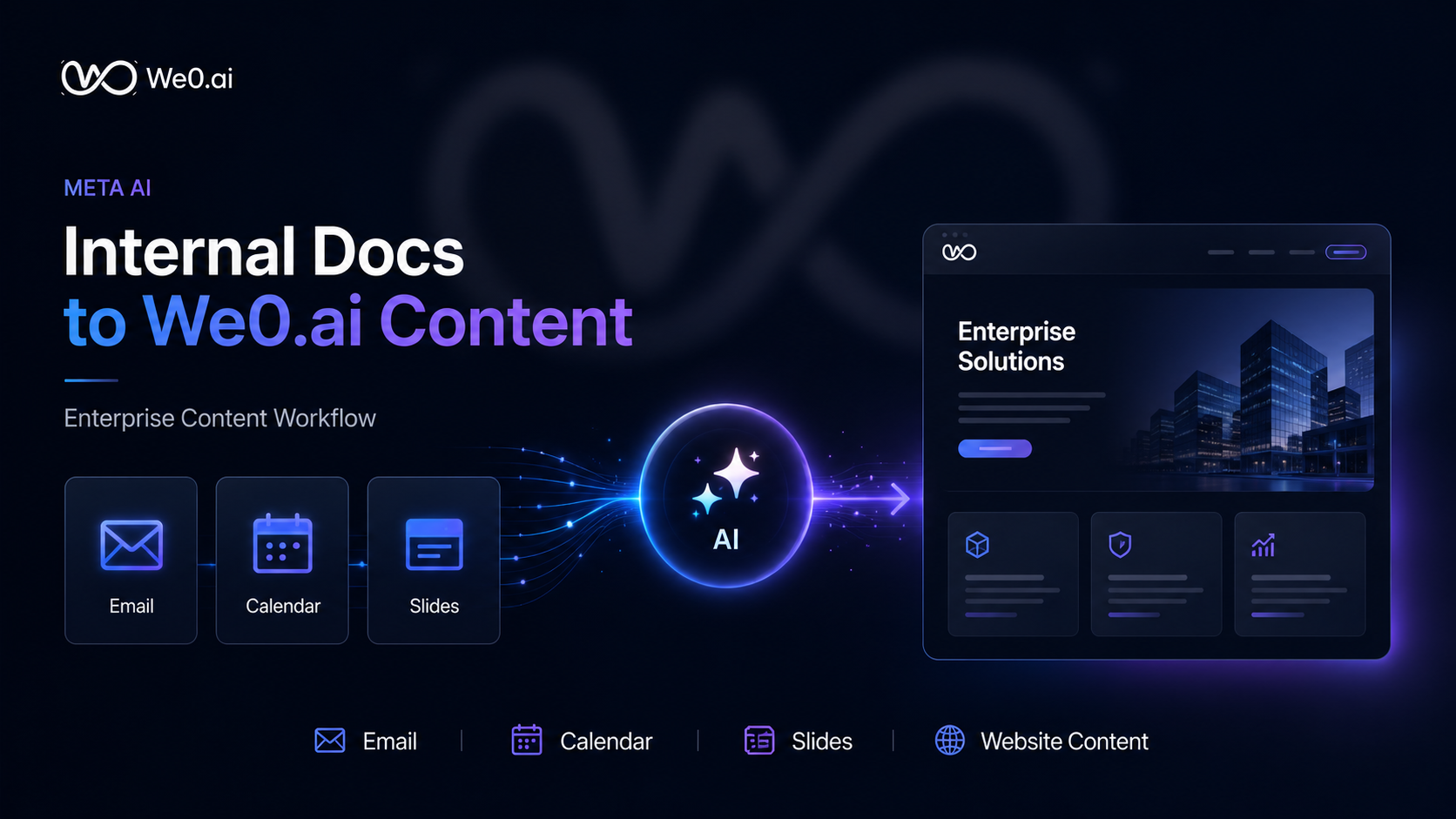
First, the conclusion: What companies lack most isn't content—it's "organized content"
Many companies are in a strange state:
Lots of materials, but an empty website.
Emails contain customer questions, calendars hold project timelines, Slides contain proposals, documents have product information, and meeting notes capture real case studies. Yet when it comes to the website, all you find are a few generic lines of introduction, plus a homepage that looks "okay."
That's the problem.
It's not that there's nothing to write. It's that no one has turned these materials into content that can be published, searched, and converted.
And this is where capabilities like Meta AI send a clear signal: AI is moving from "writing text" to "reading context, connecting workflows, and delivering results directly."
For businesses, this shift matters. Because website content shouldn't rely on brainstorming anymore. It should come from your real internal materials.
What We0.ai does is connect that entire pipeline:
Build -> Showcase -> Grow -> Leads
First, get it up. Then, show the value. Then, build traffic and content. Finally, turn it all into leads.
1. Why internal business materials are especially suited for website content
Because these materials are inherently more authentic than "essay-style copy."
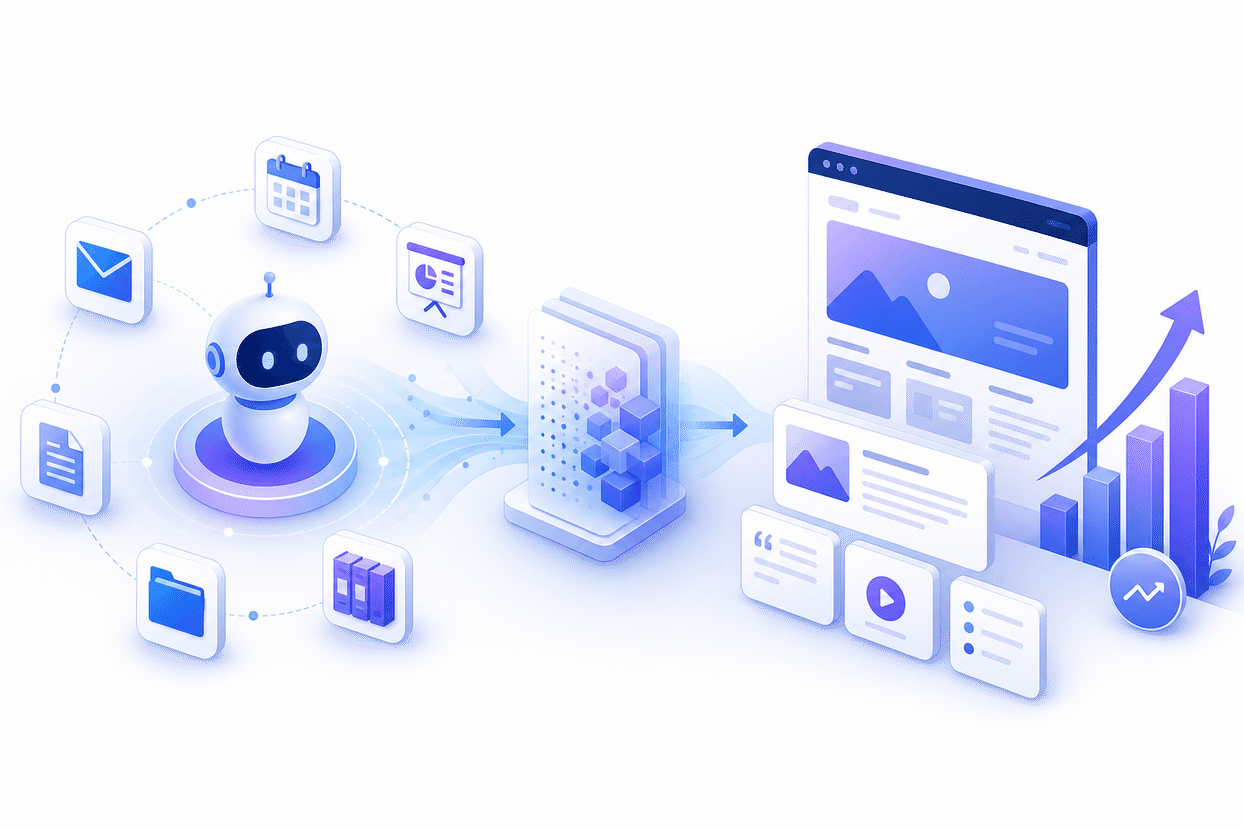
| Internal Material | What Website Content It Can Become | Suitable Pages |
|---|---|---|
| Emails | Common customer questions, industry problems, pre-sales FAQ | FAQ page, product page |
| Calendars | Project cadence, event schedules, release timelines | Roadmap page, events page |
| Slides | Product proposals, case demos, capability overviews | Homepage, case study page, solutions page |
| Meeting notes | Decision-making process, requirement changes, retrospectives | Blog, insights page |
| Documents | Product descriptions, service processes, SOPs | Services page, help center |
| Recordings/transcripts | Customer verbatims, pain points, use-case scenarios | Case study page, landing page |
The greatest value of this type of content isn't that it "looks professional"—it's that it carries real business traces.
What are websites most afraid of?
Emptiness.
Empty introductions, empty vision, empty selling points, empty case study names.
But internal materials are different. They have detail, context, and real problems. With a bit of organization, they become far more credible content assets.
2. Don't treat website content as PR copy—treat it as "knowledge assets"
Many teams still think about website content the old way:
- Who we are
- What we do
- How great we are
To be honest, this kind of content rarely resonates.
Because users aren't here for a "self-introduction." They're here for answers.
So website content should instead be:
- How is this problem solved
- Who is this solution for
- Why is your approach different
- What does the real process look like
- How are results verified
That's a content asset. Not slogans.
This is where We0.ai's value lies. It doesn't just stitch together a page for you—it turns your internal materials into showcase website content that can be accessed, searched, and converted.
In other words, We0.ai isn't just building "websites." What it's doing is:
Turning a company's tacit knowledge into publicly accessible, lead-generating content.
3. The 5 most practical steps for turning internal materials into website content
1) Gather first, don't write first
Don't rush into writing homepage copy.
Pull out your materials first:
- Emails
- Slides
- Meeting notes
- Customer feedback
- Product documentation
- Support records
- Project retrospectives
Find the content first, then find the expression.
This step is like doing a content version of an "asset inventory."
2) Reorganize by user questions, not by department
Don't categorize by department. Categorize by how users search.
For example:
- How is pricing determined
- Who is this for
- What's the difference from competitors
- How do we get started
- How long is the delivery cycle
- Can it be customized
- Are there case studies
This step is critical. Because website content is essentially SEO content—and conversion content.
3) Convert "raw information" into "page modules"
Don't cram all the information into one long article.
Instead, break it into these page modules:
- Homepage hero
- Product overview page
- Solutions page
- Case study page
- FAQ page
- Blog posts
- Download/whitepaper page
Content needs to be modular for the website to be manageable.
4) Translate internal language into external language
Internally, you might say:
We completed several delivery-loop optimizations.
Externally, you should say:
You can launch faster, get customer feedback sooner, and see conversions more quickly.
This isn't "polishing"—it's translation.
Translating internal organizational language into user language.
5) Keep iterating after launch
Content isn't a one-and-done task.
After launch, you need to track:
- Which pages get the most visits
- Which keywords are starting to drive traffic
- Which FAQs get the most clicks
- Which case study pages get the longest dwell time
- Which CTAs convert the highest
Content requires ongoing management, not a one-time handoff.
This is also why We0.ai functions more like a "showcase growth platform" than a typical website builder.
4. A highly practical content conversion framework
You can directly organize internal materials using this logic:
| Raw Material | Questions to Extract | Corresponding Page | End Goal |
|---|---|---|---|
| Customer emails | What do they ask most often? | FAQ / Blog | Reduce comprehension cost |
| Proposal slides | How do we solve it? | Product page / Solutions page | Communicate value |
| Project retrospectives | Why did it work? | Case study page | Build trust |
| Product documentation | How do we get started? | Help center | Lower the barrier to entry |
| Meeting notes | Why this direction? | Brand story / Insights page | Reinforce decision-making |
You'll find that website content isn't "written"—it's "organized."
That statement matters.
5. Why this fits We0.ai especially well
Because We0.ai doesn't build a single page—it builds a showcase website system that can grow continuously.
It's not suited for "just make a demo and done" scenarios. Instead, it's for:
- Brand websites
- Product websites
- Case study pages
- Services pages
- Content sites
- Inquiry pages
- Waitlist pages
You have the content. We0.ai helps you turn content into pages.
You have the pages. We0.ai continues to help you with SEO, GEO, content updates, and conversion.
That's the pipeline businesses truly need.
Because the question today was never "Do we have a website?"
The real question is:
Can your website actually carry your business?
6. A more realistic approach for businesses: content first, pages second—not the other way around
Many teams get the order backwards.
They start with design, templates, and assembling a homepage.
The result: the website looks fine, but the content doesn't hold up.
A steadier sequence is:
- Organize internal materials first
- Extract user questions next
- Then build the page structure
- Then write the copy
- Then launch and optimize
Get the order right, and your website becomes an asset.
Get the order wrong, and your website is just an "online display board."
7. Closing: AI isn't here to write your website for you—it's forcing you to articulate your company clearly
Meta AI can read emails, calendars, and Slides. That's interesting in itself.
But the bigger shift isn't "AI got better at work."
It's a reminder:
A company's most valuable content has always been hidden internally.
It just never got organized before.
Now things are different.
You can turn these materials into website content, into search traffic, into case studies, into FAQs, into lead-generation entry points.
And We0.ai
all you need to do is make this process smoother:
Turn materials into content, turn content into a website, and turn the website into a growth asset.
FAQs
1. Companies already have lots of internal materials—why bother reorganizing them into website content?
Because raw materials aren't meant for external audiences. Only after they've been organized can they be more easily found, understood, and converted.
2. Which materials are the best candidates for website content first?
Customer emails, product proposals, FAQs, case study reviews, and service process documents.
3. How is website content different from regular marketing copy?
Website content focuses more on user questions, search intent, and conversion paths—it's not just about introducing yourself.
4. What types of websites is We0.ai best suited for?
Brand sites, product sites, case study pages, service pages, content hubs, lead generation pages, and launch pages.
5. What do we need to do after the content is organized?
Go live, monitor traffic, optimize keywords, add FAQs, and keep updating pages.
Related Tools
Ready to Get Started?
If you already have a pile of emails, slides, documents, and meeting minutes, don't let them keep gathering dust.
Turning them into website content is what truly gets growth started.
Want to turn those materials into a live, searchable, customer-generating website faster? You can use We0.ai to run the whole pipeline.
Summary
AI isn't writing content for companies. AI is pushing companies to turn content into assets.
Whoever organizes first, goes live first, gets search traffic and leads first.