Meta AI can now execute tasks on its own—should the official website also evolve from “designed for humans” to “built for AI to operate”?
--- In the past, when we built official websites, the default audience was human. People would browse, understand, compare, place orders, and ask questions. So pages needed to look good, tell a story, and build trust. But things are different now. AI has started doing things on behalf of people.
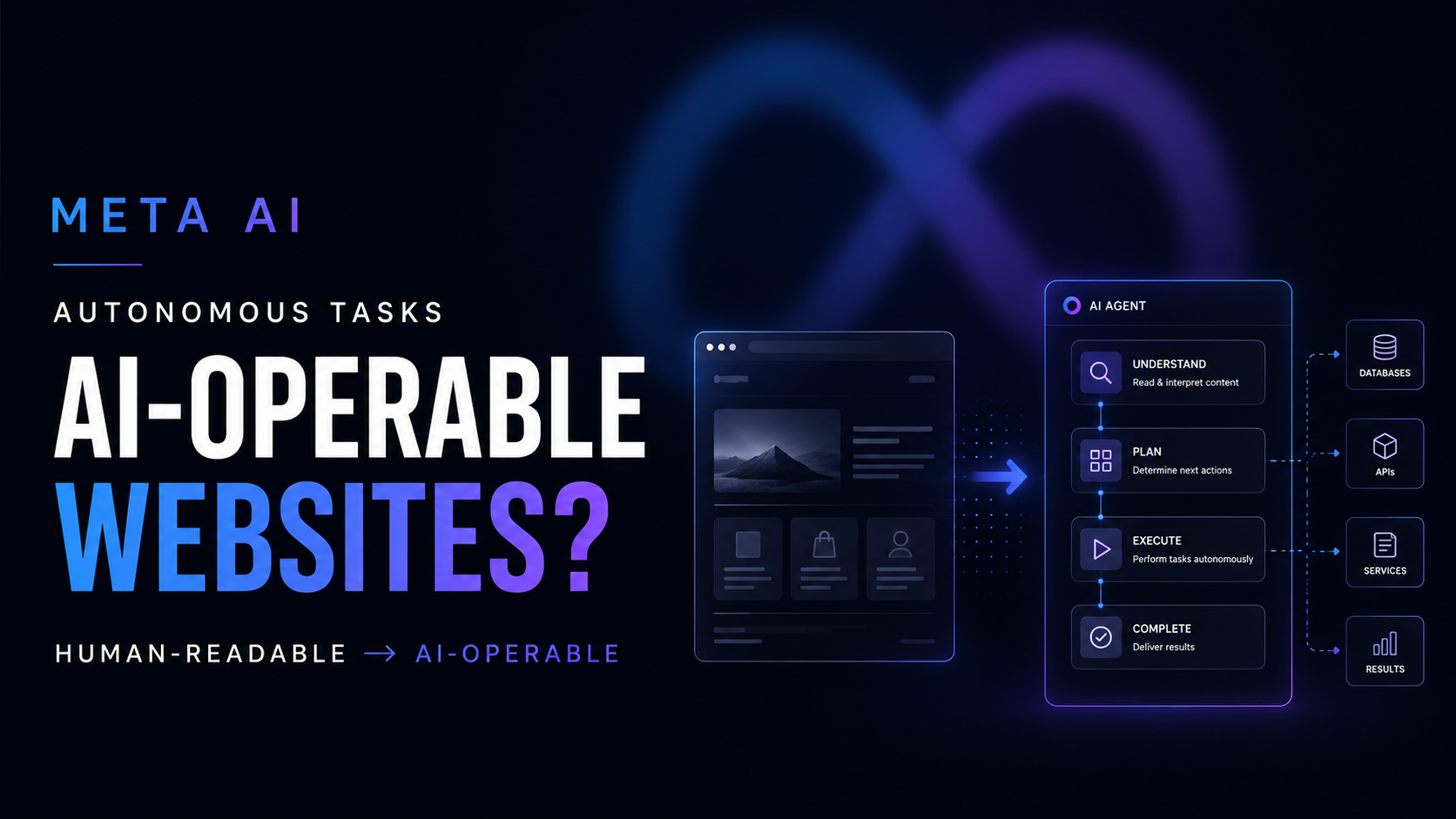
Meta AI can already execute tasks on its own — shouldn't official websites also upgrade from "designed for humans" to "built for AI"?
Bottom line first: Websites will change, and faster than you think
In the past, when we built corporate websites, the default audience was human.
Humans browse, understand, compare, order, and ask questions.
So pages needed to look good, tell a story, and build trust.
But things are different now.
AI is starting to act on behalf of people.
It's not just answering questions — it's also participating in searching, filtering, filling out forms, making calls, submitting requests, and even completing entire tasks for users.
This raises a very practical question:
If more and more traffic, decisions, and actions will flow through AI in the future, is it still enough for a website to be designed only for human eyes?
I think the answer is very likely no.
The next step for websites isn't necessarily "more beautiful" — it's more operable.
Not just understandable by humans, but also readable, callable, executable, and returnable by AI.
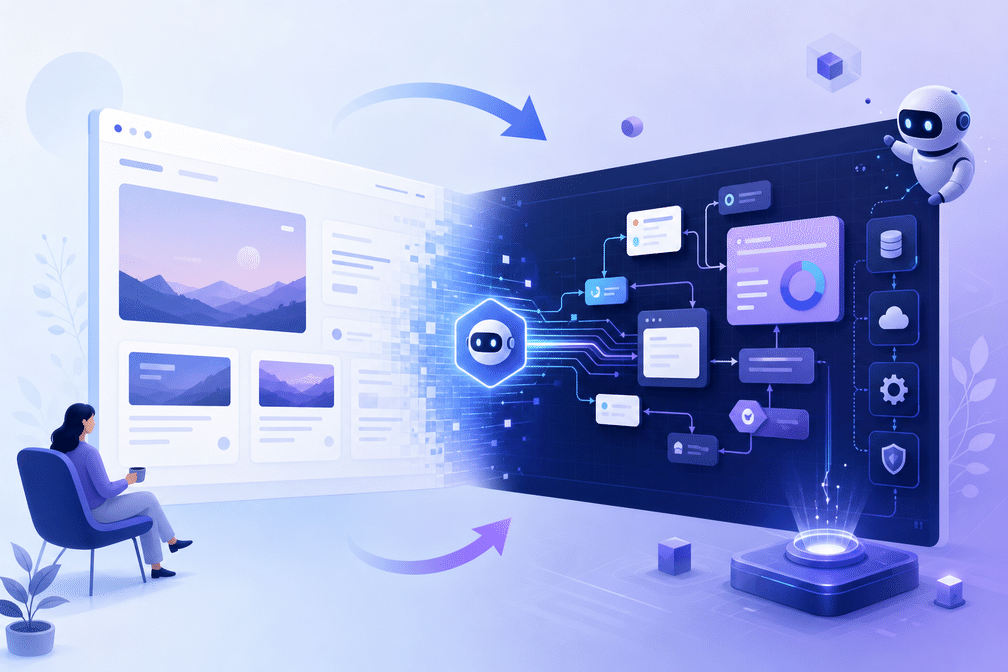
1. In the past, websites were built around display
The logic of traditional websites was simple:
| Goal | Design focus | Success metric |
|---|---|---|
| Make humans understand | Visuals, copy, structure | Longer dwell time |
| Make humans trust | Case studies, endorsements, reviews | More leads |
| Make humans buy | CTA, forms, pathways | Higher conversion |
There's nothing wrong with this logic — it just assumes one premise: the visitor is human.
But when visitors start becoming AI, a lot of this falls short.
Because AI won't slowly browse your hero banner like a human, and it won't be persuaded by "we're very professional."
What it cares about is:
- Can this page be understood quickly?
- Does this site have a clear structure?
- Can the information be extracted, called, and executed?
- Where is the next action?
In plain terms: websites are shifting from "content pages" to "task entry points."
2. In the future, websites will be built around operation
If the value of a website in the past was "display," then in the future its value will increasingly resemble "collaboration."
It's no longer about just throwing information at visitors and calling it done — it's about letting visitors — especially AI agents — take the next step.
When humans look at a website, they care about:
- Who you are
- What you do
- Whether you're credible
- Why I should contact you
When AI looks at a website, it might care about:
- What actions can you support
- What are the inputs for those actions
- What are the outputs
- Are there APIs, structured data, and clear workflows
- Can it push a task forward to the next step
That's the difference.
Humans look at expression. AI looks at execution.
3. A major shift: websites start behaving like "workflows" instead of "posters"
Many websites today are still stuck in the mindset of "making pages look like beautiful posters."
But the AI era increasingly demands:
The page is the process. The page is the action. The page is the result.
For example:
- Product pages shouldn't just describe the product — they should let AI quickly extract features, pricing, and use cases
- Service pages shouldn't just talk about services — they should let AI identify service scope, delivery steps, and contact entry points
- Case study pages shouldn't just showcase projects — they should let AI read industry, results, methodology, and evidence
- Form pages shouldn't just collect information — they should let AI understand how to fill them out, what to fill in, and where to submit
At this point, the design language of websites changes.
They don't just need to be "beautiful" — they need to be clear, structured, callable, and verifiable.
4. What's the difference between a website for humans and a website for AI?
| Dimension | Website for humans | Website for AI |
|---|---|---|
| Information expression | Emphasizes feeling and persuasion | Emphasizes structure and semantics |
| Page goal | Browse, dwell, convert | Understand, call, execute |
| Content organization | Story-driven, visual | Modular, structured |
| Behavior path | Human judgment | Clear task flow |
| Data capability | Basic tracking | Readable, traceable, feedback-ready |
Note that this doesn't mean humans will stop looking at websites.
No.
It means websites must serve both audiences simultaneously: humans and AI.
Humans handle perception and decisions; AI handles search and execution.
This transforms the website from a pure brand showcase into something closer to a callable business node.
5. What does this mean for corporate websites?
It's straightforward:
Websites are no longer just a brand facade. They're increasingly becoming a growth asset.
If a website can only be "looked at," its value will gradually decline.
If a website can also be read, understood, decomposed, and orchestrated by AI, its value will rise.
That's why more and more teams are rebuilding their websites rather than just changing the skin.
What they really need to change isn't the homepage banner —
it's:
- Information architecture
- Content modules
- Conversion paths
- Structured data
- SEO / GEO layout
- Task handoff relationships between pages
To put it more bluntly:
The website of the future isn't "built for visitors to leave after viewing" — it's "built so both humans and AI can keep moving forward."
6. This is exactly where We0 AI shines
We0 AI doesn't just help you build a page.
It helps you turn your website into an asset that keeps growing.
It doesn't focus on "generating a site" — it focuses on:
- Whether the site can go live
- Whether it can clearly communicate your business
- Whether it can capture search traffic
- Whether it can generate leads
- Whether it can be continuously optimized
In other words, We0 AI doesn't take the route of "building a pretty demo,"
but rather Build -> Showcase -> Grow -> Leads.
This matters.
Because when websites upgrade from "for human viewing" to "for AI operation," what's really needed isn't a flashy page —
it's a structure that can be sustainably operated.
We0 AI is suitable for:
- Brand websites
- Product websites
- Service pages
- Case study pages
- Portfolios
- Content sites
- Inquiry pages
- Waitlist pages
What do all these pages have in common?
They're not one-off displays — they're continuous engagement points.
7. A more realistic assessment: AI will first transform the "entry layer" of websites
Many people think AI will first transform search, content production, or customer service.
But websites will also be transformed quickly.
What changes first isn't every page — it's these areas:
- Homepage navigation
- FAQ
- Product/service structure pages
- Forms and booking pages
- Case studies and proof pages
- Page-to-page navigation logic
Because these are the areas closest to "task completion."
Once AI can understand pages, identify actions, and carry users through a task, the website is no longer just a display center —
it becomes a task distribution center.
This feels like a watershed moment.
In the past, we competed on whose homepage looked better.
In the future, we may compete on whose website is better suited for AI to read and execute.
Frequently Asked Questions
1. Will AI really operate official websites the way humans do?
It will increasingly resemble human operation. At the very least, AI has already begun participating in actions like searching, filtering, filling in forms, navigating, and summarizing.
2. Do we need to completely rebuild our official website to be "AI-friendly"?
There is no need for extreme measures. The more realistic approach is: serving both humans and AI simultaneously. Humans care about the experience; AI cares about the structure.
3. What types of websites should be upgraded first?
Product websites, service websites, inquiry pages, content sites, and case study sites—these should be prioritized for upgrades.
4. How does this relate to SEO?
It is highly relevant. SEO has always been about "making content understandable and rankable," and the AI era will push this even further.
5. How can We0 AI help?
We0 AI can help take your website from merely "being built" to "driving growth, handling leads, and acquiring customers."
Reference Sources
Ready to Get Started?
If you are no longer satisfied with "building a website that simply looks good," and instead want to create a website that can be searched, understood, invoked by AI, and continuously acquire customers, then it is time to redesign your website.
What We0 AI does is make this process faster and more comprehensive.
Summary
Official websites will not disappear, but they will take on a new way of living.
From being designed for human eyes, to being built for both humans and AI.
From display pages, to task-oriented entry points.
From static storefronts, to growth assets.
This shift has already begun.