Lovable's Valuation Surges to $13.3B: As AI Website Building Gets Easier, How Can Businesses Use We0.ai to Turn 'Going Live' into 'Generating Leads'?
Lovable's latest valuation has surged to $13.3 billion, signaling that AI website building has entered a new phase. But for businesses, what's truly scarce isn't 'being able to make a website,' but 'being able to go live, operate, and acquire customers.' This article discusses how to use We0.ai to turn a showcase website into a growth asset.
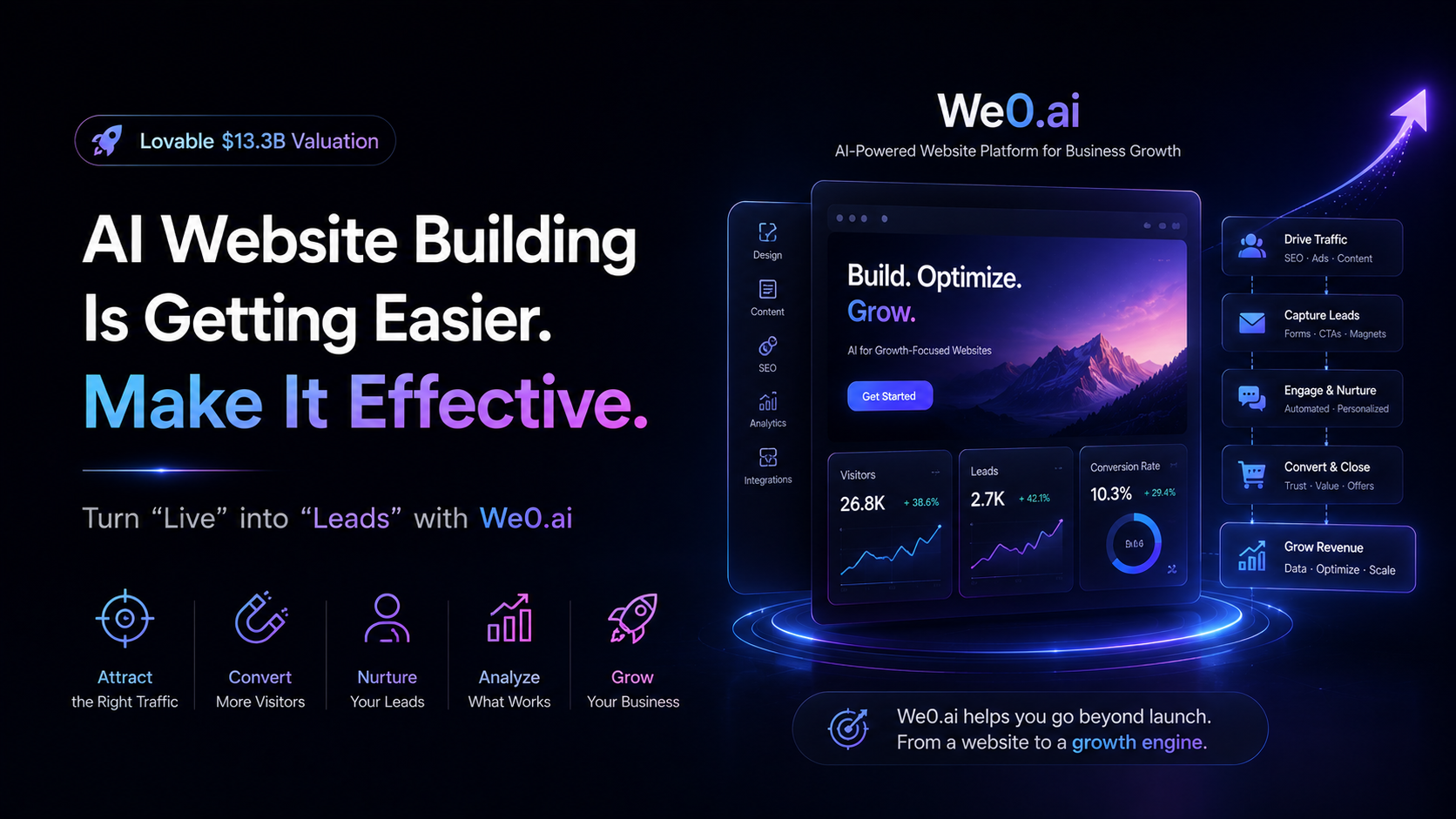
Lovable Hits $13.3 Billion — AI Website Building Is No Longer About "Can We Do It" but "What Happens After It's Done"
Lovable's latest funding round has pushed its valuation to $13.3 billion.
That fact alone speaks volumes.
People used to ask only one question about AI website building: Is it fast? Does it look decent?
That's no longer the case.
AI website building has gotten so fast that many people now mistakenly assume:
Once the pages are generated, the website is done.
But that's not reality.
Page generation is just the beginning. After launch is where the real battle begins.
Because what businesses need has never been a webpage that "looks presentable" — it's an asset that consistently delivers:
- Search traffic
- Brand awareness
- Inquiries
- Lead capture
- Registrations
- Consultations
- Conversions
If a website is merely "built" but nobody visits, nobody stays, and nobody reaches out, then it's essentially still a demo.
Not a business.
Why Is Lovable Worth So Much? Because It's No Longer Just "Generating Pages"
Several details in Lovable's announcement are worth noting:
- $400M Series C
- $13.3 billion valuation
- 60 million+ projects
- 900 million monthly visits
- Many users are building monetizable projects or businesses
- They're also strengthening payments, SEO, AI search, integrations, permissions, and security capabilities
This points to a very real trend:
Competition in AI website building has shifted from "who can generate faster" to "who can get closer to real business outcomes."
In other words, the website isn't the end goal.
It needs to be able to support the operations, search, content, and conversions that follow.
What Businesses Truly Lack Isn't a Website — It's the "Post-Website Pipeline"
Many businesses fall into a familiar trap:
- Find a tool
- Build pages
- Launch
- Wait for customers
- Then feel disappointed
The problem isn't that the website wasn't built.
The problem is that the website was never treated as a growth system.
This comparison makes it obvious:
| Websites that merely "can go live" | Websites that truly "acquire customers" |
|---|---|
| Has a homepage | Has homepage + scenario pages + solution pages + case study pages + FAQ |
| Can showcase products | Can match search queries and user intent |
| Looks decent | Can continuously produce content and leads |
| Done after launch | Continues SEO / GEO / content / data optimization after launch |
| Relies on luck for visitors | Relies on keywords, brand terms, long-tail keywords, and distribution for traffic |
That's the difference.
One is "having a website." The other is "having a customer acquisition asset."
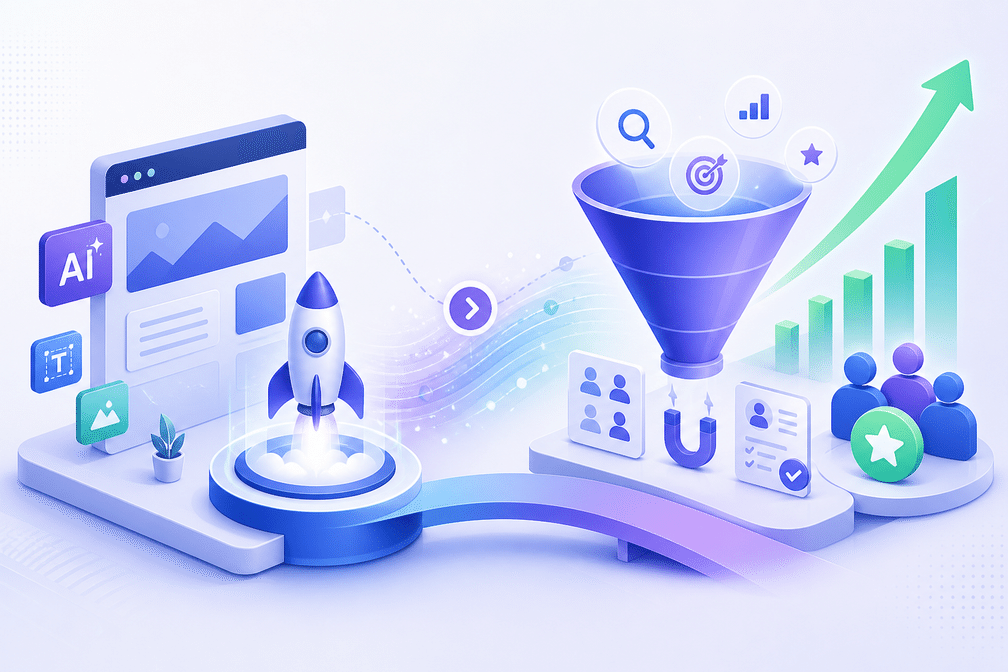
Why the Easier AI Website Building Gets, the Less Businesses Should Focus Only on "Generation Speed"
Because as the barrier drops, everyone starts to look the same.
Everyone can make homepages, landing pages, and contact forms. Even English-language sites and multilingual sites can be produced quickly.
But at this point, what truly sets people apart is no longer "who can produce pages first" — it's:
- Who better understands what users search for
- Who better understands how pages should match search intent
- Who better understands how to structure content
- Who better understands how to organize site architecture
- Who better understands how to design conversion paths
- Who better understands how to continuously optimize after launch
Plain and simple:
AI lowers the production barrier, not the growth barrier.
This is also why many businesses now feel:
The website was built fast, but still no customers.
Because "fast" solves the production problem, not the customer acquisition problem.
The Value of We0.ai Is Not Helping You "Make a Website" — It's Helping You Turn That Website into a Growth Engine That Runs
If We0.ai is understood merely as an AI website builder, that's a shallow take.
It's better described as an AI-powered website building and customer acquisition growth platform for showcase-style websites.
The core logic is simple:
Build → Showcase → Grow → Leads
Which means:
- Build: Get the website up
- Showcase: Present products, services, case studies, and portfolios clearly
- Grow: Execute SEO / GEO / content / distribution / data optimization
- Leads: Turn traffic into contacts and customers
This pipeline matters.
Because most "website builders" only handle the first half.
They generate pages for you.
They don't handle the growth that comes after.
And the part that matters most to businesses is precisely the second half.
How Should Businesses Use We0.ai? Don't Ask "Can It Be Done" — Ask "Can It Deliver Results"
If you fall into any of these categories, the thinking becomes clearer:
- Owner: You have a business, a brand, and products — you want your website to actually win customers
- Independent: You're a solo developer, consultant, or freelancer — you want a site that showcases your capabilities and lands clients
- Creator: You're a content creator, designer, or expert — you want to unify your content, portfolio, and consultation entry points
What you need to build is not a website that "looks complete."
It's a website that can answer these questions:
- Why should users trust you?
- Why should users contact you right now?
- What search terms will lead users to you?
- After users click in, where do they go next?
- After reading case studies, services, and pricing, will users leave their contact info?
These questions matter far more than "does the page look good."
A More Practical Approach: Structure First, Then Content, Then Growth
Many websites fail because the order is reversed.
They chase visual design first, fill in content later, and think about traffic last.
It should be the opposite:
- Define the business goal first: Is it lead acquisition, bookings, consultations, registrations, or downloads?
- Define the page structure next: Homepage, product pages, case study pages, pricing page, FAQ, contact page
- Define keywords next: Brand terms, category terms, scenario terms, question-based terms, long-tail terms
- Fill in content next: Case studies, comparisons, tutorials, guides, scenario explanations
- Execute growth last: SEO, GEO, social media distribution, on-site data iteration
This sequence is simple, but it works.
And the value of We0.ai is to compress this pipeline, connect the dots, and make it solid.
If a Website Can't Acquire Customers, the Problem Usually Lies in These 4 Areas
1) It Doesn't Match Search Intent
Users search for "AI website building for customer acquisition," "how to get leads from a corporate website," or "how to do SEO for a standalone site" — but you only show them a product homepage.
That's a mismatch.
2) There's No Content Layer
Users won't just look at the homepage.
They'll keep looking for case studies, pricing, comparisons, FAQs, and usage scenarios.
Without a content layer, a website can't hold onto traffic.
3) There's No Conversion Path
The CTA is there but too vague.
The form is there but too long.
The contact entry point is there but not clear enough.
The result: users leave after browsing.
4) There's No Continuous Optimization
Launch isn't the finish line.
After launch, you need to monitor traffic data, bounce rates, time on page, click paths, and form conversion rates.
If you're not watching these, the website is a one-off project.
Not an asset.
So the Most Important Upgrade in AI Website Building Isn't Speed — It's Completeness
Completeness is the real barrier.
A website that can actually acquire customers needs at least these capabilities:
- Clear presentation: Who you are, what you do, and why you're credible
- Search visibility: Findable via Google, AI search, brand terms, and long-tail keywords
- Scalable content: Ability to keep adding pages, case studies, and articles over time
- Trackable conversions: Knowing where your leads come from
- Iterative growth: Ability to optimize every week and every month
This is where We0.ai delivers more value than "mere website building."
It doesn't just help you get the site live.
It's trying to help you turn your website into a lead-generation machine that works continuously.
Think of it this way: your website upgrades from a "showcase page" to a "growth page"
This change may sound small, but it makes a huge difference.
A showcase page aims to get people to see you.
A growth page aims to get people to remember you, search for you, contact you, and use you.
The former is about presence.
The latter is about business outcomes.
Lovable's valuation surging to $13.3 billion shows this direction has already been validated by the market:
AI isn't just helping people "build software."
It's also helping people turn ideas into operable businesses.
For businesses, the next stage of AI website building isn't about "how fast you can build it."
It's about "once it's built, can it start acquiring customers?"
That's the problem We0.ai is here to solve.
Summary in Chinese
AI website building has already made "building a website" easy.
But what businesses really need is to upgrade their website from "ready to launch" to "ready to generate leads."
If your website is just a page, it will be forgotten quickly.
If it can capture search traffic, hold content, showcase cases, drive conversions, and enable review, then it becomes an asset.
This is also We0.ai's positioning: not just to build a website, but to build one that can grow, operate, and win customers.
Ready to get started?
If you already have a business, product, service, or a clear customer-acquisition goal, don't just think about "getting a website built."
The real question you should be asking is:
Can this website start bringing me leads?
If the answer isn't solid yet, maybe it's time to rebuild with We0.ai.
FAQ
1. What's the difference between AI website builders and We0.ai?
Many AI website builders are more like "page generators." We0.ai places greater emphasis on showcase + SEO / GEO + content + growth + lead generation, with the focus on building an operable growth asset.
2. Why does my website still get no traffic after going live?
Because going live is only the first step. Without keyword strategy, content support, internal linking, and continuous optimization, it's very hard for a website to gain organic traffic.
3. Is SEO a must for a corporate website?
If you want your website to bring in leads consistently over the long term, the answer is basically yes. SEO isn't just "a nice-to-have"—in many cases, it's the foundation.
4. What scenarios is We0.ai suitable for?
It's suitable for brand websites, product websites, service pages, case study pages, portfolios, consultation pages, waitlist pages, content sites, and multilingual showcase sites.
5. Won't AI-generated websites all look the same?
Yes, they will—if you only focus on generation. What really sets them apart is structure, content, case studies, keywords, conversion design, and ongoing optimization.
Related Tools
Conclusion
Lovable's valuation surging to $13.3 billion sends a clear signal:
AI website building is no longer just about "whether you can build it," but "once it's built, can it actually perform."
For businesses, what's truly valuable isn't a page.
It's a website that can keep showcasing, keep growing, and keep acquiring customers.
That's exactly what We0.ai is here to do.