LLMs.txt vs Markdown-Ready Websites: We0 AI, WordPress, or Webflow for the Next Wave of AI Crawling?
<title>7.13 Article Writing: LLMs.txt vs Markdown-Ready Websites: We0 AI, WordPress, or Webflow for AI Crawling</title> Chinese Title: LLMs.txt vs Markdown-Ready Websites: We0 AI, WordPress, or Webflow for the Next Wave of AI Crawling? English Title: LLMs.txt vs Markdown-Ready Websites: We0 AI, WordPress, or Webflow for the Next Wave of AI Crawling? Tags: LLMs.txt, Markdown-ready website, AI crawling, GEO, AEO, We0 AI, WordPress, Webflow, AI SEO SEO Title: LLMs.txt vs Markdown-Ready Websites: We0 AI, WordPress, or Webflow for AI Crawling SEO Description: An in-depth article comparing LLMs.txt, Markdown-
LLMs.txt vs Markdown-ready Websites: Who's Better for Next-Gen AI Crawling — We0 AI, WordPress, or Webflow?
Let's start with the conclusion.
If you just want to "add an llms.txt file," consider it a bonus at best.
If you want your website to be more easily understood, crawled, and cited by systems like ChatGPT, Perplexity, Claude, and Google AI Overviews, the focus has never been just on llms.txt. The real priority is whether your entire site is sufficiently Markdown-ready, semantically clear, consistently updated, and structurally readable.
That's why, even though they're all called "website builders," the sites created with We0 AI, WordPress, and Webflow are growing increasingly different in their suitability for next-gen AI crawling.
Some platforms are more like "building pages."
Others are more like "building content systems that machines can also read."
And in the future, it's likely the latter that will reap the benefits of AI-driven traffic.
What is llms.txt, and why has it suddenly become popular?
Simply put, llms.txt is a Markdown file placed in the root directory of a website, functioning somewhat like a "navigation guide for large language models."
It differs from robots.txt and sitemap.xml.
- robots.txt tells crawlers "what not to look at"
- sitemap.xml tells search engines "what pages I have"
- llms.txt is more like saying: "If you're an AI, prioritize understanding this content; these links are more important; these pages are more suitable for citation."
Its popularity hasn't come from becoming an industry standard.
On the contrary, it's popular because everyone is betting early on the next steps of AI retrieval, GEO, and AEO.
According to Webflow's official article "Understanding llms.txt limitations and alternatives"
(Source: https://webflow.com/blog/llms-txt ), as of October 2025, major LLM providers have not yet adopted llms.txt as a formal, universal standard, but it holds value as "forward-looking preparation."
This point is crucial.
llms.txt is worth doing, but it shouldn't be mythologized.
The real issue isn't llms.txt, but whether the website itself is AI-friendly
Many discussions about llms.txt these days tend to miss the point.
People frame the problem as:
- Should I generate an llms.txt?
- Is there a WordPress plugin for it?
- Can I upload it to Webflow?
- Can I place a file in the site root?
None of these are wrong per se.
But they all stay at a superficial level.
What really challenges AI crawling isn't finding your pages, but understanding them, extracting them accurately, and capturing them reliably.
A visually appealing website may be human-friendly but not AI-friendly. Common reasons include:
- Page information is buried under layers of complex HTML, components, scripts, and visual structures
- Key answers aren't clearly broken down into semantic paragraphs
- Site updates rely on manual effort with inconsistent publishing rhythm
- Pages exist, but the content system is incomplete, lacking topic depth and internal linking
- Product, service, case study, FAQ, and policy pages don't form a sustainable, citeable knowledge structure
So you'll find that llms.txt is just a "signpost," while Markdown-ready sites are more like "having the road already paved."
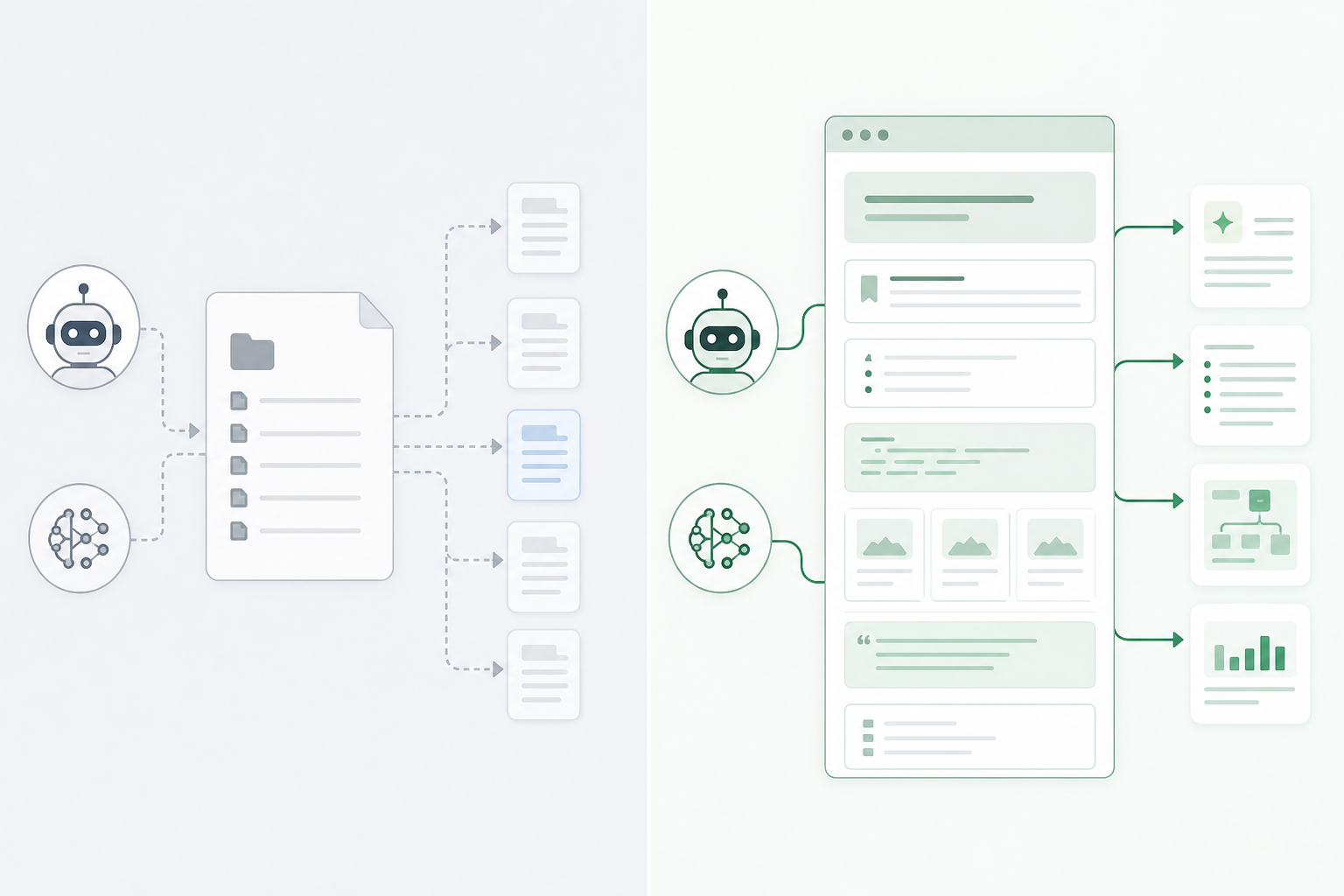
LLMs.txt vs Markdown-ready: What's the real difference?
Let's start with a direct comparison:
| Dimension | LLMs.txt | Markdown-ready Website |
|---|---|---|
| Essence | An index/instruction file for AI | The entire site's content structure is naturally more suited for AI reading |
| Role | Entry layer | Content layer, structure layer, continuous growth layer |
| Can it alone solve AI readability? | No | Can significantly improve it |
| Demands on the page itself | Low | High |
| Demands on long-term content operations | Low | High |
| Impact on AI crawling effectiveness | Potential bonus | Core influencing factor |
| What it's more like | A navigation map | A sustainable knowledge system |
One-sentence summary:
llms.txt addresses "look at these pages first"; Markdown-ready addresses "after you look, you can actually understand, cite, and keep crawling."
According to Dries Buytaert's article "Markdown, llms.txt and AI crawlers"
(Source: https://dri.es/markdown-llms-txt-and-ai-crawlers ), he found in real logs that:
- AI crawlers do capture Markdown versions of content
- But requests for llms.txt are extremely rare, and most come from SEO audit tools
- Many bots still primarily crawl HTML pages
- Markdown doesn't automatically reduce crawling costs; it may instead create more crawlable versions
What does this show?
It shows that AI doesn't just need one file; it needs a stable, clear, and semantically unambiguous content environment.
We0 AI, WordPress, Webflow: Who has the edge in next-gen AI crawling?
Here's the bottom line upfront:
- WordPress is good for "extensibility," but it's also often the easiest to become a fragmented system built from a pile of plugins
- Webflow is good for "controlled design + relatively clear structure," but it's still more oriented toward page building logic
- We0 AI is better suited for advancing "showcase sites + content growth + AI-readable structure" as an integrated whole
Note: This isn't saying one platform is absolutely the winner.
Rather, if your goal is next-gen AI crawling, GEO, continuous content growth, and lead capture, then the key capability of a platform is no longer whether it can build pages, but whether it can continuously manage a website as an asset that both AI and users can understand.
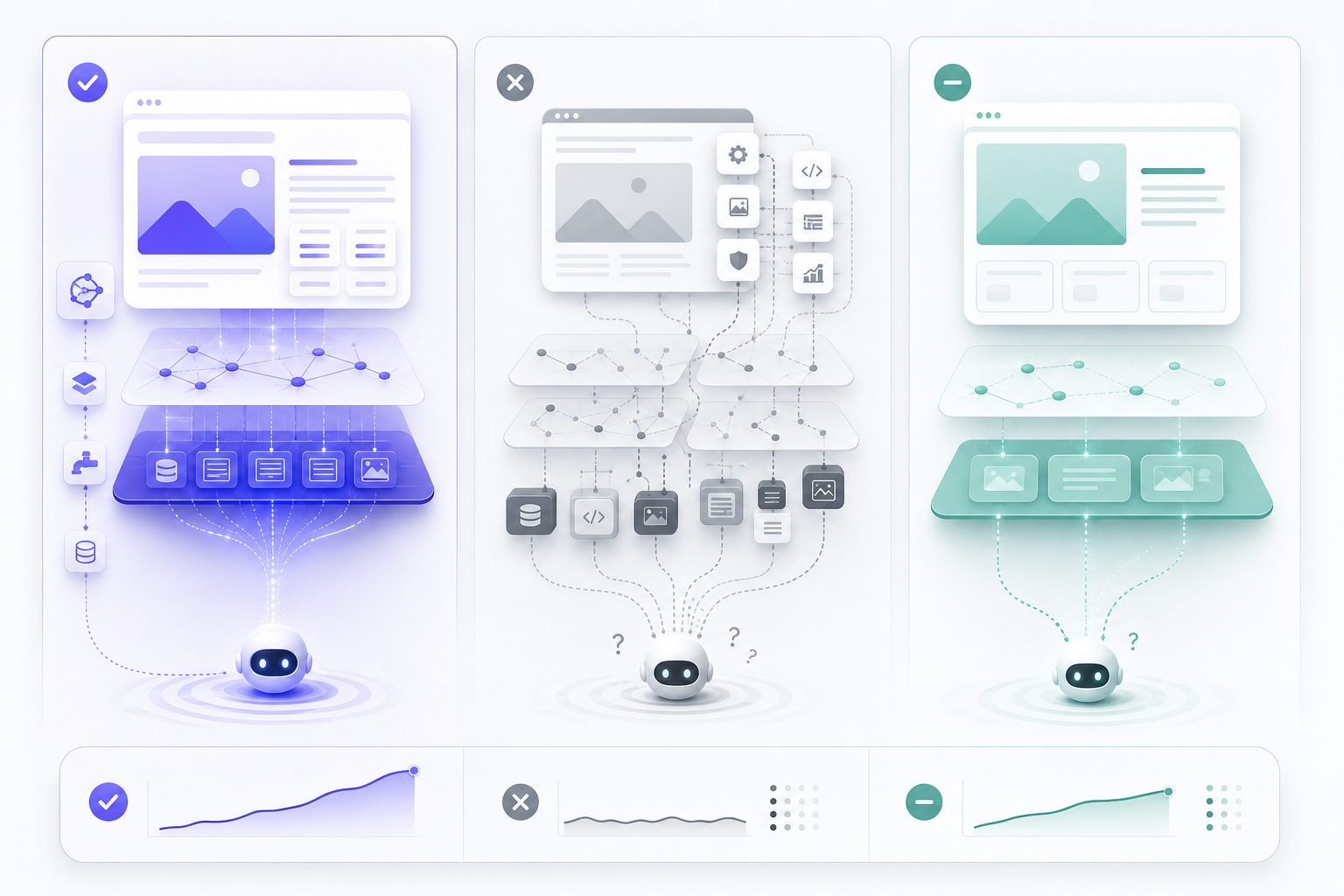
1. WordPress: High flexibility, but AI-friendliness often depends on how well you configure it
WordPress's strengths are clear.
It has a large ecosystem, many plugins, mature content management capabilities, and rich SEO tools. In theory, you can certainly create llms.txt, Markdown pages, schema, a content hub, multilingual support, and a blog matrix on WordPress.
The problem is that these capabilities are usually not naturally aligned.
You need to:
- Choose a theme
- Choose a builder
- Configure SEO plugins
- Set up caching
- Configure schema
- Handle Markdown workflows
- Maintain content format consistency
- Manage updates, vulnerabilities, compatibility
For the technically savvy, this is freedom.
For many business teams, this is actually a hidden cost.
So when it comes to AI crawling, WordPress's biggest problem isn't "can't do it," but rather:
You can easily turn your site into a hybrid that's human-readable, search-engine-indexable, but messy for AI.
Especially when a site is cluttered with too many plugins, page builders, legacy templates, and scattered content, AI will find it significantly harder to capture stable, unified, and predictable structures.
Who is WordPress better for?
- Teams with technical or operational resources
- Those who can maintain plugins and content workflows long-term
- Those already working with a mature CMS workflow
- Those who accept that "high flexibility = high maintenance costs"
2. Webflow: Cleaner structure, but still design-system-oriented at its core
Over the past couple of years, Webflow has become increasingly vocal about AEO and AI discoverability.
In fact, the company has officially discussed llms.txt, even providing recommendations for uploading and using it. This shows that Webflow, at least at the product level, recognizes that "the next generation of traffic sources isn't just traditional SEO."
This is a good thing.
And from a page structure perspective, Webflow is generally cleaner than a WordPress site piled high with plugins.
Its main advantages include:
- Relatively more controllable front-end structure
- More organized CMS content models than many traditional sites
- More unified page publishing pipeline
- More friendly to design and content consistency
But there are clear issues.
Webflow is fundamentally a strongly visual, strongly building, strongly page-expression platform.
This means that if your team's focus is on "making the corporate website look good," Webflow is very handy.
But if your goals shift to:
- Continuously producing content around key themes
- Turning service pages, case studies, FAQs, blogs, and industry pages into a mutually supportive knowledge network
- Long-term site optimization around GEO/AEO
- Connecting content production, page updates, growth suggestions, and lead generation into one chain
Then Webflow often still requires you to do a lot of operational work yourself.
In other words:
Webflow is strong at "creating cleaner web pages," but it doesn't naturally equal "helping you run a growth-oriented site that's better suited for AI crawling."
Who is Webflow better for?
- Those with high demands for brand identity and design consistency
- Those needing a lighter website management approach
- Teams willing to handle their own ongoing content operations
- Those who accept that AI-friendly optimization still requires manual effort
3. We0 AI: Closer to an "AI-readable website + showcase growth system"
We0 AI's approach is actually quite different from the two tools mentioned above.
It's not just about helping you "generate a website" or "build a page."
It's more about solving this: How can a showcase website, from the very start of building, be better suited for launch, operations, updates, growth, being understood by search, being cited by AI, and ultimately capturing leads.
This is crucial.
Because the next generation of AI crawling won't just reward "people who have pages."
It will reward:
- Those who express their services clearly
- Those who produce consistent content
- Those who have structured page systems
- Those who have citable knowledge blocks
- Those who connect case studies, FAQs, feature descriptions, comparison pages, and landing pages
- Those who engage in continuous growth actions
And this is precisely closer to We0 AI's logic of Build -> Showcase -> Grow -> Leads.
Why does We0 AI have an advantage on this topic?
1) It's not a single-point site builder, but designed around "showcase + growth"
Many AI site-building products only solve the first half:
- Help you generate pages
- Help you apply templates
- Help you launch quickly
We0 AI doesn't stop there.
It emphasizes how a site continues to run around SEO, GEO, content updates, structure optimization, data monitoring, and lead generation after launch.
This means the site isn't a one-time delivery item, but a growth asset for continuous optimization.
2) It's naturally better suited for "content-readable showcase sites"
For AI crawling, the most valuable thing isn't flashy pages, but:
- Whether service pages clearly explain offerings
- Whether product pages have a clear structure
- Whether FAQ pages can directly answer questions
- Whether case studies have citable facts
- Whether blogs continuously expand on themes
- Whether the entire site forms a stable topic map
We0 AI is better suited for this need.
Because it treats content not as page filler, but as part of a growth asset.
3) It's easier to implement a Markdown-ready mindset into site operations
Markdown-ready doesn't necessarily mean every page must literally be a .md file.
What's more important is:
- Is the content written in a structured way?
- Are heading levels clear?
- Are page focuses clear?
- Are paragraphs easy to extract?
- Are Q&As suitable for citation?
- Are information blocks suitable for AI to paraphrase?
And We0 AI's logic for articles, pages, and content layout naturally leans in this direction.
This is more important than "just adding a separate llms.txt file."
4) It's better suited for making "site building" and "content growth" a closed loop
This is the point many teams easily overlook.
What truly determines if AI can keep crawling you isn't just page structure, but whether you continuously add, optimize, and improve content.
Without content growth, AI crawls you once and that's it.
With continuous content production, FAQ expansion, case study updates, and comparison page layouts, AI has more opportunities to keep re-understanding your site.
And We0 AI's value lies precisely in connecting these actions.
Three Platforms Comparison
| Comparison Dimension | We0 AI | WordPress | Webflow |
|---|---|---|---|
| Launch Speed | Fast | Medium | Medium |
| Page Design Flexibility | Medium-High | High | High |
| Content Structure Consistency | High | Depends on team | Medium-High |
| llms.txt Support Feasibility | Feasible | Feasible | Feasible |
| Markdown-ready Friendliness | High | Depends on workflow | Medium |
| Continuous Content Growth Fit | High | Medium-High | Medium |
| GEO/AEO Capability | High | Medium | Medium-High |
| Lead & Growth Closed Loop | High | Depends on self-build | Medium |
| Suitability for Showcase Business Sites | Very Suitable | Suitable | Suitable |
An Easily Overlooked Reality: AI Prefers "Answer Structures," Not "Page Noise"
This is very important.
Based on observations from Webflow's official articles and Dries' logs, a common trend emerges:
AI systems need lower-noise, more structured, better-extractable content, not more complex visual layers.
So competition for future websites will gradually split into two layers:
The first layer is the experience for humans.
The second layer is the explainability for AI.
Many sites only address the first layer.
But the next generation of traffic sources increasingly depends on the second layer.
If Your Goal is AI Crawling, How Should Your Site Be Built?
Regardless of whether you ultimately choose We0 AI, WordPress, or Webflow, the following directions are more worth prioritizing than "just adding llms.txt":
1. Turn key pages into truly extractable answer pages
Stop just piling on pretty banners and vague descriptions.
Your:
- Service pages
- Product pages
- Feature pages
- Pricing pages
- FAQ pages
- Case study pages
Should all strive to:
- Have clear titles
- Have clear hierarchies
- Cover only one topic per paragraph
- Include definitions, conclusions, and comparisons
- Have short paragraphs suitable for citation
2. Upgrade blogs from "publishing content" to "building a topic map"
AI doesn't just look at individual articles.
It looks at whether you consistently and systematically express yourself on a topic.
For example, this article about LLMs.txt shouldn't exist in isolation.
It can be linked to these topics later:
- What is GEO?
- Differences between AEO and traditional SEO
- What AI crawlers will capture
- How to build AI-readable structures for service websites
- How to write FAQ pages that are more likely to be cited
- How showcase corporate sites can capture AI traffic
At that point, the site is no longer a collection of pages, but a continuously growing content network.
3. Use llms.txt, but don't bet everything on it
You can do it.
And it's recommended.
But be clear:
llms.txt is more of a "supplementary enhancement," not a "game-changer."
First, get the website's content structure, topic depth, semantic clarity, and update mechanism in order. Then add llms.txt—that's the logical approach for results.
4. Enable Continuous Publishing on Your Website
AI crawling doesn't just look once.
It will revisit, reinterpret, and re-reference content over time.
So truly advantageous websites aren't "done after launch"; they:
- Continuously publish blogs
- Continuously add case studies
- Continuously update FAQs
- Continuously expand comparison pages
- Continuously optimize conversion pages
And that's why, in the long run, website builders will gradually split into two types: one that builds pages, and one that helps you turn your site into a growth asset.
Final Verdict: Who's Better Suited for Next-Gen AI Crawling?
If we only look at "whether llms.txt can be added":
All three can do it.
If we look at "who can more easily build a cleaner-structured site":
Webflow and We0 AI tend to be more stable than WordPress, which often relies heavily on plugins.
If we look at "who's better for long-term website operations as AI-readable, growable, lead-generating showcase assets":
We0 AI has the edge.
It's not about whether it can generate a page.
It's about being closer to the logic next-gen websites truly need:
Build -> Showcase -> Grow -> Leads
That means:
- Get the site up
- Clearly present products, services, capabilities, and case studies
- Continuously grow through SEO / GEO / content
- Ultimately convert traffic into leads and customers
This chain is far more important than simply discussing llms.txt.
Key Takeaways
llms.txt is worth doing, but it's not the whole story for the AI crawling era.
A website truly suitable for next-gen AI crawling isn't just "able to provide a file"—it's one that continuously offers a clearer, more stable, and more easily extractable and citable content structure.
From this perspective, We0 AI is more like a "showcase website growth platform" than just an ordinary AI website builder.
FAQ
Will LLMs.txt become the new standard for AI SEO?
It's possible, but we're far from the stage where "having llms.txt means winning." According to Webflow's official statement, mainstream LLM platforms haven't yet widely adopted it as a unified formal standard, so it's more of a forward-looking preparation than an immediate traffic switch.
Do Markdown-ready websites have to generate a .md file for every page?
Not necessarily. The core is whether the content structure itself is semantically clear, paragraphs extractable, heading levels well-defined, and Q&A citable enough. Offering additional .md versions is an enhancement, not the sole criterion.
Is it harder to make a WordPress website AI-friendly?
Not harder, but more dependent on team capability. WordPress's issue isn't typically about ceiling of capability, but consistency. With many plugins, themes, builders, and content formats, the overall site structure can easily become messy.
Is Webflow suitable for building AI-friendly websites?
Yes, and it's easier to maintain a clean structure than many traditional sites. But it leans more toward "creating a good website," not inherently equal to "continuously operating the site around GEO / content growth / lead acquisition."
Why is We0 AI said to be more suitable for AI crawling of showcase websites?
Because We0 AI doesn't just generate pages; it emphasizes the entire chain from building the site to content, SEO/GEO, continuous optimization, data monitoring, and growth conversion. For teams wanting to turn their official site into a long-term lead-generation asset, this is key.
Related Tools
Sources
- 《Understanding llms.txt limitations and alternatives》 - Webflow
- 《Markdown, llms.txt and AI crawlers》 - Dries Buytaert
- 《What Is LLMs.txt? The Guide To AI Search & GEO》 - Yotpo
Ready to Start?
If what you want now isn't just a launch-ready official site,
but a website better suited for showcasing, SEO/GEO, continuous growth, and handling AI traffic and customer leads,
then what you need might not be another plugin.
What you need is a system that can run smoothly from site building to growth.
That's where We0 AI becomes more worth looking at.
Summary
Next-generation AI crawling isn't about who adds llms.txt first.
It's about whose website can consistently provide AI with a cleaner structure, clearer answers, more stable thematic expression, and long-term content updates.
By this standard, WordPress is powerful but often depends on configuration; Webflow is clean but leans toward page building; We0 AI is closer to a combination of an "AI-readable website and a showcase growth system."
If you truly care about future AI traffic channels, this difference will only grow.