Kimi K3 Pauses New Subscriptions After Demand Pushes GPU Capacity to the Limit
Kimi K3 had been available for only about 48 hours when Moonshot AI announced that it would temporarily stop accepting new consumer subscriptions.
Kimi K3 Pauses New Subscriptions After Demand Pushes GPU Capacity to the Limit
Introduction
Kimi K3 had been available for only about 48 hours when Moonshot AI announced that it would temporarily stop accepting new consumer subscriptions.
The reason was not a planned product change or a lack of demand. It was the opposite. According to Moonshot, requests for Kimi K3 rose far beyond its forecasts and moved close to the capacity limit of its existing compute clusters.
Existing paid users were allowed to continue using the service. Moonshot said it would direct available computing resources toward current subscribers while expanding capacity, then reopen new subscription places in batches.
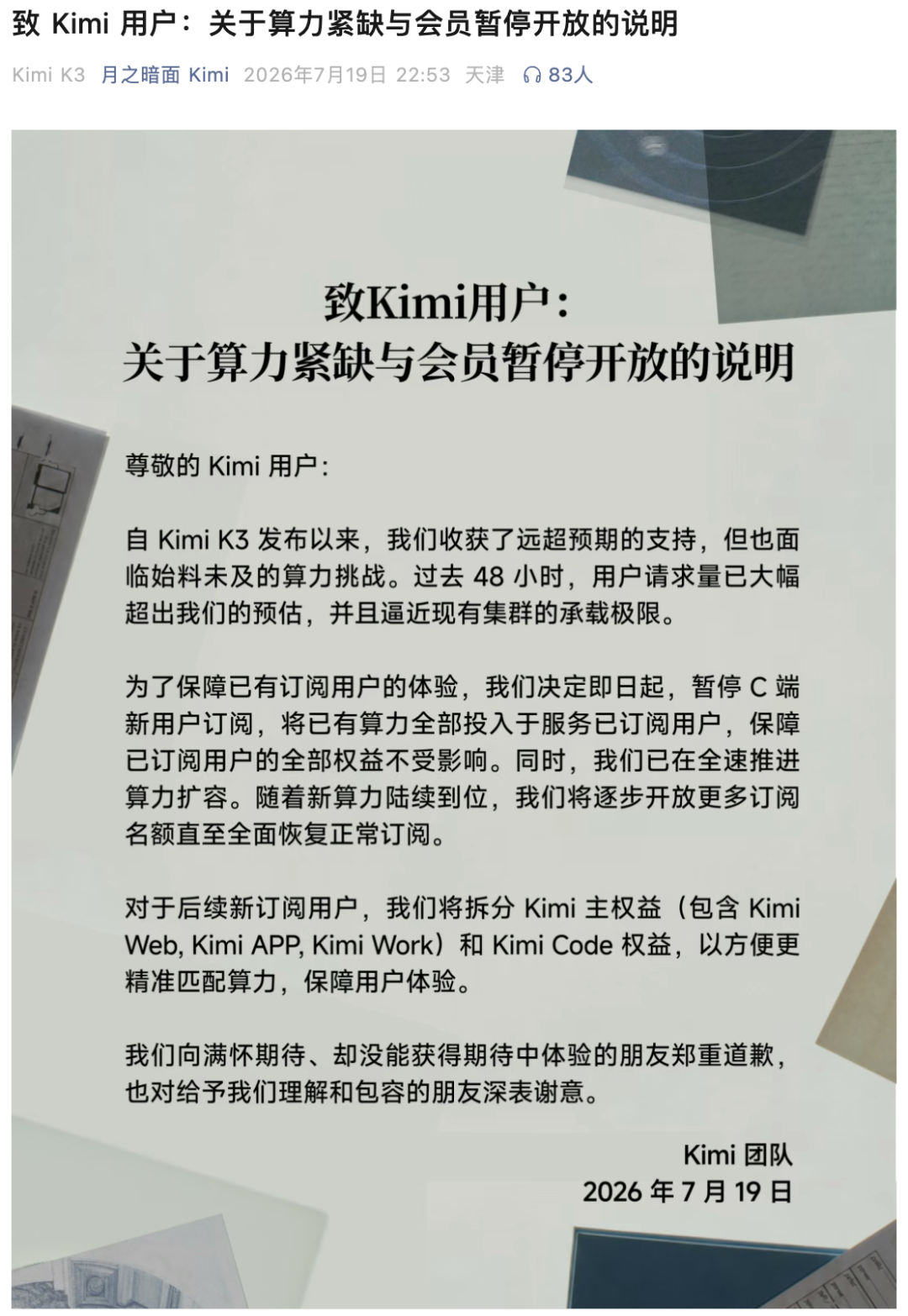
Moonshot’s July 19 notice explaining the compute shortage and temporary subscription pause.
The sudden capacity problem followed an unusually strong launch for Kimi K3, a 2.8-trillion-parameter native multimodal model designed for long-horizon coding, visual creation, knowledge work, and agent-based tasks.
Moonshot describes K3 as the first open 3T-class model. Its launch article also states that complete model weights are scheduled for release by July 27, 2026, so “open” at launch should be understood in the context of that announced release timetable.
Kimi K3 Became Popular Within Two Days
The surge in demand is easier to understand when viewed alongside the model’s early performance and the volume of user demonstrations that appeared soon after launch.
Kimi K3 entered the market with a 1-million-token context window, native vision capabilities, and a sparse Mixture-of-Experts architecture with 2.8 trillion total parameters. It is aimed at tasks that can continue for long periods and require repeated tool calls, code execution, visual inspection, or multi-step reasoning.
Moonshot’s own technical blog acknowledges that K3 still trails Claude Fable 5 and GPT-5.6 Sol in overall performance. At the same time, the model posted strong results in several coding and agent-oriented evaluations.
First Place in the Preliminary Frontend Code Arena
At the time covered by the original report, Kimi K3 held first place on Arena’s preliminary WebDev leaderboard with a score of approximately 1,679.
The live leaderboard on July 21 showed Kimi K3 in first place with a preliminary score of 1,678, ahead of Claude Fable 5 and GPT-5.6 Sol.
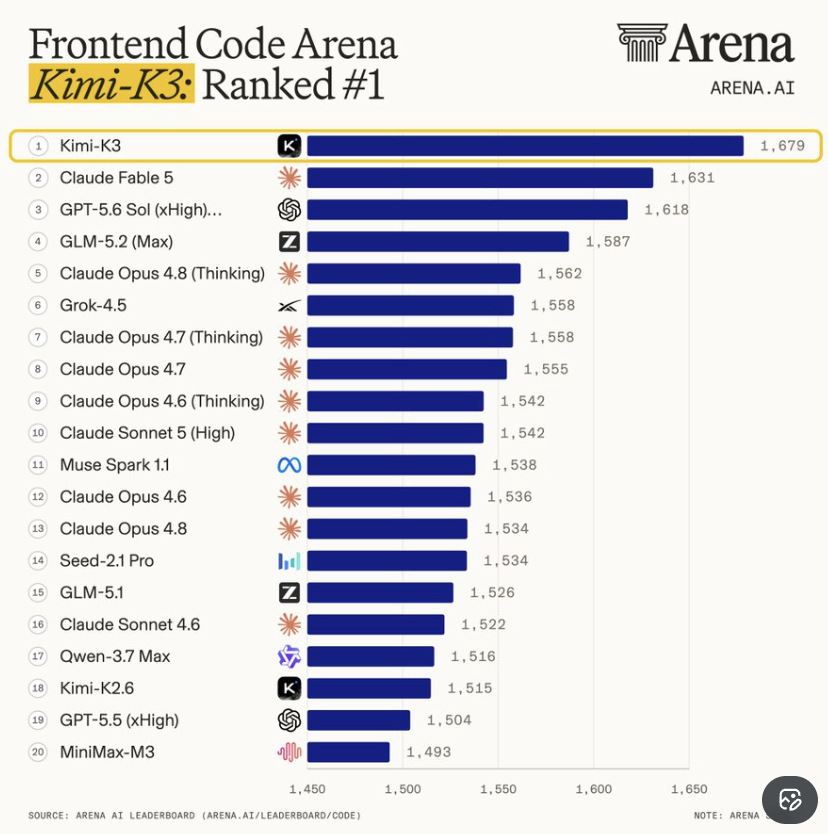
Kimi K3’s preliminary first-place result in Arena’s frontend development ranking.
Frontend evaluations are useful because they test more than whether a model can produce valid code. A strong result often requires the model to understand a visual goal, create a working interface, inspect the rendered output, and revise the implementation.
Kimi K3 is designed for this type of “vision in the loop” workflow. It can move between source code and live screenshots, using the rendered result as feedback for another development pass.
Because the leaderboard is based on ongoing voting, its scores and positions can change. The live Arena page should be treated as the current source rather than any static launch graphic.
Strong but Mixed Coding Results
The original report also highlighted three software-engineering evaluations:
| Benchmark | Kimi K3 | Claude Fable 5 | GPT-5.6 Sol |
|---|---|---|---|
| DeepSWE | 67.5 | 70.0 | 73.0 |
| Program Bench | 77.8 | 76.8 | 77.6 |
| SWE Marathon | 42.0 | 35.0 | 39.0 |
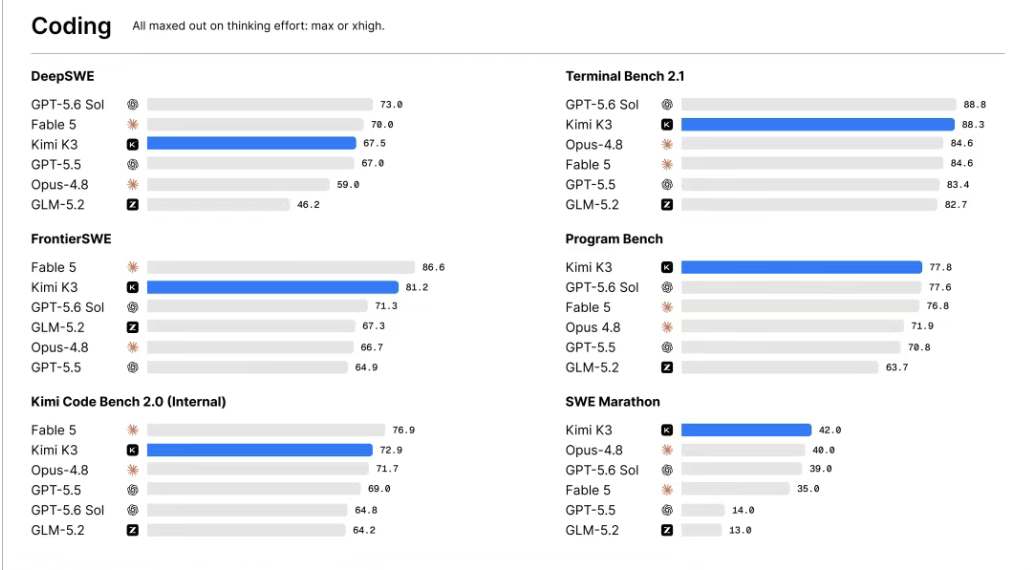
Kimi K3’s reported results across coding and long-horizon software-engineering benchmarks.
The results show a more balanced picture than a simple “best model” claim.
K3 remained behind Claude Fable 5 and GPT-5.6 Sol on DeepSWE, edged ahead on Program Bench, and achieved the highest reported score in Moonshot’s SWE Marathon comparison.
Benchmark methodology matters here. Moonshot used different agent harnesses depending on the model and notes that its SWE Marathon evaluation used an H20-calibrated branch of the official tasks. It also reports that Claude Fable 5 encountered fallback behavior on part of that evaluation.
These differences do not make the results useless, but they mean that scores from different harnesses should not be treated as perfectly identical laboratory conditions.
Developers Quickly Turned Kimi K3 into a Creative Playground
Leaderboards were only one part of the launch. Developers also began posting websites, interactive tools, games, 3D scenes, and visual experiments created with K3.
One example featured an open-world game that a user said would have been difficult to imagine generating from a prompt only a few months earlier.

A user demonstration of an open-world game created with Kimi K3.
Another user compared Kimi K3 and Claude Opus 4.8 on the task of generating a virtual warehouse environment. In the posted comparison, the Kimi result contained more lighting, objects, environmental structure, and visible detail.
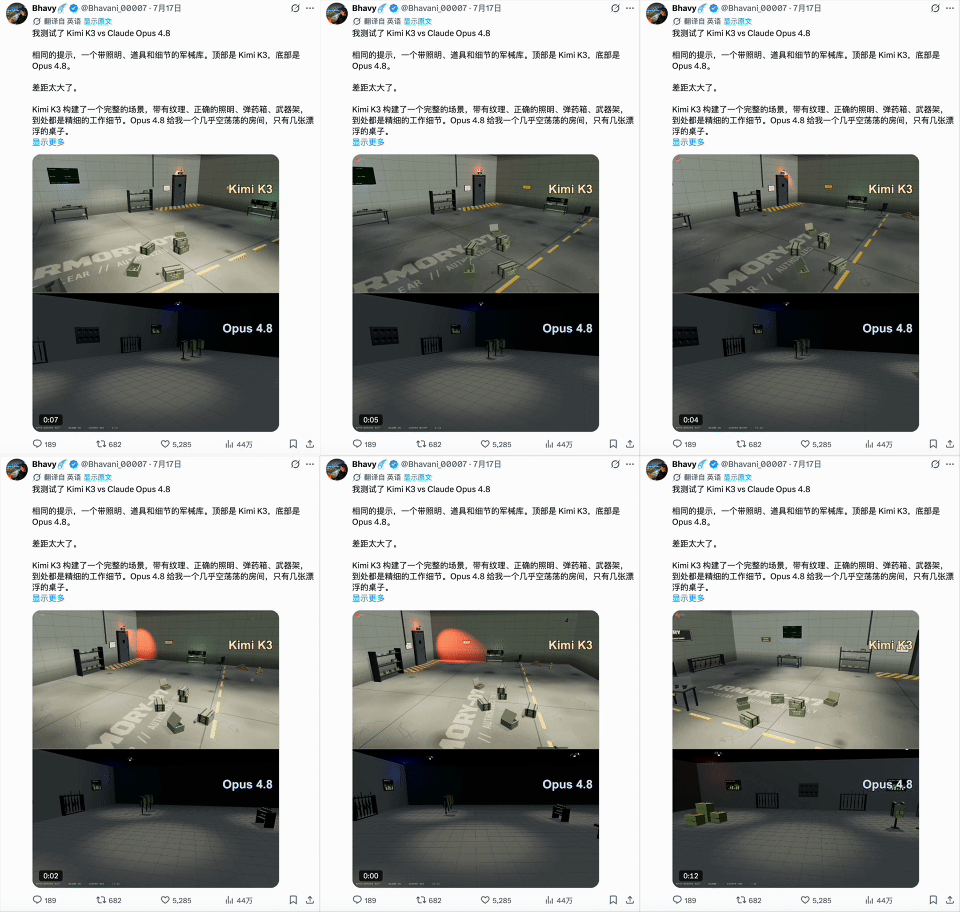
A user-posted comparison of virtual warehouse scenes generated by two models.
These examples are anecdotal demonstrations rather than controlled benchmarks. Prompt wording, agent setup, tool access, time limits, and manual intervention can all influence the output.
Even so, the rapid appearance of these projects helped drive interest. Users were not only asking K3 questions; many were running long coding sessions that involved building, rendering, testing, and revising substantial projects.
That distinction matters for infrastructure.
A short chatbot answer may require one model request. A coding agent can repeatedly read files, plan, write code, call tools, execute commands, inspect results, and begin another reasoning cycle. One user task can therefore consume far more inference capacity than a conventional conversation.
Request Volume Approached the Existing Cluster Limit
On July 19, Moonshot said that Kimi K3 had received much more interest than expected.
Within the previous 48 hours, user requests had sharply exceeded forecasts and were approaching the carrying limit of the company’s existing clusters.
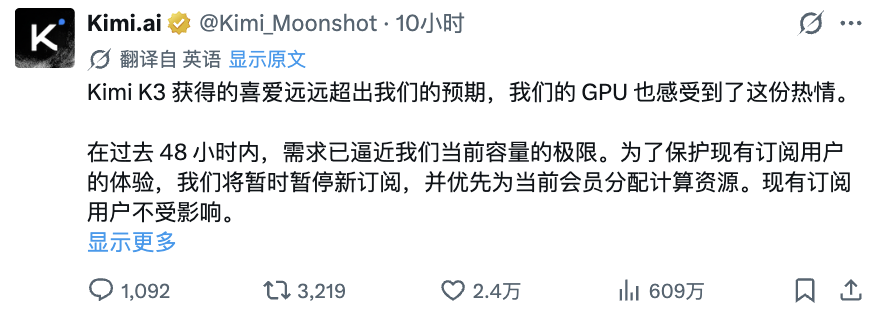
Moonshot said demand had approached the limit of its current compute capacity.
When too many inference requests reach a cluster at the same time, several problems can appear:
- Responses may become slower.
- Requests may wait in a queue.
- Long-running agent tasks may occupy capacity for extended periods.
- Users may experience timeouts or temporary service failures.
- The provider may need to limit access to protect service quality.
Kimi K3 makes the issue more difficult because of its scale and product focus.
The model contains 2.8 trillion total parameters, and many of its most attractive use cases involve long contexts, repeated reasoning, screenshots, file operations, and tool calls. Although its sparse architecture activates only part of the full model for each token, serving it at high volume still requires substantial infrastructure.
Moonshot therefore announced three immediate steps:
- Pause new consumer subscriptions.
- Prioritize compute for existing paid members.
- Expand capacity and reopen subscription places gradually.
Current subscribers were not expected to lose their existing benefits because of the temporary pause.
Status note: The pause applied to new consumer subscriptions, not necessarily to every free account, API product, enterprise arrangement, or existing membership. Product availability can change quickly, so users should check Kimi’s official pricing and membership pages for the current status.
Kimi and Kimi Code Memberships Will Be Separated
Moonshot also said that its future membership structure would change.
The company plans to separate the main Kimi benefits—including Kimi Web, the Kimi app, and Kimi Work—from Kimi Code benefits.
This points toward two different usage categories.
General Kimi Usage
The main Kimi membership is intended for broader personal productivity, including:
- General conversations
- Research and knowledge work
- Documents and presentations
- Visual and multimodal tasks
- Kimi Work agent workflows
Kimi Code Usage
Kimi Code is built for sustained software-engineering tasks, including:
- Reading and editing repositories
- Running terminal commands
- Debugging and refactoring
- Executing development tools
- Launching subagents
- Managing long coding sessions
The compute profile of these products can be very different.
A developer may leave a coding agent running while it explores a repository, modifies several files, runs tests, investigates failures, and repeats the cycle. Separating the plans gives Moonshot more control over rate limits, pricing, and resource allocation for users with substantially different workloads.
The announcement did not provide final pricing, quotas, or a confirmed date for the new membership system.
The Infrastructure Challenge Behind the Pause
The subscription halt illustrates a wider problem for frontier AI providers: a successful model launch can create demand faster than physical infrastructure can be expanded.
Adding capacity is not as simple as updating a software setting. Providers may need to obtain accelerators, deploy servers, connect networking and storage, configure inference software, validate reliability, and rebalance traffic across clusters.
Kimi has previously published research on Mooncake, its KV-cache-centric serving architecture. The system separates prefill and decoding workloads and uses distributed CPU memory, DRAM, and SSD resources to improve long-context serving efficiency.
The Mooncake paper reports that the architecture allowed Kimi to handle 75% more requests under the real workloads tested at the time.
Kimi K3 creates a newer and larger challenge. More efficient serving can increase the work handled by existing hardware, but it does not remove the need for additional physical compute when demand rises sharply enough.
This is why the temporary pause is best understood as a capacity-management decision. Moonshot chose to limit new paid demand rather than continue selling subscriptions that its current clusters might not serve reliably.
Revenue Growth and IPO Preparations
The original report connects K3’s popularity with Moonshot AI’s broader commercial momentum.
According to media reports citing people familiar with the company, Moonshot’s daily sales increased by at least six times after K3 launched.
Bloomberg-sourced reporting also said that Moonshot’s annual recurring revenue reached approximately $300 million in June 2026**, up from **$200 million in April.
Annual recurring revenue is not the same as audited annual revenue. It is a forward-looking run-rate metric based on current subscription and contract income.
Reports also said Moonshot had distributed a shareholder resolution seeking support for a Hong Kong listing and could pursue an IPO within roughly six months.
Reuters separately reported that:
- Moonshot was unwinding its offshore structure ahead of a potential Hong Kong IPO.
- The company had engaged advisers including Goldman Sachs and China International Capital Corporation.
- It had raised more than $2 billion in May.
- Total historical fundraising had exceeded $5.5 billion.
- Its valuation reached approximately $30 billion in June.
- It had begun seeking up to another $2 billion.
These details were reported through unnamed sources or fundraising materials rather than an official Moonshot filing. The company declined to comment to Reuters on the IPO process.
Subsequent Bloomberg-sourced reporting said Moonshot was discussing a pre-IPO financing round at a valuation of up to $50 billion. That figure represents a reported target under discussion, not a completed financing or confirmed public-market valuation.
Why the Timing Matters
Model performance, user demand, revenue growth, fundraising, and listing preparations all arrived at nearly the same time.
For an AI startup, that combination can strengthen the story presented to investors:
- The model has visible technical momentum.
- Users are actively trying the product.
- Demand is strong enough to create a capacity problem.
- Subscription and API revenue are growing.
- The company has a path toward additional capital.
At the same time, the compute shortage reveals the cost of that growth.
A strong coding model is expensive to serve. The more successful its agent features become, the more users are likely to launch long-running workloads rather than short chats.
That creates a difficult balance. Moonshot needs enough capacity to preserve the user experience, but it also needs to manage the capital cost of adding hardware quickly.
The decision to stop selling new consumer subscriptions, at least temporarily, suggests that reliability for existing users took priority over maximizing immediate membership growth.
What Existing and New Users Need to Know
For existing paid members, Moonshot said that service benefits would remain available and that the current shortage would not remove their subscription rights.
For people who had not yet subscribed, the practical situation was different:
- New consumer subscriptions were temporarily unavailable.
- Additional places would reopen in batches as compute capacity increased.
- Future general Kimi and Kimi Code plans would be separated.
- Final plan details had not yet been announced.
Developers who need programmatic access can still check the Kimi API platform. API availability, pricing, and rate limits are managed separately from consumer membership and may follow different capacity rules.
The Kimi API currently lists K3 at:
| Usage Type | Price per Million Tokens |
|---|---|
| Cached input | $0.30 |
| Uncached input | $3.00 |
| Output | $15.00 |
These prices are current platform listings at the time this file was prepared and may change later.
Frequently Asked Questions
Why did Kimi pause new subscriptions?
Moonshot said Kimi K3 demand rose far beyond its forecasts and approached the capacity limit of its existing compute clusters. The company paused new consumer subscriptions so it could prioritize the experience of current paid members.
Are existing Kimi subscribers affected?
Moonshot said existing subscribers would retain their benefits and would not be affected by the subscription pause. Actual service speed may still vary during periods of unusually high demand.
When will Kimi reopen new subscriptions?
No fixed reopening date was announced. Moonshot said it would add compute capacity and release new subscription places in batches until normal subscriptions could resume.
Is Kimi K3 still free to use?
The pause concerned new consumer subscriptions, not necessarily every form of access. Free access, Kimi API access, enterprise products, and existing subscriptions may have separate limits and availability rules.
Why does Kimi K3 require so much compute?
K3 is a 2.8-trillion-parameter model designed for long contexts, multimodal input, coding agents, and repeated tool use. Coding workflows can generate many sequential model calls during one user task, increasing total inference demand.
What will change with Kimi’s membership plans?
Moonshot said it plans to separate general Kimi benefits from Kimi Code benefits. This would allow the company to assign different pricing, usage limits, and compute resources to general users and intensive coding-agent users.
Is Kimi K3 the top frontend coding model?
Kimi K3 held first place on Arena’s preliminary WebDev leaderboard at the time of publication. Arena results are continuously updated, so the live leaderboard should be checked for the latest ranking.
Is Moonshot AI definitely going public within six months?
No final IPO has been confirmed. Media reports say Moonshot is preparing for a possible Hong Kong listing and has discussed a timeline of roughly six months, but Reuters noted that the timetable remains fluid.
Related Tools
- Kimi: Moonshot AI’s main workspace for K3-powered conversations, research, visual tasks, and agent workflows.
- Kimi Work: Kimi’s general-purpose environment for documents, slides, research, and multi-step work.
- Kimi Code: Moonshot’s coding-agent product for terminals, repositories, debugging, and long-running engineering tasks.
- Kimi API Platform: The official API service for Kimi K3 and other Moonshot models.
- Kimi Membership Pricing: The official page for current consumer membership availability and plan information.
- Arena WebDev Leaderboard: The live community-voting ranking for frontend development models.
- DeepSWE: A public software-engineering benchmark referenced in the K3 technical evaluation.
- SWE Marathon: A benchmark focused on long-horizon software-engineering tasks.
Related Links
- Kimi K3 Official Technical Blog: Moonshot’s official overview of the model, architecture, evaluations, availability, and limitations.
- Official Kimi Subscription-Pause Statement: Moonshot’s announcement that it was temporarily pausing new subscriptions.
- Reuters Report on the Compute Shortage and IPO: Independent reporting on the capacity problem, fundraising, and possible Hong Kong listing.
- Arena WebDev Leaderboard: The current Kimi K3 frontend ranking and vote count.
- Kimi API Platform: Official K3 API pricing, documentation, and access information.
- Kimi Code: Official product information and installation guidance for the coding agent.
- Mooncake Research Paper: Moonshot’s research on the KV-cache-centric serving architecture used for Kimi workloads.
Summary
Kimi K3’s launch generated enough demand to push Moonshot AI’s existing GPU clusters close to their capacity limit within approximately 48 hours. The company responded by temporarily pausing new consumer subscriptions and prioritizing existing paid members.
The surge followed strong coding results, a preliminary first-place position on Arena’s frontend leaderboard, and a wave of user-created websites, games, and 3D applications. Long-running coding and agent tasks also consume considerably more inference capacity than ordinary chat sessions.
Moonshot plans to separate general Kimi membership from Kimi Code benefits, giving it more control over compute allocation and future pricing. At the same time, media reports indicate rapid revenue growth, new fundraising discussions, and preparations for a possible Hong Kong IPO, although those financial details remain based largely on anonymous sources.
The launch demonstrated both sides of frontier AI demand: Kimi K3 attracted users quickly, but serving those users reliably became an immediate infrastructure challenge.