Kimi K3 Launches with 2.8 Trillion Parameters and a 1M-Token Context Window
Moonshot AI has officially introduced **Kimi K3**, its new flagship model, shortly before the 2026 World Artificial Intelligence Conference and High-Level Meeting on Global AI Governance. With **2.8 trillion total parameters**, Kimi K3 enters the market as the first openly released model in the near-3-trillion-parameter class. The launch is notable not only because of the headline number, but also because the model combines native visual understanding, a **1-million-token context window**, and c
Kimi K3 Launches with 2.8 Trillion Parameters and a 1M-Token Context Window
Introduction
Moonshot AI has officially introduced Kimi K3, its new flagship model, shortly before the 2026 World Artificial Intelligence Conference and High-Level Meeting on Global AI Governance.
With 2.8 trillion total parameters, Kimi K3 enters the market as the first openly released model in the near-3-trillion-parameter class. The launch is notable not only because of the headline number, but also because the model combines native visual understanding, a 1-million-token context window, and capabilities aimed at software engineering, knowledge work, deep research, multimodal understanding, and long-horizon reasoning.
The release marks another major step in the rapid expansion of China’s open-model ecosystem.
Kimi K3 Reaches 2.8 Trillion Parameters
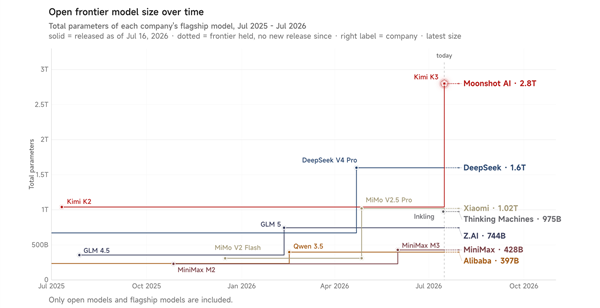
Moonshot AI announced Kimi K3 on July 16, 2026. At 2.8 trillion parameters, it is larger by total parameter count than other widely discussed open frontier models available at the time of launch.
The original report describes Kimi K3 as the world’s largest open-source model by parameter scale. International coverage has often used the more precise term open-weight, meaning that model weights can be made available for downloading, deployment, and customization even when every part of the training pipeline is not necessarily published.
Moonshot AI’s official documentation calls Kimi K3 the first open-source model in the 3-trillion-parameter class. It also states that the complete model weights are scheduled to be released by July 27, 2026, while technical details are being coordinated with inference partners and open-source maintainers.
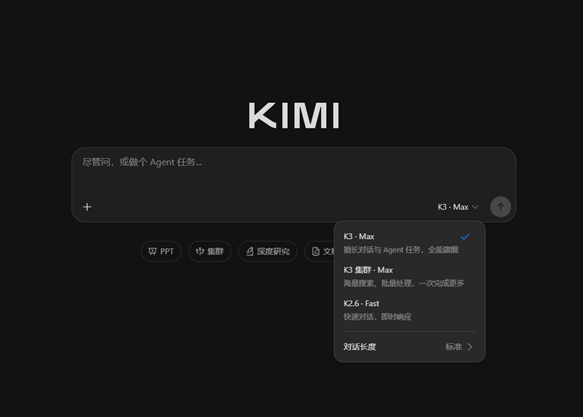
The scale comparison below shows how quickly the largest open models have grown. Kimi K3 moves the upper boundary from roughly 1.6 trillion parameters to 2.8 trillion in a single release cycle.
A larger parameter count does not automatically guarantee better real-world performance. Architecture, training data, activated parameters, inference efficiency, post-training, tool use, and evaluation design all matter. Even so, reaching this scale with an openly available model is a significant technical and ecosystem milestone.
More Than a Large Parameter Count
Kimi K3 is not designed to rely on scale alone.
According to Moonshot AI’s official model documentation, K3 is built with Kimi Delta Attention, or KDA, a hybrid linear-attention mechanism, together with Attention Residuals. These architectural changes are intended to improve computational efficiency while supporting demanding long-context workloads.
The model’s main capabilities include:
- 2.8 trillion total parameters
- Native visual understanding
- A 1-million-token context window
- Long-horizon software engineering
- End-to-end knowledge work
- Deep reasoning and research
- Multimodal content understanding
- Tool calling and structured output through the API
A 1-million-token context window gives the model room to process unusually large collections of material in a single working context. Depending on the task and file format, that may include extensive documentation, a large codebase, research material, long reports, or a combination of text and visual inputs.
The benefit is not simply that K3 can “read more.” Long-context performance also depends on whether the model can locate relevant information, maintain consistency, connect evidence across distant sections, and complete a long sequence of work without losing the original objective.
Designed for Software Engineering
Moonshot AI positions Kimi K3 for long-horizon coding rather than isolated code completion.
That includes tasks such as understanding a large repository, tracing dependencies, planning a multi-file change, debugging, refactoring, generating interfaces, working with visual feedback, and completing a project across multiple stages.
Kimi K3 is also available through Kimi Code, where Moonshot describes it as particularly strong in coding, game and 3D development, and complex knowledge tasks.
Built for Knowledge Work and Deep Research
The model is also aimed at broader professional workflows. A large context window can help when a task involves many source documents, lengthy background material, or several connected deliverables.
Typical scenarios may include:
- Reviewing large document collections
- Comparing evidence across multiple reports
- Producing structured research outputs
- Analyzing technical or business material
- Building presentations from source documents
- Maintaining context across multi-stage projects
These are precisely the kinds of tasks that become difficult when documents must be split into many disconnected prompts.
Native Visual Understanding
Kimi K3 can accept visual content in addition to text. Moonshot AI’s documentation says the model can understand information such as text inside images, colors, objects, shapes, screenshots, and video content.
This allows visual information to remain part of the same reasoning process as written instructions and code. For example, a coding agent can examine a screenshot, modify an interface, inspect the new result, and continue refining the implementation.
Market Attention Is Rising Alongside Model Capability
The original report also connects the Kimi K3 release with growing commercial interest in Chinese AI models.
It cites a research note from CITIC Securities suggesting that global large-model usage could continue rising week over week, while competitively priced Chinese models remain prominent in traffic rankings. The report also points to faster commercialization across the domestic market, including more varied pricing plans, subscriptions, and enterprise services.
These observations should be treated as market commentary rather than technical characteristics of Kimi K3. They do, however, reflect a broader shift: open and lower-cost models are becoming practical alternatives for more developers and companies.
At the same time, access policies and pricing among model providers continue to change. Model selection is therefore increasingly based on a combination of capability, context length, deployment options, data requirements, latency, and total operating cost—not benchmark scores alone.
Related Chinese AI Companies Mentioned in the Report
The source article also highlights several publicly listed companies connected with China’s broader AI sector.
360 Security Technology
The report notes that 360 has developed products including 360 Brain and a security-focused large model. Its AI work covers multimodal understanding, reasoning, and code generation.
This is broader industry context and does not imply that 360 participated in the development of Kimi K3.
Kunlun Tech
The article also cites Kunlun Tech’s announcement that its Tiangong AI-native model and product business had passed $800 million in annual recurring revenue during the second quarter of 2026.
Again, this is presented as an indicator of commercial momentum in China’s AI market rather than a direct connection to Moonshot AI or Kimi K3.
What the Kimi K3 Release Means
Kimi K3 raises the scale ceiling for openly available frontier models. More importantly, it brings that scale together with long context, visual understanding, coding, and agent-oriented workflows.
The release may benefit several groups:
- Developers gain access to a larger model for complex coding and tool-driven tasks.
- Researchers can examine a new large-scale architecture built around hybrid linear attention.
- Enterprises receive another option for document-heavy and long-horizon knowledge workflows.
- Open-model infrastructure providers gain an opportunity to improve inference support for models approaching the 3-trillion-parameter range.
- The wider AI ecosystem gets another reference point for comparing open and proprietary frontier systems.
The practical limits will become clearer after the full weights, technical report, deployment guidance, independent evaluations, and real-world usage data are available.
常见问题
What is Kimi K3?
Kimi K3 is Moonshot AI’s flagship large language model released in July 2026. It has 2.8 trillion parameters, native visual understanding, and a context window of up to 1 million tokens.
Is Kimi K3 open source?
Moonshot AI describes Kimi K3 as an open-source model, while some independent reporting calls it open-weight. Moonshot’s documentation says the complete weights are expected to be released by July 27, 2026, with additional architecture and evaluation details to follow.
How large is the Kimi K3 context window?
Kimi K3 supports up to 1 million tokens of context. This is intended for large codebases, long documents, complex research, and extended multi-stage workflows.
Does Kimi K3 support images and video?
Yes. Official Kimi documentation lists native visual understanding and support for visual content. Its vision documentation also states that Kimi K3 can process video content in supported workflows.
What is Kimi K3 designed for?
Moonshot AI positions the model for long-horizon coding, software engineering, knowledge work, deep reasoning, research, multimodal tasks, and agent-based workflows.
Can developers access Kimi K3 through an API?
Yes. Kimi K3 is listed on the official Kimi API Platform under the model ID kimi-k3. The platform documents support for reasoning, tool calling, JSON output, structured output, and context caching.
Can Kimi K3 be run locally?
Local deployment depends on the availability of the full weights and suitable inference software and hardware. A 2.8-trillion-parameter model is extremely demanding, so most individual users will be more likely to access it through hosted services or specialized infrastructure.
相关工具
- Kimi: Moonshot AI’s official assistant for research, coding, presentations, and complex knowledge tasks.
- Kimi API Platform: The official platform for accessing Kimi K3 and other Moonshot AI models through APIs.
- Kimi Code: Moonshot AI’s coding agent and command-line development environment.
- Moonshot AI on GitHub: The official organization hosting Moonshot AI’s open repositories and developer projects.
- Moonshot AI on Hugging Face: The official model profile for downloadable Kimi model releases and collections.
Related Links
- Kimi K3 Official Quickstart: Official model specifications, architecture summary, and release information.
- Kimi K3 Technical Blog: Moonshot AI’s introduction to Kimi K3 capabilities and use cases.
- Kimi API Model List: Official model identifiers, context limits, and capability descriptions.
- Kimi K3 API Pricing: Current API pricing and supported K3 features.
- Kimi Code Model Configuration: Documentation for selecting Kimi K3 in Kimi Code.
- Reuters Report on the Kimi K3 Launch: Independent reporting on the model’s scale, positioning, and market context.
Summary
Kimi K3 is Moonshot AI’s largest model to date, combining 2.8 trillion parameters with native visual understanding and a 1-million-token context window. It is designed for long-horizon coding, knowledge work, research, reasoning, and multimodal tasks.
The model sets a new scale benchmark for open models, but parameter count alone will not determine its practical value. Independent evaluations, inference requirements, final weight availability, and real-world reliability will be equally important.
The launch also reflects the growing commercial and technical momentum behind China’s open-model ecosystem.
Kimi K3’s real significance is not simply that it is larger—it is that frontier-scale modeling, long context, vision, and agentic work are being brought together in an openly accessible system.