80%+ of Japanese Companies Haven't Truly Utilized AI in Depth: How Traditional Businesses Can Start Implementing AI with We0.ai?
AI adoption rates among Japanese companies appear relatively high, but not many have truly leveraged AI in depth. This article breaks down the real obstacles traditional businesses face in implementing AI and provides a practical path with We0.ai, starting from corporate websites, content, and customer acquisition.
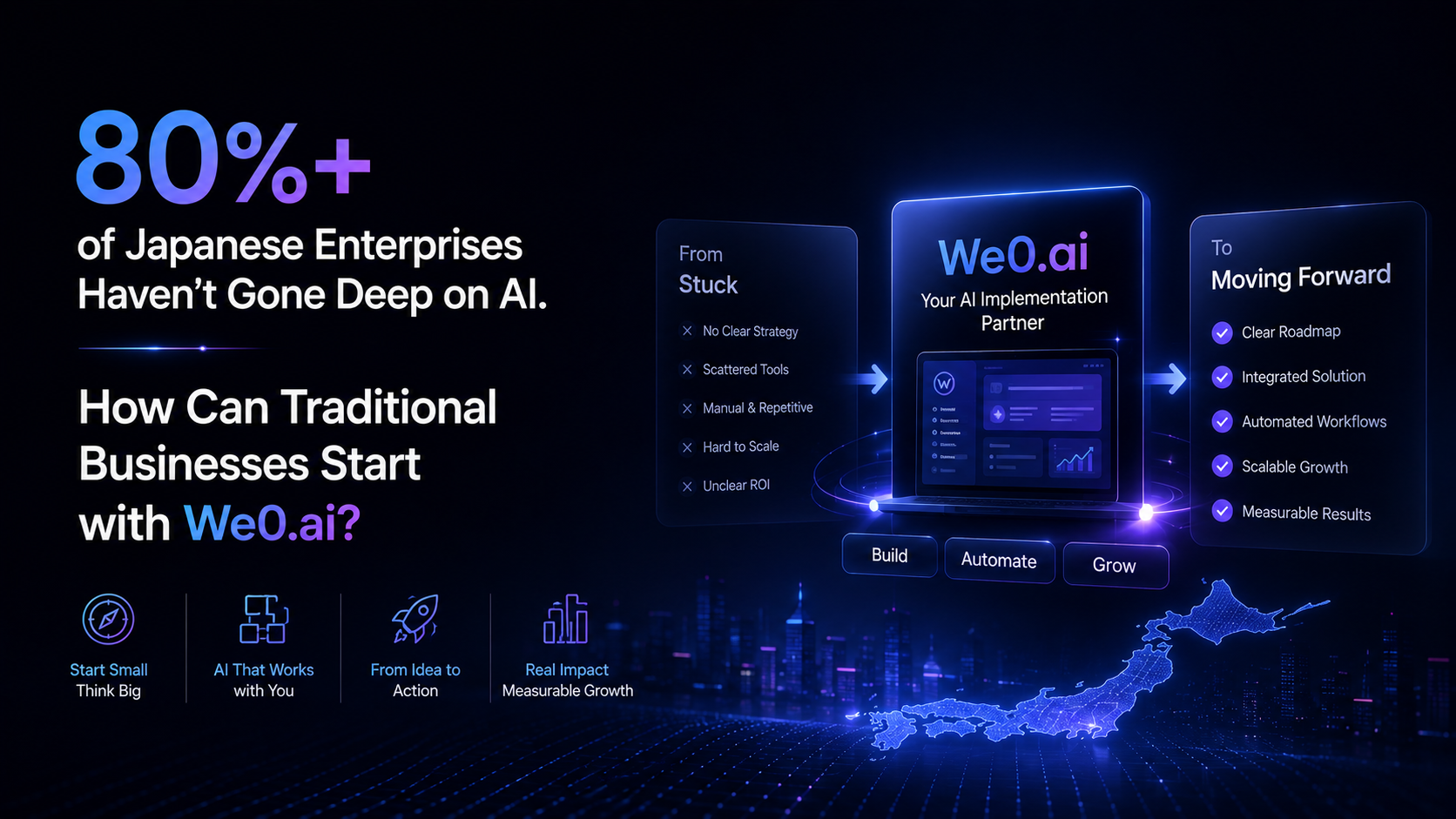
80%+ of Japanese companies haven't really used AI deeply yet: How can traditional companies start deploying AI with We0.ai?
80%+ of Japanese Companies Haven't Really Used AI Deeply: How Can Traditional Companies Start Deploying AI with We0.ai?
Let's start with the conclusion: Many Japanese companies haven't "never touched AI" — they've "touched it, but never truly used it deeply."
These are two very different things.
On the surface, everyone is talking about AI, trying AI, and holding meetings about AI. But when it comes down to actual business operations, it's still the same as before:
- Reports are still compiled manually
- Content is still written piece by piece by humans
- Corporate websites haven't been updated in years
- Leads are still chased by salespeople
- Business workflows still require layer upon layer of approvals
So the question isn't "should we adopt AI."
The real question is: Which layer should AI be applied to first, so that it can actually start producing results?
For many traditional companies, the first bottleneck isn't the model or the technology — it's these three points:
- Not knowing which use case to start with
- Not knowing how to integrate AI into existing business processes
- Not knowing how to turn AI into visible business outcomes
That's why I recommend starting with showcase websites + content + lead generation funnels.
It's not about pursuing a "big, all-encompassing AI transformation" first — it's about building an entry point that can go live, capture traffic, and sustain growth.
And this is exactly where We0.ai fits in.
1. Why Are Many Japanese Companies "Seemingly Using AI" but Not Really Using It Deeply?
First, don't overthink AI.
In traditional companies, AI deployment usually produces only two kinds of outcomes:
- Saving time
- Acquiring more customers
If it does neither, then it's just a "novel new tool."
1) What AI Hits First Isn't a Technology Problem — It's a Process Problem
Many traditional Japanese companies have processes that are stable but also heavy.
Stable means less prone to errors. Heavy means hard to change.
After AI is introduced, the most common outcome isn't "immediate efficiency gains" but rather:
- Legacy systems can't connect
- Data is scattered across departments
- Permission approvals are too slow
- On-site managers are afraid to make changes
- Employees don't know how to collaborate
So AI doesn't lack tools — it lacks a deployment path.
2) Many Companies Treat AI as an "Internal Efficiency Tool" but Overlook It as an "External Growth Tool"
This point is critical.
When companies mention AI, their first reaction is often:
- Auto-writing emails
- Generating meeting minutes
- Internal knowledge base Q&A
- Customer service chatbots
None of these are wrong, but focusing too early and too narrowly on internal use means missing a more direct opportunity:
Using AI to build out the corporate website, content, case studies, inquiry pages, and product pages first.
Because this is the path where results are easiest to see.
3) What Traditional Companies Need Most Isn't Showing Off Technology — It's Visible Growth
Bosses won't pay just because "we've integrated AI."
They'll only look at:
- Is the website easier to find?
- Have inquiries increased?
- Can case studies be produced faster?
- Is sales follow-up less labor-intensive?
- Can new products be launched and validated faster?
The value of AI always has to come back to growth.
2. What's the Most Realistic First Step for Traditional Companies to Deploy AI?
Not rebuilding your ERP.
Not investing in one massive system all at once.
And not hiring an entire AI team first.
A more realistic first step is:
Build a showcase and lead-generation entry point that AI can continuously serve.
For example:
- Brand website
- Product showcase pages
- Service pages
- Case study pages
- FAQ pages
- Multilingual inquiry pages
- Launch pages / waitlist pages
These pages don't look "high-tech," but they're where companies can gain traction most easily.
Why Start Here?
Because this addresses three things at once:
| Goal | Function | Why It Fits Traditional Companies |
|---|---|---|
| Showcase | Help customers understand who you are | Reduces communication costs |
| Search | Help customers find you | Captures organic traffic first |
| Conversion | Get customers to leave their contact info | Directly connects to business results |
This is the classic Build -> Showcase -> Grow -> Leads model.
It's not about "doing AI" first — it's about building the "business entry point that AI can serve."
3. Why Is We0.ai Better Suited to Start from This Point?
Because We0.ai isn't one of those tools that just "generates a page."
It's more like an AI-powered website-building, lead-generation, and growth platform for showcase websites.
In other words, it doesn't just care about whether a page is published. It cares more about:
- Whether the website can go live
- Whether content can be continuously updated
- Whether SEO/GEO can deliver results
- Whether pages can capture inquiries
- Whether continuous optimization and review can happen afterward
What Traditional Companies Really Need Is "Post-Launch Growth Capability"
Many tools can create pages.
But after the page is published, that's usually where it ends.
The problem is, companies don't want a demo.
Companies want an asset.
We0.ai's value isn't just "building" a website — it's turning a website into something that can grow.
That's a huge difference.
Think of It as a More Practical Path
| Stage | Traditional Approach | We0.ai's Approach |
|---|---|---|
| Step 1 | Think about systems and architecture first | Launch a usable website first |
| Step 2 | Stack features and workflows | Get showcase and conversion working first |
| Step 3 | Wait for IT scheduling | Move fast with AI + human collaboration |
| Step 4 | No one manages it after launch | Continuously do SEO, content, optimization, and growth |
The key isn't "build a website faster" — it's "build a website that can continuously deliver results faster."
4. How Can Traditional Companies Start Deploying AI with We0.ai?
If you're a traditional company, trading company, service provider, or manufacturing brand, I'd suggest not jumping straight into "large model transformation."
Start with these 4 steps instead.
Step 1: Pick the Page That Can Monetize Most Easily
The general priority order is:
- Inquiry page
- Product page
- Case study page
- Service page
- FAQ page
- Multilingual landing page
Why?
Because these pages are closest to business outcomes.
Step 2: Turn "Product Information" into "Language Customers Understand"
Many companies' problem isn't a lack of content — it's content that reads like internal documentation.
Customers don't care how much technology you used.
Customers care about:
- What problem can you solve?
- Where are you faster than others?
- Why should I contact you?
- Can you give me a clear outcome?
So the first step is to rewrite the messaging in language customers can understand.
AI is very good at this.
Step 3: Build Pages as Structures That Can Continuously Grow
A page isn't done once it's written.
It needs to be continuously enriched with:
- SEO titles
- Long-tail keywords
- FAQs
- Case studies
- Comparison content
- Call-to-action buttons
The more a page operates like a growth entry point, the more valuable it becomes.
Step 4: Keep Optimizing After Launch — Don't Stop
The most common failure for traditional companies isn't that they can't build something — it's that no one manages it after it's built.
We0.ai is better positioned to handle what comes next:
- Review traffic data
- See which keywords are getting traffic
- Identify which pages convert better
- Determine what content needs to be added
- Decide which pages need to be rewritten
That's what real deployment looks like.
5. A More Practical Scenario: The Website Isn't a Showcase — It's a Lead-Generation Asset
Many companies still view their website as a "storefront."
But today's website should be:
- Findable through search
- Able to clearly explain the business
- Able to address customer questions
- Able to support continuous content updates
- Able to capture and keep leads
If the website is just decoration, then it's merely a business card.
If the website can work continuously, then it's an asset.
That's why I've always believed that traditional companies shouldn't start their AI journey with "internal tech showcase" — they should start with "external results."
External results are easier to validate, and they make it easier to get internal buy-in for AI.
6. A Comparison: Why Do Many AI Projects End Up Not Working?
| Common Practice | Result | Problem |
|---|---|---|
| Buying tools first | Many tools, but nobody uses them | Value is unclear |
| Building a large system first | Long cycle, slow progress | High cost |
| Starting with internal automation | Only saves a little time | No visible business growth |
| Building a website and content first | Easier to generate traffic and inquiries | Results are more visible |
What traditional companies fear most is not slowness—it's doing something and seeing no results.
So if you ask me:
What should be the first step in adopting AI?
My answer would be very direct:
First, let AI help you get the "showcase, content, search, and inquiries" pipeline running.
7. How Much Can We0.ai Actually Help?
When applied to real business scenarios, We0.ai is better suited for these tasks:
- Organizing brand information and website structure
- Planning pages and copy
- Quickly building showcase websites
- Setting up foundational SEO / GEO configurations
- Filling in content, case studies, and FAQs
- Monitoring traffic and conversions
- Continuously optimizing on-site content and pages
- Providing growth recommendations and reviews
In plain terms, it doesn't just "build you a website."
It helps turn your website into a long-term, operable customer acquisition asset.
This is especially important for traditional companies.
Because what many traditional companies truly lack is not budget, not product, and not necessarily people.
What they lack is an entry point that continuously showcases their business capabilities to the outside world.
8. A Benchmark for Traditional Companies
If you're currently wondering whether to adopt AI, start by asking yourself three questions:
- Can my customers quickly understand what I do?
- Can my website help me capture search traffic?
- Can my content consistently generate inquiries?
If you can't answer at least two of these three questions, what you may need is not a more complex system.
What you need is a more practical entry point.
Having AI participate in showcasing and growth first is often more effective than having AI tackle the "most difficult internal processes" first.
FAQ
1. Why is AI adoption slow in traditional Japanese companies?
Because of heavy processes, outdated systems, multiple departments, slow approvals, and the fact that many teams are still unclear about AI's real business value.
2. What type of AI project is best for traditional companies to start with?
Typically projects closer to business results, such as websites, content, FAQs, inquiry pages, and multilingual pages.
3. How is We0.ai different from ordinary AI website-building tools?
We0.ai places greater emphasis on launching, showcasing, SEO/GEO, content growth, and customer acquisition—it's not just about creating a single page.
4. Does AI adoption always have to start with internal efficiency?
Not necessarily. Many companies are better off starting with the external customer acquisition pipeline, because results become visible faster.
5. Can traditional companies without a content team still do this?
Yes. It's better to start with an AI + human collaboration approach—first get the core pages done, then iterate continuously.
Related Tools
- AI Website Builder
- SEO Content Planning
- Multi-language Landing Pages
- AI Lead Generation Pages
- Showcase Website Growth
Ready to Get Started?
If you currently have a traditional business, a brand website, or a showcase site that hasn't really taken off yet, you can start with We0.ai.
First do what can go live, then do what can grow.
First do what can showcase, then do what can acquire customers.
This path is usually shorter than you think.
Summary
AI adoption is not a slogan, nor is it about piling up systems.
For many traditional Japanese companies, the most realistic starting point is not "comprehensive transformation," but first getting the website, content, and inquiry pipeline up and running.
When a company can showcase itself faster, get found faster, and receive leads faster—that's when AI truly begins to make a difference.
And for that, We0.ai is well-suited to help you get it done first.