How OpenCode Grew into a Major Open-Source Coding Agent
OpenCode has grown in a market dominated by vertically integrated products such as Claude Code, Codex, Cursor, Gemini-based coding tools, and model-specific command-line agents. It
How OpenCode Grew into a Major Open-Source Coding Agent
Introduction
OpenCode has grown in a market dominated by vertically integrated products such as Claude Code, Codex, Cursor, Gemini-based coding tools, and model-specific command-line agents.
Its strategy is different. Instead of asking developers to commit to one model provider, OpenCode positions itself as an open-source, model-neutral layer that can run in the terminal, desktop app, or IDE and connect to models from many providers.
In interviews published during July 2026, OpenCode’s founders reported that the product had reached roughly 13 million monthly active users, was processing around seven trillion tokens per day, and had built two revenue streams that together implied approximately $56 million to $58 million in annualized revenue.
Those figures are company-reported and have not been publicly audited. OpenCode’s current homepage separately displays more than 7.5 million monthly developers, so the two public figures may use different measurement periods or definitions. The company has not published a detailed reconciliation.
Even with that caveat, OpenCode’s trajectory is notable. It shows how an application company can grow between competing model laboratories by occupying a position those laboratories cannot easily fill themselves: an open, neutral interface that benefits whenever a new model becomes useful.
1. OpenCode Started with a Terminal-First Observation
OpenCode’s founders had been building open-source developer tools for years before launching the coding agent.
Their earlier project, SST, had become a successful developer-infrastructure product. After reaching profitability, the team began exploring what to build next and concluded that ignoring AI would mean ignoring the most important shift in software development during the decade.
The early experiments did not immediately become convincing products. The turning point came when the team began using Claude Code.
Many developers were already asking language models for help, but the workflow was fragmented:
- Work inside an editor.
- Encounter a problem.
- Open a browser chat.
- Copy code or an error message.
- Wait for a response.
- Copy the answer back into the development environment.
For terminal-oriented developers, that context switching was especially disruptive.
Cursor had already shown that an AI-native editor could attract a large audience, but OpenCode’s team primarily used Vim and terminal tools. Moving into another editor involved giving up a familiar editing environment in exchange for AI features.
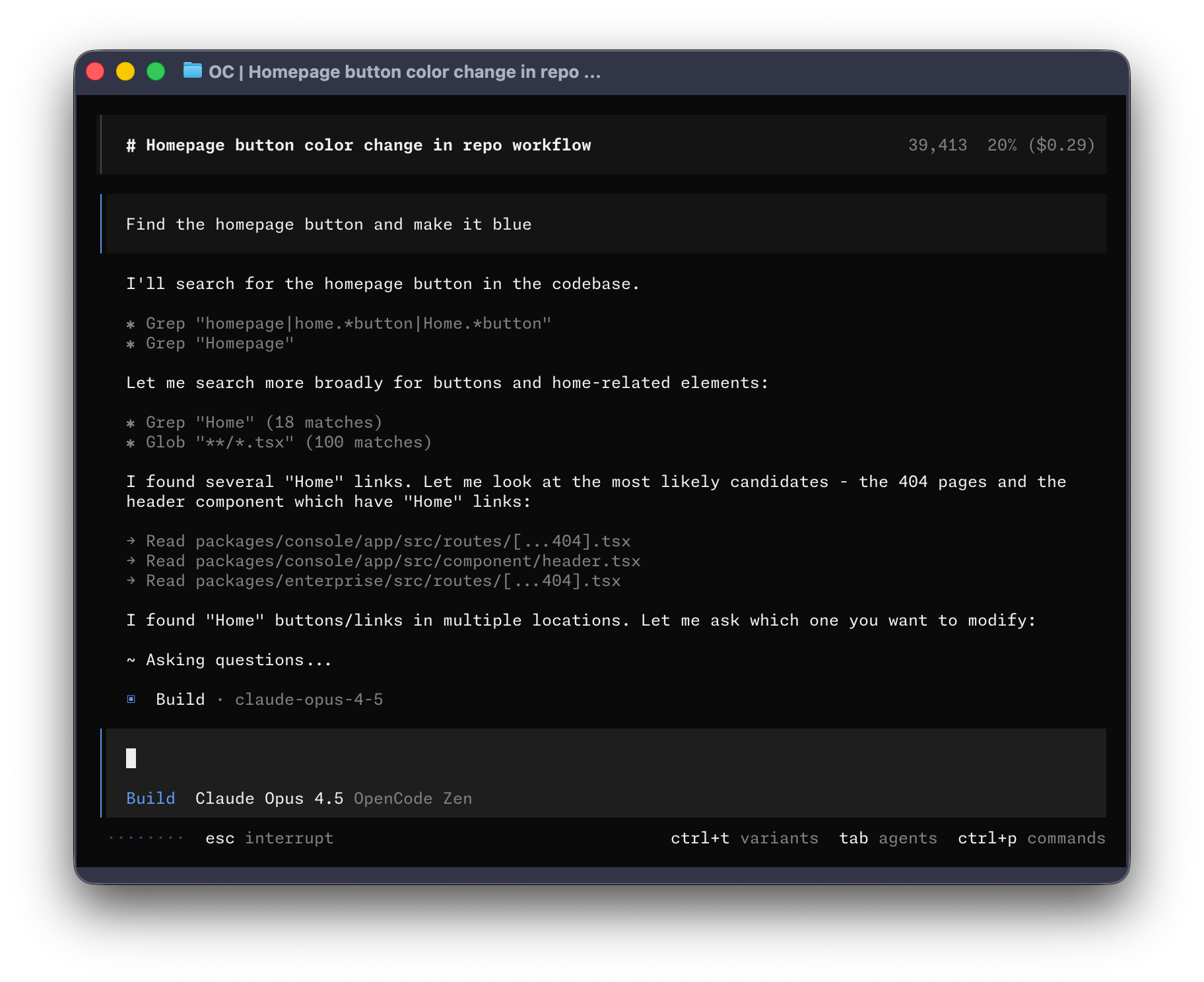
Claude Code demonstrated a different interaction model. It ran beside the editor, inspected the repository, used the filesystem, executed commands, and made changes without requiring developers to abandon their existing setup.
The OpenCode team saw an opening: create a similar terminal-native agent, but make it open source and independent of any single model provider.
2. The Open-Source Position Was More Important Than Feature Parity
The coding-agent market already contained many products. OpenCode did not need to prove that no competitor existed.
It needed to own a position that remained unclaimed.
The founders believed that model competition would intensify. Anthropic, OpenAI, Google, xAI, Chinese model developers, and open-weight communities would continue releasing systems with different strengths, prices, speeds, and deployment requirements.
A tool tied to one model benefits when that model improves. A neutral tool can benefit whenever any supported model improves.
That created a clear initial objective:
Become the default open-source coding-agent interface before another project establishes that identity.
Open source is especially useful for OpenCode because supporting a wide model ecosystem creates a long tail of integration work.
Different providers vary in:
- Authentication
- API formats
- Tool-call behavior
- Streaming
- Context limits
- Reasoning controls
- Regional endpoints
- Rate limits
- Error handling
- Local deployment
- Enterprise gateways
A small internal team cannot reproduce every provider, region, local setup, corporate proxy, or private cloud environment.
An open-source community can report provider-specific failures, contribute fixes, and test configurations that the core team does not use itself.
OpenCode’s official documentation now states that it uses the AI SDK and Models.dev to support more than 75 model providers, including local models.
3. Models.dev Became Part of the Product’s Neutral Infrastructure
To support many models, OpenCode needed reliable structured information about providers and model capabilities.
The team created Models.dev, an open-source database that records details such as:
- Model and provider identifiers
- Context limits
- Output limits
- Reasoning support
- Tool calling
- Structured output
- Temperature support
- Weight availability
- Pricing
- Release dates
This dataset is useful beyond OpenCode itself. It creates a shared layer for applications that need to understand how model names, capabilities, and provider implementations differ.
The strategic value is important. When a new model is released, OpenCode does not need to redesign the whole product around that laboratory. It can add the provider or model to the shared catalog, test the integration, and expose it through the same interface.
The user can then select a model without changing the primary coding workflow.
4. Growth Accelerated Rapidly in Early 2026
The founders described a sharp increase in usage after the initial launch.
According to their interview figures:
| Period | Reported Monthly Active Users |
|---|---|
| June 2025 launch | Early-stage release |
| December 2025 | About 650,000 |
| January 2026 | About 2.5 million |
| End of June 2026 | About 13 million |
They also reported approximately 4.6 million weekly active users and roughly seven trillion tokens processed per day by the middle of 2026.
OpenCode’s public website currently presents a different monthly figure: more than 7.5 million developers. Because the company has not published the exact methodology behind both numbers, readers should treat the 13 million figure as a founder-reported interview metric rather than a standardized audited statistic.
The official data dashboard provides a more directly inspectable subset of activity for OpenCode Go and Zen. It shows daily model usage, unique users, session cost, token prices, cache ratios, market share, and geographic distribution.
That dashboard also illustrates one part of OpenCode’s thesis: model usage can change quickly as new open and proprietary systems arrive.
5. Anthropic’s Restriction Became a Growth Event
One of the most important moments in OpenCode’s public growth came when Anthropic restricted the use of Claude subscription authentication through third-party coding harnesses.
OpenCode users could still access Claude through approved API billing, but the restriction affected people who had been using Claude subscription allowances inside external tools.
From Anthropic’s perspective, subscription plans were designed around its own products and usage patterns. Heavy third-party-agent usage could create a different cost profile.
From the OpenCode community’s perspective, the change looked like a model provider using its control over authentication and subscriptions to favor its own vertically integrated product.
OpenCode’s founders said the controversy helped the smaller product in several ways.
It Put OpenCode in the Same Conversation as Claude Code
Before the restriction, many developers had never heard of OpenCode.
When Anthropic acted against a third-party integration, developers began asking why the tool mattered enough to attract that response.
The event made OpenCode appear less like one of many small coding agents and more like a meaningful alternative.
It Made Model Choice Concrete
Vendor independence can sound abstract until a provider changes a policy.
The restriction gave users a direct example of why they might prefer an application layer that can move between providers.
It Created an Opportunity for Competitors
OpenCode had already been discussing official integrations with other model and subscription providers.
The founders said they used the moment to approach OpenAI, arguing that official support for OpenCode would present a clear contrast with Anthropic’s position.
OpenCode’s current homepage states that users can sign in with ChatGPT Plus or Pro and can also use a GitHub Copilot account.
The broader lesson is not that one provider is permanently the “bad actor.” It is that a neutral application can benefit when model companies compete for distribution.
6. OpenCode’s Strategic Position Is Neutrality, Not Vertical Integration
Claude Code is designed to deliver a tightly integrated experience around Anthropic’s models.
Codex can be optimized around OpenAI’s models and infrastructure.
That vertical integration has real advantages:
- The product team understands the model deeply.
- New model capabilities can appear in the application quickly.
- The provider can tune the model and interface together.
- Authentication, billing, caching, and safety controls can be coordinated.
OpenCode is making a different trade-off.
Its advantages are:
- Model choice
- Open-source code
- Local-model support
- Provider switching
- Community integrations
- Enterprise gateways
- Reduced application-layer lock-in
The founders do not argue that open source makes every product automatically better.
Their claim is narrower: open source is valuable when the product must cover a large number of environments and long-tail integrations that one company cannot fully test itself.
This is why OpenCode can coexist with vertically integrated coding tools while still competing with them for developer attention.
7. “Good Enough” Models Expand the Market
The earliest coding-agent market was dominated by a simple assumption: developers would always want the most capable model available.
That assumption made sense when the quality gap between frontier proprietary models and alternatives was large.
As open-weight and lower-cost models improved, other characteristics became more important:
- Speed
- Price
- Regional availability
- Data control
- Hosting quality
- Frontend design ability
- Long-context behavior
- Tool-call reliability
- Local deployment
A model does not need to win every benchmark to be the best option for a particular workflow.
A faster model may be preferable for short iterative changes. A cheaper model may be suitable for repetitive subagent tasks. A locally hosted model may be required inside a restricted enterprise environment.
OpenCode’s usage data shows that open models can capture substantial real-world token share when they are affordable and reliably hosted.
The company’s OpenCode Go product was created around this idea. It offers selected open coding models through a low-cost subscription designed primarily for international users.
The current published price is:
| Plan | Price |
|---|---|
| First month | $5 |
| Following months | $10 per month |
The product is optional. Developers can continue using OpenCode with their own providers and API keys.
8. The More Valuable Form of Routing May Be Orchestration
OpenCode’s founders are skeptical of simple model routing as a standalone category.
A basic router examines an incoming prompt and decides which model should receive it. That can help at the start of a request, but switching models in the middle of a long conversation is more difficult.
A mid-session switch can lose provider-specific cache benefits and may create inconsistencies in context, tool behavior, and reasoning style.
The founders see more value in an orchestration pattern:
- A capable primary model receives the user’s request.
- The primary model plans the work.
- It delegates independent tasks to subagents.
- Each subagent can use a model suited to that task.
- Subagents run in parallel where possible.
- Results return to the primary model for synthesis and judgment.
This approach preserves one coherent main session while using cheaper or specialized models for execution.
For example:
| Task | Possible Model Strategy |
|---|---|
| Architecture and final review | Strong frontier reasoning model |
| Repository search | Fast low-cost model |
| Repetitive file edits | Reliable coding model |
| Documentation lookup | Search-oriented subagent |
| Frontend iteration | Model strong in visual and UI tasks |
| Test generation | Lower-cost parallel agents |
OpenCode already supports multiple sessions and subagents, making it a natural environment for this type of orchestration.
9. OpenCode Has Three Main Commercial Layers
The open-source application remains available without requiring users to buy an OpenCode-hosted model product.
The company is building commercial services around access, hosting, and organizational control.
OpenCode Zen
OpenCode Zen is a pay-as-you-go gateway for models tested and selected for coding-agent use.
Users add a balance, receive an API key, and connect Zen as a provider inside OpenCode or another compatible agent.
The company says Zen uses transparent per-token pricing and does not add a markup beyond stated processing costs. The catalog includes models from OpenAI, Anthropic, Google, Moonshot, Zhipu, DeepSeek, MiniMax, xAI, Qwen, and other providers.
The product began as a way to reduce the setup and rate-limit friction involved in connecting many separate model accounts. It evolved into a curated inference layer.
OpenCode Go
OpenCode Go is a lower-cost subscription focused on selected open coding models.
The team tests combinations of models and inference providers, looking for stable latency and agent performance rather than assuming every host serves the same model equally well.
This matters because open weights do not guarantee a consistent hosted experience. Quantization, batching, context limits, serving software, and hardware can all change the result.
OpenCode Enterprise
OpenCode Enterprise is designed for organizations that want centralized governance while keeping code and context inside approved infrastructure.
The official documentation lists:
- Per-seat pricing
- Central configuration
- SSO integration
- Internal AI gateway support
- Provider restrictions
- No token charge from OpenCode when the customer uses its own gateway
- Optional disabling of session sharing
- A roadmap for self-hosting shared session pages
OpenCode states that it does not store code or context data by default. Processing happens locally or through direct calls to the selected AI provider.
The optional /share feature is an exception because shared conversation data is sent to the service hosting the share page. Enterprises can disable it centrally:
{
  "$schema": "https://opencode.ai/config.json",
  "share": "disabled"
}
10. Founder-Reported Revenue Approached $60 Million ARR
The source article combines two revenue streams described by the founders.
Inference Revenue
The founders said that June usage implied approximately $31 million to $33 million in annualized inference revenue, while a later weekly run rate was closer to $38 million to $40 million.
Subscription Revenue
They also reported approximately 160,000 monthly subscribers contributing around $18 million in annualized revenue.
Combined Figure
Using the higher inference run rate, the two businesses imply roughly:
| Revenue Stream | Founder-Reported Annualized Run Rate |
|---|---|
| Inference and model access | $38M–$40M |
| Monthly subscriptions | About $18M |
| Combined | About $56M–$58M |
These numbers are management estimates based on short recent periods, not audited annual revenue.
Annualized run rate can change quickly when usage, model prices, discounts, and customer behavior change.
11. Inference Can Have Attractive Margins, but the Claims Need Context
OpenCode’s founders argued that inference resale can produce strong gross margins when a platform has sufficient scale, utilization, caching, and provider discounts.
They cited margins around 80% for some workloads and suggested that major laboratories may approach 90% in favorable circumstances.
These are founder estimates, not independently verified financial disclosures.
Inference economics depend on many variables:
- GPU purchase or rental price
- Utilization
- Power
- Networking
- Memory and storage
- Model efficiency
- Quantization
- Batching
- Cache-hit ratio
- Provider discounts
- Customer input-output mix
- Free-tier subsidies
- Support and operations
OpenCode’s global user base can help utilization because demand moves across time zones. When users in Asia are active, users in the Americas may be offline, and the pattern reverses later.
More consistent 24-hour demand can reduce idle capacity.
The official OpenCode data dashboard also reports high cache ratios for several Go and Zen models. Caching can materially reduce the cost of repeated context in coding sessions.
12. Tokens Are Becoming a Customer-Acquisition Cost
Traditional software companies often acquire users through paid advertising, sales outreach, events, or free trials.
AI products can acquire users by subsidizing inference.
OpenCode’s founders describe free tokens as a new form of customer-acquisition cost.
The user needs to experience the moment when an agent understands a repository, solves a bug, or completes a useful change. Until that happens, the value of a coding agent can remain abstract.
A free model or subsidized allowance creates that first experience.
The business then depends on converting a portion of those users into:
- Pay-as-you-go Zen customers
- OpenCode Go subscribers
- Heavy model users
- Enterprise deployments
The economics work only if the long-term contribution from paying users exceeds the cost of free usage, infrastructure, support, and acquisition.
13. Quick Start: Install and Use OpenCode
The original interview article focused on strategy rather than setup. The following commands come from OpenCode’s official documentation.
Install with the Official Script
curl -fsSL https://opencode.ai/install | bash
Review remote installation scripts before running them in a sensitive environment.
Alternative Package Managers
npm install -g opencode-ai
bun install -g opencode-ai
brew install anomalyco/tap/opencode
Run with Docker
docker run -it --rm ghcr.io/anomalyco/opencode
Connect a Provider
Start OpenCode and run:
/connect
Choose OpenCode Zen, OpenCode Go, or another supported provider and add the required credentials.
Initialize a Repository
cd /path/to/project
opencode
Inside OpenCode, run:
/init
This analyzes the project and creates an AGENTS.md file.
OpenCode recommends committing AGENTS.md to Git so the agent can consistently understand the repository structure, conventions, and workflows.
Use Plan and Build Modes
OpenCode includes two built-in modes:
- Plan: read-only analysis and implementation planning
- Build: full-access development work
Use the Tab key to switch between them.
A safer workflow for a substantial feature is:
- Start in Plan mode.
- Describe the desired behavior and constraints.
- Review the proposed implementation.
- Add missing context or examples.
- Switch to Build mode.
- Ask the agent to implement the approved plan.
- Run tests and review the diff before committing.
14. AI Can Increase Output Without Improving Product Judgment
The final part of the founders’ argument is less about OpenCode and more about the limits of coding agents.
AI can make implementation easier. It does not automatically answer the hardest product question: what should the team build?
Before widespread coding agents, a founder might spend most of the day deciding what to do and a smaller portion implementing it.
If AI reduces implementation effort, the planning burden can become even more visible.
The team can now respond to every signal:
- A customer reports a bug.
- A competitor launches a feature.
- A stakeholder requests a workflow.
- A metric falls.
- A salesperson asks for an exception.
The agent can implement each request quickly.
But responding to every request can create an incoherent product. Features accumulate without a shared abstraction, and every new behavior becomes another compatibility obligation.
The founders’ point is that shipping ten times more software does not mean the organization has ten times more good ideas.
15. AI Can Make Bad Patches Easier to Accept
Coding agents also change the trade-off between architectural repair and short-term patching.
Before AI, an ugly workaround carried an obvious implementation cost. That friction sometimes forced the team to redesign the underlying system.
When an agent can generate and maintain the workaround cheaply, the temporary patch becomes easier to approve.
That can hide technical debt rather than eliminate it.
Engineering judgment is still required to decide:
- Whether a feature belongs in the product
- Whether the architecture supports it
- Whether a patch should be rejected
- Which abstractions should be redesigned
- Whether the tests reflect real behavior
- Whether generated code is safe to deploy
The engineer’s responsibility does not disappear when the agent writes the code. It moves toward constraints, review, testing, architecture, and release safety.
16. Coding Agents Need Stronger Guardrails, Not Weaker Ones
A coding agent can work continuously and generate a large volume of changes. That productivity increases the importance of reliable boundaries.
Useful safeguards include:
- An accurate
AGENTS.md - Read-only planning modes
- File and command permissions
- Protected branches
- Required code review
- Automated tests
- Static analysis
- Security scanning
- Reproducible development environments
- Small, reviewable commits
- Clear rollback paths
OpenCode’s Plan mode, permission controls, policies, custom agents, and enterprise configuration provide pieces of this structure.
The tools do not replace engineering governance. They make it possible to encode more of that governance into the environment in which the agent works.
17. OpenCode’s Long-Term Bet
OpenCode is betting on a future in which no single model provider permanently controls all important coding use cases.
In that future:
- Models compete aggressively.
- Prices fall.
- Open models improve.
- Specialized systems emerge.
- Enterprises demand control over routing and data.
- Developers want to preserve the option to switch.
If that future arrives, the neutral application and orchestration layer becomes valuable.
The risk is that frontier laboratories could restrict their strongest models to first-party applications, making external tools less competitive.
The counterpressure is commercial. Model providers also need distribution, API revenue, developer adoption, and enterprise reach. Those incentives can keep model access open even when product teams would prefer tighter integration.
OpenCode’s position is strongest when several powerful model providers are competing and none can dictate the entire developer workflow.
常见问题
What is OpenCode?
OpenCode is an open-source AI coding agent available through a terminal interface, desktop app, and IDE extension. It can inspect repositories, plan changes, edit files, run commands, and connect to models from more than 75 providers.
Is OpenCode a Claude Code alternative?
Yes, although the products have different strategies. Claude Code is vertically integrated with Anthropic’s models, while OpenCode is open source and designed to work across many proprietary, open-weight, and local models.
Did OpenCode really reach 13 million monthly users?
OpenCode’s founders reported approximately 13 million monthly active users for the end of June 2026. The current official homepage displays more than 7.5 million monthly developers, and the company has not publicly explained the difference in measurement definitions.
How does OpenCode make money?
Its commercial products include OpenCode Zen for pay-as-you-go model access, OpenCode Go for a low-cost open-model subscription, and OpenCode Enterprise for centralized configuration, SSO, internal gateways, and organizational governance.
Does OpenCode store source code?
OpenCode states that it does not store code or context data by default. Data is processed locally or sent directly to the model provider selected by the user; the optional session-sharing feature sends associated data to the share-page service.
Can OpenCode use local models?
Yes. The official model documentation says OpenCode supports local models as part of its broader provider ecosystem. Actual performance depends on the model, server, hardware, and configuration.
Is OpenCode free?
The open-source agent can be installed and used without buying OpenCode Zen or Go. Users still need access to a model, which may come from a free model, an existing supported subscription, a local deployment, or a paid API.
What license does OpenCode use?
The official GitHub repository is published under the MIT License. Organizations should review the repository and dependency licenses for their own compliance requirements.
相关工具
- OpenCode: The official open-source coding-agent product and download page.
- OpenCode Zen: A pay-as-you-go gateway for models tested for coding-agent workflows.
- OpenCode Go: A low-cost subscription for selected open coding models.
- Models.dev: An open-source database of model capabilities, providers, context limits, and pricing.
- OpenCode Enterprise: Centralized configuration, SSO, and internal AI-gateway support for organizations.
- GitHub Copilot: A supported subscription option listed on OpenCode’s official site.
Related Links
- OpenCode Documentation: Official installation, configuration, initialization, and usage instructions.
- OpenCode GitHub Repository: Source code, MIT license, releases, issues, and contribution history.
- OpenCode Model Documentation: Official details on supported providers, model selection, variants, and local models.
- OpenCode Enterprise Documentation: Data handling, ownership, pricing model, SSO, gateways, and deployment guidance.
- OpenCode Data Dashboard: Public model-usage, token, cost, cache, market-share, and geographic data.
- Models.dev GitHub Repository: Source repository for the open model-and-provider database.
- Y Combinator Interview with OpenCode CEO: The interview reporting OpenCode’s recent growth and neutral-harness strategy.
Summary
OpenCode grew by taking a position that model laboratories are structurally unlikely to occupy: an open-source, model-neutral coding interface that supports proprietary, open-weight, and local systems.
Its founders report rapid growth, approximately seven trillion tokens processed per day, and a combined annualized revenue run rate approaching $60 million across inference and subscription products. Those figures are company-reported estimates, and the current homepage presents a different monthly-developer count.
The commercial strategy combines a free open-source application with Zen, Go, and Enterprise services. The technical strategy is moving beyond basic model selection toward orchestration, where a strong primary model can delegate work to lower-cost or specialized subagents.
OpenCode’s larger lesson is that faster code generation does not remove the need for product judgment, architecture, taste, and disciplined release controls—it makes those human responsibilities more important.