Grok Voice Think Fast 2.0: xAI’s Faster, More Accurate Voice Agent Model
Grok Voice Think Fast 2.0: xAI’s Faster, More Accurate Voice Agent Model Grok Voice Think Fast 2.0 Guide: Benchmarks, Pricing, Accuracy, and Migration xAI’s Grok Voice Think Fast 2.0 improves speech reasoning, transcription accuracy, agentic performance, and latency. See the benchmarks, pricing, Starlink results, and August 5 migration details. Grok Voice Think Fast 2.0, xAI voice agent, Grok Voice API, speech-to-speech AI, voice agent model, Grok Voice pricing, AI voice benchmark, transcription
Grok Voice Think Fast 2.0: xAI’s Faster, More Accurate Voice Agent Model
Introduction
xAI has released Grok Voice Think Fast 2.0, the next generation of its speech-to-speech model for developers building real-time voice agents.
The new release focuses on four areas that matter most in production voice systems: intelligence, transcription accuracy, conversational behavior, and reliable tool use. xAI says existing applications can move to the new model without rewriting their prompts in most cases.
Think Fast 2.0 is priced at $0.08 per minute of audio. Developers can use the versioned model name grok-voice-think-fast-2.0, while the grok-voice-latest alias is scheduled to move from version 1.0 to 2.0 on August 5, 2026.
The model is designed for practical voice-agent workloads such as customer support, sales, phone automation, and multi-step business workflows where the agent must understand speech, reason, call tools, and respond quickly enough to keep a natural conversation moving.
Grok Voice Think Fast 2.0 Improves Across Major Voice Benchmarks
xAI published benchmark results sourced from Artificial Analysis comparing Think Fast 2.0 with its predecessor, OpenAI’s GPT-Realtime-2.1, and Google’s Gemini 3.1 Flash.
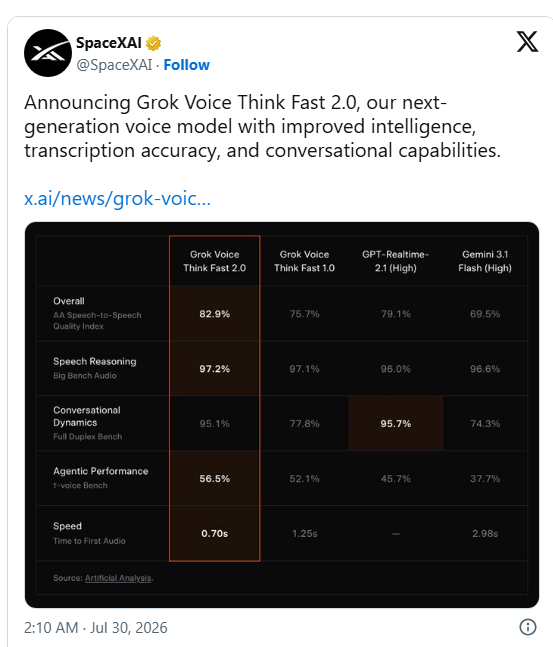
The reported results are:
| Benchmark | Grok Voice Think Fast 2.0 | Think Fast 1.0 | GPT-Realtime-2.1 High | Gemini 3.1 Flash High |
|---|---|---|---|---|
| AA Speech-to-Speech Quality Index | 82.9% | 75.7% | 79.1% | 69.5% |
| Big Bench Audio | 97.2% | 97.1% | 96.0% | 96.6% |
| Full Duplex Bench | 95.1% | 77.8% | 95.7% | 74.3% |
| τ-voice Bench | 56.5% | 52.1% | 45.7% | 37.7% |
| Time to First Audio | 0.70s | 1.25s | — | 2.98s |
The overall Artificial Analysis Speech-to-Speech Quality Index rises from 75.7% to 82.9% compared with Think Fast 1.0.
The largest practical changes appear in conversational dynamics, agentic performance, and response latency.
Speech Reasoning
On Big Bench Audio, Think Fast 2.0 scores 97.2%, only slightly above the previous model’s 97.1%.
This suggests the release is not mainly about a dramatic jump in raw speech reasoning. Instead, much of the improvement comes from how the model behaves during a live conversation.
Conversational Dynamics
Think Fast 2.0 reaches 95.1% on Full Duplex Bench, compared with 77.8% for Think Fast 1.0.
Full Duplex Bench evaluates behaviors such as knowing when to speak, handling pauses, responding to interruptions, recognizing backchannels, and maintaining natural turn-taking.
GPT-Realtime-2.1 High scores slightly higher at 95.7% on this individual benchmark, so the xAI model does not lead every category.
Agentic Performance
On the τ-voice Bench, which focuses more heavily on whether a voice agent can complete real tasks, Think Fast 2.0 reaches 56.5%.
That is higher than Think Fast 1.0 at 52.1%, GPT-Realtime-2.1 High at 45.7%, and Gemini 3.1 Flash High at 37.7%.
This metric is especially relevant for customer-service and sales agents because good conversational audio is not enough. The system also needs to follow instructions, use tools, collect information, and complete a workflow correctly.
Faster First Audio
xAI reports a 0.70-second time to first audio, down from 1.25 seconds for Think Fast 1.0.
Lower latency reduces the awkward silence between a user finishing a sentence and the AI beginning its reply.
Artificial Analysis currently lists Think Fast 2.0 among the faster speech-to-speech systems it has measured, although it is not the fastest model in the entire leaderboard.
Transcription Accuracy Improves Across 24 Languages
xAI also tested Think Fast 2.0 on thousands of short speech samples covering 24 languages.
According to the company, the new model achieved roughly 1.5–2.0× better transcription accuracy than Deepgram Nova 3 and ElevenLabs Scribe v2 in its evaluation, and roughly 1.4× better accuracy than Grok Voice Think Fast 1.0.
xAI also says the gap can widen to around 10× in some noisy and telephony-compressed environments.
These figures are xAI’s own transcription evaluation rather than the Artificial Analysis benchmark table. That distinction matters because the benchmark comparison and the transcription experiment measure different things and come from different evaluation setups.
The emphasis on noisy audio makes sense for production voice agents. Real calls often include mobile-network compression, poor microphones, road or office noise, accents, fast speech, interruptions, incomplete sentences, names, addresses, and account details.
The Model Reasons While It Speaks
One of the more unusual design choices in Grok Voice Think Fast is parallel reasoning.
xAI says the model can continue reasoning while it is already speaking, instead of completing all reasoning before producing audio. This is intended to reduce the trade-off between intelligence and latency.
Think Fast 2.0 also uses fewer reasoning tokens than its predecessor. xAI reports a median relative reasoning-token usage of:
| Model | Relative Reasoning Tokens per Response |
|---|---|
| Grok Voice Think Fast 2.0 | 0.4× |
| Grok Voice Think Fast 1.0 | 1.0× |
The company says this makes tool calls faster and often allows a tool to execute before the agent has finished its first spoken sentence.
For example, a support agent might begin saying “I can check that for you…” while simultaneously calling an account lookup tool in the background. By the time the spoken introduction finishes, the tool result may already be available for the next part of the response.
Reinforcement Learning Makes Conversations Shorter
xAI says Think Fast 2.0 was trained with extensive reinforcement learning to behave more like a useful human operator during real conversations.
The model is encouraged to use shorter sentences, ask one question at a time, avoid unnecessary filler, keep the interaction focused, and guide the user through complex workflows without exposing unnecessary complexity.
This may sound like a small change, but voice interfaces are much less tolerant of long answers than text chat. A long response may be acceptable on a screen but frustrating to listen to during a phone call.
Tool Use Is a Core Part of the Voice API
The current xAI Speech-to-Speech API supports several tool types directly inside a voice session:
file_searchweb_searchx_search- Remote MCP tools
- Custom functions
This allows a voice agent to move beyond answering questions.
Depending on the permissions provided by the application, an agent could understand the caller’s request, search approved documents, look up account information, call a business API, perform an allowed action, and explain the result by voice.
For production use, the application still needs strong permission boundaries. A model should not receive access to sensitive tools simply because it is capable of calling them.
Starlink Is A/B Testing Think Fast 2.0
Grok Voice is already used in Starlink’s phone-based sales and customer-support workflows.
xAI says it has A/B tested Think Fast 2.0 on the Starlink phone line at +1 888 GO STARLINK.
The company reports significant improvements in sales conversion rate and support containment rate.
xAI has not published the exact percentage uplift for the Think Fast 2.0 A/B test in its launch post.
That should not be confused with earlier public numbers for the original Think Fast 1.0 deployment, where xAI reported a 20% sales conversion rate and a 70% autonomous support-resolution rate. The 2.0 announcement only says the new version improved the existing Starlink results.
Pricing: $0.08 per Minute
The official xAI pricing page lists:
| Voice Model | Audio Price |
|---|---|
grok-voice-think-fast-1.0 |
$0.05/min |
grok-voice-think-fast-2.0 |
$0.08/min |
Think Fast 2.0 therefore costs $4.80 per hour of audio at the published API rate.
Text input for the Speech-to-Speech API is separately listed at $0.004 per text input.
Additional server-side tools can also create separate charges. For example, xAI currently prices Web Search, X Search, and Code Execution at $5 per 1,000 tool calls.
Developers should therefore calculate total cost using the complete workflow rather than multiplying only the audio rate.
grok-voice-latest Will Switch to 2.0 on August 5
Developers already using the Grok Voice API need to pay attention to the model alias.
The current documentation states that:
grok-voice-latest
points to:
grok-voice-think-fast-1.0
until August 5, 2026.
On August 5, the alias is scheduled to move automatically to:
grok-voice-think-fast-2.0
Applications using grok-voice-latest do not need to make a change to receive the upgrade.
However, teams that require stable behavior should pin a version explicitly.
To remain on version 1.0:
grok-voice-think-fast-1.0
To adopt the new model immediately:
grok-voice-think-fast-2.0
Pinning is especially important for production systems with regulated workflows, fixed evaluation baselines, or change-management requirements.
Existing Prompts Usually Do Not Need to Change
xAI says Think Fast 2.0 is designed to improve most existing applications without prompt changes.
That makes migration relatively simple, but production teams should still run regression tests.
A voice-model upgrade can affect answer length, timing, turn-taking, tool-call frequency, clarifying questions, escalation behavior, transcription, pronunciation, and structured-data collection.
A sensible migration process is:
- Pin the existing 1.0 model.
- Run the same test conversations on 2.0.
- Compare task success and tool use.
- Test noisy and telephony-quality audio.
- Check interruption handling.
- Review latency.
- Measure cost per completed task.
- Move production traffic gradually.
A Minimal Grok Voice Connection
The original AIBase report does not contain code, but xAI’s official documentation provides a simple WebSocket example for connecting to the Speech-to-Speech API.
The model is selected through the WebSocket URL:
MODEL = "grok-voice-think-fast-2.0"
url = f"wss://api.x.ai/v1/realtime?model={MODEL}"
A session can then define the voice, instructions, and turn detection:
session_config = {
    "type": "session.update",
    "session": {
        "voice": "eve",
        "instructions": "You are a concise customer support assistant.",
        "turn_detection": {
            "type": "server_vad"
        }
    }
}
For browser or mobile clients, xAI recommends ephemeral tokens rather than exposing a long-lived API key to the client. Server-side applications can authenticate with an API key in the authorization header.
Supported Audio Formats
The Speech-to-Speech API currently supports:
| Format | Typical Use |
|---|---|
| PCM | General high-quality audio |
G.711 μ-law / audio/pcmu |
Telephone audio |
G.711 A-law / audio/pcma |
Telephone systems |
| Opus | Compressed real-time audio |
PCM supports several sample rates from 8 kHz to 48 kHz.
For normal voice applications, the documentation recommends 24 kHz PCM by default. Native G.711 support is useful for telephony because it can reduce the need for additional transcoding in some phone systems.
What Think Fast 2.0 Is Best Suited For
The release is aimed primarily at real-time agent workflows rather than simple offline transcription.
Customer Support
The model can listen to a customer, search approved information, use account tools, and move through multi-step troubleshooting.
Phone Sales
A voice agent can answer questions, qualify a lead, use sales tools, and guide a caller through a purchase flow.
Appointment and Booking Agents
The system can collect dates, times, names, and preferences while calling scheduling APIs.
Internal Enterprise Assistants
Employees can interact with company systems using voice while the model calls internal tools or searches approved knowledge.
Multilingual Voice Services
xAI’s broader Grok Voice platform supports more than 25 languages, making the model relevant to global support operations.
What Developers Should Still Test Themselves
Benchmark numbers are useful, but they cannot tell you whether the model is good for a specific application.
Before production deployment, test your actual caller accents, phone codec, background noise, product names, customer names, addresses, long account numbers, interruptions, silence, users changing their minds, tool failures, incorrect tool results, human-transfer conditions, and safety or compliance rules.
A 0.70-second first-audio time is valuable only if the response is also correct. Similarly, a high benchmark score does not guarantee that the agent will follow a company-specific refund policy or accurately enter an unusual customer name.
常见问题
What is Grok Voice Think Fast 2.0?
Grok Voice Think Fast 2.0 is xAI’s next-generation speech-to-speech model for real-time voice agents. It combines native audio interaction, reasoning, conversational turn-taking, transcription, and tool use.
How much does Grok Voice Think Fast 2.0 cost?
xAI lists the model at $0.08 per minute of audio, equivalent to $4.80 per hour. Tool calls and some other API features may create additional charges.
Is Think Fast 2.0 faster than Think Fast 1.0?
Yes. xAI and Artificial Analysis report time to first audio falling from 1.25 seconds to 0.70 seconds.
Does it outperform GPT-Realtime-2.1?
Think Fast 2.0 scores higher on the overall Artificial Analysis Speech-to-Speech Quality Index and the τ-voice agentic benchmark in the published comparison. GPT-Realtime-2.1 High remains slightly ahead on Full Duplex Bench, so Think Fast 2.0 does not lead every individual metric.
Do I need to rewrite my prompts for version 2.0?
xAI says most applications should see improved performance without prompt changes. Production teams should still run regression tests because timing, tool use, turn-taking, and response style can change between model versions.
When will grok-voice-latest switch to Think Fast 2.0?
xAI says the alias will switch automatically on August 5, 2026. Developers who need to stay on version 1.0 should pin grok-voice-think-fast-1.0.
Can Grok Voice Think Fast 2.0 call tools?
Yes. The current Speech-to-Speech API supports custom functions, file search, web search, X search, and remote MCP tools.
Is Think Fast 2.0 only for customer support?
No. Customer support and sales are prominent examples, but the model can be used for other real-time voice-agent workflows such as bookings, enterprise assistants, and interactive applications.
相关工具
- Grok Voice Think Fast 2.0: xAI’s official announcement for the new flagship voice model.
- Grok Voice API: Official speech-to-speech API documentation, model selection, audio formats, tools, and session settings.
- Grok Voice Agent Builder: xAI’s no-code environment for building production voice agents.
- Artificial Analysis Speech-to-Speech Leaderboard: Independent benchmark comparisons covering speech reasoning, conversational dynamics, agentic performance, speed, and pricing.
- Deepgram Nova: Speech-recognition platform referenced in xAI’s transcription comparison.
- ElevenLabs: Voice AI platform whose Scribe model is included in xAI’s transcription evaluation.
Related Links
- Introducing Grok Voice Think Fast 2.0: Official release announcement with benchmarks, transcription results, reasoning efficiency, Starlink testing, migration, and pricing.
- Speech-to-Speech API Documentation: Official implementation guide for real-time Grok Voice applications.
- xAI API Pricing: Current voice, speech-to-text, text-to-speech, and tool pricing.
- Artificial Analysis Speech-to-Speech Models: Independent benchmark data used in xAI’s release comparison.
- Grok Voice Think Fast 1.0: The previous-generation model and its Starlink production results.
- Grok Voice Agent Builder: Official information about telephony, tools, guardrails, observability, SIP support, and agent configuration.
- Grok Speech-to-Text and Text-to-Speech APIs: Official details on xAI’s standalone audio APIs.
Summary
Grok Voice Think Fast 2.0 improves xAI’s real-time voice stack in the areas that matter most for production agents: agentic task completion, conversational dynamics, transcription accuracy, and latency.
The model reaches an 82.9% Artificial Analysis Speech-to-Speech Quality Index, a 56.5% τ-voice score, and a 0.70-second time to first audio. xAI also reports better transcription across 24 languages and more efficient reasoning that can make tool calls execute earlier in a spoken response.
Developers can use the model now for $0.08 per minute of audio. Existing users should also note that grok-voice-latest is scheduled to switch automatically from Think Fast 1.0 to Think Fast 2.0 on August 5, 2026.
The main upgrade is not simply a smarter voice model—it is a more production-oriented agent that can listen, reason, speak, and use tools with less delay.