Grok Build Mode Can Publish a Site Instantly — So Why Can’t a Company Treat That Public Link as Its Official Website?
Grok Build Mode makes it incredibly fast to "generate and publish instantly," but a company's official website is more than just a link that can be opened. This article explains the key differences between a public link, an official website, a custom domain, SEO, brand trust, and long-term operations.
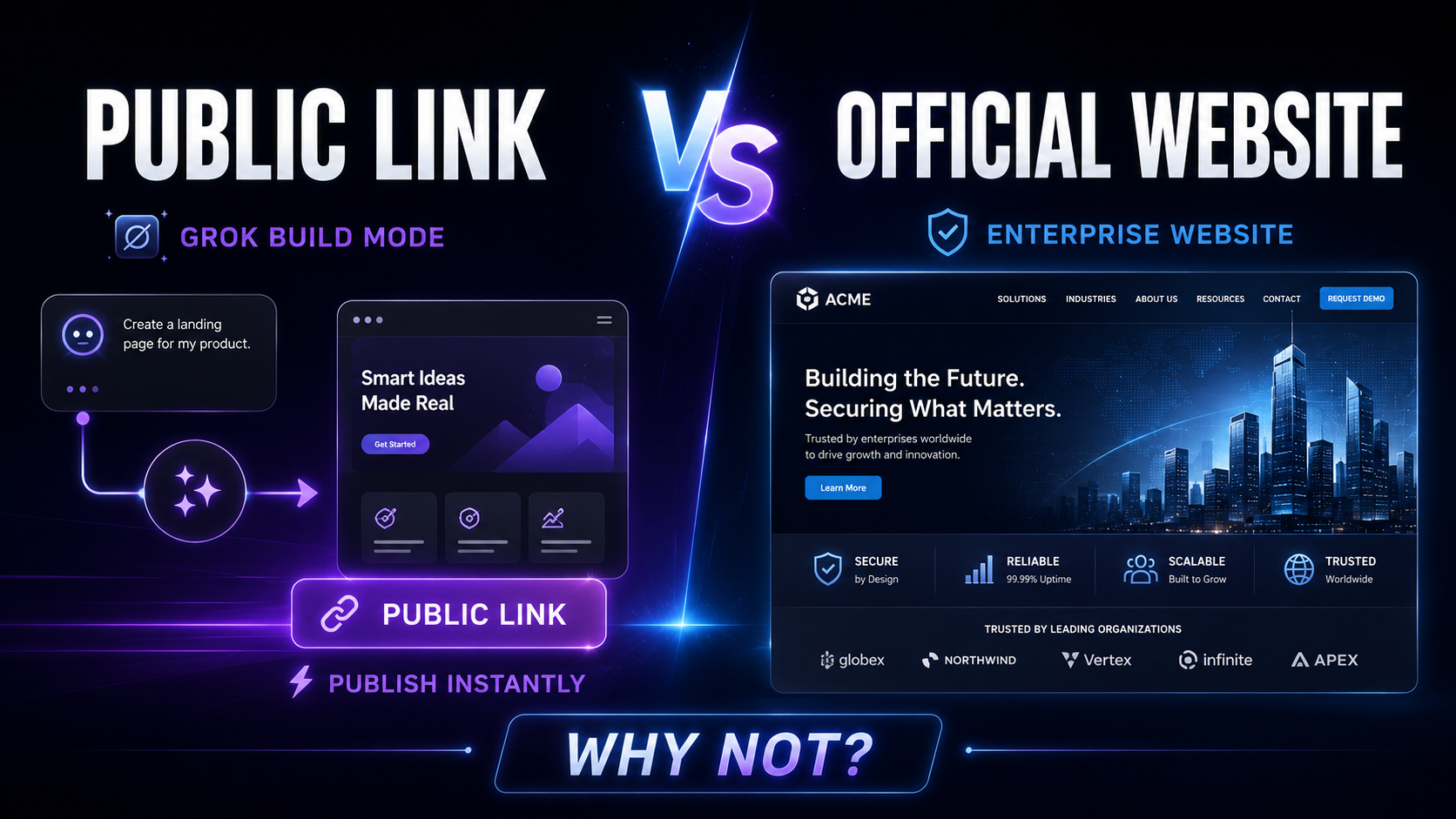
Grok Build Mode Can Publish a Site Instantly — So Why Can’t a Company Treat That Public Link as Its Official Website?
The Bottom Line First
Being accessible doesn’t mean it represents the company.
Being publishable doesn’t mean it can go live as an official website.
Many people tend to conflate these two things.
But an enterprise official website is not just "a page that can be viewed."
It’s more like a long-term asset: a brand entry point, a search entry point, a sales entry point, a trust entry point, and even the foundation for all subsequent content, advertising, SEO, GEO, and customer acquisition efforts.
The greatest value of a capability like Grok Build Mode is this: it compresses the process "from zero to accessible" into a very short time.
That’s powerful.
Really powerful.
But what enterprises need is something else:
to go from accessible to capable of receiving traffic, operating, and growing.
The gap between these is far from small.
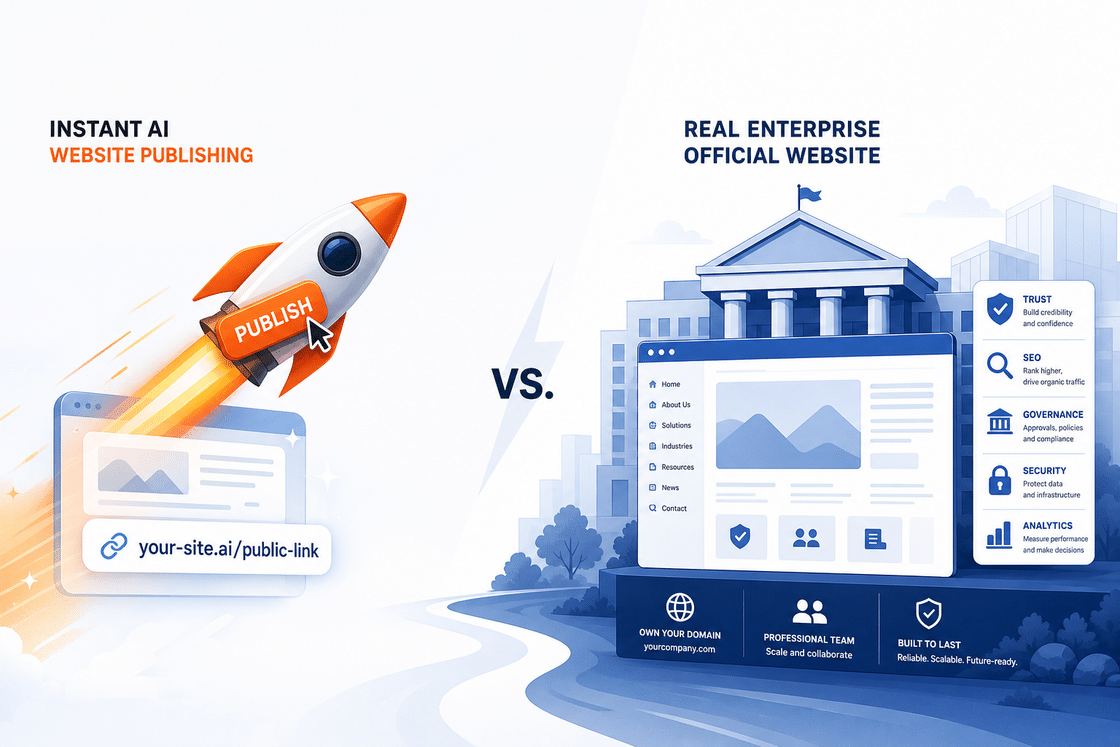
Why a Public Link Looks Like an Official Website but Essentially Isn't
On the surface, a public link already meets several conditions:
- It has a page
- It's accessible
- It can be shared
- It can display content
- It even looks quite complete
So many people naturally conclude:
"Since it can be published directly, isn't that an official website?"
No.
The reason is simple:
"Looks like an official website" doesn't equal "is an official website."
An enterprise official website must at least answer these questions:
- Who does this site belong to?
- Can visitors build trust?
- Can it be maintained over the long term?
- Can search engines understand it reliably?
- Can it support business operations?
- Who is responsible if something goes wrong?
A public link can usually solve "display," but it rarely inherently solves "governance."
And an official website is precisely a product of governance.
Public Link vs. Official Website: Where the Real Differences Lie
| Dimension | Public Link | Official Website |
|---|---|---|
| Identity | A temporary accessible page | The company's formal external entry point |
| Domain | Usually a platform's default address | Custom domain, branded domain |
| Trust | Sufficient but lightweight | More stable, feels like a formal asset |
| SEO | Usable but often more restricted | Better for long-term accumulation |
| Collaboration | Suitable for quick sharing | Suitable for multi-person management and division of labor |
| Maintenance | Tends to be one-time | Tends to be continuous iteration |
| Risk Control | Weaker | More suitable for enterprise-level governance |
| Conversion Reception | Can include forms, but may not be complete | Can systematically handle leads, inquiries, subscriptions |
You'll notice the difference isn't about "whether it can be viewed."
The difference is: whether it is an entry point that a company can rely on over the long term.
The Core Reason Companies Can't Treat a Public Link as an Official Website Isn't "Technology" — It's "Responsibility"
Many people's first thought is a technical issue:
- Can't bind a domain?
- Can't modify the code?
- Can't add features?
These are all correct, but insufficient.
The more fundamental issue is actually: the boundary of responsibility.
Once an enterprise official website becomes a formal entry point, it means:
- Representing the brand externally
- Supporting sales and marketing activities internally
- Taking responsibility for external search results
- Being accountable for user data and privacy
- Ensuring content accuracy
- Maintaining long-term availability
A link that is "generated and then made public" is usually more like a final preview, not a complete operational system.
A preview can be very functional.
But a preview isn't suitable for directly serving as the company's front door.
That's Why "Can Be Published" Doesn't Equal "Can Go Live as an Official Website"
Grok Build Mode's strength lies in speed.
But when it comes to launching an enterprise official website, in addition to speed, several other aspects must be considered:
1) Domain Ownership
An official website should ideally have its own domain.
Because a domain isn't just decoration—it's part of the brand's assets.
If the company switches platforms, suppliers, or teams, can the official website still be used?
That's what companies care about.
2) SEO Structure
A public link can display a page.
But an official website needs to capture search traffic over the long term.
This means:
- The title structure must be stable
- Page hierarchy must be clear
- Content must be continuously updated
- URL rules must be consistent
- Internal links must be strategically placed
- Sitemaps, indexing, and canonicalization must be considered
Having a page doesn't mean having SEO.
SEO is a long-term structure, not a one-time generation.
3) Content Governance
An enterprise official website isn't something you publish once and forget.
It will constantly change:
- Product updates
- Pricing changes
- New case studies
- Team changes
- Compliance copy adjustments
- Business direction upgrades
Without content governance, a corporate website can quickly become outdated.
4) Data and Conversion
A formal corporate website must handle user actions effectively:
- Lead collection
- Appointments
- Downloads
- Subscriptions
- Consultations
- Redirects
- Form submissions
This goes far beyond simply "adding a button."
It requires connecting visits, dwell time, clicks, and conversions into a seamless flow.
5) Brand Trust
Users will use a corporate website as a standard to judge:
- Is this company legitimate?
- Are they serious about their business?
- Are they operating sustainably?
- Can they be contacted?
A public link can convey information.
But a formal corporate website conveys: This company means business.
That's a big difference.
But Don't Get Me Wrong: Public Links Are Not Useless
They are very valuable.
And often, that's the first step.
Public links are particularly suitable for these scenarios:
- Internal reviews
- Rapidly testing ideas
- Showcasing product prototypes
- Trials for campaign pages
- Small-scale sharing
- Early landing page testing
In other words, public links are perfect for "getting something off the ground quickly."
The problem is simply:
You can't treat something built "to get started" as a fully-fledged, mature corporate website.
What's needed to bridge the gap isn't just a custom domain.
It's a complete set of go-to-launch processes.
If a Company Wants to Turn a Site Generator Output into Its Official Website, at Minimum These 6 Things Are Needed
- Custom Domain: Consistent branding, more stable trust.
- Page Structure Organization: Homepage, product pages, about page, case studies page, contact page, FAQ.
- Basic SEO Setup: Titles, descriptions, sitemaps, indexing logic, internal links.
- Content Governance Mechanism: Who updates, how often, what changes, how reviews are done.
- Data Tracking & Conversion Funnel: Visibility into traffic and conversion metrics.
- Continuous Post-Launch Optimization: The work doesn't end at publishing; it's an ongoing evolution.
This is why many companies ultimately need more than just a builder.
They need a system that transforms a showcase site into a growth asset.
The Connection to We0 AI
We0 AI's focus isn't just "creating pages."
It's about building a website as an asset that can continuously showcase, optimize, and generate leads.
Therefore, it's suited for more than just "generating a page"; it's for:
- Brand websites
- Product websites
- Service introduction pages
- Case study pages
- Portfolios
- Content sites
- Inquiry pages
- Waitlist pages
In other words, We0 AI focuses on Build -> Showcase -> Grow -> Leads.
First, build it.
Then, showcase it.
Then, growth happens.
Finally, capture leads.
This is the chain that businesses truly need.
Think of It This Way
| Goal | Public Link | Formal Corporate Website |
|---|---|---|
| Quick Demos | Very Capable | Capable, but not the primary focus |
| Brand Representation | Average | Very Strong |
| Search Engine Retention | Weak | Very Strong |
| Long-Term Operations | Unstable | Stable |
| Business Conversion | Possible, but rough | More Complete |
| Organization Collaboration | Not Systematic Enough | More Suitable for Enterprises |
So the question isn't "Can it be used?"
It is:
Do you need it for a demo, or as the public face of your company?
If it's just a demo, public links are more than sufficient.
If it's for representing your brand and business, the answer changes.
A Very Realistic Judgment
Any site that appears before customers, in search results, on business cards, in ad placements, in media coverage, or on partner introductions should not be merely a public link.
Because that's beyond "just checking how it looks."
That is representing the company.
Frequently Asked Questions
1. Can a public link serve as a temporary official website?
Yes, especially in the early validation phase.
But it's better for "temporary holding" than for taking on the full responsibilities of a formal corporate site.
2. Is a custom domain necessary for a corporate website?
It's highly recommended.
A custom domain feels like a formal asset and is better for branding, SEO, and long-term credibility.
3. Why do businesses often need to redo an AI-generated website even when it looks usable?
Because "functional" doesn't equal "operational."
An official website requires governance, updates, conversions, compliance, and long-term maintenance.
4. What scenarios are capabilities like Grok Build Mode suitable for?
It's perfect for rapid prototyping, campaign pages, validation pages, internal run-through pages, and early landing pages.
5. How is We0 AI different from common website generation tools?
We0 AI places a stronger emphasis on the growth path of showcase websites:
It's not just about building pages; it's about creating website assets that are ready for launch, operational management, and lead generation.
Related Tools
Ready to Start?
If you currently have an accessible page, don't rush to say "The website is ready."
First, ask yourself:
Can it represent the brand? Can it effectively capture traffic? Can it grow continuously?
If the answer isn't solid enough, it's more of a starting point.
Not the destination.
And that's precisely where We0 AI aims to help you bridge the gap.
Summary
Grok Build Mode makes the act of "publishing" simple.
But the true challenge of a corporate website is never the publishing.
It is: Trustworthy, Manageable, Searchable, Convertible, Sustainable.
So, a public link can be fast.
But a formal corporate website requires serious effort.