Grok 4.5: Musk Pitches an Opus-Class Model at a Much Lower Cost
Grok 4.5 is being introduced as a high-capability, lower-cost model aimed at coding, app development, office work, research, and writing. The main message is not only that it can compete with leading models, but that it may do so with better token efficiency and more aggressive pricing. For developers and companies, the most important question is practical performance. Benchmarks are useful, but real decisions should be based on workload-specific testing, total API cost, latency, and reliability. **The key takeaway: Grok 4.5 is trying to compete on the full equation — capability, speed, token efficiency, and price — not just leaderboard performance.**
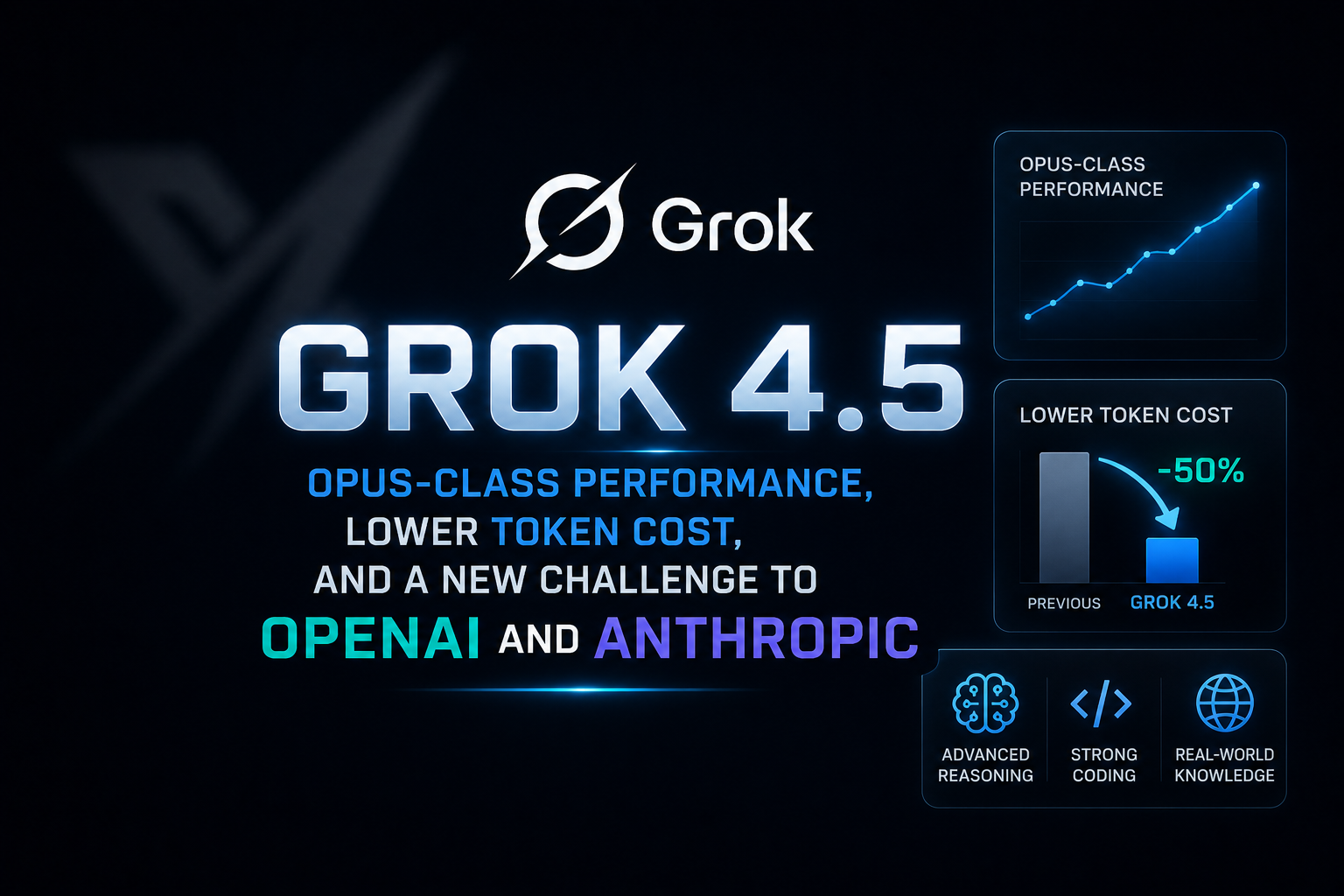
Grok 4.5: Musk Pitches an Opus-Class Model at a Much Lower Cost
Introduction
SpaceXAI has introduced Grok 4.5, a new large model that Elon Musk is positioning directly against the high-end models from OpenAI and Anthropic. The pitch is clear: Grok 4.5 aims to deliver near-Opus-level capability, faster responses, better token efficiency, and a much lower price.
The original AIbase report describes Grok 4.5 as the company’s first major model update after its recent public-market milestone. Musk also promoted the model on X, calling it an “Opus-class” model that runs faster, uses tokens more efficiently, and costs less to operate.
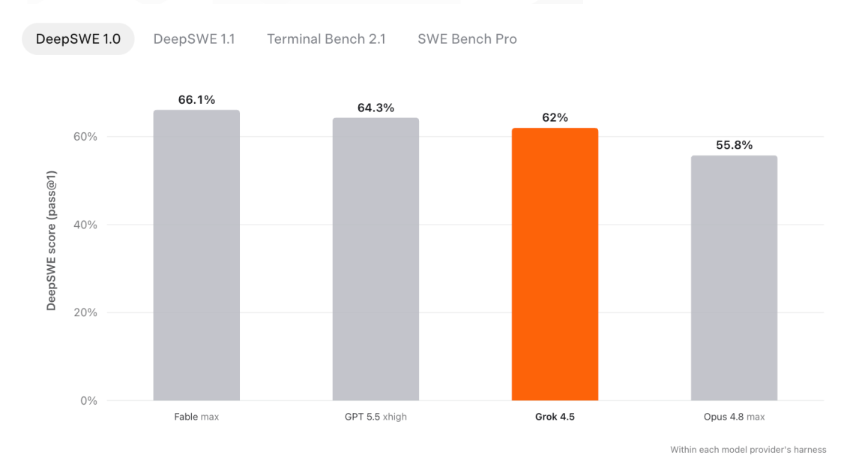
Musk Positions Grok 4.5 Against OpenAI and Anthropic
According to the launch messaging, Grok 4.5 is not being framed as a small upgrade. SpaceXAI is presenting it as a serious competitor to advanced models used for complex reasoning, coding, research, and professional work.
Musk compared Grok 4.5 with Anthropic’s Opus line, especially for workloads that require stronger reasoning and longer task execution. The message is not only about raw benchmark scores. It is also about the combination of performance, speed, and cost.
That matters because many teams now choose models based on practical deployment economics. A model that is slightly behind the very top benchmark leader but meaningfully cheaper can still be more attractive for high-volume use cases.
A General-Purpose Workhorse for Coding, Office Work, Research, and Writing
SpaceXAI describes Grok 4.5 as a general-purpose “main model” for many of the tasks developers and businesses are currently trying to automate.
The model is positioned for scenarios such as:
- Code generation and app development — helping developers write, debug, and iterate on software.
- Office and document work — assisting with written documents, presentations, spreadsheets, and structured business output.
- Research and writing — supporting information gathering, drafting, analysis, and long-form content creation.
- Agentic work — handling multi-step tasks that require planning, execution, and revision.
The original report notes that Grok 4.5 has entered the top competitive range of current models. It may not be described as the absolute ceiling across every benchmark, but it is being positioned as a strong option for real production workloads.
Token Efficiency Doubles, with Aggressive Pricing
One of the most important claims around Grok 4.5 is token efficiency. SpaceXAI says the model can complete similar workloads with fewer generated tokens, which can reduce inference cost in real applications.
For developers and enterprise users, this is not a small detail. Token usage directly affects API bills, latency, and how easily a model can be deployed across large user bases.
The reported Grok 4.5 pricing is:
| Model | Input Price | Output Price | Notes |
|---|---|---|---|
| Grok 4.5 | $2 / 1M input tokens | $6 / 1M output tokens | Positioned as a high-efficiency, lower-cost frontier model |
| Anthropic Opus 4.7 | Around $5 / 1M input tokens | Around $25 / 1M output tokens | Used as a high-end comparison point in the original article |
| OpenAI Sol version | Around $5 / 1M input tokens | Around $30 / 1M output tokens | Described as OpenAI’s most expensive tier in the original report |
| OpenAI Luna version | Around $1 / 1M input tokens | Around $6 / 1M output tokens | Described as a lower-cost OpenAI option |
The core point is simple: Grok 4.5 is trying to compete not only by claiming strong capability, but by changing the cost conversation. If the token-efficiency claims hold up in practical workloads, the pricing could make Grok 4.5 appealing for coding tools, internal agents, research assistants, and other products that make heavy API calls.
A Crowded Week of AI Model Launches
The Grok 4.5 announcement lands during a busy week for the AI model market. The original article places the launch alongside OpenAI’s planned GPT-5.6 rollout and continued competition from Anthropic’s Opus models.
Musk said that early trial customers had given strong positive feedback, and that Grok 4.5 would become broadly available soon after the announcement. He also emphasized that the model’s value comes from the mix of capability, speed, and cost rather than any one metric alone.
This is why Grok 4.5 is being watched closely. The market is no longer only asking which model has the highest score on a leaderboard. Teams also care about whether a model is fast enough, cheap enough, reliable enough, and available enough to build real products around.
Why Grok 4.5 Matters for Developers and Teams
For developers, Grok 4.5 could be especially relevant if it performs well in coding and app-building workflows. Lower output-token cost can matter a lot in debugging, refactoring, test generation, code review, and agentic development, where a model may produce long responses across many steps.
For business teams, the office-work positioning is also important. If a model can handle documents, reports, spreadsheets, and research workflows at a lower cost, it becomes easier to justify broader internal deployment.
Still, benchmark claims should be tested against real tasks. Teams comparing Grok 4.5 with OpenAI, Anthropic, or other models should evaluate their own workload: code quality, reasoning reliability, latency, tool calling, context handling, safety behavior, and total cost.
Source Note
- Original source: AIbase — Grok 4.5 report
- The AIbase logo image from the original page was not included because it is a site identity image, not a content-relevant figure.
- The benchmark chart image was retained because it directly supports the model comparison discussed in the article.
- Public details were cross-checked against the official SpaceXAI / xAI Grok 4.5 announcement and documentation where available.
FAQ
What is Grok 4.5?
Grok 4.5 is SpaceXAI’s newer frontier model positioned for coding, agentic tasks, knowledge work, research, and office productivity. It is being marketed as a strong general-purpose model with competitive pricing and improved token efficiency.
Why is Grok 4.5 being compared with Anthropic Opus?
Musk described Grok 4.5 as “Opus-class,” meaning it is being positioned near Anthropic’s high-end Opus models for complex tasks. The comparison is mainly about advanced reasoning, coding ability, speed, and cost efficiency.
How much does Grok 4.5 cost?
The reported API pricing is $2 per million input tokens and $6 per million output tokens. The official SpaceXAI launch page also highlights token efficiency as part of the model’s cost advantage.
Why does token efficiency matter?
Token efficiency affects both cost and speed. If a model can solve the same task with fewer tokens, teams may spend less on API usage and get faster responses in real applications.
Is Grok 4.5 only for coding?
No. The model is strongly positioned for coding and app development, but the launch messaging also highlights office work, research, writing, and broader knowledge tasks.
Should teams replace OpenAI or Anthropic models with Grok 4.5 immediately?
Not automatically. Grok 4.5 may be attractive on price and speed, but teams should test it on their own tasks before switching production workloads. Real-world evaluation should include quality, latency, reliability, safety, tool support, and total cost.
Where can developers try Grok 4.5?
Developers can start from the official SpaceXAI / xAI console and documentation. Availability may vary by region and product, so the official docs should be checked before planning deployment.
Related Tools
- Grok: SpaceXAI’s AI assistant for chat, coding, real-time search, and creative tasks.
- SpaceXAI / xAI: The official site for Grok models, products, developer access, and company updates.
- SpaceXAI API Console: The developer console for creating keys and accessing Grok API tools.
- SpaceXAI Documentation: Official API documentation for model integration, pricing, tools, and developer workflows.
- Cursor: An AI coding agent and editor often used for software development workflows.
- Anthropic Claude: Anthropic’s Claude model family, including high-end Opus models.
- OpenAI: OpenAI’s official site for ChatGPT, API access, research, and model announcements.
Related Links
- Original AIbase Article: The Chinese source article covering the Grok 4.5 announcement and pricing comparison.
- Introducing Grok 4.5: Official SpaceXAI announcement for Grok 4.5.
- SpaceXAI Pricing: Official pricing page for Grok plans and related access options.
- SpaceXAI API Docs: Official developer documentation for building with Grok models.
- SpaceXAI Models Documentation: Official model documentation for current Grok model availability.
- Cursor and SpaceX Model Training: Cursor’s official post about working with SpaceXAI on model training.
- Anthropic Claude Opus 4.7 Announcement: Official Anthropic post with Opus 4.7 availability and pricing details.
- Cursor Official Site: Official site for the Cursor AI coding agent.
Summary
Grok 4.5 is being introduced as a high-capability, lower-cost model aimed at coding, app development, office work, research, and writing. The main message is not only that it can compete with leading models, but that it may do so with better token efficiency and more aggressive pricing.
For developers and companies, the most important question is practical performance. Benchmarks are useful, but real decisions should be based on workload-specific testing, total API cost, latency, and reliability.
The key takeaway: Grok 4.5 is trying to compete on the full equation — capability, speed, token efficiency, and price — not just leaderboard performance.