GPT-5.6 Sol, Terra, and Luna: OpenAI’s New Model Series Explained
GPT-5.6 introduces a three-model structure: Sol for the most difficult work, Terra for balanced everyday use, and Luna for cost-sensitive high-volume workloads. This makes the release easier to adapt to real-world product and enterprise workflows. The main themes are cybersecurity, coding, agentic work, and cost efficiency. OpenAI is not only presenting a more powerful model family, but also a more practical pricing and routing strategy for developers and businesses. ChatGPT Work expands the same model family into office and productivity tasks, making GPT-5.6 relevant beyond developers and API users. **The core message is simple: GPT-5.6 is not just about stronger models. It is about matching the right model to the right workload at the right cost.**
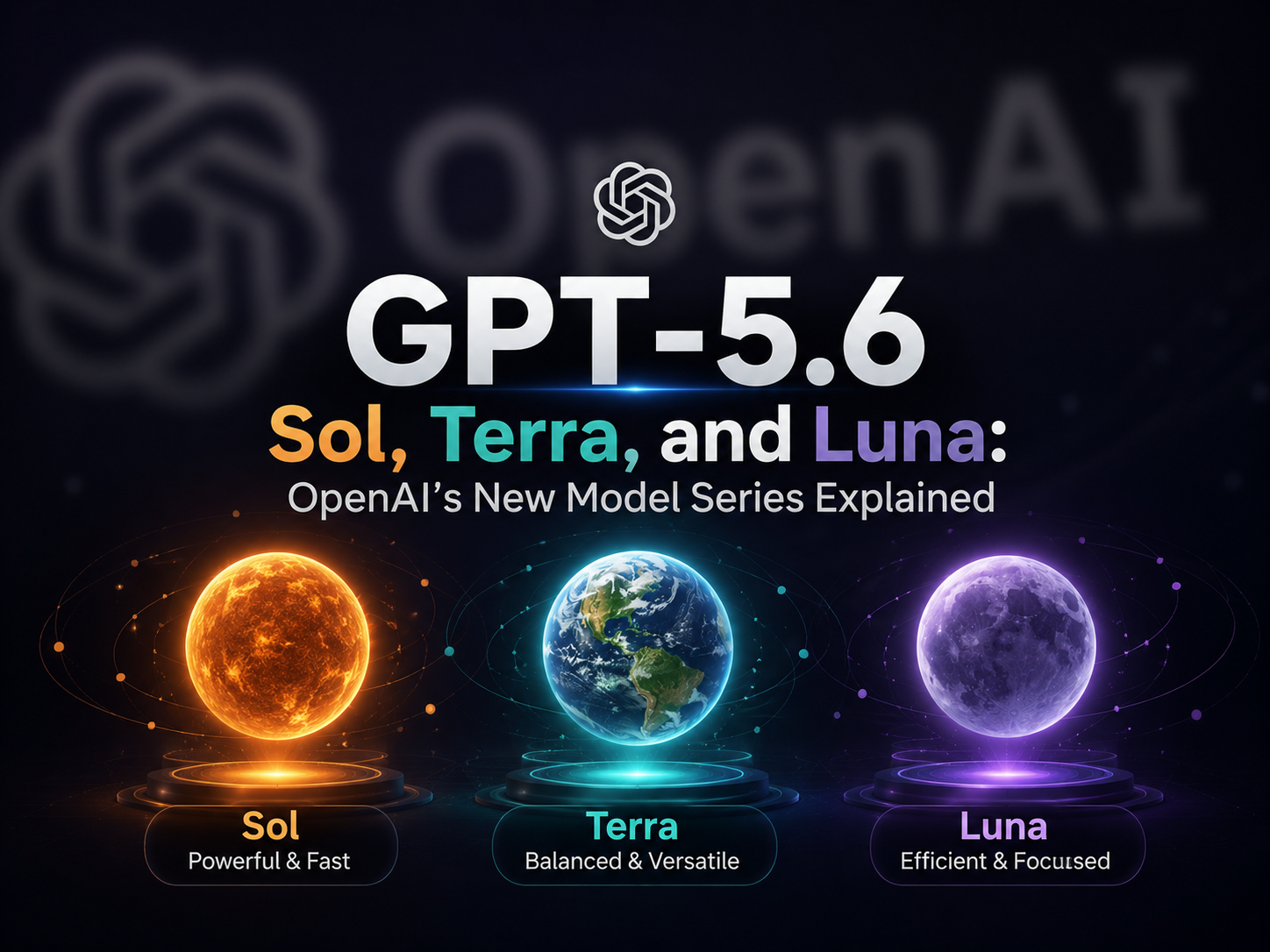
GPT-5.6 Sol, Terra, and Luna: OpenAI’s New Model Series Explained
Introduction
OpenAI has released the GPT-5.6 model family, with three versions designed for different levels of performance and cost: Sol, Terra, and Luna. According to the original AIBase report, the series is now available across ChatGPT, Codex, and the OpenAI API.
The launch is mainly positioned around two themes: stronger capability for complex work, especially cybersecurity and coding, and better cost efficiency across different workloads. Instead of releasing one model for every use case, OpenAI is splitting the family into a flagship model, a balanced model, and a lower-cost model.
GPT-5.6 Comes in Three Versions: Sol, Terra, and Luna
The GPT-5.6 family is structured around three model tiers:
| Model | Positioning | Best Fit |
|---|---|---|
| GPT-5.6 Sol | Flagship model | Complex reasoning, coding, cybersecurity, and advanced agentic tasks |
| GPT-5.6 Terra | Balanced model | Everyday professional work with a better balance of performance and cost |
| GPT-5.6 Luna | Cost-efficient model | High-volume workloads where price and speed matter most |
The original article describes Sol as the main flagship model, Terra as the mid-tier option, and Luna as the economical version. This structure makes the release easier to understand: users do not need to use the largest model for every task.
OpenAI’s official model documentation also presents Sol as the flagship option for complex reasoning and coding, Terra as the model that balances intelligence and cost, and Luna as the option for cost-sensitive, high-volume workloads.
A Strong Focus on Cybersecurity
One of the biggest themes in the release is cybersecurity. The original article says GPT-5.6 is positioned as OpenAI’s strongest cybersecurity model so far.
The important point is that the model is framed around defensive security work, not unrestricted offensive activity. Useful security-related tasks include:
- Threat modeling
- Code review
- Vulnerability analysis
- Patch development
- Debugging
- Defensive testing
- Blue-team exercises
- Security education
OpenAI’s official materials also emphasize this balance. The company says the GPT-5.6 models were developed with stronger safeguards, while still supporting legitimate security work such as vulnerability research, code review, patch development, and defensive testing.
This is an important distinction. More capable cybersecurity models can help defenders move faster, but they also require stricter safeguards, monitoring, and policy boundaries.
Coding and Agent Performance Claims
The original AIBase article highlights GPT-5.6 Sol’s performance in coding and agentic benchmarks. It says Sol scored 80 on the ACI coding-agent benchmark, setting a new record and outperforming Anthropic’s Fable 5 by 2.8 points.
It also says Sol can produce the same results with less than half the output tokens and time used by Fable, while costing about two-thirds as much.
For SEO and publishing accuracy, it is better to phrase these numbers carefully:
According to the original AIBase report, Sol achieved an 80 score on the ACI coding-agent benchmark and showed strong efficiency compared with Fable 5.
Official OpenAI materials describe the same broader direction: GPT-5.6 is designed to improve performance-per-dollar, reduce unnecessary model round trips, and support stronger tool-heavy workflows. OpenAI also describes new higher-effort reasoning modes such as max and multi-agent ultra mode for more demanding tasks.
Why Token Efficiency Matters
A model’s benchmark score is only one part of the story. For real developers and businesses, cost per finished task often matters more.
If a model uses fewer tokens, needs fewer retries, and finishes tasks faster, it becomes more practical for everyday workflows. This is especially true for:
- AI coding agents
- Long document analysis
- Data-heavy workflows
- Multi-step research
- Security audits
- Enterprise automation
- Tool-heavy agent tasks
The original article says Sol improves token efficiency in AI coding tasks by 54%. This is one of the main reasons OpenAI is presenting GPT-5.6 as a model family built around both capability and commercial efficiency.
Terra and Luna: Lower-Cost Options for Everyday Workloads
The original report also points out that the mid-tier and economical models are not just “small backups.” It says Terra performs slightly above Fable 5, while Luna also beats Opus 4.8 in the cited comparison.
The broader takeaway is that OpenAI is trying to make the full GPT-5.6 series useful across different budgets:
- Use Sol when the task is complex, high-value, or requires the strongest reasoning.
- Use Terra when you need strong performance but want better cost control.
- Use Luna when volume, speed, and price matter more than maximum capability.
This kind of model routing is becoming more important. Teams no longer need to send every task to the most expensive model. They can design workflows that choose a model based on task risk, complexity, and budget.
GPT-5.6 Pricing
The original article lists clear commercial pricing for the three GPT-5.6 models. OpenAI’s official model documentation gives the same per-million-token pricing:
| Model | Input Price | Output Price |
|---|---|---|
| GPT-5.6 Sol | $5 / 1M tokens | $30 / 1M tokens |
| GPT-5.6 Terra | $2.50 / 1M tokens | $15 / 1M tokens |
| GPT-5.6 Luna | $1 / 1M tokens | $6 / 1M tokens |
For teams that run many agent workflows, these differences can add up quickly. A high-volume product might use Luna for routine tasks, Terra for more important workflows, and Sol only for the most difficult planning, coding, or security decisions.
Availability Across ChatGPT, Codex, and the OpenAI API
The original AIBase article says GPT-5.6 is available in ChatGPT, Codex, and the OpenAI API.
For developers, the API side is especially important. OpenAI’s official model documentation lists the GPT-5.6 model IDs as:
gpt-5.6-sol
gpt-5.6-terra
gpt-5.6-luna
The documentation also notes that the gpt-5.6 alias routes to gpt-5.6-sol.
OpenAI’s current model guidance recommends:
- Use
gpt-5.6-solfor frontier capability. - Use
gpt-5.6-terrafor a balance of intelligence and cost. - Use
gpt-5.6-lunafor efficient, high-volume workloads. - Use the Responses API for reasoning, tool-calling, and multi-turn workflows.
- Set reasoning effort intentionally based on the task.
ChatGPT Work: OpenAI’s Enterprise Office Assistant
Alongside the model release, the original article says OpenAI also introduced ChatGPT Work, an office assistant designed for enterprise teams.
The tool is described as supporting desktop, web, and mobile use. Its purpose is to help with everyday document and office work, including:
- Drafting documents
- Creating spreadsheets
- Generating presentations
- Working with templates and reference files
- Handling multi-step work tasks
OpenAI’s official ChatGPT Work page describes it as powered by GPT-5.6 and designed to help users handle more ambitious work through multi-step reasoning and file-aware content creation.
This makes GPT-5.6 more than a model update. It also connects the model family to a broader productivity workflow.
What This Launch Says About the AI Model Race
The original article ends by framing GPT-5.6 as part of a larger industry shift. OpenAI, SpaceXAI, Meta, Anthropic, and other major AI companies are no longer competing only on raw model size.
The competition is now moving toward:
- Task performance
- Cost efficiency
- Token efficiency
- Coding ability
- Cybersecurity capability
- Enterprise workflows
- Agentic tool use
- Real business deployment
This shift matters because model adoption depends on practical results. A model needs to be strong, but it also needs to be affordable enough to run repeatedly in real products and work environments.
Practical Takeaways for Developers and Teams
For developers and teams evaluating GPT-5.6, the release suggests a few practical rules:
- Do not use the flagship model for everything. Use Sol where the task truly needs strong reasoning.
- Route routine work to Terra or Luna. This can reduce cost without removing GPT-5.6 from the workflow.
- Measure cost per completed task. Token price alone is not enough; retries and output length matter too.
- Use stronger safeguards for cybersecurity tasks. Defensive use is valuable, but sensitive workflows need review and monitoring.
- Test real workloads, not only demos. Coding agents, document workflows, and security reviews should be evaluated on your own tasks.
FAQ
What is GPT-5.6?
GPT-5.6 is OpenAI’s model family released with three versions: Sol, Terra, and Luna. Sol is the flagship model, Terra balances performance and cost, and Luna is designed for cost-sensitive, high-volume use.
What is GPT-5.6 Sol used for?
GPT-5.6 Sol is best suited for complex reasoning, coding, cybersecurity, and advanced agentic workflows. It is the strongest model in the GPT-5.6 family.
What is the difference between Sol, Terra, and Luna?
Sol is the high-performance flagship model. Terra is a balanced model for everyday professional work, while Luna is the most cost-efficient model for high-volume tasks.
How much does GPT-5.6 cost?
OpenAI lists GPT-5.6 Sol at $5 per million input tokens and $30 per million output tokens. Terra is listed at $2.50 input and $15 output, while Luna is listed at $1 input and $6 output per million tokens.
Is GPT-5.6 available through the OpenAI API?
Yes. OpenAI’s model documentation lists GPT-5.6 Sol, Terra, and Luna as available through the API. The model IDs are gpt-5.6-sol, gpt-5.6-terra, and gpt-5.6-luna.
Why is GPT-5.6 important for cybersecurity?
OpenAI describes GPT-5.6 as stronger for legitimate defensive security work, including code review, vulnerability research, patching, and defensive testing. Because these capabilities are sensitive, OpenAI also emphasizes stronger safeguards and phased deployment.
What is ChatGPT Work?
ChatGPT Work is OpenAI’s work-focused assistant powered by GPT-5.6. It is designed to help with multi-step professional tasks such as drafting documents, working with reference files, creating spreadsheets, and generating presentations.
Should teams use GPT-5.6 Sol for every task?
Not necessarily. For many production workflows, it is better to route tasks by complexity and cost. Sol is useful for the hardest tasks, while Terra and Luna may be better for routine or high-volume work.
Related Tools
- ChatGPT: OpenAI’s user-facing AI assistant for everyday and professional tasks.
- OpenAI API: The developer platform for building applications with OpenAI models.
- OpenAI Models Documentation: Official model list, pricing, model IDs, and capability guidance.
- OpenAI Model Guidance: Official guidance for choosing GPT-5.6 Sol, Terra, or Luna by workload.
- Codex: OpenAI’s coding-agent environment for software engineering workflows.
- ChatGPT Work: OpenAI’s work-focused product powered by GPT-5.6.
Related Links
- GPT-5.6: Frontier Intelligence That Scales With Your Ambition: OpenAI’s official GPT-5.6 launch page.
- Previewing GPT-5.6 Sol: OpenAI’s preview article explaining Sol, Terra, Luna, capabilities, safeguards, and pricing.
- OpenAI Models Documentation: Official API documentation for GPT-5.6 model IDs, tools, context window, and pricing.
- OpenAI Model Guidance: Official guidance on model selection, reasoning effort, and Responses API usage.
- GPT-5.6 System Card: OpenAI’s deployment safety material for GPT-5.6.
- ChatGPT Work Official Page: Official OpenAI page introducing ChatGPT Work.
- GPT-5.6 in Microsoft 365 Copilot: OpenAI’s announcement about GPT-5.6 becoming the preferred model in Microsoft 365 Copilot.
Summary
GPT-5.6 introduces a three-model structure: Sol for the most difficult work, Terra for balanced everyday use, and Luna for cost-sensitive high-volume workloads. This makes the release easier to adapt to real-world product and enterprise workflows.
The main themes are cybersecurity, coding, agentic work, and cost efficiency. OpenAI is not only presenting a more powerful model family, but also a more practical pricing and routing strategy for developers and businesses.
ChatGPT Work expands the same model family into office and productivity tasks, making GPT-5.6 relevant beyond developers and API users.
The core message is simple: GPT-5.6 is not just about stronger models. It is about matching the right model to the right workload at the right cost.