GPT-5.6 Sol First Beta Results: Same Task Costs About Half as Much as Fable 5
The first GPT-5.6 Sol beta impressions suggest that OpenAI’s new flagship model is strong in long coding tasks, spatial reasoning, frontend generation, and performance-focused optimization. It also appears to produce cleaner, shorter code in some tests. The comparison with Claude Fable 5 is not one-sided. Fable 5 may still have an edge in some end-to-end coding and finished product quality scenarios, but Sol is much cheaper by listed token pricing and appears highly competitive in early results. Safety behavior remains an important factor. Both OpenAI and Anthropic are adding stronger safeguards around high-capability coding and cybersecurity models, which means developers should evaluate not only output quality, but also access rules, blocked requests, retry behavior, and real task cost. **Bottom line: GPT-5.6 Sol is not simply a cheaper model. It is a serious frontier coding model whose real value will depend on how well it performs in full, repeated developer workflows.**
GPT-5.6 Sol First Beta Results: Same Task Costs About Half as Much as Fable 5
Introduction
GPT-5.6 Sol has been in preview for a short time, and the first round of user testing is starting to appear. The early signal is clear: Sol looks strong in long coding tasks, complex reasoning, and visual generation, while also being much cheaper than Claude Fable 5 on a per-token basis.
This article is based on the original BAAI / QbitAI post and keeps the same overall structure: early impressions, coding feedback, comparison with Fable 5, pricing, and safety restrictions. The wording has been rewritten into natural English for blog publishing, while the key numbers, claims, and source logic are preserved.
Source note: The original article was published by BAAI Hub and reposted from QbitAI. It includes several screenshots from X posts and comparison images. Screenshots directly tied to the article content are retained below. Meme-like reaction images, QR codes, community recruitment images, and unrelated decorative graphics have been omitted.
Original source: BAAI Hub article
Early GPT-5.6 Sol Preview Results
The GPT-5.6 Sol preview has been out for only a short period, but early testers are already sharing results. One of the most direct comments came from an NVIDIA engineer, who described Sol’s progress in CUDA acceleration in very plain terms: Sol looked powerful.
In one reported run, Sol reached a CUDA speedup result in around 30 hours that Opus took 64 hours to reach. The tester also noted that Sol did not appear to rely on low precision first. Instead, it leaned on clustering and DSMEM-style optimization, with room to turn later toward low precision and tensor cores.
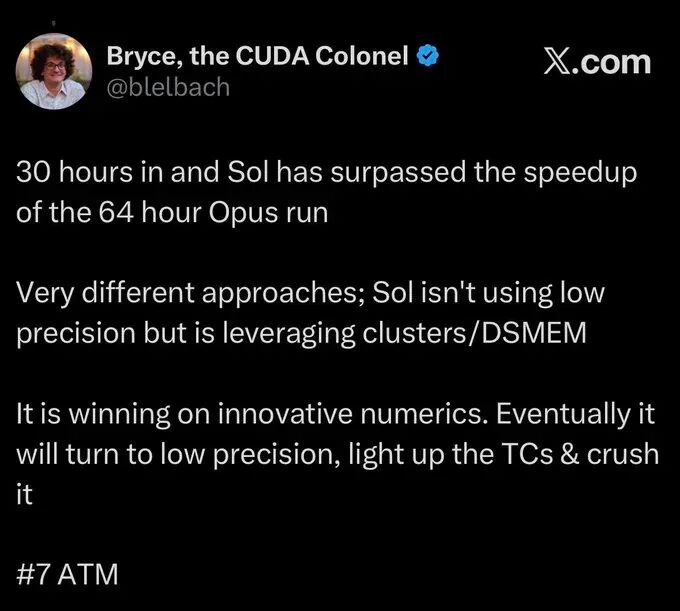
The point is not only that Sol produced a fast result. What matters more is the approach. The early comments suggest that Sol is willing to work through deeper optimization paths instead of simply producing a surface-level working answer.
There were also visual generation comparisons. In the original discussion, users compared GPT-5.6 and GPT-5.5 on similar “spaceship” prompts. GPT-5.6 produced a corridor with stronger lighting, clearer contrast, and a more cinematic sense of depth. GPT-5.5 looked flatter and more muted by comparison.
The same pattern appeared in the space scene. GPT-5.6 delivered a cleaner and more coherent result, while GPT-5.5 looked rougher. For visual consistency and spatial composition, Sol clearly came out ahead in those early examples.
Another reason GPT-5.6 Sol became a hot topic again is timing. Claude Fable 5 had just returned to public attention, and OpenAI’s own model lineup finally appeared to be moving again. The original article cited social posts suggesting that the model might become more widely available soon, although OpenAI’s Help Center still says the preview is limited and that no general-availability date has been announced.
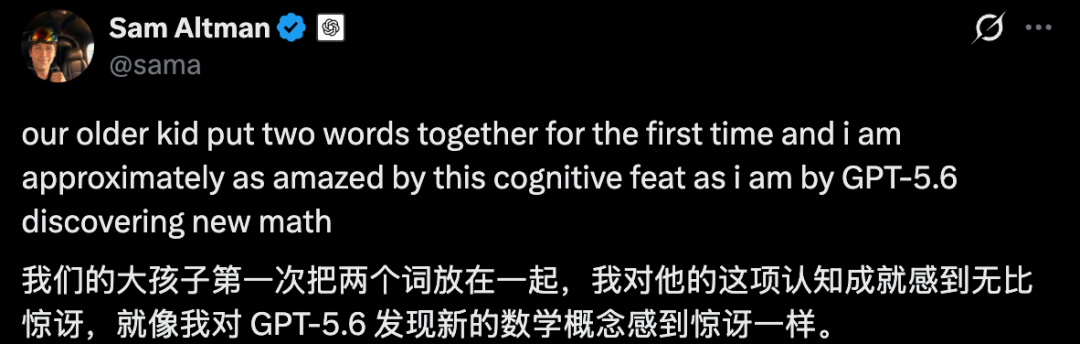
Sam Altman also joined the conversation with a lighthearted comparison, saying that his older child putting two words together for the first time felt about as amazing as GPT-5.6 discovering new math.
First Beta Feedback Is In
After looking through posts from early testers, several themes are beginning to repeat.
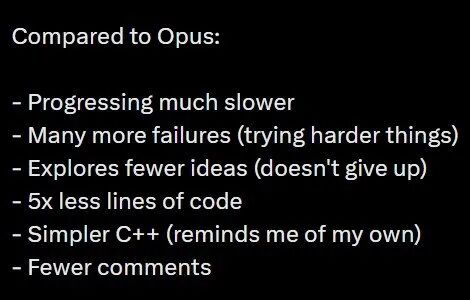
The first one is code style. Compared with some other frontier models, Sol tends to write less code. It appears more restrained. If a problem can be solved in three lines, it does not stretch the answer into five.
One tester said that Sol used about one-fifth as many lines of code as Opus on a comparable task. The difference was especially visible in C++, where Sol’s output looked closer to something a human engineer might write by hand. There were fewer comments, fewer extra layers, and less unnecessary scaffolding.
For long-term maintenance, that matters. Smaller, cleaner code is easier to review and easier to keep alive in real projects.
That said, the early reports were not all praise. Sol also appears to move more slowly during iteration. It may fail more often because it tries harder problems. Compared with Opus, it seems to explore fewer directions. Once it picks a path, it tends to stay with that path and dig deeper.
In simple terms, Sol seems less interested in broad trial-and-error and more interested in long-horizon optimization. It does not always chase the most polished surface result first. Instead, it spends more effort on the underlying performance and reasoning path.
This matches OpenAI’s own positioning for GPT-5.6 Sol. OpenAI describes it as a model for difficult reasoning, complex code, and long-chain workflows that require planning, iteration, tool use, and step coordination. The official launch post also says Sol introduces a higher max reasoning effort and an ultra mode that can use subagents for complex work.
Prompt Comparisons Against GPT-5.5 Pro
When the same prompts were given to GPT-5.6 Sol and GPT-5.5 Pro, the differences were easy to see in several categories.
For interactive SVG, 3D models, and generated games, Sol appeared stronger in instruction following and spatial reasoning. Its outputs were also more consistent. That consistency matters when a task depends on layout, object relations, camera angle, or visual logic.
Frontend design was another area where Sol performed well. Compared with GPT-5.5, Sol produced cleaner page structures, better spacing, clearer hierarchy, and a more refined visual style. In other words, it did not just complete the task. It made the result feel more usable.
Did GPT-5.6 Sol Successfully Challenge Fable 5?
The question many people care about is simple: how does GPT-5.6 Sol compare with Claude Fable 5?
The answer from the early discussion is mixed. Sol is very strong, but Fable 5 may still have an edge in overall model feel and code quality in some scenarios.
In some benchmark comparisons, Sol matched or even exceeded Fable 5. But user experience is not only about benchmark scores. For complex coding and finished product quality, some testers still felt Fable 5 was slightly ahead.
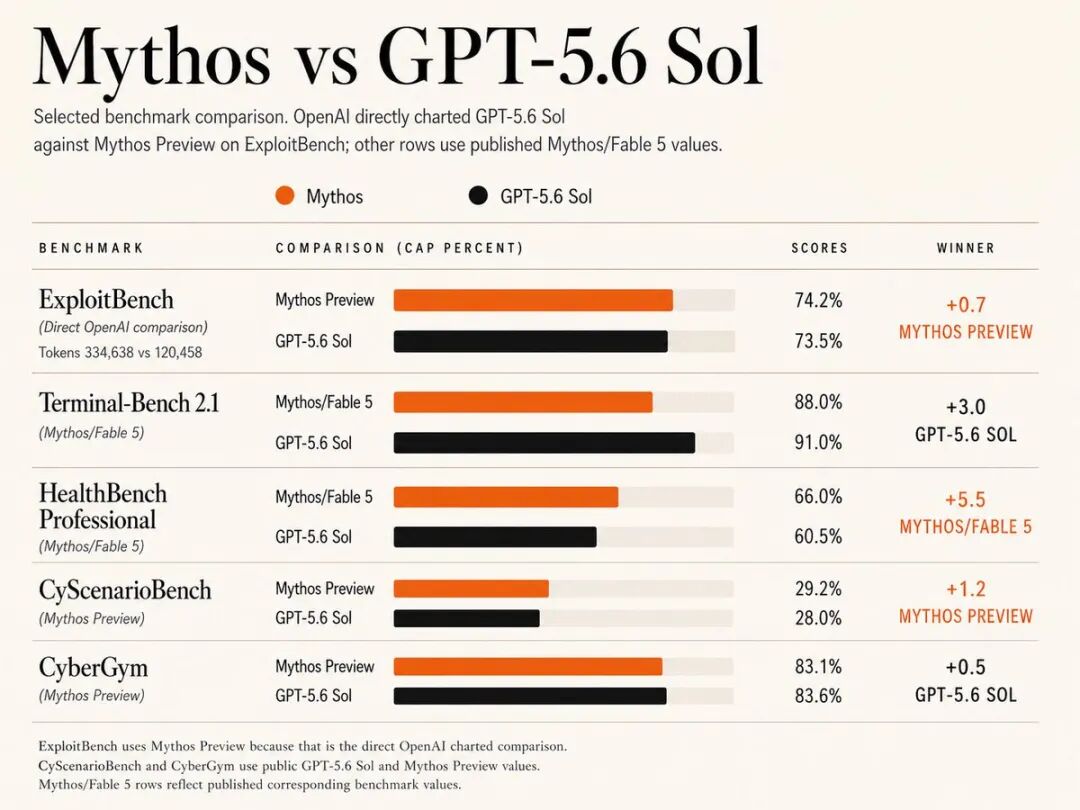
One example cited in the original article was a 3D FPS game test by a user named Gipp. GPT-5.6 was still working through the game world, lighting, and gameplay details, while Fable 5 could turn a single prompt into a more complete playable game.
That is an important difference. In creative coding and one-shot prototyping, the final user experience can matter more than the model’s raw benchmark number.
Cost Difference: Sol Is Much Cheaper Than Fable 5
The cost side is where GPT-5.6 Sol looks especially competitive.
According to OpenAI’s Help Center, GPT-5.6 Sol is priced at $5 per 1 million input tokens and $30 per 1 million output tokens during the preview. Anthropic’s Claude Fable 5 model page lists Fable 5 at $10 per 1 million input tokens and $50 per 1 million output tokens.
| Model | Input Price / 1M Tokens | Output Price / 1M Tokens | Notes |
|---|---|---|---|
| GPT-5.6 Sol | $5.00 | $30.00 | OpenAI’s flagship GPT-5.6 model |
| GPT-5.6 Terra | $2.50 | $15.00 | Lower-cost GPT-5.6 option |
| GPT-5.6 Luna | $1.00 | $6.00 | Fastest and most cost-efficient GPT-5.6 option |
| Claude Fable 5 | $10.00 | $50.00 | Anthropic’s high-end Fable model |
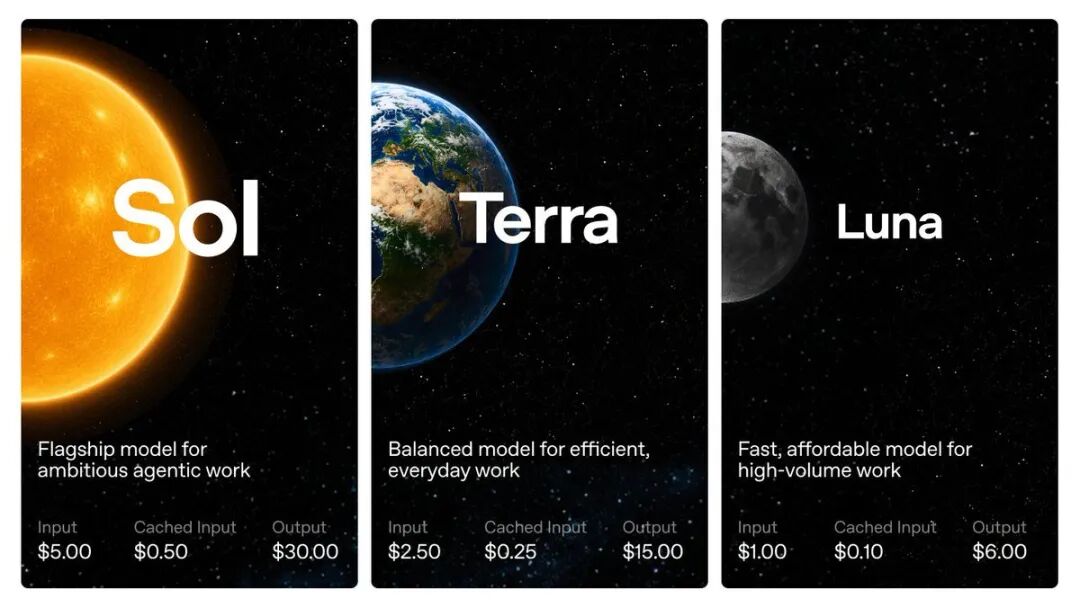
Based on those numbers, Sol is roughly half the input-token price of Fable 5 and also significantly cheaper on output tokens. For teams running long agentic coding tasks, that difference can matter a lot.
Of course, model choice should not be based only on token pricing. If one model finishes a task in fewer attempts, fewer tool calls, or fewer total tokens, its real task cost can be lower even if its headline token price is higher. But if capability is close, Sol’s lower price gives it a strong advantage.
Safety Restrictions Are Still a Key Issue
The other major factor is safety behavior.
After Fable 5 returned, users noticed that its safeguards were strict. In routine coding or debugging tasks, some prompts could be classified as high risk and routed away from Fable 5 to Opus 4.8. Even harmless-looking prompts were sometimes caught by the filter, according to the original article’s summary of user reactions.
Anthropic has explained that Fable 5 uses stronger cybersecurity safeguards and safety classifiers. The company also says these classifiers can sometimes block benign requests because they are designed with a wide safety margin.
OpenAI’s GPT-5.6 Sol also comes with stronger safeguards. OpenAI says the GPT-5.6 family uses layered protections, including model-level refusal behavior, real-time checks, account-level signals, differentiated access, monitoring, and continued testing. The official system card also treats the GPT-5.6 family as high capability in cybersecurity and biological / chemical risk, while saying the models do not reach the highest “Critical” threshold.
The practical takeaway is straightforward: both model families are becoming more powerful, especially in code and cybersecurity-related work. As a result, users should expect more safety checks, more blocked edge cases, and more careful rollout policies.
What This Means for Developers
For developers, GPT-5.6 Sol looks promising in three areas.
First, it seems strong at long, difficult coding tasks. Early testers described cleaner code, fewer lines, and a more human-like C++ style. Second, it appears better than GPT-5.5 at spatial reasoning, frontend design, and interactive output. Third, its token pricing is meaningfully lower than Fable 5, which makes it attractive for high-volume or long-running agentic tasks.
But it is still early. The model is in preview, access is limited, and public impressions are based on a relatively small number of tests. Fable 5 may still produce stronger end-to-end results in some creative coding and complex prototyping tasks.
The real comparison will become clearer when both models are broadly available and tested on the same workflows, under the same budget, with the same prompts and evaluation criteria.
FAQ
What is GPT-5.6 Sol?
GPT-5.6 Sol is OpenAI’s flagship model in the GPT-5.6 family. OpenAI describes it as its strongest model yet, aimed at difficult reasoning, software engineering, scientific work, cybersecurity, and long-chain agentic workflows.
Is GPT-5.6 Sol publicly available?
During the preview period, OpenAI says GPT-5.6 Sol, Terra, and Luna are available only to a limited group of trusted partners and organizations through the API and Codex. OpenAI’s Help Center says GPT-5.6 is not available in ChatGPT during the preview and that no general-availability date has been announced.
How much does GPT-5.6 Sol cost?
OpenAI lists GPT-5.6 Sol at $5 per 1 million input tokens and $30 per 1 million output tokens during the preview. The same Help Center page lists Terra at $2.50 / $15 and Luna at $1 / $6 per 1 million input / output tokens.
How does GPT-5.6 Sol compare with Claude Fable 5?
Early user feedback suggests Sol is strong in coding, frontend layout, spatial reasoning, and long-horizon optimization. Fable 5 may still feel stronger in some end-to-end coding and creative prototyping tasks, but Sol has a clear pricing advantage.
Why is Sol considered cheaper than Fable 5?
Sol’s listed price is $5 per million input tokens and $30 per million output tokens, while Claude Fable 5 is listed at $10 per million input tokens and $50 per million output tokens. This makes Sol roughly half the input cost and cheaper on output as well.
Why do advanced coding models have stricter safety checks?
Models that can reason deeply about code and cybersecurity can also be misused for offensive tasks. That is why OpenAI and Anthropic both describe layered safeguards, safety classifiers, phased access, and monitoring around their most capable models.
Should developers switch to GPT-5.6 Sol immediately?
Not necessarily. Sol looks promising, especially for cost-sensitive coding and agentic tasks, but access is still limited and public testing is early. Developers should compare models on their own workloads, including quality, total token use, retries, latency, and blocked-request behavior.
Related Tools
- OpenAI API: Official developer documentation for building with OpenAI models and APIs.
- OpenAI Codex: OpenAI’s coding agent for software development workflows.
- Codex Developer Docs: Official Codex documentation for setup, workflows, tools, and model usage.
- Claude: Anthropic’s AI assistant platform for chat, work, and coding use cases.
- Claude Code: Anthropic’s agentic coding tool for editing code, running commands, and working across development tools.
- Claude Platform Pricing: Official Claude API pricing documentation.
Related Links
- Original BAAI Hub Article: The source article this English rewrite is based on.
- Previewing GPT-5.6 Sol: OpenAI’s official GPT-5.6 Sol announcement.
- A Preview of GPT-5.6 Sol, Terra, and Luna: OpenAI Help Center page covering availability, access, pricing, and FAQ.
- GPT-5.6 Preview System Card: OpenAI’s deployment safety report for the GPT-5.6 preview.
- Claude Fable 5 and Claude Mythos 5: Anthropic’s official announcement for Fable 5 and Mythos 5.
- Claude Fable Model Page: Anthropic’s official Fable page, including positioning and pricing information.
- Redeploying Fable 5: Anthropic’s update on Fable 5 redeployment, export controls, and safety classifier changes.
- Terminal-Bench: Benchmark project for testing agents on realistic command-line tasks.
Summary
The first GPT-5.6 Sol beta impressions suggest that OpenAI’s new flagship model is strong in long coding tasks, spatial reasoning, frontend generation, and performance-focused optimization. It also appears to produce cleaner, shorter code in some tests.
The comparison with Claude Fable 5 is not one-sided. Fable 5 may still have an edge in some end-to-end coding and finished product quality scenarios, but Sol is much cheaper by listed token pricing and appears highly competitive in early results.
Safety behavior remains an important factor. Both OpenAI and Anthropic are adding stronger safeguards around high-capability coding and cybersecurity models, which means developers should evaluate not only output quality, but also access rules, blocked requests, retry behavior, and real task cost.
Bottom line: GPT-5.6 Sol is not simply a cheaper model. It is a serious frontier coding model whose real value will depend on how well it performs in full, repeated developer workflows.