GPT-5.6 Emphasizes 'More Reliable Facts': How Enterprises Can Use We0.ai to Build a Website That ChatGPT Can Verify More Easily?
As ChatGPT increasingly prioritizes 'more reliable facts', a corporate website can no longer just look good. This article clearly explains: how to use We0.ai to build a website that AI can verify more easily, turning content, structure, FAQ, Schema, and llms.txt into credible sources.
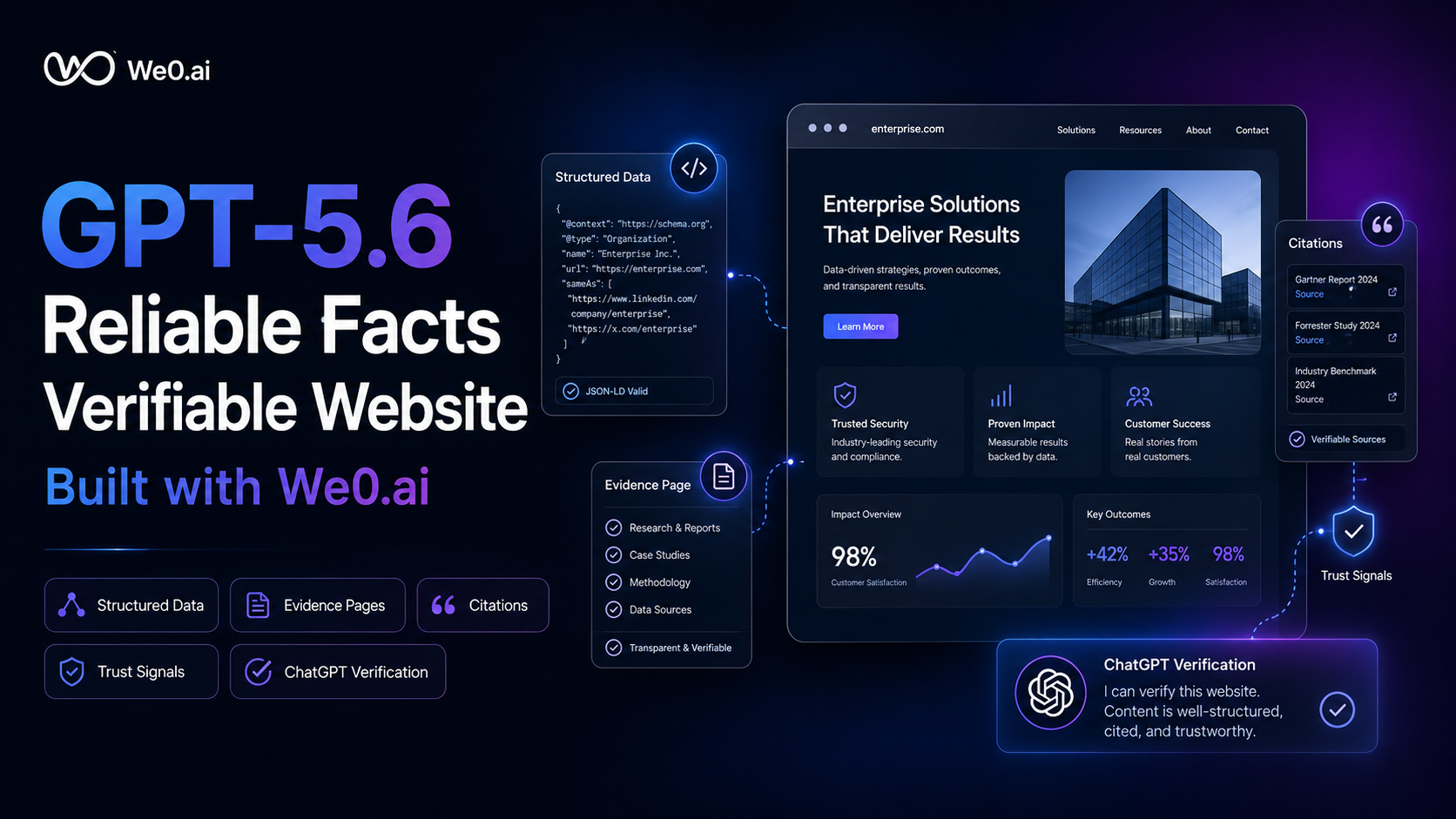
GPT-5.6 is starting to emphasize "more reliable facts": How can businesses use We0.ai to build a corporate website that ChatGPT can verify more easily?
GPT-5.6 is starting to emphasize "more reliable facts": How can businesses use We0.ai to build a corporate website that ChatGPT can verify more easily?
Here's the bottom line: From now on, the question isn't "can you build a website," but "can AI trust it, verify it, and fact-check it?"
This is no longer just a topic within SEO circles.
GPT-5.6 has publicly emphasized stronger factual reliability, knowledge work capabilities, and better tool collaboration. In plain language: models are increasingly unwilling to "guess" — they want to "verify."
This is a major signal for corporate websites.
In the past, a website was like a beautiful showroom. Now, a website is more like a fact repository that AI can read, deconstruct, and cross-check.
If your website structure is disorganized, the content is full of marketing fluff, the FAQ isn't well-organized, and product pages contradict case study pages, then models like ChatGPT will struggle to treat it as a "credible source."
But if you structure your website as a clear knowledge system, the situation is completely different.
1. Models like GPT-5.6 are pushing "website credibility" to the forefront
In OpenAI's introduction to GPT-5.6, one direction is repeatedly mentioned: better knowledge work, more stable fact-handling, and stronger tool usage. This shows that models don't just write — they care about whether information can be reconciled.
At this point, corporate websites face a very practical problem:
Can your website let AI quickly understand who you are, what you sell, what evidence you have, which pages contain primary facts, and which pages are supplementary?
If the answer is no, the model will be more likely to pull external results, third-party content, or even inaccurate claims.
So today, building a website isn't about "having enough pages."
It's about: whether your website has been organized into a verifiable information system.
2. What kind of website is easier for ChatGPT to verify?
I'd break it down into 5 layers.
| Layer | Purpose | What to Include |
|---|---|---|
| Homepage | Provide an immediate identity judgment | Who you are, what you do, who it's for |
| Product/Service Pages | State core facts | Features, pricing, process, scope |
| Case Studies/Proof Pages | Provide cross-checkable evidence | Client cases, screenshots, results, data |
| FAQ/Help Pages | Answer common questions | Cost, delivery, limitations, use cases |
| llms.txt / Structured Data | Help models quickly find key points | Page guides, summaries, schema, readable versions |
The most overlooked layers are actually the last two.
Many corporate websites only achieve "looking like a website" without becoming "a knowledge base designed for machine verification."
That's a real loss.
Because when AI reads web pages, it fears three things most:
- Dispersed information
- Unclear semantics
- Facts without anchors
From a human perspective, "good enough" seems fine.
But from a model's perspective, it will simply give up.

3. What We0.ai is suited for isn't an ordinary website — it's a "growable, credible website"
This is where We0.ai truly adds value.
We0.ai doesn't just help you build pages. What it's better suited for is:
turning your website into an asset that can be showcased, operated, grown, and acquired through.
In other words, the website isn't the finish line.
After launch is when it truly begins.
Platforms like We0.ai are better at connecting the following:
- Brand message organization
- Website structure planning
- Page copy organization
- FAQ and help content development
- SEO / GEO foundational setup
- Structured data configuration
- Continuous content updates
- Traffic data monitoring
- Conversion path optimization
This is fundamentally different from "making a page."
The former is an asset; the latter is just checking a box.
4. How should businesses revamp their websites to be more easily recognized and verified by AI?
1) Build "fact pages" first, not "pretty pages"
Many websites prioritize visuals, animations, and hero banners right away.
But AI doesn't care about that.
What AI actually needs is:
- Who you are
- What problem you solve
- What clients you serve
- What products/services you offer
- What evidence you have
- What limitations you have
So, the first batch of pages on your website should prioritize:
- Homepage
- Product/Service pages
- Pricing page
- Case studies page
- FAQ page
- About page
- Contact page
- Policy pages
These pages are the most fundamental fact anchors.
2) Each page should cover one type of fact
Don't cram everything into a single page.
One page, one task:
- Product pages explain what the product is
- Case study pages explain what the results are
- FAQ pages explain what common questions are
- About pages explain who you are
The clearer your pages, the easier it is for AI to judge.
3) Treat FAQ as a "model entry point"
Many companies treat FAQ as an afterthought.
In reality, it's extremely important.
Because when AI answers questions, it loves to piece together answers from FAQs.
If your FAQ is well-written, the model is more likely to cite it;
if your FAQ is full of empty platitudes, it will look elsewhere.
A good FAQ isn't about "filling word count."
It's about:
- Can I use this?
- How much does it cost?
- How soon will it launch?
- Who is it for?
- Who is it not for?
- What are the delivery boundaries?
The more specific these questions are, the better.
4) Make Schema speak plain language
Structured data isn't decoration.
It's a "machine-readable summary" for search engines and AI.
For example:
- Organization
- Product
- Service
- FAQPage
- BreadcrumbList
- Article
These schemas may not directly determine rankings, but they help machines understand you faster.
For machines to understand you, you first have to explain yourself clearly.
5) Add an llms.txt file
This step is increasingly worth doing now.
According to the
The idea behind llms.txt is that a website can provide a dedicated entry file specifically for models, telling the AI:
- Which pages matter most
- Which are official documentation
- Which are service descriptions
- Which are readable versions
It's not a magic button.
But it's very much like a "official website map."
The model doesn't have to guess — it just follows the map.
That saves a lot of hassle.
5. A More Enterprise-Friendly Order for Website Overhaul
| Step | What to Do | Purpose |
|---|---|---|
| 1 | Unify brand messaging | Let AI know who you are first |
| 2 | Fill in core pages | Get the main facts in place first |
| 3 | Organize FAQ and help center | Address high-frequency questions thoroughly first |
| 4 | Implement Schema | Help machines understand better |
| 5 | Create llms.txt | Give AI an entry-point map |
| 6 | Connect content updates | Keep the website continuously stocked with new facts |
| 7 | Monitor traffic and conversions | Turn the site from "viewable" to "usable" |
This order matters a lot.
Because many companies do it backwards: they spend big money on visuals first, then patch up content later, and end up finding that AI still can't understand them.
Get the order wrong, and costs double.
6. Why We0.ai Is a Good Fit Here?
Because this isn't simply a website-building task.
It's a task that combines "website + content + structure + growth" all at once.
We0.ai is better suited for building the official website into these forms:
- Brand website
- Product website
- Service website
- Case study pages
- Content site
- Lead generation pages
- Multi-language showcase site
- Waitlist page
If you just want a demo, plenty of tools can do that.
But if what you want is:
An official website that AI can read more easily, search engines can index more readily, and that can keep generating leads, then it's not as simple as one-click generation.
That's also what makes We0.ai more interesting.
It's closer to a showcase-site growth platform, not a one-off page builder.
7. Practical Advice: 6 Things Your Official Website Can Do Right Now
- Rewrite the homepage opening as one clear statement.
Don't beat around the bush. - Add a "Who We Are / What We Do" page.
This is the most important page for AI to identify who you are. - Separate product, pricing, and service scope into distinct pages.
Don't mix them together. - Compile 10–20 high-frequency FAQs.
The more genuine the questions, the better. - Add schema to core pages.
At minimum, start with Organization, Product, and FAQPage. - Create an llms.txt file.
Even if it's very simple at first, it's better than nothing.
8. Conclusion: The Future of Official Websites Is Not About "Looking the Part" — It's About "Being Real and Being Clear"
Model changes like GPT-5.6 are really reminding every business of one thing:
AI will increasingly lean toward verifying facts rather than appreciating polish.
So the next phase of the official website isn't about being flashier — it's about being clearer. Not more like an ad, but more like a source of truth.
If you want ChatGPT to understand you more easily, cite you, and verify you, your official website needs to be rebuilt the way machines can also read it.
And that's exactly where We0.ai comes in.
It doesn't just help you build a page and call it done — it's more like helping you turn your official website into a growth asset that can be seen, understood, verified, and converted.
FAQ
1. Does GPT-5.6's emphasis on "more reliable facts" affect official website content?
Yes. It means models place greater weight on sources that are verifiable, traceable, and clearly structured.
2. If an official website wants AI to understand it more easily, what should be changed first?
Start with the homepage messaging, core product pages, FAQ, and schema.
3. Is llms.txt necessary?
Yes. It's not a silver bullet, but it's very helpful for organizing AI entry points.
4. Do only large companies need to do this?
No. The smaller the site, the more it needs to state the facts clearly.
5. Is We0.ai suitable for building this kind of official website?
Yes — especially for showcase-oriented, lead-generation websites that need sustained growth.
Related Tools
- AI Website Generation
- OpenAI GPT-5.6 Official Introduction
- llms.txt Specification
- Google Structured Data Beginner's Guide
- Google Structured Data General Guidelines
Ready to Get Started?
If your current official website is already live, but the content is scattered, the structure is messy, and AI can't understand it, you can use We0.ai directly to reorganize it.
It's not just about building pages — it's about turning the official website into a site that can keep presenting, keep growing, and keep acquiring customers.
Summary
More reliable facts will become the baseline requirement for next-generation AI when it comes to official websites.
And what businesses really need to do isn't chase after every model update — it's to get ahead of the curve by organizing their official website into a clear, credible, verifiable fact system.
The sooner you do this, the more money you save.