GPT-5.6 Sol Ultra and the 64-Agent Proof of the Cycle Double Cover Conjecture
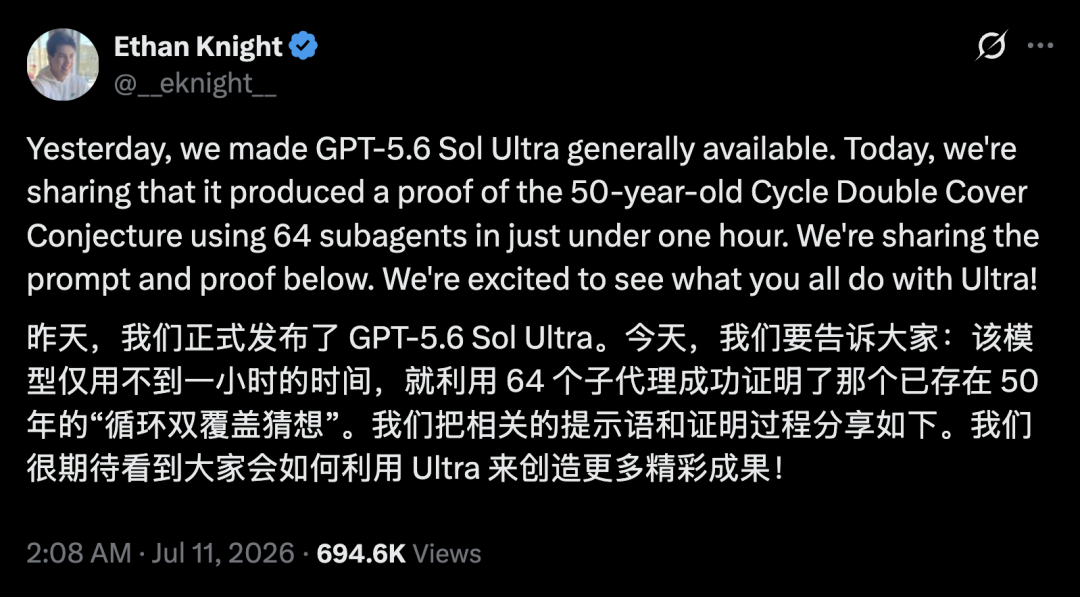
OpenAI has published a three-page manuscript claiming a complete proof of the Cycle Double Cover Conjecture, a major open problem in graph theory that dates back to the 1970s. According to OpenAI researchers Ethan Knight and Noam Brown, GPT-5.6 Sol Ultra generated the result in under one hour of wall-clock time while coordinating as many as 64 parallel subagents. Codex with GPT-5.6 Sol was then used to prepare the final mathematical write-up. OpenAI also released the full two-page prompt. That d
GPT-5.6 Sol Ultra and the 64-Agent Proof of the Cycle Double Cover Conjecture
Introduction
OpenAI has published a three-page manuscript claiming a complete proof of the Cycle Double Cover Conjecture, a major open problem in graph theory that dates back to the 1970s.
According to OpenAI researchers Ethan Knight and Noam Brown, GPT-5.6 Sol Ultra generated the result in under one hour of wall-clock time while coordinating as many as 64 parallel subagents. Codex with GPT-5.6 Sol was then used to prepare the final mathematical write-up.
OpenAI also released the full two-page prompt. That document is valuable because it shows how a difficult research task can be framed for a large multi-agent system.
The key caveat is simple: OpenAI has published a claimed proof, not a peer-reviewed mathematical consensus. Specialists still need to independently verify the argument before the conjecture can be treated as formally settled.
What OpenAI Announced
Ethan Knight said GPT-5.6 Sol Ultra produced a proof of the Cycle Double Cover Conjecture with 64 subagents in just under one hour.
Noam Brown highlighted two points:
- The model configuration was publicly available rather than limited to an internal research system.
- Parallel test-time compute reduced the elapsed time for a task that might otherwise require much longer sequential reasoning.
OpenAI describes ultra as the highest-capability GPT-5.6 setting. It coordinates multiple agents across parallel workstreams and trades higher token use for stronger results and faster time-to-result on demanding tasks.
What Was Published
| Document | Length | Purpose |
|---|---|---|
| Proof manuscript | 3 pages | Presents a complete affirmative proof |
| Full prompt | 2 pages | Defines the theorem, completion criteria, search strategy, agent management, and review requirements |
The proof manuscript says the proof is entirely due to GPT-5.6 Sol Ultra and that Codex with GPT-5.6 Sol was used for the write-up.
What Is the Cycle Double Cover Conjecture?
A graph is a collection of vertices connected by edges.
A cycle is a closed route. A bridge is an edge whose removal increases the number of connected components.
The conjecture states:
Every finite bridgeless graph has a
A collection of cycles in which every edge appears exactly twice.
The word “exactly” creates the difficulty. Adding a new cycle may fix one under-covered edge while causing another edge to appear three times.
Why Bridges Are Excluded
A bridge cannot belong to a cycle. If an edge is the only connection between two parts of a graph, no valid closed route can include it. A cycle double cover is therefore impossible when a bridge exists.
The Core Idea of the Published Proof
The manuscript does not search for the required cycles directly.
It converts the problem into an edge-labeling problem over a finite vector space and then uses linear algebra to show that the local labels can be made globally consistent.
Step 1: Reduce to Cubic Graphs
The proof uses a standard reduction attributed to Jaeger. It is enough to treat loopless cubic multigraphs, where every vertex has exactly three incident edges.
Step 2: Assign a Nonzero Flow Label
The proof uses the finite vector space:
Γ = F₂³
A nowhere-zero flow assigns a nonzero vector to every edge while satisfying a conservation rule at each vertex.
For incident edge labels x, y, and z:
x + y + z = 0
The proof relies on the established theorem that every bridgeless graph has a nowhere-zero flow over this eight-element group.
Step 3: Replace Each Label with a Two-Element Set
Each edge e receives a two-element set:
Pₑ ⊆ Γ
The target local rule is:
For every vertex v and label s ∈ Γ,
the number of incident edges e with s ∈ Pₑ is either 0 or 2.
Fix a label s and collect all edges whose set contains it. Every vertex then has degree zero or two in that subgraph, so the selected edges form a disjoint union of cycles.
Because each edge has two labels, it belongs to exactly two label-defined cycle families. That creates a cycle double cover.
Step 4: Solve Global Consistency
The local construction must agree at both endpoints of each edge.
The proof expresses that condition as a linear system:
tᵤ + tᵥ + εₑ f(e) = dₑ
A dual-space and parity argument is then used to show that the system always has a solution.
The local two-element sets can therefore be combined into one global assignment, and the required cycles follow automatically.
The Strategy in One Sentence
The proof does not construct the cycles one at a time. It constructs labels whose parity structure forces the cycles to appear.
Why Independent Verification Still Matters
A short proof of a famous open conjecture requires careful checking, regardless of whether it was written by a person or an AI system.
Reviewers need to verify that:
- The reduction to cubic graphs applies exactly as used.
- The nowhere-zero flow theorem has the required hypotheses.
- The local labeling handles every valid cubic configuration.
- The duality argument proves full solvability.
- Parallel edges and disconnected graphs are handled correctly.
- No step assumes an
equivalent form of the conjecture.
Earlier papers have also claimed proofs of the Cycle Double Cover Conjecture without producing a broadly accepted resolution. The existence of a manuscript is therefore not enough on its own.
A careful description is:
GPT-5.6 Sol Ultra produced a short manuscript that OpenAI presents as a complete proof, and the argument is now available for independent mathematical review.
What the Prompt Did Differently
The prompt did not prescribe one proof method. It created a task contract.
It defined:
- The exact theorem.
- All important terms and edge cases.
- What counted as completion.
- What did not count as completion.
- How agents should explore alternatives.
- When a route should be marked blocked.
- How candidate proofs should be reviewed.
- What evidence each agent had to return.
- When the root agent could stop.

Prompt Lesson 1: Define Completion, Not a Guessed Procedure
For a difficult task with an unknown solution path, a rigid workflow may encode a bad assumption.
A stronger prompt defines the final artifact and the tests it must pass.
Deliver a complete result that satisfies every acceptance criterion below.
You may choose and revise the process dynamically, but the final output must
cover every stated case and survive independent review.
Prompt Lesson 2: Remove Ambiguity Early
The prompt defines the graph class, bridges, cycles, parallel edges, disconnected graphs, and exact multiplicity before asking for a proof.
For business or technical work, the equivalent is defining:
- Time range.
- Data source.
- User group.
- Measurement unit.
- Required format.
- Allowed assumptions.
- Excluded cases.
- Approval boundaries.
Prompt Lesson 3: State What Does Not Count
The prompt rejects:
- Proofs for special graph classes only.
- Covers where some edges do not appear exactly twice.
- Reductions to another unproved conjecture.
- Verification only up to a fixed graph size.
- Partial progress presented as a complete solution.
This technique prevents an agent from returning something impressive but incomplete.
Prompt Lesson 4: Preserve Independent Search Paths
The root agent was told to begin with genuinely different approaches and not reveal the favored route to most agents too early.
That reduces premature convergence and groupthink.
A practical agent portfolio could include:
| Agent family | Responsibility |
|---|---|
| Structural | Search for reductions and invariants |
| Algebraic | Translate the problem into equations |
| Constructive | Build the required object directly |
| Computational | Test cases and proposed lemmas |
| Literature | Verify standard theorems |
| Adversarial | Search for counterexamples and hidden |
assumptions |
| Synthesizer | Compare and merge compatible results |
Prompt Lesson 5: Mark Blocked Routes
When a route encounters a missing lemma as difficult as the original problem, it should be marked as blocked.
No additional agents should be assigned unless someone introduces a genuinely new mechanism, invariant, construction, or counterexample.
This prevents computing resources from being wasted on an elegant but circular reduction.
Prompt Lesson 6: Separate Generation from Review
The prompt requires adversarial agents to check exact multiplicity, parallel-edge cases, disconnected graphs, invalid closed trails, and circular reasoning.
The agent that creates a solution should not be the sole agent judging it.
This applies to product launches, data analyses, migrations, security reviews, and legal or financial workflows.
Prompt Lesson 7: Require Concrete Evidence
Subagents must return concrete lemmas, equations, constructions, or counterexamples. Vague reports such as "promising direction" were not accepted.
A reusable instruction is:
Every agent must return an artifact another agent can inspect.
Do not accept status updates without calculations, tests, sources,
code, examples, or a precisely stated unresolved gap.
The Eight-Hour Instruction and the One-Hour Result
The prompt instructs the system to spend at least eight hours before considering stopping or giving up. OpenAI’s announcement states that the proof was produced in under one hour.
The public documents do not detail exactly how that instruction was interpreted.
One plausible explanation is the difference between wall-clock time and aggregate agent time. With 64 agents running in parallel, one hour of elapsed time can contain many agent-hours of work.
This is an inference rather than a confirmed accounting method for the experiment.
A Reusable Multi-Agent Task Contract