Google Concentrates Gemini Leadership in California as It Explores a \$1.5B Mechanize Deal
Google is reorganizing how its most important AI work is managed. The company is not literally ordering every Google DeepMind employee to move to Silicon Valley, as the original Ch

Google Concentrates Gemini Leadership in California as It Explores a $1.5B Mechanize Deal
Introduction
Google is reorganizing how its most important AI work is managed.
The company is not literally ordering every Google DeepMind employee to move to Silicon Valley, as the original Chinese headline jokingly suggests. London remains a major Google DeepMind research center, and Demis Hassabis says he will continue working with the organization from Google’s new Platform 37 offices there.
What is changing is the center of day-to-day decision-making around Gemini.
Koray Kavukcuoglu, who was appointed Google’s Chief AI Architect and a senior vice president in 2025, relocated from London to California and now leads Google DeepMind as SVP. He reports directly to CEO Sundar Pichai and oversees Gemini model development, frontier AI research, the Gemini app, and developer teams.
Reporting cited by the source also says key Gemini post-training work has been increasingly concentrated around Google’s Mountain View headquarters.

At the same time, Google is reportedly negotiating a separate deal worth more than $1.5 billion with San Francisco AI startup Mechanize. Business Insider reported that the proposed arrangement would involve a non-exclusive license to Mechanize’s technology and the hiring of some of its staff, who would work on model evaluation and development.
The two developments address different parts of the same problem.
Google already has frontier models, TPUs and large-scale compute, Google Cloud, massive product distribution, and one of the world’s largest AI research organizations. The challenge is turning those assets into faster model iterations and stronger AI products—particularly in coding agents, where competition from Anthropic, OpenAI, and specialist tools has intensified.
Google Is Moving More Gemini Decision-Making Toward California
For more than a decade, Google’s AI organization had two powerful geographic centers.
One was Google’s headquarters in Mountain View, California, where the company’s product, cloud, search, Android, advertising, and business organizations are concentrated.
The other was DeepMind in London, founded in 2010 and acquired by Google in 2014.
That structure was not inherently a problem. DeepMind could focus on long-horizon AI research while Google’s product organizations worked on global consumer and enterprise products.
The difficulty became more visible after generative AI moved from research into a fast consumer-product cycle.
Google Brain and DeepMind Were Merged in 2023
In April 2023, Google formally combined the Brain team from Google Research with DeepMind to create Google DeepMind.
Google said the goal was to accelerate progress in AI by bringing together two research groups responsible for technologies including Transformers, AlphaGo, AlphaFold, WaveNet, TensorFlow, JAX, deep reinforcement learning, and sequence-to-sequence learning.
Gemini became one of the first major model families produced under the unified organization.
The merger solved the formal organizational split. It did not eliminate geography.
The teams involved in Gemini continued to work across multiple locations and time zones.
Eight Time Zones Make Fast Product Iteration Harder
The BAAI source describes Gemini development as involving employees distributed across offices spanning roughly eight time zones.
That creates a very practical coordination problem.
A model team may need rapid decisions across pre-training, post-training, safety, evaluation, product integration, developer APIs, serving infrastructure, Search integration, and enterprise deployment.
A question that could be resolved in a short room discussion can take much longer if several responsible teams are starting and ending their workdays at different times.
The source cites reports that Hassabis sometimes worked deep into the night in London to overlap with colleagues in California.
The exact number of chats or late-night meetings is less important than the underlying point: once Gemini became a product operating on a rapid release cycle, physical distance between research leadership and major product organizations became an operational cost.
Post-Training Is One of the Teams Moving Closer to Headquarters
According to reporting summarized in the original article, Google has been concentrating more of the Gemini post-training organization in California.
Post-training is the stage after the base model has been pretrained. It can include instruction tuning, reinforcement learning, preference optimization, safety tuning, model evaluations, tool-use training, agent behavior, and product-specific adaptation.
This stage matters because it strongly affects how the final model behaves in real products.
A base model can have excellent underlying capabilities while still performing poorly in an assistant, coding agent, or search product if post-training and product integration are weak.
Placing model, evaluation, product, and executive teams closer together can shorten the feedback loop:
Model behavior
      ↓
Evaluation
      ↓
Product test
      ↓
User feedback
      ↓
Post-training change
      ↓
New model behavior
The goal is not to make geography itself a technical breakthrough. It is to reduce the time required to move through this loop.
Koray Kavukcuoglu’s Move Was Already Underway in 2025
The shift toward California did not begin with the August 2026 leadership announcement.
In June 2025, Google appointed Google DeepMind CTO Koray Kavukcuoglu as its first Chief AI Architect and made him a senior vice president reporting directly to Sundar Pichai.
Reuters reported at the time that Kavukcuoglu would relocate from London to California.
His mandate was explicitly cross-company: Google wanted a senior technical leader who could help coordinate how its AI models become products.
That appointment matters because it shows the latest restructuring is not a sudden overnight decision. It is the continuation of a change that has been developing for more than a year.
Koray Now Runs Google DeepMind Day to Day
On August 5, 2026, Google formalized the next step.
Sundar Pichai announced that Kavukcuoglu would lead Google DeepMind as SVP while continuing as Google’s Chief AI Architect.
His remit now includes:
- Gemini model development
- Frontier AI research
- Gemini app teams
- Developer teams
He reports directly to Pichai.
Google says Kavukcuoglu has been at DeepMind for 13 years and previously helped lead work including WaveNet and DQN.
This is the clearest evidence that the operational center of Gemini has moved closer to Alphabet’s central product leadership.
Sergey Brin Is Also More Active Around Google’s AI Work
The source adds a second California-based figure to the new power structure: Google co-founder Sergey Brin.
Brin returned to a more active role in Google’s AI work after the arrival of ChatGPT and has been repeatedly reported to participate directly in Gemini-related technical discussions.
He does not hold the formal operating role that Kavukcuoglu now holds.
Google’s August 5 leadership announcement does not name Brin as the head of Google DeepMind or as Kavukcuoglu’s manager.
The formal chain is:
Sundar Pichai
      ↓
Koray Kavukcuoglu
      ↓
Gemini models + frontier research + Gemini app + developer teams
Brin is better understood as an influential co-founder who has become much more involved in the company’s AI strategy.
That distinction matters because the original source’s humorous framing can make it sound as if Brin is personally supervising every team from the next desk. The evidence supports a stronger Brin role, but not a newly announced executive operating title.
Demis Hassabis Steps Away From Daily Management
The final piece of the leadership change is Demis Hassabis.
Hassabis is not leaving Google DeepMind. He is changing roles.
Google announced that he is now:
- Chair of Google DeepMind
- Chief Scientist of Alphabet
- Still leading Isomorphic Labs
Hassabis said he chose to hand over day-to-day operational responsibilities so he could focus more of his time on long-term AGI strategy, scientific breakthroughs, the societal impact of advanced AI, and Isomorphic Labs.
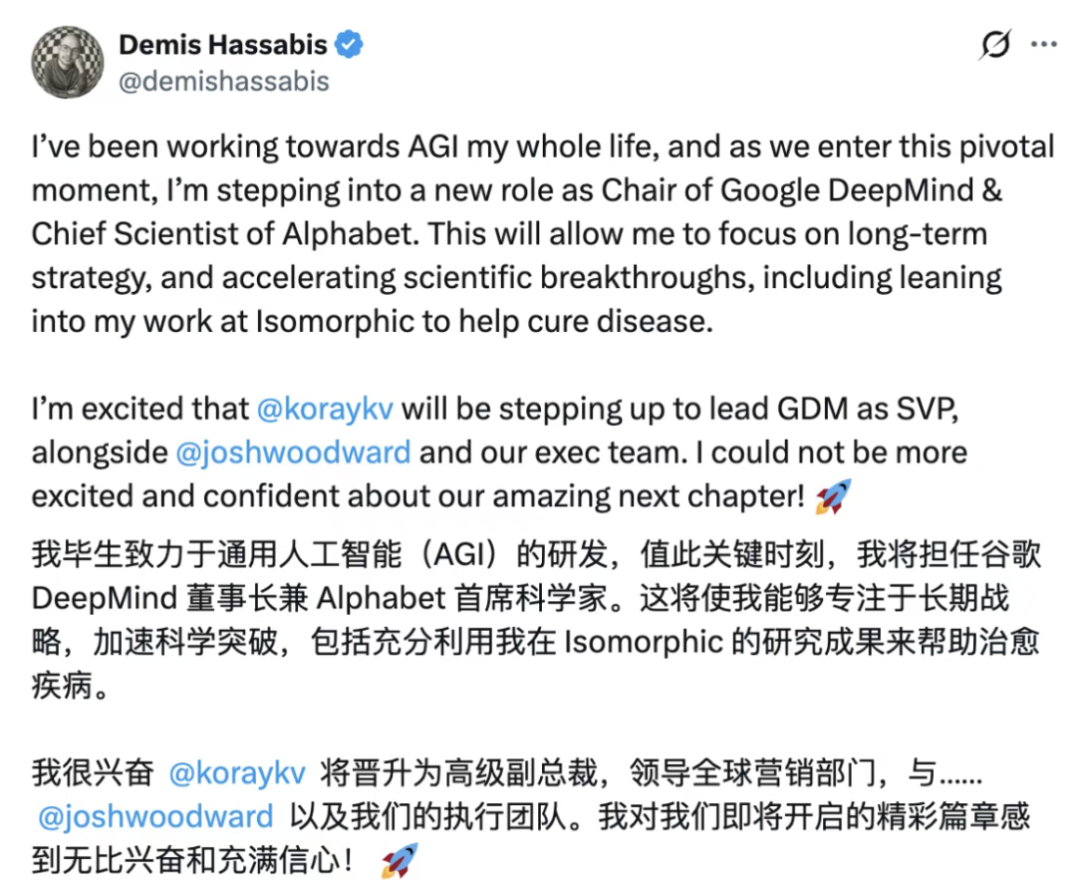
Google also says Hassabis will remain closely involved with Kavukcuoglu and Google DeepMind’s model and research leadership.
So the transition is not accurately described as Hassabis being removed from AI research.
The clearer split is:
| Executive | Main Focus After the Change |
|---|---|
| Koray Kavukcuoglu | Day-to-day Google DeepMind operations, Gemini development, product and developer execution |
| Demis Hassabis | Long-term AGI, scientific strategy, Alphabet chief-scientist role, Isomorphic Labs |
| Sundar Pichai | Direct executive oversight of Koray and company-wide AI priorities |
| Sergey Brin | Increasing strategic and technical involvement, without a newly announced operating title |
London Is Still a Major Google DeepMind Center
The source’s “AI power moves back to California” framing captures the shift in operational leadership, but it should not be read as Google abandoning London.
Hassabis specifically said he will continue advising Google DeepMind from the company’s new London Platform 37 offices.
Google continues to employ major research teams in the UK.
Reuters Breakingviews also noted that London remains an important AI ecosystem, with significant venture funding, DeepMind alumni, and continuing Google investment.
The change is therefore best described as:
More of Gemini’s operational command is centered in California, while London remains an important research center.
That is a meaningful shift without turning it into a complete geographic withdrawal.
Google Is Also Discussing a $1.5B-Plus Deal With Mechanize
Moving people into the same time zone addresses coordination. It does not automatically solve every product gap.
The source identifies AI coding as one of the areas where Google wants to move faster.
Business Insider reported on August 5 that Google is in advanced discussions with San Francisco startup Mechanize.
The proposed deal could be worth more than $1.5 billion.
According to the report, the structure being discussed includes:
- A non-exclusive license to Mechanize technology
- Google hiring some Mechanize employees
- Those employees working on model evaluation and development
Both Google and Mechanize declined to comment to Business Insider, and the report emphasized that the terms could still change.
For that reason, the deal should not be written as a completed acquisition.
This Is Not Reported as a Full Acquisition
The original Chinese article casually describes Google as “buying” the team.
The reported structure is more specific.
Google is not currently reported to be acquiring Mechanize outright.
Instead, the talks resemble a licensing-plus-talent arrangement.
This type of transaction allows a large technology company to gain access to technology, experienced researchers, evaluation infrastructure, and domain expertise while the startup can potentially continue operating independently.
The important point is that the Mechanize talks remain ongoing and unconfirmed by the companies themselves.
What Mechanize Actually Builds
Mechanize describes itself as a company that builds reinforcement-learning environments and evaluations for frontier coding agents.
Its environments give models realistic software-engineering tasks such as:
- Building a feature
- Deploying an application
- Debugging an unfamiliar codebase
- Working through realistic development workflows
A grader then evaluates the model’s performance.
Those scores can be used during reinforcement learning, model evaluation, and capability measurement.
Mechanize’s core idea is that coding models need more than static benchmark questions. They need realistic environments where an agent can take actions over time and be judged on whether it actually completes a software task.
Why This Matters for Coding Agents
A coding assistant can look strong on isolated code-generation questions while still struggling to complete a real engineering job.
Real tasks require the agent to:
- Understand an unfamiliar repository.
- Decide which files matter.
- Use development tools.
- Run tests.
- Interpret failures.
- Make several coordinated edits.
- Avoid breaking unrelated behavior.
- Verify the final result.
Training environments that reproduce this workflow can provide better reinforcement-learning signals than short code snippets alone.
That makes Mechanize relevant to any lab trying to improve long-running software-engineering agents.
Mechanize Was Founded by Researchers With an Evaluation Background
Mechanize was founded in 2025 by:
- Tamay Besiroglu
- Matthew Barnett
- Ege Erdil
Besiroglu previously co-founded Epoch AI, an organization known for research on AI models, compute, scaling trends, and evaluations.
Business Insider reported that Mechanize had raised $9.1 million** at a **$500 million valuation earlier in 2026.
Its reported investors include Nat Friedman, Patrick Collison, and Dwarkesh Patel.
Mechanize’s own stated ambitions extend beyond software engineering.
The company says its long-term goal is the full automation of valuable economic work.
Its current focus on coding makes sense because software engineering offers relatively clear feedback mechanisms. A model’s work can often be tested using unit tests, integration tests, build systems, runtime behavior, and structured graders.
That makes coding a practical domain for reinforcement learning.
Why Google Would Want Mechanize
The source describes Google as falling behind Claude Code, Codex, and Cursor in AI coding.
That statement is difficult to reduce to one objective ranking.
Different coding products compete on different dimensions, including base-model quality, repository understanding, autonomous task length, IDE integration, terminal access, tool use, latency, price, enterprise controls, and reliability.
Google already has strong developer products and coding models.
The reason Mechanize could still be valuable is more specific: Mechanize specializes in the training and evaluation infrastructure needed to make coding agents more capable.
That expertise could help Google improve:
- Agent training
- Long-horizon coding tasks
- Model evaluation
- Reinforcement-learning environments
- Software-engineering benchmarks
- Product-level coding reliability
In other words, Google would not simply be buying a code editor. It would be gaining people and technology focused on teaching models to perform realistic software work.
The California Move and Mechanize Talks Solve the Same Execution Problem
The two stories initially look separate.
One is an organizational reshuffle.
The other is a possible technology and talent deal.
But the strategic logic is similar.
Google has enormous AI resources. The problem is reducing the distance between:
Research
→
Training
→
Evaluation
→
Product integration
→
User feedback
→
Next model
Concentrating more leadership and post-training work around Mountain View can make internal decisions faster.
Mechanize could add external expertise in coding-agent training and evaluation.
Together, the moves suggest Google is trying to shorten the cycle from research capability to competitive product.
One More Thing: What the Hassabis Shift Means for DeepMind
The source ends with the tension around Hassabis and London.
DeepMind has always had a strong identity as a research laboratory.
Its history includes projects such as AlphaGo, AlphaZero, AlphaFold, WaveNet, and deep reinforcement learning.
Hassabis has also spoken publicly about proving that world-class AI research could be built in London rather than requiring every leading researcher to move to Silicon Valley.
The new structure tests whether that research identity can coexist with a more centralized product operating model.
Why Hassabis May Prefer the New Role
The original article presents three possible interpretations of Hassabis’ move:
- He gave up power.
- He was promoted into a broader scientific role.
- He deliberately chose a job closer to his research interests.
Public evidence supports elements of all three, but not the more dramatic claim that he was forced out because he refused to move to California.
Google says Hassabis and Pichai had been discussing a new role for some time.
Hassabis says he wanted the time and space to focus on the broader AGI picture.
He will also remain in London rather than following the operational organization to Mountain View.
A reasonable interpretation is that the restructuring creates a cleaner separation:
Koray:
ship models and products faster

Demis:
focus on AGI, science, and long-term strategy
Whether that separation works will depend on how closely the two sides continue to collaborate.
A Timeline of Google’s AI Organizational Shift
| Date | Event |
|---|---|
| April 2023 | Google merges the Brain team and DeepMind into Google DeepMind |
| June 2025 | Koray Kavukcuoglu becomes Google Chief AI Architect and SVP, reporting to Sundar Pichai |
| 2025–2026 | Koray relocates from London to California as his cross-company AI role expands |
| 2026 | Reporting says more Gemini post-training work is being concentrated in California |
| August 5, 2026 | Google announces Demis Hassabis will become Chair of Google DeepMind and Chief Scientist of Alphabet |
| August 5, 2026 | Koray is appointed SVP of Google DeepMind with responsibility for models, frontier research, Gemini app, and developer teams |
| August 5, 2026 | Business Insider reports Google is discussing a $1.5B-plus Mechanize technology-and-talent deal |
| August 10, 2026 | The original QbitAI/BAAI article connects the California concentration and Mechanize talks as part of Google’s push for faster AI execution |
What Is Confirmed and What Is Reported
Confirmed by Google
- Google Brain and DeepMind were merged into Google DeepMind in 2023.
- Demis Hassabis is now Chair of Google DeepMind and Chief Scientist of Alphabet.
- Koray Kavukcuoglu now leads Google DeepMind as SVP.
- Koray reports directly to Sundar Pichai.
- Koray oversees Gemini model development, frontier AI research, Gemini app teams, and developer teams.
- Hassabis remains involved in model and research strategy.
- Hassabis will continue working from Google’s London offices.
- Google says it wants to accelerate its work at the AI frontier.
Confirmed by Mechanize
- Mechanize builds RL environments and evaluations for frontier coding agents.
- Its current work focuses on realistic software-engineering tasks.
- Its longer-term stated goal is broader automation of valuable work.
Reported by Reuters, Bloomberg, Business Insider, and Other Media
- Koray’s 2025 role included relocating from London to California.
- More Gemini post-training work has been concentrated around California.
- Sergey Brin has become more active in Google’s AI work.
- Google is discussing a deal worth more than $1.5 billion with Mechanize.
- The possible deal would involve non-exclusive technology licensing and hiring some Mechanize employees.
- Deal terms remain subject to change.
Not Established as Fact
- Google is forcing all core AI employees to move to California.
- Google is abandoning London as an AI research center.
- Hassabis stepped aside solely because he refused to relocate.
- The Mechanize transaction is already completed.
- Google is acquiring all of Mechanize.
- Google’s coding products are objectively worse than every named rival in every workload.
常见问题
Is Google moving all Google DeepMind employees to California?
No. Google DeepMind remains a global organization, and London is still an important research center. The change is that more operational leadership, Gemini decision-making, and reportedly some post-training work are being concentrated around Mountain View.
Who now runs Google DeepMind?
Koray Kavukcuoglu now leads Google DeepMind as senior vice president while continuing as Google’s Chief AI Architect. He reports directly to Sundar Pichai and oversees Gemini model development, frontier AI research, the Gemini app, and developer teams.
Did Demis Hassabis leave Google DeepMind?
No. Hassabis became Chair of Google DeepMind and Chief Scientist of Alphabet. He remains involved in long-term AGI strategy and research while continuing to lead Isomorphic Labs.
Did Koray Kavukcuoglu move from London to California?
Yes. Reuters reported in June 2025 that he would relocate to California after becoming Google’s Chief AI Architect and SVP. More recent reporting places him at Google’s Mountain View headquarters as his responsibilities expand.
Is Google buying Mechanize for $1.5 billion?
Not according to the current reporting. Business Insider says Google is discussing a deal worth more than $1.5 billion involving a non-exclusive technology license and the hiring of some Mechanize employees; both companies declined to comment, and the terms could change.
What does Mechanize build?
Mechanize builds reinforcement-learning environments and evaluations for frontier coding agents. The environments simulate realistic software-engineering work and provide graders that can score agent performance for training and evaluation.
Why is Google interested in Mechanize?
The reported deal would give Google technology and talent focused on training and evaluating coding agents. That could help improve long-horizon software-engineering performance, an increasingly important area for frontier AI products.
Is Sergey Brin officially leading Google DeepMind?
No new formal operating title has been announced for Brin. Public reporting describes him as increasingly active in Google’s AI strategy, while the official management structure puts Koray Kavukcuoglu in charge of Google DeepMind’s day-to-day operations under Sundar Pichai.
相关工具
- Gemini: Google’s main consumer AI assistant and one of the key products affected by the company’s push for faster Gemini development.
- Google AI Studio: Google’s official environment for testing Gemini models and building with the Gemini API.
- Vertex AI: Google Cloud’s enterprise AI platform for building and deploying generative-AI applications.
- Mechanize: The AI startup building reinforcement-learning environments and evaluations for frontier coding agents.
- Epoch AI: The AI research organization previously co-founded by Mechanize CEO Tamay Besiroglu.
- Google DeepMind: Google’s frontier AI research organization responsible for Gemini and major scientific AI programs.
Related Links
- Google: The Next Chapter of Our AI Momentum: Google’s official August 2026 announcement detailing the new roles of Demis Hassabis and Koray Kavukcuoglu.
- Google DeepMind: Bringing Together Two World-Class AI Teams: Google’s official 2023 announcement merging Google Brain and DeepMind.
- Reuters: Google Names Koray Kavukcuoglu Chief AI Architect: Reporting on Koray’s 2025 appointment, direct reporting line to Sundar Pichai, and planned move from London to California.
- Business Insider: Google’s $1.5B-Plus Mechanize Talks: The original report on the proposed non-exclusive technology license and talent deal.
- Mechanize Official Site: Mechanize’s description of its RL environments, coding-agent evaluations, and core business.
- Mechanize: How to Fully Automate Software Engineering: The startup’s explanation of why realistic RL environments matter for software-engineering agents.
- Bloomberg: Google Shifts AI Power to California: The report cited by the original article on the geographic concentration of Google’s AI leadership.
Summary
Google’s AI reorganization is less about ordering every researcher back to headquarters and more about shortening the distance between model development, post-training, product decisions, and executive leadership.
Koray Kavukcuoglu’s move to California and promotion to lead Google DeepMind formalize a shift that began in 2025. Demis Hassabis remains a central scientific figure but has stepped away from daily operations to focus on AGI, science, and Isomorphic Labs.
The reported $1.5 billion-plus Mechanize talks address another execution problem: improving the training and evaluation of coding agents. If a deal is completed, Google would gain specialized technology and talent rather than simply acquiring another coding interface.
The common thread is speed: Google is reorganizing people, decision-making, and external talent around a shorter path from frontier research to competitive AI products.