If Google Is Asking Businesses How AI Should Describe Them, Should We0.ai Websites Also Have a Brand Facts Page?
You'll notice something interesting. In the past, when building a company website, the default assumption was: **If I make the homepage look good and describe the products clearly, that's probably enough.** But things are different now. AI is starting to "recount" brands, explain companies, and summarize services on behalf of users. And it doesn't just faithfully copy your homepage—it picks and chooses what it believes looks more like facts. So here's the question: **If AI is going to introduce
If Google Is Asking Businesses How AI Should Describe Them, Should We0.ai Websites Also Have a Brand Facts Page?
If Google Is Asking Businesses How AI Should Describe Them, Should We0.ai Also Have a Brand Facts Page?
You'll notice something interesting.
In the past, when building a company website, the default assumption was:
If I make the homepage look good and describe the products clearly, that's probably enough.
But things are different now.
AI is starting to "recount" brands, explain companies, and summarize services on behalf of users.
And it doesn't just faithfully copy your homepage—it picks and chooses what it believes looks more like facts.
So here's the question:
If AI is going to introduce you, what makes it introduce you correctly?
This is a new signal I've noticed recently: brand information is shifting from "designed for people to read" to "designed for AI to read."
And this matters especially for a product like We0.ai, which focuses on showcase websites, brand websites, and lead-generation websites.
Because what we build has never just been "having a website."
What we do is: turn a website into an asset that can be searched, understood, recommended, and converted.
1. This Isn't Really About "Adding a Page"—It's About Adding a Layer of Factual Entry Points
Many people, when they hear "Brand Facts," think it's just another version of "About Us."
It's not, really.
It's more like a brand fact layer that both AI and users can see.
You can think of it this way:
- Who you are
- What you do
- What you don't do
- Who your target users are
- What your advantages are
- Where your product boundaries lie
- How you want others to describe you
This information used to be scattered across the homepage, About page, FAQ, case studies, and blog posts.
Now, there's a growing need to present it in a structured way in one place.
Not to look professional. To reduce misunderstanding.
Because AI's biggest problem isn't that it doesn't write.
It's that it writes too fast—fast enough to get things wrong.

2. Why Brands Now Need to "Tell AI How to Introduce Me"
Behind this trend, there are actually three shifts.
1) AI Has Become a New Entry Point
Users don't necessarily visit your homepage first.
They might first look at an AI summary, an AI Search result, or an AI Overview.
In other words, the scenario where a brand gets "first explained" is no longer the website homepage.
It's that short paragraph AI outputs.
2) Structured Information Is More Likely to Be Cited Than Polished Copy
AI can more easily understand:
- Who you are
- What you offer
- Who you serve
- Where you're located
- Your pricing logic
- Your differentiators
Rather than that kind of well-written but vague brand jargon.
3) Businesses Are Starting to Realize: Search Isn't Just SEO Anymore
Going forward, it's increasingly becoming: SEO + GEO + Brand Facts + Structured Brand Assets.
In other words, websites aren't just for search engines anymore—they're also for AI summaries, AI recommendations, AI comparisons, and AI recounts.
This is very real.
And very unforgiving.
If you don't define yourself, AI will define you using someone else's context.
3. Why Should We0.ai's Website Also Have a Brand Facts Page?
Because We0.ai itself isn't the kind of product that relies solely on a "pretty homepage."
We0's core mission is to help users turn showcase websites into growth assets.
In other words, it's naturally suited to these scenarios:
- Brand websites
- Product websites
- Service websites
- Case study pages
- Portfolios
- Inquiry pages
- Waitlist pages
- Content-driven websites
And what do these pages fear most?
Inconsistent messaging.
One day the homepage says "AI website builder," the next day a case study page says "growth services," and the pricing page looks like "managed operations."
In the end, users aren't sure what you actually are.
AI is even less sure.
So if We0.ai had a Brand Facts page, it would be extremely valuable:
- It would unify the website's messaging
- It would help AI understand We0.ai more accurately
- It would make brand descriptions feel more like "facts" rather than "marketing speak"
- It would fill the brand explanation layer beyond the homepage
In one sentence: Brand Facts isn't a decorative page—it's the brand's "interpreter."
4. What Should a Brand Facts Page Look Like?
If We0.ai were to actually build one, I don't think it should read like "About Us 2.0."
It should feel more like a fact sheet that both machines and humans can quickly scan.
Suggested modules:
| Module | Purpose |
|---|---|
| One-line positioning | Define what We0.ai is in one sentence |
| What We0.ai does | Clearly explain website building, showcasing, SEO/GEO, growth, and lead generation |
| Who it is for | Target users: Owners / Independents / Creators |
| Use cases | Brand websites, product pages, case study pages, inquiry pages, etc. |
| What it is not | Clearly state it's not just a regular page builder, nor a demo-only tool |
| Brand tone | Brand voice, expression style, and how it should be described |
| Proof points | Verifiable facts, capabilities, and delivery methods |
| FAQ | Common misconceptions and clarifications |
The most important part here isn't "writing a lot."
It's writing accurately, writing consistently, and writing in a way that can be cited.
5. What's the Real Insight Here?
Let's be honest.
If a business is being introduced by AI and gets it wrong, users won't blame AI—they'll blame the brand.
They'll think: this company isn't clear about what it does.
"About Us" has been around for a long time, but it was designed for humans to read.
It's emotional, narrative-driven, and often lacks structured facts.
Brand Facts, on the other hand, is designed for the "AI first, humans second" reading scenario.
It's a clear, structured, and referenceable way for a brand to express itself.
6. Even Google Is Doing This
If you've been paying attention to Google's recent moves, you'll see something significant:
Google launched a feature in Business Profile that lets businesses tell AI how to describe them.
You can write things like:
- Our brand positioning
- What we're best at
- What problems we solve
- How we want to be described
Google uses this information to generate more accurate AI Overviews.
That's essentially Google telling you:
"Instead of letting AI guess, you should tell AI directly."
This confirms one thing:
AI is already rewriting how brands are described. The question is whether you want to provide the source material—or let AI figure it out on its own.
7. A Brand Facts Page Is Not Optional Anymore—It's the Baseline
For AI search, AI summaries, AI recommendations, AI comparisons, and AI conversations,
if your brand doesn't actively provide structured facts, AI will fill in the gaps with:
- Social media chatter
- Third-party reviews
- Competitor comparisons
- Outdated information
And these might not be what you want.
So every brand—especially products like We0.ai that help others build their websites—should have a Brand Facts page.
It's not about pleasing algorithms.
It's about protecting your brand's right to define itself.
8. What We0.ai Could Do Starting Now
- Add a Brand Facts page to the We0.ai official website
- Also include it in the product's own site as a demonstration case
- Enable users building sites on We0 to have the same kind of structured brand facts layer
In fact, if We0.ai can integrate this into its website-building capabilities—
It's not just doing SEO anymore. It's laying out a structured layer for GEO, AI search, and corporate knowledge bases.
A Final Thought
If Google is already making "Brand Facts" a standard option for businesses to clarify themselves to AI,
then a product that claims to help businesses build websites should not just be a passive observer.
AI is listening. The question is, what message is the brand sending it?
A Brand Facts page is not just a page.
It's a brand's statement of facts to the AI era.
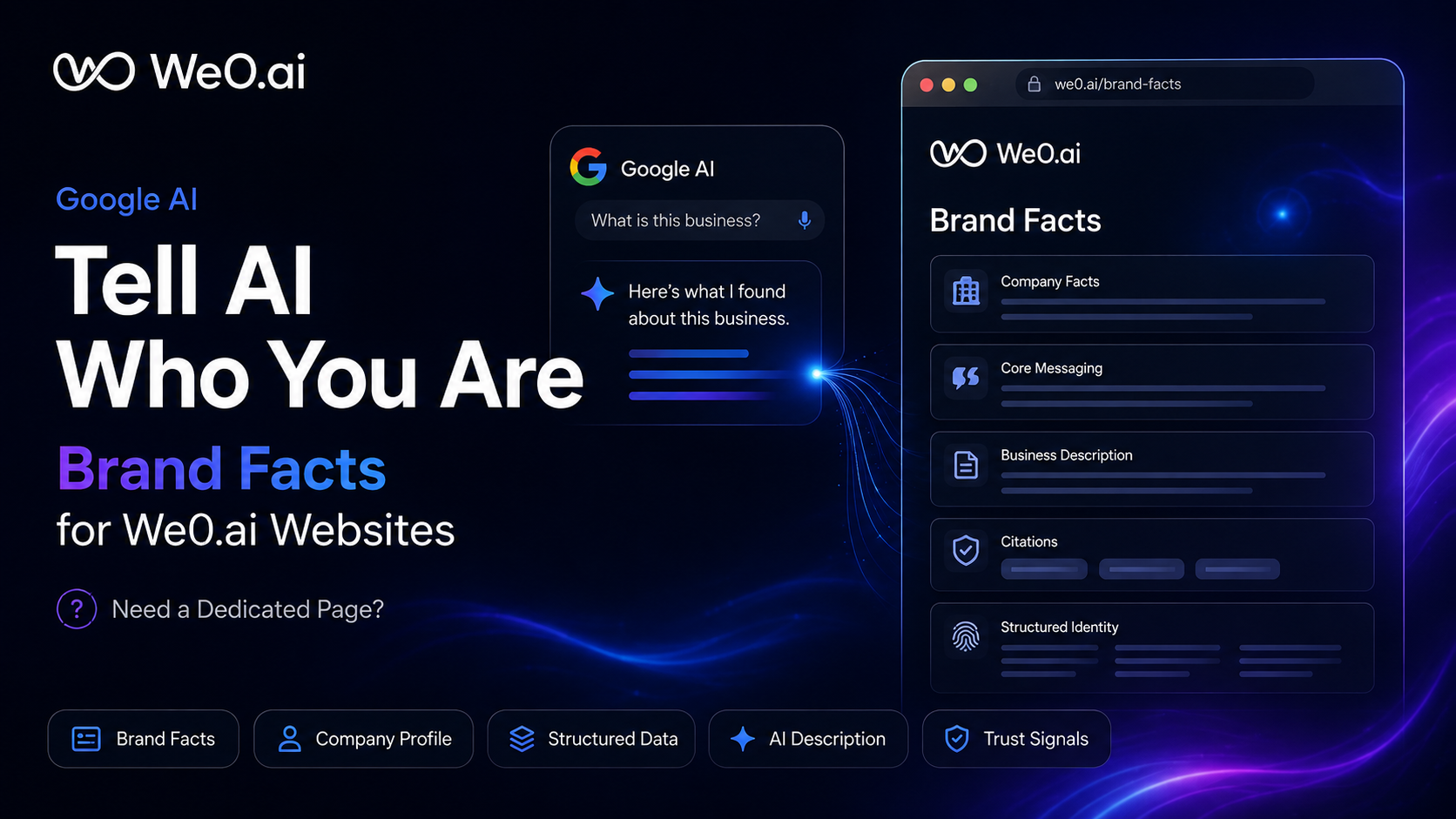
The Facts page contains the core functional modules that demonstrate how this page enables precise information transmission between brands and AI.](https://we0-cms.oss-cn-beijing.aliyuncs.com/cms-assets/image/2026/08/b14b8842-3c39-4760-aaa6-74cf6008b522-14b55f4c-8444-4699-9f62-0a46ed502489.png)

5. This Is Actually We0's Product Philosophy Upgrade
If it were just a "website builder," the focus of the official site might be: Is it fast? Does it look good? Are there enough templates?
But that's not We0's logic.
We0 is more like:
Build -> Showcase -> Grow -> Leads
First build, then showcase, then grow, then capture leads.
The Brand Facts page fills exactly the middle layer that often gets overlooked:
- Who you really are
- Who you're really for
- How you want to be understood
- What your actual position is in the market
This isn't "brand packaging."
This is growth-first thinking.
Because if AI describes you incorrectly, your SEO, content, and conversion pages will all be pulled off track.
6. A Simple Comparison
| Homepage Only | With Brand Facts |
|---|---|
| Focuses on visual presentation | Focuses on presenting facts |
| Suitable for quick browsing | Suitable for AI reading and citation |
| Prone to message drift | Easier to unify messaging |
| More like a marketing page | More like brand infrastructure |
| Users have to piece together info | Info is proactively organized |
The difference looks small, but it's actually huge.
The former says, "I'm great."
The latter says, "Let me lay out the facts first."
In the AI era, the latter is more valuable.
7. If We Were to Do It Now, How Could Brand Facts Be Applied to We0?
I'd suggest putting it on the official site, but not burying it too deep.
It could be:
- An item in the top navigation
- A fixed entry in the footer
- An "About We0" extension page below the homepage
- A dedicated brand facts page for AI and media citation
In terms of content, keep it short, stable, and precise.
You could write it directly as these sentences:
We0.ai is a showcase website growth platform powered by AI.
We0 helps brands build, showcase, grow, and convert.
We0 is designed for websites that need traffic, trust, and leads — not just pages.
We0.ai 不是普通 AI 建站工具。
We0 更关注展示型网站的增长和获客。
We0 帮用户把网站做成长期资产。
These phrases aren't flashy.
But they're useful.
Because what AI fears most is "you can't even explain yourself clearly."
8. My Take on This Trend Is Simple
Brand websites are shifting from "display pages" to "fact systems."
That might sound a bit bold, but I believe it's true.
Going forward, it's not just about homepage design.
It's also about:
- Whose brand facts are clearer
- Whose page structure is easier for AI to understand
- Whose content is more consistent
- Who gets cited more accurately
- Who makes AI guess less
So if We0.ai builds Brand Facts early, it's not following a trend.
It's proactively positioning itself within the new search and recommendation logic.
These pages don't look flashy, but they're actually very valuable.
准备开始构建?
If you're also working on a brand website, product site, or showcase site — or if you've already noticed:
"The website exists, but the brand messaging is still a mess."
Then what you need isn't another promotional page.
It's a Brand Facts page that both people and AI can truly understand.
That's also one of the things We0.ai does best:
Getting the website built is just the beginning. Keeping it clear, growing, and generating leads — that's what matters.
FAQ
1. What's the difference between a Brand Facts page and an About page?
An About page is more like a brand story, while a Brand Facts page is more like brand facts. The former leans toward narrative, the latter toward structured, citable information.
2. Why would AI need a brand facts page?
Because when AI summarizes a brand, it prioritizes capturing clearer, more structured, and more consistent information.
3. What are the benefits of We0.ai having a Brand Facts page?
It unifies brand messaging, enhances AI understanding, and improves the accuracy of the official site in search and recommendation scenarios.
4. Would a Brand Facts page feel too "technical"?
No. The key is keeping content short, clear, and fact-like — not like a manual.
5. What kind of companies is this page suitable for?
It's suitable for all brands that need to be searched, introduced, compared, and cited — especially SaaS companies, service providers, independent sites, and B2B businesses.
相关工具
结论
Changes like what Google is doing may look like search product upgrades on the surface.
But at their core: brands now need to provide an "official interpretation" for AI.
So, should We0.ai's official site have a Brand Facts page?
I think it's not just that it should. It's that it should happen soon.