Google AI Overviews Citations Don’t Fully Match Traditional Rankings — Can Question-Led Pages Built with We0.ai Earn More Mentions?
Title: Google AI Overviews Citations Don’t Fully Match Traditional Rankings — Can Question-Led Pages Built with We0.ai Earn More Mentions?
Title: Google AI Overviews Citations Don’t Fully Match Traditional Rankings — Can Question-Led Pages Built with We0.ai Earn More Mentions?
Google AI Overviews Citations Don’t Fully Match Traditional Rankings — Can Question-Led Pages Built with We0.ai Earn More Mentions?
Let’s start with the conclusion.
Yes, they are more likely in that direction.
But note: “Just making the headline a question doesn’t guarantee a citation from Google AI Overviews.” What truly gets cited more is content that:
- Clearly defines the problem
- Structures the answer clearly
- Provides thorough contextual support
- Is crawlable, extractable, and verifiable
- Can also expand naturally based on user queries
That’s why many AI SEO / GEO practitioners are now noticing something:
Traditional SEO ranking logic and AI Overviews’ source selection logic are no longer the same thing. At least, not exactly the same.
An Increasingly Apparent Shift: Ranking High Doesn’t Always Mean Being Cited
In the past, SEOs operated on a simple assumption:
“If I rank in the top 10, or even top 3, my chances of being seen by Google are naturally higher.”
That statement still holds true today.
But in the era of AI Overviews, things have gotten more complex.
According to an updated study by Ahrefs in 2026, which analyzed 863,000 keyword SERPs and 4 million AI Overview citation URLs, they found:
- Only about 38% of AIO-cited pages also appear in the top 10 rankings for the same query.
- Approximately 31.2% come from positions 11–100.
- Roughly 31.0% are not even in the top 100.
The most noteworthy aspect of these figures isn’t the exact percentages, but what they tell us:
AI Overviews doesn’t just copy the top 10 traditional blue links when selecting citation sources.
What Does This Mean?
It means your old approach of focusing on a single primary keyword ranking may no longer be sufficient.
You’re dealing not with one keyword, but with a series of related questions that the AI breaks down.
Google Has Essentially Explained Why: Query Fan-Out
Google Search Central, in its guide “AI Features and Your Website,” states it quite directly.
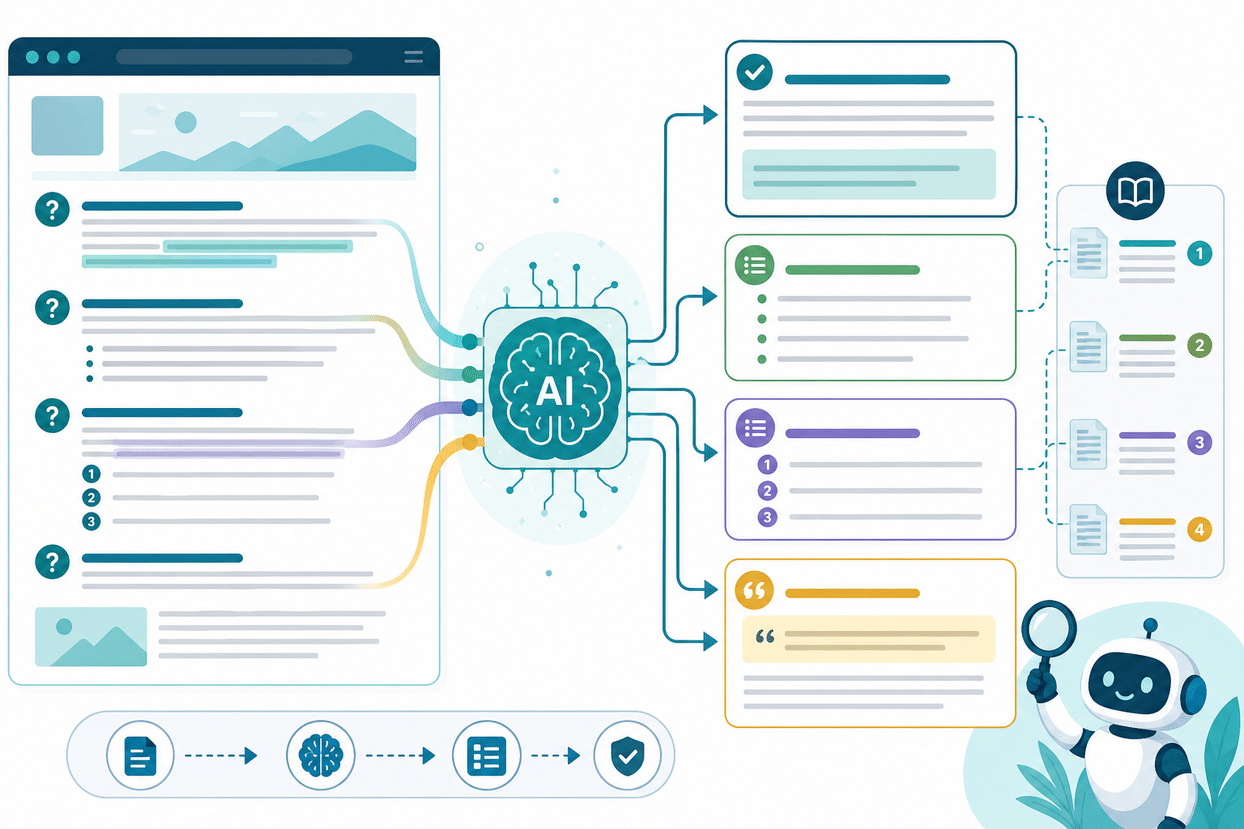
When AI Overviews and AI Mode generate answers, they may use a query fan-out technique, breaking the user’s original search into multiple related sub-questions, subtopics, data sources, and then looking for supporting webpages.
Even more crucially, Google explicitly says:
AI features will display a wider, richer, and more diverse set of links than classic web search.
That sentence is very important.
It’s almost a direct message to website owners:
AIO’s candidate pool is not the same as the candidate pool on a traditional search results page.
So, the judgment in the article’s title—
“Google AI Overviews citations don’t fully match traditional rankings” —isn’t an emotional opinion; it’s essentially a public fact.
So, the Question: Are Question-Led Pages More Likely to Be Cited?
My assessment is:
Yes, but only if it’s genuinely a “page that answers a question,” not a “regular advertorial page with a pseudo-Q&A title.”
Because AIO is fundamentally doing one thing:
It needs to quickly piece together an answer that is reliable, clear, and expandable.
Question-led pages are naturally better suited for this task.
Why? Because They Align with Several Basic Preferences for AI Answer Extraction
| Dimension | Generic Content Page | High-Quality Question-Led Page |
|---|---|---|
| Query Match | Often too broad | Directly aligns with user question |
| Answer Extraction | Often requires whole-page understanding | Easier to extract core paragraph |
| Structure Clarity | Prone to being scattered | Usually more focused |
| Sub-Question Expansion | Doesn’t necessarily cover | Easier to expand along fan-out |
| Citation Likelihood | Depends on overall authority | Depends on “answering a specific sub-question” |
In other words, AIO isn’t just looking for “high-authority sites.”
It’s also looking for:
- Which paragraph can answer this specific question
- Which page can fill the missing context in the current answer
- Which source is better suited to be woven into a comprehensive answer
That’s where question-led pages have an advantage.
They don’t try to cover a little bit of everything like traditional homepages, brand pages, or general overview pages. They’re designed to address a single question.
But Don’t Misunderstand: It’s Not “Question Headline” That Wins, but “Citable Structure” That Wins
When many people hear that “question pages are more easily cited,” they immediately create ones like:
- What is XXX?
- Why is XXX important?
- What is the difference between XXX and YYY?
But then the main body is still a large block of fluff, full of filler, and the answer appears slowly.
Such pages are not necessarily more likely to be cited.
The pages that genuinely have a better chance typically share these characteristics:
1. Gives the Answer Quickly at the Start
Answer first, then elaborate.
Don’t set the stage with 800 words of background before finally getting to the point.
2. Clear Hierarchies Between Paragraphs
For example: definition, cause, scenario, comparison, steps, misconception, conclusion.
This structure is ideal for AI extraction.
3. One page solves one main problem, but covers relevant sub-problems along the way.
This is especially important.
Because Google’s fan-out doesn’t just look at the original query.
It also expands into:
- Is this a ranking issue?
- Is there any content structure impact?
- Does the video have an advantage?
- Are FAQs helpful?
- Which type of page is more likely to earn citations?
If your page naturally covers these related angles, it has a higher chance of being seen.
4. The page contains clear judgment sentences, comparison blocks, tables, and step blocks.
These aren’t just for "looking good."
They are designed to make the answer easier for machines to understand and for people to scan.
5. Content is text-visible, not solely expressed through images or complex interactions.
Google has explicitly stated that important content should be provided in a textual form.
This is particularly crucial for AIO.
So why is using We0.ai for this type of page actually more suitable?
Because what truly stumps many people on this topic isn’t "I don’t know that problem pages are important."
It’s:
Can I consistently and systematically create problem pages and turn them into a content asset that grows?
That’s where We0.ai adds more value.
We0.ai is not just an ordinary AI builder that "generates a page in one sentence."
It’s better suited for building showcase websites + SEO/GEO content strategy + sustained growth.
In other words, you’re not just making a single page and calling it done.
You are building a pipeline:
Build → Showcase → Grow → Leads
The advantages of using We0.ai for problem-based pages typically manifest in these layers
1. Easier to mass-produce pages with clear structures
Problem pages dread two things:
- Inconsistent page structure
- Low content publishing efficiency
We0.ai is ideal for turning FAQ pages, solution pages, comparison pages, scenario pages, and long-tail query pages into a structured asset, rather than publishing them in a scattered, piecemeal fashion.
2. Easier to integrate content with landing pages.
Many content teams face this awkward problem: articles are separate, products are separate, and the conversion path is broken.
But for AI search traffic, being “cited” is not the end; what follows—the engagement—is crucial.
We0.ai is better suited for placing:
- Problem pages
- Service pages
- Product introduction pages
- Case study pages
- Inquiry pages
all within the same growth logic.
3. Easier to create content clusters, rather than betting on individual pages.
AIO increasingly looks like it cares about topic coverage, not just individual point pages.
Therefore, a more valuable strategy is to create a group of problem pages that support each other:
- Core definition page
- Comparison page
- Tutorial page
- Misconception page
- Scenario page
- Expanded FAQ page
This is a more sustainable long-term approach than gambling on one “viral article.”
4. Better suited for continuous iteration.
AI Overviews results are not static.
Citations can change based on time, query specifics, or context.
So, a page is not finished once it’s published.
You need to continuously supplement with:
- New questions
- New comparisons
- New case studies
- New data
- New media formats
We0.ai is more suitable for this cycle of continuous optimization.
What is truly more likely to be cited is not the phrase “problem page,” but this model for the page itself.
If you ask me what kind of problem page is more likely to enter AIO's candidate pool, I would give you this template:
An AIO-friendly problem page structure
- Title directly corresponds to a real user search query.
- First 2-4 sentences give a clear conclusion.
- Use H2 headings to structure: What is / Why / Is it / How to / Common Misconceptions.
- Include tables, step blocks, and comparison blocks.
- Add a section for related sub-problems (FAQ).
- Connect topic clusters with internal links.
- Naturally lead to a product or service action at the end.
This structure works well for both SEO and GEO/AIO.
A realistic assessment: Problem-based pages are more likely to be cited, but it doesn’t mean you can neglect traditional SEO.
This also needs to be stated clearly.
Don't interpret this article as "traditional rankings no longer matter."
Google has clearly stated: AI features are still built on the foundation of standard SEO.
Pages need to be indexed, be eligible for snippets, have crawlable and accessible content, and comply with policies. These are all prerequisites.
So, a more accurate statement is:
Traditional SEO is still the foundation. AIO citation optimization is the optimization of the source selection built upon that foundation.
This means:
- You can't talk about AIO without getting indexed.
- You can't talk about AIO with poor page experience.
- You can't talk about AIO with thin content.
- You can't talk about AIO with just a question in the title but no answer structure.
If you were to start today, how would you implement it?
You can follow this sequence directly.
Step 1: Convert target keywords into "query clusters."
Don't just list one main keyword.
List out the sequential questions a user might ask.
For example, surrounding this topic, you could break it down into:
- Are AI Overviews citation sources the same as traditional rankings?
- Why is a page ranking high but not cited by AIO?
- Does query fan-out affect content visibility?
- Are FAQ pages more likely to be cited by Google AI?
- How should a problem page be written to be better suited for AIO?
Step 2: Use We0.ai to build a content cluster, not just publish a single article.
Plan the core page, sub-problem pages, comparison pages, and case study pages together.
Step 3: On every page, "answer first, then elaborate."
Don't write slow-burn content.
Step 4: Add scan-friendly structures to the page.
Tables, lists, steps, and conclusion blocks are a must.
Step 5: Monitor which pages have impressions, clicks, but no conversions.
Because the true value isn't a "screenshot of being cited," but whether it can subsequently lead to:
- Time on page
- Deep reading
- Sign-ups
- Inquiries
- Leads
This is precisely where We0.ai excels in follow-up.
Key Conclusion Block
The citation sources for Google AI Overviews are increasingly less like a simple map of traditional organic blue link rankings.
Problem-based pages are more likely to be cited, not because they look like FAQs, but because they are better suited for answering the specific sub-questions that emerge from fan-out.
We0.ai's value is not just in helping you generate a page, but in helping you turn problem pages into a content asset that is liveable, operable, growable, and capable of capturing leads.
Frequently Asked Questions
1. Are Google AI Overviews citation sources completely different from organic rankings?
They aren't completely different, but they are definitely not the same either. Google mentions that AI Overviews uses query fan-out, and Ahrefs research shows only about 38% of cited pages are also in the Top 10 for the same query.
2. Are problem-based pages always more likely to be cited than regular articles?
Not necessarily. The advantage is only clear when the page actually answers the question effectively, has a clear structure, and covers relevant sub-problems.
3. Is it useful to just change the title into a question?
The help is very limited. What truly matters is the answer structure, information density, extractability, and topic coverage.
4. Do I still need traditional SEO when optimizing for AIO citations?
Yes. Basic SEO is a prerequisite, not an option. A page must first be crawlable, indexed, and visible before being cited.
5. What type of team is We0.ai better suited for in making these kinds of pages?
It's more suitable for teams that need to operate their official website, content, SEO/GEO, case study pages, and inquiry pages within a single growth system. Examples include SaaS companies, AI products, consulting firms, foreign trade showcase sites, and independent developer project sites.
Related Tools
References
- 《AI Features and Your Website》 — Google Search Central
- 《Update: 38% of AI Overview Citations Pull From The Top 10》 — Ahrefs
- 《Google AI Overview Citations From Top-Ranking Pages Drop Sharply》 — Search Engine Journal
Ready to Get Started?
If you’ve realized that the future of content competition isn’t just about “who ranks highest,” but who is more easily selected, understood, cited by AI, and ultimately drives high-quality clicks, then it’s time to stop focusing on individual articles.
What’s more worthwhile is turning question-driven pages into a complete growth asset.
With We0.ai, you can quickly link your homepage, content pages, FAQ pages, comparison pages, case study pages, and conversion pages into a single growth path—rather than stopping once a page is published.
Summary
So, back to the original question.
The citation sources in Google AI Overviews are not exactly the same as traditional rankings.
And this gap will likely continue to widen in the future.
Amid these changes, question-driven pages do stand a better chance of being cited. But the precondition is that they must be genuinely built around user questions, with a content structure that is extractable, scalable, and verifiable.
As for why We0.ai is a better fit for this?
Because it helps you do more than just “publish a few more articles.”
It turns these pages into a website system that can continuously showcase, grow, and acquire customers.