Google AI Overviews Lawsuit Explained: What AI Search Liability Means for Websites and Brands
Google AI Overviews lawsuits and complaints are reshaping how website owners, publishers, and brands think about AI search. This guide explains the legal pressure around AI-generated summaries, including publisher traffic disputes, content consent arguments, antitrust complaints, false-answer liability, and brand safety risks. It also explains what AI search liability means for websites and brands, how AI Overviews change source attribution and click behavior, and what companies should do to protect visibility, accuracy, reputation, and customer trust in the AI search era.
Google AI Overviews Lawsuit Explained
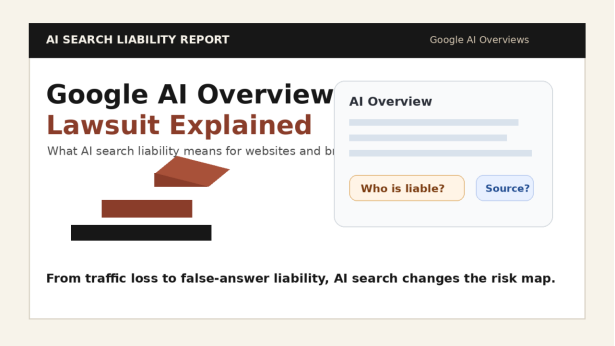
The legal fight over Google AI Overviews is not only a publisher problem. It is a preview of how AI search liability may affect almost every website and brand that depends on search visibility, reputation, and user trust.
At the center of the debate is a simple but uncomfortable question: when an AI search engine summarizes the web, who is responsible for the summary? Is the platform just pointing to information, like a traditional search engine? Or is it creating a new statement that can reduce traffic, distort meaning, or damage a brand?
That question is no longer theoretical. Penske Media, the owner of Rolling Stone, Billboard, Variety, and other titles, sued Google over AI Overviews in 2025, arguing that the feature uses publisher content in AI-generated summaries and reduces traffic to original websites. European publisher groups have also filed antitrust complaints around AI Overviews. In Germany, a court ruling found Google liable for false statements generated by AI Overviews, with Google saying it would appeal.
The details differ across cases, but the direction is clear. AI search is moving from a marketing issue into a legal and business-risk issue. Websites and brands now have to think about visibility, source attribution, traffic loss, defamation risk, and content control at the same time.
What is Google AI Overviews?
AI Overviews are Google Search features that generate a snapshot of key information for some queries, with source links that users can open for more detail. Google describes AI Overviews as a way to make searching faster and easier, and its documentation tells website owners that AI features such as AI Overviews and AI Mode draw from Search systems and may show links in different formats.
For users, this can feel convenient. Instead of clicking several links, they get a synthesized answer at the top of the results page. For website owners, the same feature creates a harder question. If the answer satisfies the search intent, will the user still click through? If the answer cites a source but paraphrases it incorrectly, who owns the mistake? If the brand is summarized inaccurately, how quickly can it be corrected?
This is why AI Overviews sits at the intersection of search, publishing, reputation, competition, and liability. It is not simply a new search feature. It changes where users see information, how sources are credited, and who controls the first impression.
Why publishers are suing or complaining
The publisher argument is mostly about control and economics. Traditional search sends users to web pages. AI-generated summaries may answer the query before the user visits the source. Publishers argue that this weakens the exchange that made search work: websites produce content, search engines index it, and users click through to the original page.
Penske Media argued that Google was using its journalism in AI Overviews without proper consent while making search visibility difficult to separate from AI summary use. Reuters reported that Penske described the case as the first major U.S. publisher lawsuit directly challenging Google AI Overviews in court. The lawsuit matters because it frames AI search not just as a copyright or traffic dispute, but also as an antitrust problem: if a dominant search engine controls both discovery and AI summarization, what real choice do publishers have?
European publisher complaints follow a similar logic. Publisher groups have argued that AI Overviews can divert traffic and revenue while giving publishers no practical opt-out that preserves ordinary search visibility. Google, meanwhile, says AI experiences can create new opportunities for discovery and include links to sources.
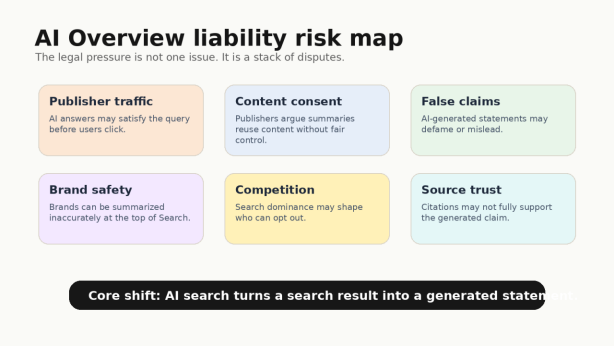
The German ruling adds a different kind of risk
The German case is important because it is less about traffic and more about false-answer liability. Reuters reported that Google planned to challenge a German court ruling holding it liable for misinformation in AI Overviews. According to reports, the Munich court treated the AI-generated statements as Google’s own content rather than merely third-party information displayed in search results.
That distinction could become one of the most important legal questions in AI search. Traditional search engines often point to external sources. AI search systems synthesize information into a new answer. If that answer contains false claims, defamatory statements, or misleading associations, courts may ask whether the platform created a new statement and therefore should bear responsibility.
For brands, that is a major shift. A wrong blue link is one kind of problem. A wrong AI-generated statement at the top of search is a different kind of problem because it can look authoritative, appear before organic results, and shape user perception before the brand has a chance to respond.
What AI search liability means for websites
For websites, AI search liability creates two parallel risks. The first is economic: fewer clicks, lower organic traffic, weaker affiliate revenue, reduced ad impressions, and less control over the user journey. The second is informational: the possibility that AI-generated summaries misrepresent what a page says, cite the wrong source, or omit important context.
A website owner can no longer measure only rankings. A page might still rank, but users may stop at the AI Overview. A page might be cited, but the summary may not fully support the claim being made. A page might be used as a source, but the brand may not receive the traffic or context that made the content valuable in the first place.
This does not mean websites should block all AI systems or stop investing in search. It means the strategy has to mature. Websites need clearer source pages, better factual structure, stronger brand definitions, and monitoring for how AI systems describe them. Visibility without accuracy is risky. Accuracy without visibility is invisible.
What AI search liability means for brands
For brands, the issue is not only whether AI Overviews sends traffic. The issue is whether AI search becomes a public reputation layer. If an AI-generated answer says the wrong thing about a company, product, founder, safety issue, pricing model, policy, or controversy, the damage can happen before the user clicks anywhere.
This is especially serious for regulated or trust-sensitive categories such as health, finance, legal services, education, cybersecurity, public companies, and consumer safety. But the risk is broader than regulated industries. A local business can be summarized incorrectly. A software company can be described with outdated information. A creator or consultant can be associated with the wrong offer. A publisher can be cited but not clicked.
Brands should treat AI search as part of reputation management. That means monitoring important queries, keeping official pages clear and current, correcting outdated third-party information where possible, and making the brand’s own website the most reliable source for definitions, policies, pricing, product claims, and contact details.
The liability debate in one table
Issue | What plaintiffs argue | What brands should watch |
Traffic loss | AI answers reduce clicks to original pages. | Organic traffic, CTR, referrals and revenue mix. |
Content use | Publisher content is summarized without fair control. | How your content appears in AI summaries. |
False claims | AI-generated statements can mislead or defame. | Brand queries, product claims and high-risk topics. |
Opt-out pressure | Publishers may lose visibility if they restrict use. | Robots settings, indexing and content access. |
Source attribution | Citations may not fully support the answer. | Whether cited pages match the AI claim. |
Competition | Search dominance may shape publisher choice. | Dependency on one discovery platform. |
The website response: from SEO to evidence strategy
The response to AI search liability is not panic. It is evidence strategy. Websites and brands need pages that are easier for search engines, AI systems, journalists, customers, and regulators to understand.
That starts with official source pages. If a brand has one clear page explaining its products, pricing, policies, founders, claims, safety notes, and contact routes, AI systems have a better source to use. If the official site is vague, outdated, or fragmented, AI systems may rely on weaker sources.
This is where SEO and GEO meet legal risk. Traditional SEO helps pages be discovered. GEO, or generative engine optimization, tries to make content easier for AI answer engines to select and summarize. But in a liability context, the goal is not only visibility. The goal is accurate visibility.
A good page should make the claim, explain the context, show the evidence, and point to the next step. That is useful for users. It is also useful for AI systems that need clean information. And if a false claim appears, a clear official source gives the brand stronger material for correction.
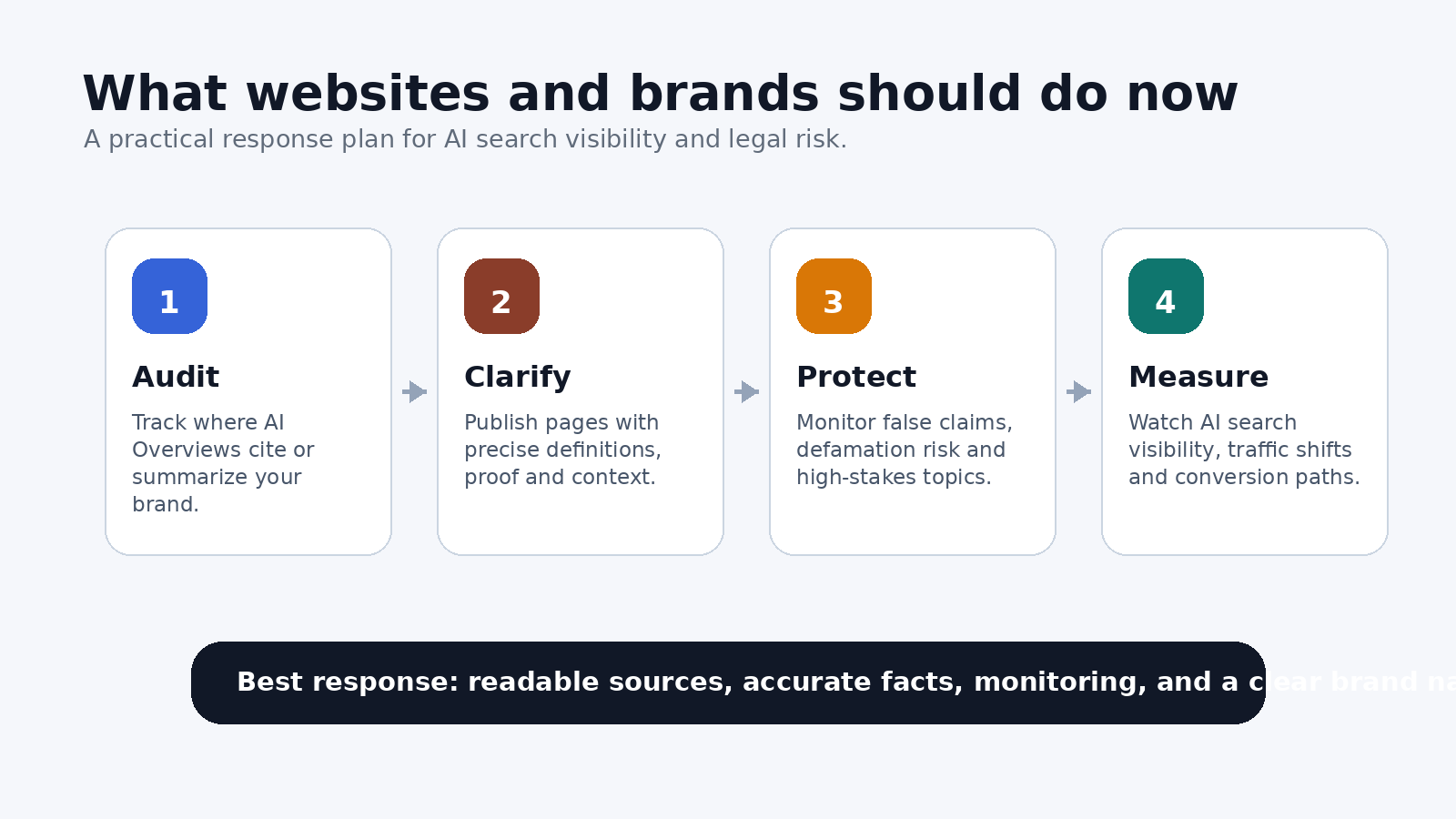
What websites and brands should do now
First, monitor the queries that matter. Search your brand name, product names, founder names, legal issues, customer complaints, industry comparisons, and high-intent purchase queries. Save examples where AI Overviews appears and note whether it cites accurate sources.
Second, strengthen official pages. Create clear pages for product facts, company background, pricing, policies, safety claims, case studies, and contact information. Avoid burying important facts in PDFs, vague marketing copy, or social posts that are hard to parse.
Third, write with source attribution in mind. Use descriptive headings, concise definitions, comparison tables, FAQs, dated updates, and proof. If a claim matters legally or commercially, support it with context. This does not mean stuffing pages with disclaimers. It means making the truth easier to find.
Fourth, prepare a correction workflow. If AI search produces a false claim about your brand, you need screenshots, query records, the exact wording, source pages, and a process for escalation. Treat it like a reputation issue, not just an SEO issue.
Fifth, diversify discovery. AI Overviews litigation shows the risk of depending too heavily on one traffic channel. Brands should build email lists, direct traffic, community, social distribution, partnerships, and content assets that do not rely entirely on one search interface.
What this means for content strategy
Content strategy has to move beyond ranking articles. Every important page should now answer three questions. Can a user understand it? Can an AI system summarize it accurately? Can the brand defend it if the summary is wrong?
That means the best content will be more precise. It will use clearer definitions, better examples, stronger evidence, and fewer vague claims. It will treat source pages as reputation infrastructure. It will also assume that users may meet the brand through an AI-generated summary before they ever visit the website.
For publishers, the fight is partly about economics and control. For brands, the practical lesson is about accuracy and preparedness. If AI search becomes the new front door to the web, your official website needs to be the most reliable source in the room.
Final takeaway
The Google AI Overviews lawsuits and complaints show that AI search is not just a feature upgrade. It changes who controls the answer, who receives the click, and who may be responsible when the answer is wrong.
For websites, the risk is losing traffic and attribution. For brands, the risk is losing control of the first impression. For publishers, the risk is that the web’s old traffic exchange becomes weaker. For search platforms, the risk is that AI-generated summaries may be treated as new statements rather than neutral links.
The safest response is not to disappear from AI search. It is to become easier to understand accurately. Build clearer source pages. Monitor AI results. Protect brand facts. Make evidence visible. And treat AI search liability as part of modern website strategy.
CTA
If your brand depends on search visibility, treat AI search as both a growth channel and a liability surface. Audit your pages, monitor your most important queries, and make your official website the clearest source for accurate information.
FAQ
What is the Google AI Overviews lawsuit about?
The main disputes involve AI-generated summaries, publisher content use, traffic loss, antitrust arguments, and liability for false or misleading AI-generated statements.
Why does AI search create liability risk?
AI search can generate new summaries rather than simply list links. If the summary is false, misleading, or damaging, courts may ask whether the platform created a new actionable statement.
How can AI Overviews affect websites?
AI Overviews can reduce clicks, change source attribution, summarize pages without full context, and alter how users discover brands and publishers.
What should brands do about AI search risk?
Brands should monitor key queries, strengthen official source pages, keep facts current, document false claims, and build a correction workflow.
Is this legal advice?
No. This article is a business and content strategy explanation. Brands facing legal exposure should consult qualified counsel.
Related Tools
- ChatGPT
- Ahrefs
- Semrush
Sources
- AI Guide