Google AI Overview Says You're Not Good, but Google Ads Is Still Running Ads for You: Should Businesses Fix Ads or GEO First?
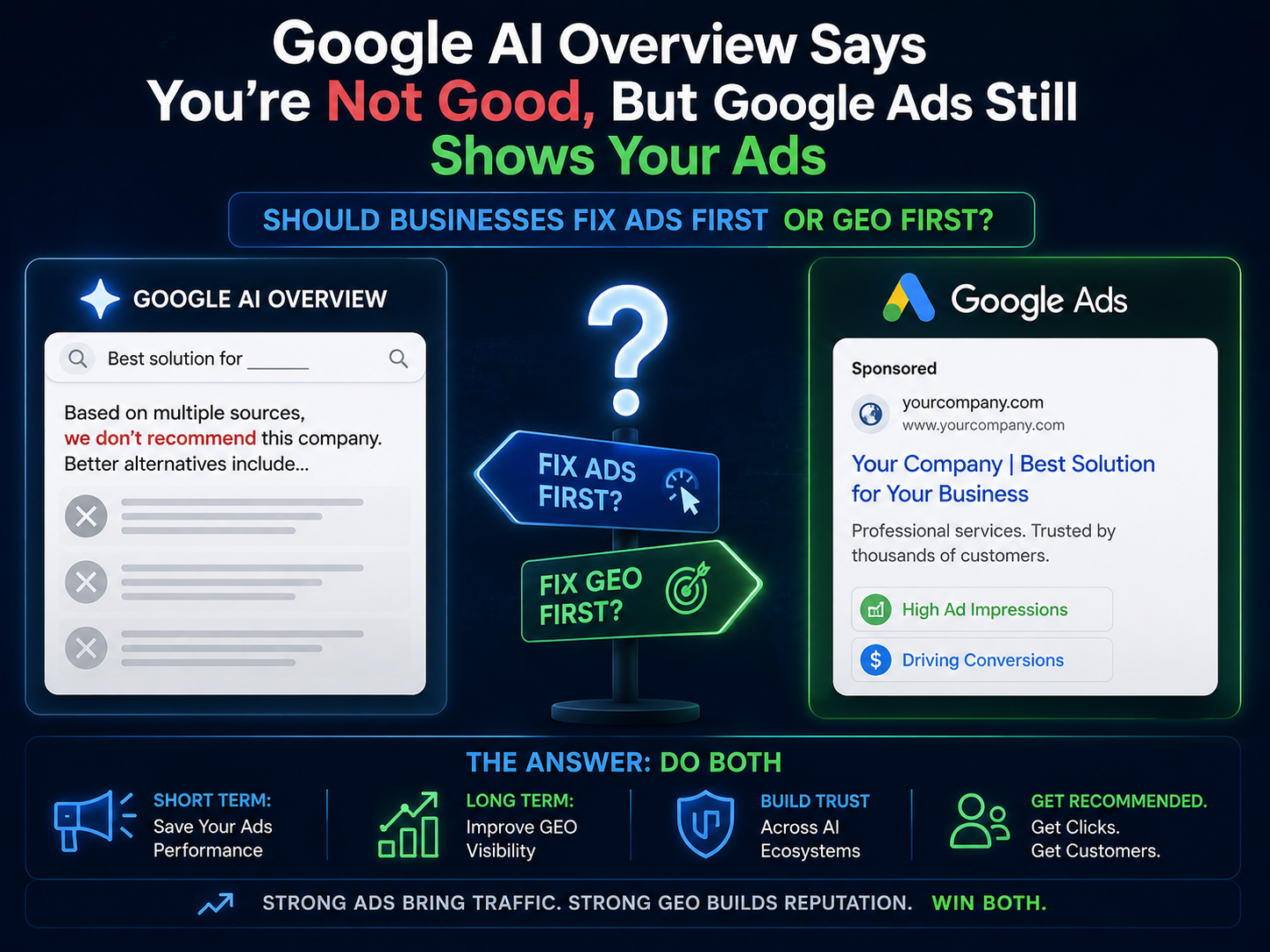
Some businesses are in an awkward position right now. Google AI Overview seems to be saying: your page isn't strong enough, your brand isn't credible enough, you're not the answer I'd proactively recommend. But on the other hand, Google Ads is still running, clicks are still coming in, and inquiries haven't dried up. The easiest mistake to make at this point is to get carried away by 'GEO anxiety.' Actually, the order isn't necessarily: do GEO first. In many cases, the right order is: first save what directly brings in revenue, then save what affects long-term distribution. In short: ads are today's revenue, GEO is tomorrow's gateway. If ads are still steadily bringing in leads today, the first thing you should do is not chase the vanity metric of 'AI finally wants to cite me,' but rather fix the funnel first. Because GEO sounds too 'futuristic.' It sounds like a very respectable term: - more advanced - more cutting-edge - more like the next generation of search - more like a brand upgrade. But running a business isn't about putting on a conceptual exhibition. The questions a business must answer first are: Can customer acquisition this month be more stable? Can this week's conversions be higher? Can the money being spent right now be wasted less? If the ad system can already deliver results, even if imperfect, you should fix it first. Because ads are your shortest path to revenue. GEO is important, but it's usually more like long-term asset building. This point is crucial. When many people hear 'fix ads first,' they misinterpret it as: Not that. The priority order is different.
Google AI Overview Says You're Not Good, but Google Ads Is Still Running Ads for You: Should Businesses Fix Ads or GEO First?
Some businesses are finding themselves in a very awkward spot right now.
Google AI Overview seems to be saying: your page isn't strong enough, your brand isn't credible enough, you're not the answer I'd proactively recommend.
But on the other side, Google Ads are still running, clicks are still coming in, and leads haven't dried up.
The easiest mistake to make at this point is to get swept up in "GEO anxiety" first.
But the order isn't necessarily: do GEO first.
In many cases, the right order is actually: save what brings in money directly first, then fix what affects long-term distribution.
Start with a very realistic assessment
| Situation | What it means | Priority |
|---|---|---|
| You're not showing up in AI Overview | Your content, structure, credibility, or semantic clarity isn't strong enough | Needs fixing, but not necessarily first |
| Google Ads are still generating orders | You still have a cash flow entry point | Protect this first |
| Ad clicks are getting expensive, conversions are dropping | Your funnel has a problem | Fix this first |
| Both organic traffic and AI referrals are weak | You need to build your GEO / SEO foundation | Second-phase priority |
In short: ads are today's revenue; GEO is tomorrow's gateway.
If ads are still bringing in leads consistently today, the first thing you should do isn't chase a vanity metric like "AI finally cited me"—it's fixing your ad funnel.
Why do so many people get the order wrong?
Because GEO sounds too "future-forward."
It sounds like a very respectable term:
- More advanced
- More cutting-edge
- More like next-generation search
- More like a brand upgrade
But running a business isn't about putting on a concept exhibition.
The questions a business needs to answer first are:
Can this month's customer acquisition be more stable?
Can this week's conversions be higher?
Can the money we're spending right now be wasted a little less?
If the ad system is already delivering results, even imperfect ones, you should fix it first.
Because ads are your shortest path to getting paid.
GEO is important, but it's usually more like mid-to-long-term asset building.
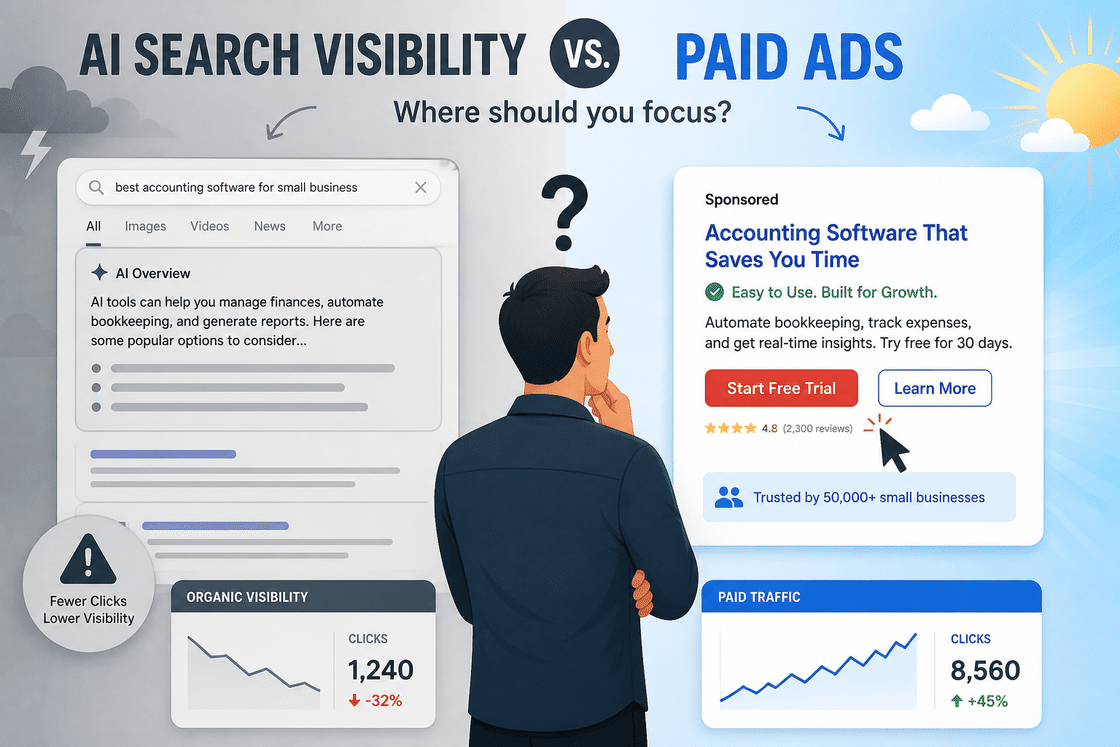
Fixing ads first doesn't mean abandoning GEO
This is crucial.
When people hear "fix ads first," some misunderstand it as:
So GEO doesn't matter anymore?
No.
It's about sequencing.
Here's how you should think about it:
- Ads: Stop the bleeding first, keep leads coming
- GEO: Then rebuild the foundation, making future AI search and organic distribution more stable
- SEO + content + page structure: The shared foundation for both
If your website is fundamentally poor, ads will get more expensive over time.
If your content is weak, AI won't like you any more than it does now.
If your pages aren't clear, traffic from ads will drop off.
So this isn't an either/or.
It's about what comes first.
A more practical sequence: fix the funnel first, then fix distribution
Layer 1: Fix the ad funnel first
Look at these points:
- Does the landing page deliver on the ad's promise?
- Is the CTA clear?
- Is the form too long?
- Does it convert smoothly on mobile?
- Are there enough trust signals?
- Is the conversion path too convoluted?
If any of these are off, fix them first.
Because these are the most direct points of waste.
Layer 2: Then fix GEO-related content
Focus on:
- Whether the page can be clearly understood
- Whether core questions are thoroughly answered
- Whether there's enough entity information, case studies, and evidence
- Whether the structure is clear, citable, and extractable
- Whether it can handle complex Q&A scenarios
This part affects your visibility in AI search.
But it's usually not a "change today, explode tomorrow" kind of thing.
Google itself has already made this clear
Google's official statements aren't that mystical at their core.
- AI Overviews and AI Mode will show relevant links to help users explore further
- These capabilities are still built on core search ranking and quality systems
- SEO fundamentals still work
- Pages need to be crawlable, indexable, and understandable
- Content needs to be helpful, reliable, and people-first
In other words, GEO isn't starting from scratch.
It's more like:
Taking what's actually useful in traditional SEO and doing it more completely.
So if you haven't even gotten your ad pages right yet, don't rush ahead fantasizing about AI citing you spontaneously.
How should businesses actually choose?
Let me give you a very blunt but practical framework:
Fix ads first, if:
- Ads are still generating leads
- Spend isn't wildly unreasonable
- The business needs results this month
- Cash flow pressure is higher
- The sales team needs leads right now
Fix GEO first, if:
- Ads have clearly stopped working
- Clicks are very expensive, lead quality is poor
- Both branded and non-branded search are weak
- You want to build long-term content assets
- Your website is naturally suited for showcasing, comparing, and explaining
Do both together, if:
- You have the budget
- You have a content team
- Your site structure can be changed
- You're aiming for long-term growth, not short-term firefighting
What truly deserves fixing first isn't the word "GEO"—it's the website itself
Many businesses frame their problem as "GEO," but the real issue isn't GEO.
It's:
- Pages aren't clear enough
- Value proposition isn't strong enough
- Evidence isn't sufficient
- Content lacks hierarchy
- Site structure is too messy
- Conversion paths are too scattered
These problems don't just affect AI Overview.
They also affect:
- Ad conversion rates
- Organic click-through rates
- Brand trust
- Sales follow-up efficiency
So you'll find that what really needs fixing first often isn't "a specific channel"—it's "the whole display website."
This is also what We0 AI frequently does: not just building you a page, but connecting site building, display, SEO/GEO, content, and growth into one flow.
Because if a website is just "built" but can't continuously absorb traffic and leads, then it's not an asset.
For businesses, it's more like a three-step approach
Step 1: Rescue the ads first
Make sure current spend isn't leaking.
Step 2: Fill in the pages AI can read
Including homepage, service pages, case studies, FAQ, comparison pages, and scenario pages.
Step 3: Turn content into a long-term asset
Not just writing a few articles and calling it done.
It's about getting pages, case studies, FAQs, product descriptions, and content sites to work together.
That's when GEO starts to matter.
The conclusion is simple
If ads are still running and still generating orders, fix the ads first.
Not because GEO isn't important—quite the opposite. It's because you need to survive first before you earn the right to pursue long-term growth.
If ads are getting more expensive and more hollow, and your website can't clearly explain who you are, then you need to work on GEO and the site's foundation at the same time.
Don't treat GEO as some new-age mysticism.
At its core, it's still the same old wisdom:
Make your content clearer, make your page more credible, make your site a true asset that can be recommended, clicked, and converted.
FAQ
1. Are GEO and SEO the same thing?
Not the same, but the foundations are very close. GEO focuses more on visibility in AI search and generative results, while SEO remains the underlying foundation.
2. Will Google AI Overview replace ads?
Not in the short term. Ads and AI search are two different paths, and many businesses will be affected by both simultaneously.
3. If AI Overview doesn't cite me, does that mean my content is useless?
Not necessarily. But it usually means your content's credibility, structure, semantic expression, or page completeness isn't strong enough.
4. Do I have to choose between ads and GEO?
No. A more realistic approach is to stabilize cash flow first, then build long-term assets.
5. How can We0 AI help?
We0 AI is better suited as the growth foundation for showcase websites: from website building, content, SEO/GEO, to ongoing optimization and lead generation.
相关工具
- We0.ai Official Website
- Google Search Central: AI Features and Your Website
- Google's Guide to Optimizing for Generative AI Features on Google Search
- Your guide to Google Ads
- Google Ads Business Home
- Creating Helpful, Reliable, People-First Content
准备开始构建?
If you already have ads running but your website content and AI visibility haven't caught up, don't rush to change direction.
First, stabilize the channels that generate revenue, then build up the foundation for long-term growth.
We0 AI can help you put both on the same map: website building, display, SEO/GEO, content, growth, and customer acquisition.
结论
The real question has never been "should I prioritize ads or GEO first."
The real question is: Do you need cash flow the most right now, or long-term distribution capability?
Figure that out first, then decide how to allocate your budget.