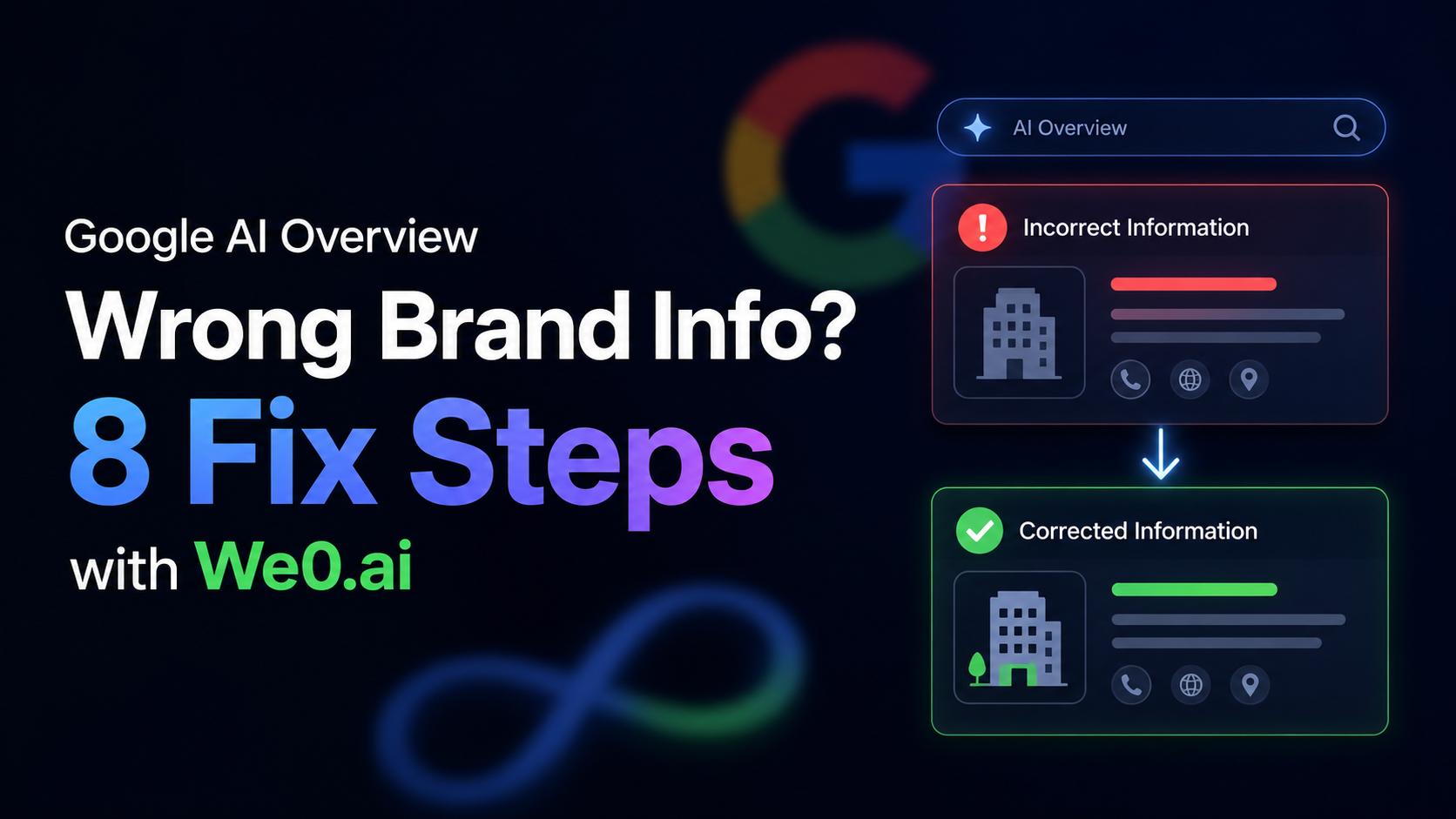
What to Do When Google AI Overview Gets Your Business Info Wrong? 8 Steps to Fix AI Brand Perception with We0.ai
Google AI Overview is convenient sometimes. But when it gets your business information wrong, the problem goes far beyond "a bit off." It might misstate your core business, mix up your address, service scope, founder information, or product positioning—or even present a competitor's content as part of your brand. **The most troubling part: users tend to treat AI answers as "official responses."** So brands can't just "correct one sentence." What really needs to happen is fixing the entire AI bra
What to Do When Google AI Overview Gets Your Business Info Wrong? 8 Steps to Fix AI Brand Perception with We0.ai
Google AI Overview is convenient sometimes. But when it gets your business information wrong, the problem goes far beyond "a bit off."
It might misstate your core business, mix up your address, service scope, founder information, or product positioning—or even present a competitor's content as part of your brand.
The most troubling part: users tend to treat AI answers as "official responses."
So brands can't just "correct one sentence." What really needs to happen is fixing the entire AI brand perception system.
And that's where We0.ai fits in well.
Because We0.ai isn't one of those tools that just "builds a page." It's more like a showcase website growth platform: first get the brand information structured correctly, then connect display, SEO/GEO, content, leads, and conversions together.
In other words, you're not just fixing one wrong piece of information—you're teaching Google how to know you all over again.
First, Diagnose: Why Does Google AI Overview Get It Wrong?
It's usually not a single-point problem.
| Common Cause | What It Looks Like | Result |
|---|---|---|
| Scattered brand information | Website, social media, directories, and press releases tell inconsistent stories | AI picks up a conflicting version |
| Weak page content | Website has only a one-line intro, no entity information | AI struggles to understand who you are |
| Missing structured data | No Organization / LocalBusiness / Product markup | Machines find it harder to confirm facts |
| Inconsistent external mentions | Third-party sites get your company name, core business, or address wrong | Errors get amplified repeatedly |
| Incomplete business pages | No case studies, FAQ, services page, or about page | Not enough credibility |
So fixing this isn't just "filing a complaint." Fixing means creating content, building structure, and ensuring consistency.
8 Steps to Fix AI Brand Perception
Step 1: Put Together an "Official Fact Sheet" First
Don't rush to rewrite articles—first fix the source of perception.
You need a brand fact sheet that includes at least:
- Full company name / English name
- Brand abbreviation
- Core business
- Target customers
- Key service scope
- Address / coverage area
- Contact information
- Founder / team information
- Common FAQs
- Content that must never be misstated
There's only one goal here: stop your own internal messaging from contradicting itself.
We0.ai's value is obvious here: it can first help you organize brand information into a unified structure, then push that information into your website, services pages, case studies, and FAQ.
Step 2: Turn Your Website into a Brand Hub That "AI Can Understand"
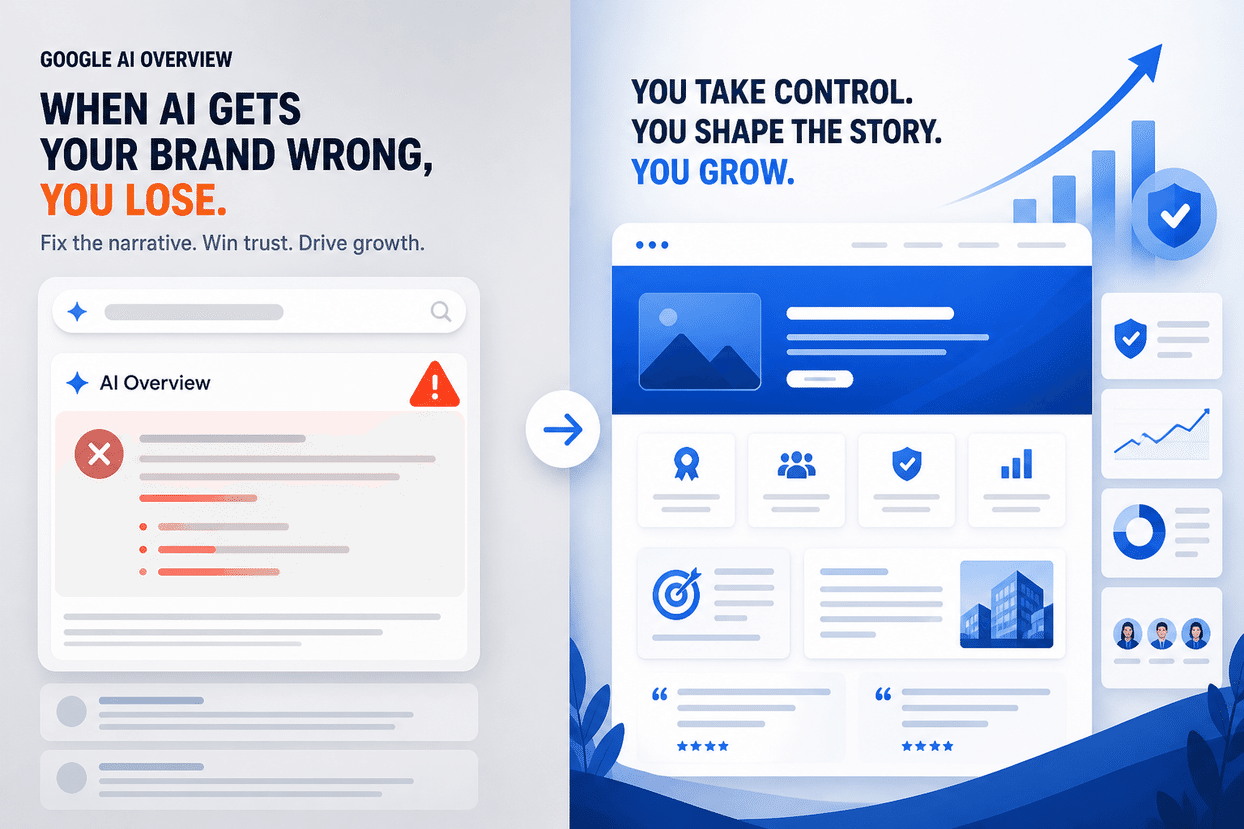
The biggest problem with many corporate websites isn't that they look bad—it's that the information is incomplete.
For AI to understand a brand, it doesn't just look at the homepage banner—it looks at the entire site's information density.
At minimum, you need to complete these pages:
- About / About Us
- Services / Products & Services
- Case Studies
- FAQ / Common Questions
- Contact / Contact Information
- Location / Regional Information (if applicable)
In one sentence: your website isn't a display poster—it's the foundation of facts.
We0.ai is particularly well-suited for this type of showcase website, because it doesn't just aim to "get it built"—it aims to go live, be explainable, and be understood by search engines.
Step 3: Unify Entity Information Across the Web
If your website says "AI Marketing Studio," LinkedIn says "Growth Agency," and a directory lists you as "SEO Consultant," AI is likely to get confused.
So what you need to do is:
- Unify the brand name
- Unify the core description
- Unify contact information
- Unify logo, avatar, and bio
- Unify address and service scope
The stronger the entity consistency, the easier it is for AI to recognize you as a stable entity.
This isn't magic—it's fundamental.
Step 4: Add Structured Data, But Don't Over-Rely on It
Structured data isn't a silver bullet, but it's still important.
Priority checks:
- Organization
- LocalBusiness
- Product
- Service
- FAQPage
- Article
The point isn't "how much schema you add," but that the schema matches the visible text on the page.
Google has also explicitly stated: there are no special hidden requirements—pages just need to be indexable, crawlable, have clear content, and structured data must match visible content.
Step 5: Build a "Brand Keyword + Question Keyword" Content Matrix
If people searching your brand only see fragmented information, AI is naturally more likely to piece things together wrong.
You need a set of content that continuously explains who you are:
- What we are
- What we do
- What we don't do
- Who we're for
- Why choose us
- How we differ from competitors
- Questions customers commonly ask
- Use cases / service scenarios
This step is critical.
Because AI doesn't just read one sentence on your homepage—it's more like assembling a "brand puzzle."
We0.ai handles this smoothly: it can tie together your website, content pages, case studies, FAQ, and landing pages into one complete showcase site, then you can build out SEO and GEO strategies on top of that.
Step 6: Strengthen Third-Party Trusted Sources
Relying on your website alone isn't enough.
If Google sees a bunch of outdated, incorrect, or duplicate information across the external web, it may still keep citing the wrong version.
You can strengthen these places:
- Google Business Profile
- Major industry directories
- Media coverage / interviews
- Social media profiles
- Review pages / case study mentions
- Partner pages
The goal isn't to "show presence"—it's to make trusted information more evenly distributed.
Step 7: Continuously Monitor with Search Console and Page Performance
Fixing things isn't the end.
You need to watch these signals:
- Changes in brand keyword search results
- Whether AI Overview is still citing incorrect information
- Whether page click-through rates are improving
- Whether time-on-site is increasing
- Whether inquiries are increasing
Google has also said that AI features' traffic will show up in Search Console, and you should review it alongside Analytics.
In short: don't just look at "whether it's fixed"—look at "whether the brand is now easier to be trusted after the fix."
Step 8: Build a "Continuous Repair" System—Don't Make It a One-Time Project
Brand perception doesn't end after you fix the pages once.
You need an ongoing system:
- Check brand keyword results monthly
- Update FAQ and case studies monthly
- Check external mentions monthly
- Add new content monthly
- Review whether AI citations have changed monthly
AI perception drifts. If you don't maintain it, it gradually drifts off course.
This is also why We0.ai is more of a "growth platform" than an ordinary website builder.
It can put content updates, SEO/GEO, page optimization, and lead conversion into one single pipeline, rather than finishing the job and walking away.
A Comparison Table to See the Difference at a Glance
| Approach | Short-Term Results | Long-Term Results | Recommended? |
|---|---|---|---|
| Only relying on platform feedback | May ease things slightly slower | Unstable | Not enough |
| Only rewriting homepage copy | Superficial improvement | Brand perception is still messy | Not enough |
| Building a brand facts sheet + official website + content matrix | Stable recovery | Continuous strengthening | Recommended |
| Using We0.ai to unify showcase site, SEO, content, and conversion | Recovery + growth in one go | Better suited for long-term brand assets | Most recommended |
Why Is We0.ai a Good Fit for This?
Because what it solves isn't "whether the page exists," but:
Can this brand be correctly understood by AI?
We0.ai's approach is well suited for the following scenarios:
- Companies with outdated or disorganized website information
- Service-based companies
- SaaS / AI product teams
- Foreign trade companies
- Consultants / Agencies
- Teams looking to plan for brand keywords and long-tail keywords
Its value chain is very clear:
Build -> Showcase -> Grow -> Leads
First build, then showcase, then grow, and finally capture leads.
This is closer to real business outcomes than merely creating a "nice-looking page."
FAQ
1. Google AI Overview got our company information wrong. Can it be fixed immediately?
Not necessarily. Usually, you first need to correct the official website and external information, then give Google some time to recrawl and re-understand it.
2. Is it enough to only update the homepage of the website?
It helps a little, but it's not enough. It's best to also fill out the About page, Services page, FAQ, and case study pages.
3. Can structured data directly correct errors?
It can't "force a correction" directly, but it can help machines understand page content more clearly.
4. How far can We0.ai help?
It can help you unify brand information, website structure, content pages, and growth paths to reduce AI confusion about your brand.
5. Is this exclusively a GEO problem?
Not entirely. It's the combined result of SEO, brand information management, content strategy, and AI search understanding.
相关工具
- We0.ai
- Google Search Console
- Google Business Profile
- AI Features and Your Website
- Google's Guide to Optimizing for Generative AI Features on Google Search
准备开始构建?
If your brand is already being cited by AI search, don't just focus on whether it's "right."
What matters more is: Does it understand you? Is that understanding stable? Could it get it wrong again?
We0.ai can help you connect brand display, search visibility, and lead conversion into one flow. It's not about fixing things once, but turning brand perception into a sustainable, maintainable asset.
结论
Google AI Overview getting your company information wrong is not a small issue.
But it's also not unsolvable.
What truly works isn't chasing down a single wrong statement and filing complaints everywhere—it's going back to the fundamentals of brand information: unifying the facts, filling out the website, strengthening content, reinforcing external credibility, and then using continuous monitoring to gradually pull brand perception back on track.
That's exactly where We0.ai fits in best.
What it does isn't one-off point fixes—it turns showcase, SEO/GEO, content, and lead acquisition into one complete pipeline.