Google Ads Is Fully Shifting to AI Max: How Businesses Can Use We0.ai to Build an Ad Landing Page System That AI Can Choose More Accurately?
This time, Google Ads is not making small tweaks. It is gradually pushing Search ads into a new logic: instead of manually choosing keywords, AI helps you choose intent; instead of writing just one ad, AI helps you assemble content; and instead of giving just one landing page, AI will find a more suitable page. That's a problem. It means many businesses' old approach of "one campaign with one page, as long as it runs, it's fine" is starting to become insufficient. Because as the system becomes more AI-driven, what determines success is not just the ad account itself, but your entire site structure. Does your page have a clear theme? Is there a clear enough product/service hierarchy? Are there content signals that AI can understand? Are there page groups that can cater to different search intents? Simply put, in the AI Max era, the competition is not about "bidding more aggressively," but about "making your page system more like a map that AI can read." And this is exactly what We0.ai excels at. Google has officially made AI Max very clear. It is not a new campaign type, but an optimization layer within Search campaigns. The core is three things: The official documentation also explicitly states that AI Max will use landing page content, assets, and keywords to optimize ad relevance, and will also direct traffic to pages with high query relevance.
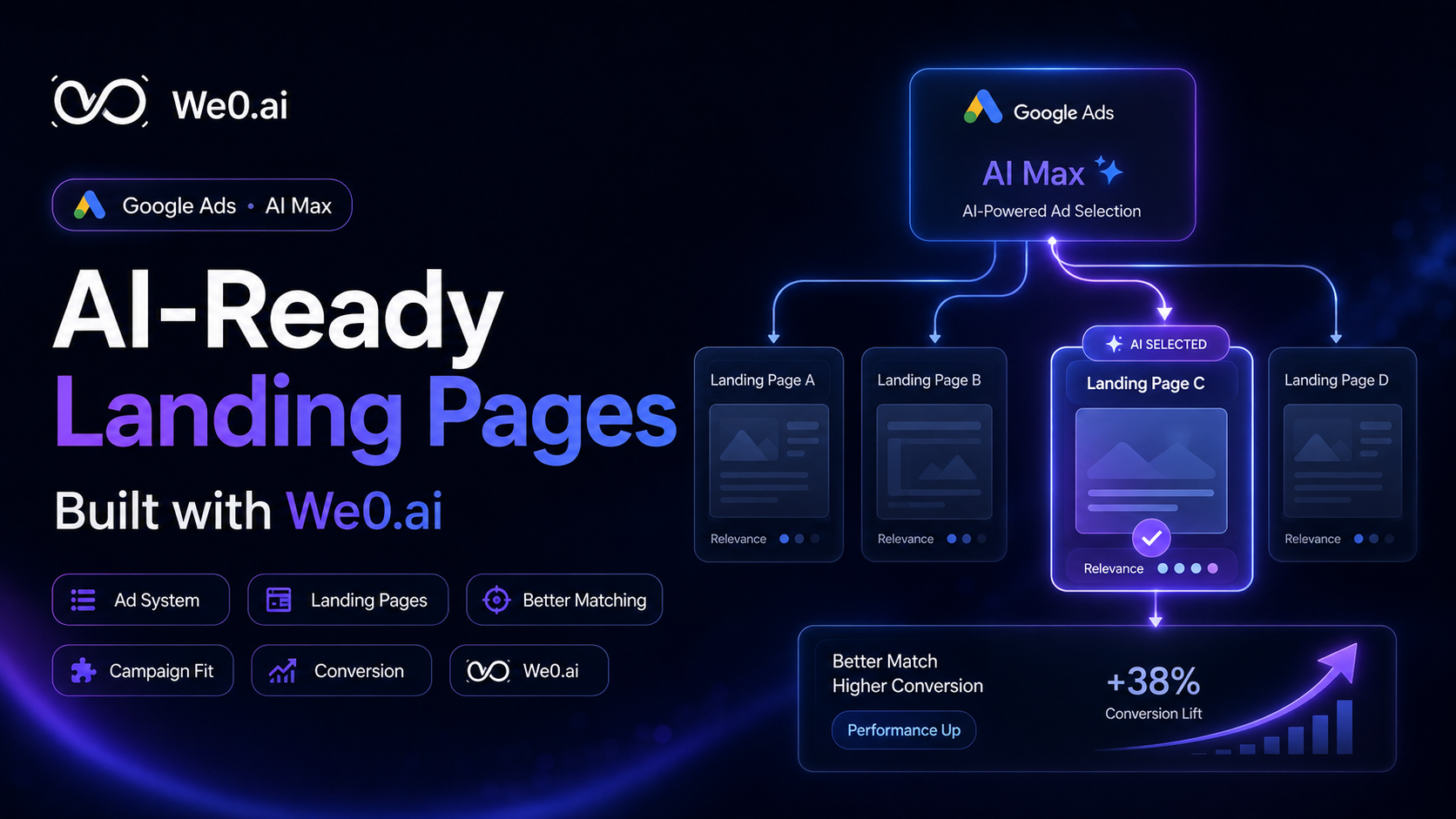
Google Ads Is Fully Shifting to AI Max: How Businesses Can Use We0.ai to Build an Ad Landing Page System That AI Can Choose More Accurately?
Google Ads isn't just making minor tweaks this time.
It's slowly pushing Search advertising into a new logic: you no longer pick keywords manually—AI picks intent for you; you no longer write just one ad—AI assembles the copy for you; and you don't even give it just one landing page—AI looks for the most relevant page.
That's where it gets tricky.
It means the old playbook many businesses relied on—"one campaign, one page, as long as it runs, it's fine"—is starting to fall short.
Because as the system becomes more AI-driven, what determines success isn't just your ad account. It's your entire site structure.
Does your page have a clear theme?
Is your product/service hierarchy explicit enough?
Are there content signals AI can actually read?
Do you have a set of pages that can match different search intents?
In plain terms: the AI Max era isn't about "bidding harder"—it's about "building a page system that reads like a map AI can understand."
And that's exactly where We0.ai excels.
Let's Get Clear First: What AI Max Is Actually Changing
Google has been pretty straightforward about AI Max. It's not a new campaign type—it's an optimization layer within Search campaigns. The core boils down to three things:
| Capability | Function | Implications for Landing Pages |
|---|---|---|
| Search term matching | Expands keyword matching to capture more high-intent traffic | Page themes need to be clearer; content needs to cover more real-world intents |
| Text customization | Auto-generates more relevant ad copy based on existing ads, landing pages, and assets | Pages need strong copy signals |
| Final URL expansion | Sends traffic to more relevant pages | The site must have a clear page structure and selectable landing pages |
Google has also explicitly stated that AI Max uses landing page content, assets, and keywords to optimize ad relevance—and that it sends traffic to query-relevant URLs. In other words, not just any page will get picked.
That raises a very real question:
If your website only has a homepage, two product pages, and the rest is thin content, AI Max is going to struggle to "get it right."
It's not that it can't choose.
It's that the options are too weak.
Before It Was "Build a Page." Now It's "Build a Page System."
These two eras are very different.
The Old Way
- One ad group
- One generic landing page
- Page packed with broad introductions
- Done as long as the form gets submitted
What the AI Max Era Calls For
- One business objective
- A set of pages broken down by intent
- Each page answers one core question
- Clear link relationships between pages
- AI, search users, and sales leads can all flow through naturally
In other words, the landing page is no longer a "destination"—it's a "node on a path."
This fundamentally changes how businesses build their websites.
For example:
- The brand site is not just a homepage
- A product page isn't just a feature list
- A service page isn't just a capabilities showcase
- A case study page isn't just a stack of examples
- An inquiry page isn't just a form
They need to work together as a structure that supports paid ads, SEO, GEO, and content distribution at the same time.
That's where We0.ai brings real value.
It's not just about "making you a page." It's about turning a display-style website into a growth asset that can continuously capture traffic, leads, and customers.
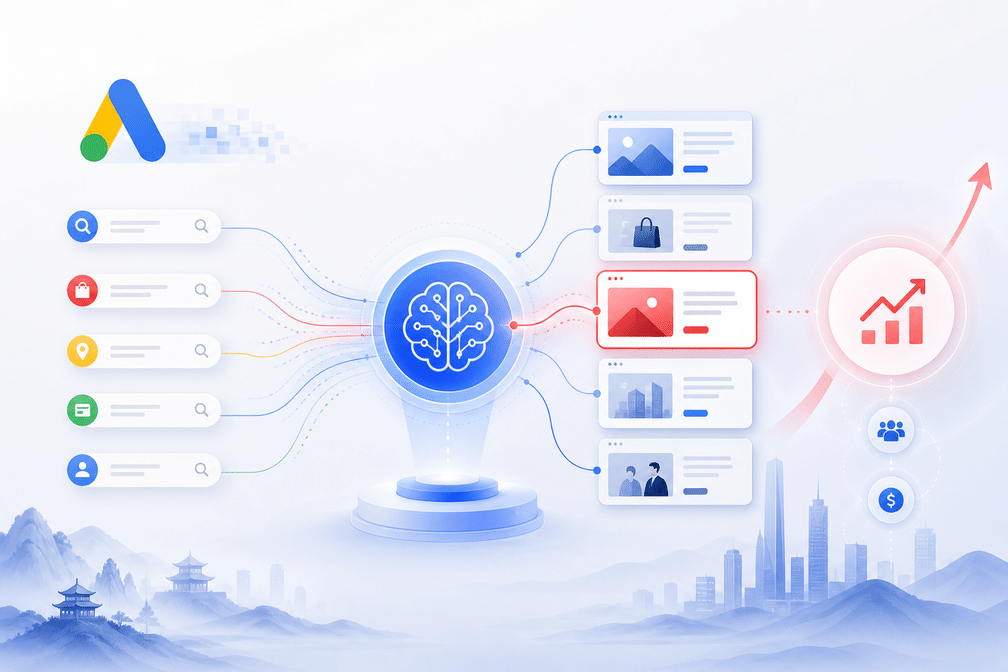
What Actually Helps AI Pick the Right Page?
I'd break it down into four words: Theme, Hierarchy, Signals, Conversion.
1) Keep the Theme Single
Try to have each page focus on just one topic.
For example, if you sell B2B SaaS, don't cram "product overview, pricing, case studies, careers, blog, contact us" all into one page.
AI can't understand it, and users won't like it either.
A better approach:
- Product overview page
- Feature pages
- Solution pages
- Industry pages
- Comparison pages
- Case study pages
- Pricing page
- Inquiry page
The narrower each page is, the easier it is for AI to match.
2) Keep the Hierarchy Clear
Don't let your site structure be a mess.
The homepage tells people who you are.
The second level tells them what you sell.
The third level tells them why you fit them.
The fourth level tells them how to convert.
The clearer this hierarchy is, the easier it is for Final URL Expansion to send users to the right place.
3) Make the Signals Rich Enough
Having text on a page isn't enough.
You need enough readable signals:
- Clear H1/H2 structure
- Page titles aligned with search intent
- Copy that reflects real scenarios
- FAQ sections
- Case studies / data / comparisons
- Specific industry terms, problem phrases, outcome keywords
AI doesn't read design mockups—it reads signals.
4) Make Conversion Complete
A page shouldn't just stop at "Learn more."
There needs to be a next step:
- Book a demo
- Get a quote
- Request a trial
- Download resources
- Leave your info for a consultation
- Join a waitlist
Without a conversion action, even great traffic just passes through.
Why Is We0.ai a Better Fit for This?
Because in the AI Max era, what's missing isn't a pretty page—it's a growth-oriented website-building approach that can quickly spin up a page system and keep iterating on it.
We0.ai's advantage isn't just "speed."
It's that it's built for things like:
- Breaking pages apart by search intent
- Arranging content along conversion paths
- Unifying brand, product, and case information into one structure
- Putting SEO / GEO / content updates / page optimization into a single operating loop
This matters.
Because AI Max isn't a set-it-once-and-done deal.
It's a continuous optimization layer.
Your website should be one too.
We0.ai turns this into a system:
Build -> Showcase -> Grow -> Leads
It's not just building a site.
It's turning the site into a scalable asset.
What Does a More Practical Landing Page System Look Like?
Here's a framework that works for most businesses.
| Page Type | Primary Role | Search Intents It Should Handle |
|---|---|---|
| Homepage | Main brand entry | Brand terms, broad needs |
| Product/Service pages | Explain what you sell | Product terms, service terms |
| Solution pages | Explain what problems you solve | Solution terms, pain-point terms |
| Industry pages | Explain who you're for | Industry terms, scenario terms |
| Comparison pages | Solve choice hesitation | Comparison terms, alternative terms |
| Case study pages | Build trust | Reputation terms, case terms |
| Pricing page | Address budget concerns | Price terms, cost terms |
| Inquiry page | Capture conversion | Booking, consultation, trial, demo |
The core of this structure isn't "having more pages."
It's that each page owns a piece of search intent.
When intent is broken apart, AI can get it right more easily.
What If You Only Have a Homepage Right Now?
Simple—don't rush into bidding on more keywords.
Do three things first:
- Break your product/service into 3–5 clear pages
- Flesh out each page with H1, core copy, FAQ, case studies, and CTA
- Make sure pages link to each other to form a closed loop
If you're already running Google
Ads, but the page is still messy. AI Max might just amplify the problem.
It sends traffic to more relevant pages, but if the page structure itself isn't clear, conversions won't necessarily improve.
So the real question businesses should be asking isn't:
"Should I turn on AI Max?"
It's:
"Is my website ready to be chosen by AI?"
What can We0.ai do about this?
A more practical way to think about it is as a "landing page growth system."
Layer 1: Build the structure first
We0.ai helps you map out your website structure first.
Not a one-page catch-all homepage, but pages broken down by business.
Layer 2: Fill in the content
Each page's content is written around a single search intent.
Not empty slogans, but content that both AI and users can understand.
Layer 3: Add growth logic
Bundle SEO, content, conversion buttons, inquiry entry points, and data tracking together.
That way, pages aren't static displays — they drive dynamic growth.
Layer 4: Keep optimizing
Keep refining pages based on traffic, clicks, dwell time, and conversion feedback.
This is where real value lies in the AI Max era.
It's not about "whether you have pages" — it's about "whether this page system gets more accurate over time."
A very practical question: What kind of websites will AI Max reward?
It rewards these:
- Websites with clear page themes
- Websites with clear structural hierarchy
- Websites where copy matches search intent
- Websites with case studies, FAQs, and comparison content
- Websites that update consistently
- Websites that can quickly expand with new pages
On the flip side, it doesn't favor these:
- Content that's vague across the entire site
- One page trying to cover everything
- Copy that feels like template stitching
- No real business information
- No clear conversion actions
At the end of the day, AI Max doesn't reward "good-looking websites." It rewards websites that are "easy to understand, easy to match, and easy to convert."
Conclusion: Google Ads is changing, and business websites need to change too
Google Ads is moving fully toward AI Max — this isn't a single feature upgrade.
Behind it all, it's telling every advertiser:
Competition in search ads has shifted from "can you run campaigns" to "do you have a website system suitable enough for AI to understand and distribute."
So the next step for businesses isn't to pile on more budget.
It's to build out the page system first.
If you want your homepage, landing pages, case study pages, pricing pages, and inquiry pages to be more easily picked by AI, more likely to capture search intent, and more effective at converting, a platform like We0.ai — which focuses on growing showcase-style websites — fits better than traditional "just build pages" tools.
What AI Max chooses isn't just based on ads. It's also about whether your website looks like an answer.
FAQ
1. Is AI Max a new campaign type?
No. It's an optimization layer inside Search campaigns.
2. Will AI Max make landing pages more unstable?
If your website structure is messy, it can amplify problems. Conversely, the clearer the structure, the better the results.
3. Can I run AI Max with just a homepage?
You can, but it's usually not enough. Websites with clear page hierarchy perform better.
4. What should businesses prioritize first?
First fix the page structure, then add content signals, and finally optimize the conversion path.
5. What types of sites is We0.ai suitable for?
It suits showcase websites, product official sites, service pages, case study pages, inquiry pages, content sites, and multilingual sites.
相关工具
- We0.ai Official Site
- Google Ads Help: How AI Max for Search campaigns works
- Google Blog: Introducing AI Max for Search campaigns
准备开始构建?
If your ads are already running, or you're about to launch AI Max, don't rush to increase the budget.
First, check whether your site makes it easy for AI to pick the right page.
We0.ai can help you turn your website from "having pages" into a growth asset with "structure, signals, and conversions."
结论
AI Max isn't just about making ads more automated.
It's pushing businesses back to a more fundamental question:
Can your website be understood by machines, and can it be trusted by people?
If yes,
traffic becomes more stable.
Conversions become more stable.
Google Ads Is Moving to AI Max: How Enterprises Can Use We0.ai to Build Landing Pages That AI Is More Likely to Pick Right
Google Ads is not just tweaking Search.
It is changing the logic behind Search.
AI is taking over more of the matching, more of the copy, and more of the destination decision.
That means the old playbook — one campaign, one generic page, one "good enough" landing page — is getting weaker by the day.
In the AI Max era, the real question is no longer only about ads.
It is about your website structure.
Can AI understand your page topics clearly?
Can it find a page that matches intent?
Do you have enough content signals for the system to trust?
Can different search intents land on different pages?
In short: the winners will not just spend more. They will build websites that are easier for AI to choose from.
That is exactly where We0.ai fits.
What AI Max is really changing
Google is very clear about this.
AI Max is not a new campaign type. It is an optimization layer inside Search campaigns.
Its core includes three things:
| Capability | What it does | What your landing pages need |
|---|---|---|
| Search term matching | Expands matching and finds more relevant queries | Clear page themes and stronger intent coverage |
| Text customization | Generates more relevant ad copy from your |
existing assets | Strong page-level messaging signals |
| Final URL expansion | Sends traffic to the most relevant page | A clean, structured site with multiple page options |
Google also says AI Max uses landing page content, assets, and keywords to improve relevance, and it can send users to query relevant URLs.
So the real issue is simple:
If your site only has a homepage and a few vague pages, AI Max has little to choose from.
Not because it is weak.
Because your options are weak.
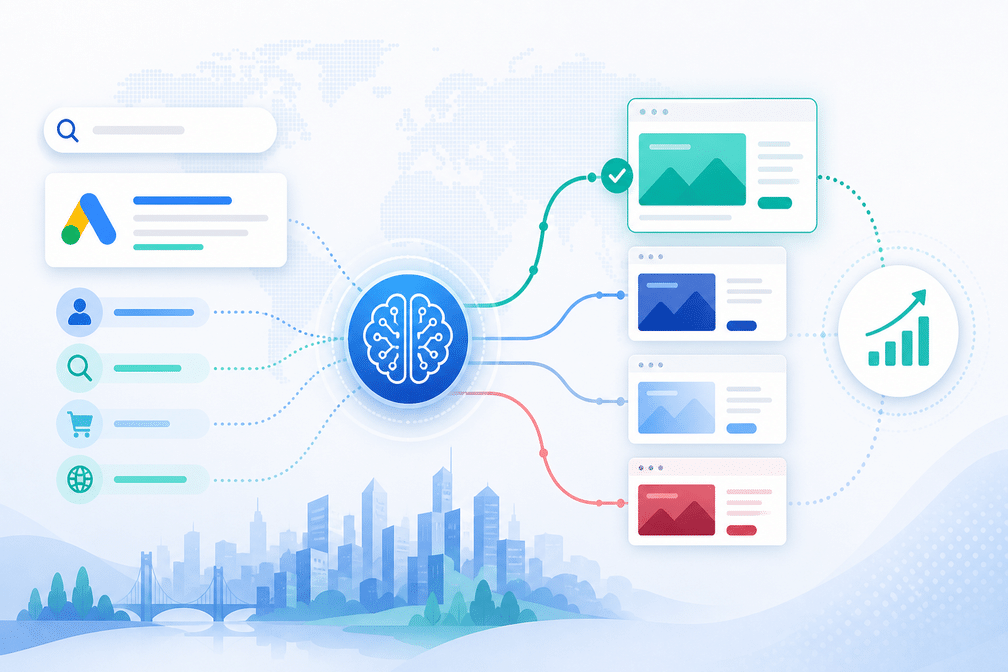
From "build a page" to "build a page system"
That is the big shift.
Old way
- One ad group
- One generic landing page
- One broad message for everyone
- A form submission counts as success
AI Max-ready way
- One business goal
- A set of pages split by intent
- Each page answers one main question
- Pages are connected in a clear internal structure
- Search, SEO, and conversion all work together
A landing page is no longer the finish line. It is one node in a path.
This changes how enterprise websites should be built.
Homepage is not enough.
Product pages are not enough.
Service pages are not enough.
Case pages are not enough.
Lead pages are not enough.
They need to work together as a system that can support paid search, SEO, GEO, and content growth.
That is why We0.ai matters.
It is not just about making a page.
It is about turning a showcase website into a growth asset that can keep attracting traffic and leads.
What makes AI more likely to choose the right page?
I would reduce it to four words: topic, structure, signals, conversion.
1) Keep the topic narrow
One page should do one job.
If you sell B2B software, do not put product overview, pricing, case studies, careers, blog, and contact all in one page.
AI gets confused. Users get tired.
A better structure looks like this:
- Product overview page
- Feature page
- Solution page
- Industry page
- Comparison page
- Case study page
- Pricing page
- Lead capture page
The narrower the page, the easier it is to match.
2) Make the site structure obvious
Your site hierarchy matters.
Home says who you are.
Second-level pages explain what you sell.
Third-level pages explain why it fits.
Lower pages drive action.
The clearer this structure is, the better Final URL Expansion can work.
3) Add enough content signals
A page is not useful just because it has text.
It needs readable signals:
- Clear H1/H2 structure
- Title aligned with intent
- Real use cases
- FAQ
- Case studies or proof
- Industry terms, problem terms, result terms
AI does not read design fluff. It reads signals.
4) Make conversion the next step obvious
The page cannot stop at "learn more."
It needs a clear next action:
- Book a demo
- Request a quote
- Start a trial
- Download a guide
Contact sales
- Join a waitlist
If there is no next step, traffic just passes through.
Why We0.ai is a better fit for this shift
Because the AI Max era does not need another pretty page.
It needs a faster way to build a structured website that can keep changing with intent.
We0.ai is strong here because it helps you:
- split pages by search intent
- organize content by conversion path
- bring brand, product, and proof into one structure
- connect SEO, GEO, content updates, page optimization, and monitoring in one workflow
That matters.
Because AI Max is not a one-time setup.
It is a continuous optimization layer.
Your website should be one too.
We0.ai is basically built around that idea:
Build -> Showcase -> Grow -> Leads
Not just build.
Build an asset.
What should a practical landing page system look like?
Here is a simple version that works for most businesses.
| Page type | Main job | Intent it should catch |
|---|---|---|
| Homepage | Brand entry point | Brand searches, broad intent |
| Product / Service page | Explain what you sell | Product and service terms |
| Solution page | Explain what problem you solve | Pain-point searches |
| Industry page | Show who it is for | Industry and scenario searches |
| Comparison page | Help users decide | Comparison and alternative searches |
| Case study page | Build trust | Proof and reputation searches |
| Pricing page | Answer budget questions | Cost and pricing searches |
| Lead page | Capture conversion | Demo, consult, trial, quote |
The point is not page count.
The point is that each page owns a specific intent.
Once intent is split clearly, AI can choose more accurately.
If you only have one homepage, what now?
Do not rush to spend more.
First do these three things:
- Split your offer into 3–5 clear pages
- Add H1, core copy, FAQ, proof, and CTA to each page
- Link the pages so they form a conversion path
If you are already running Google Ads but your site is messy, AI Max may just expose the problem faster.
It will send traffic to more relevant pages, but that does not guarantee better conversion.
So the better question is not:
"Should I turn on AI Max?"
It is:
"Is my website ready to be chosen by AI?"
How We0.ai can help
The most practical approach is to treat it as a landing page growth system.
Layer 1: Build structure first
We0.ai helps you create the site structure first.
Not one mixed homepage, but pages split by business intent.
Layer 2: Add intent-driven content
Each page gets content that answers one search intent.
Not slogans. Real meaning.
Layer 3: Add growth logic
SEO, content, CTA, lead capture, and tracking all live together.
That makes the site dynamic, not static.
Layer 4: Keep optimizing
Use traffic, click, scroll, and conversion data to keep improving the pages.
That is the part that matters most in the AI Max era.
Not whether you have a page, but whether your page system keeps getting sharper.
What kind of sites will AI Max reward?
It will reward sites that are:
- clear in topic
- clear in hierarchy
- aligned with search intent
Rich in proof, FAQ, and comparison content
- Updated regularly
- Easy to expand with new pages
And it will not love sites that are:
- Vague everywhere
- Trying to say everything on one page
- Template-like in copy
- Missing real business details
- Missing a clear conversion path
AI Max does not reward “pretty websites.” It rewards websites that are easy to understand, match, and convert.
结论
Google Ads is moving toward AI Max.
This is not just a feature update.
It is a message to advertisers:
Search competition is shifting from “can you run ads” to “do you have a website system that AI can understand and distribute well?”
So the next move is not simply to increase budget.
It is to build the page system first.
If you want your homepage, landing pages, case studies, pricing pages, and lead pages to be chosen more often — and to convert better when they are chosen — a showcase-growth platform like We0.ai is a better fit than a tool that only makes pages.
What AI Max chooses is not just ads. It also checks whether your site looks like an answer.
FAQ
1. Is AI Max a new campaign type?
No. It is an optimization layer inside Search campaigns.
2. Will AI Max make landing pages less stable?
If your site structure is messy, yes, it can expose that. If your structure is clear, it usually works better.
3. Can one homepage run AI Max?
Yes, but it is usually not enough.
4. What should businesses improve first?
Start with structure, then content signals, then conversion flow.
5. What kind of sites fit We0.ai best?
Showcase websites, product sites, service pages, case study pages, lead pages, content sites, and multi-language sites.
相关工具
- We0.ai Official Site
- Google Ads Help: How AI Max for Search campaigns works
- Google Blog: Introducing AI Max for Search campaigns
准备开始构建?
If your ads are already running, or you are about to test AI Max, do not rush to add budget.
First check whether your website makes it easy for AI to choose the right page.
We0.ai helps you turn a site from “pages that exist” into “pages that perform.”
结论
AI Max is not just about more automation.
It is forcing a more basic question:
Can your website be understood by machines, and trusted by humans?
If yes, traffic gets cleaner.
Conversion gets cleaner too.