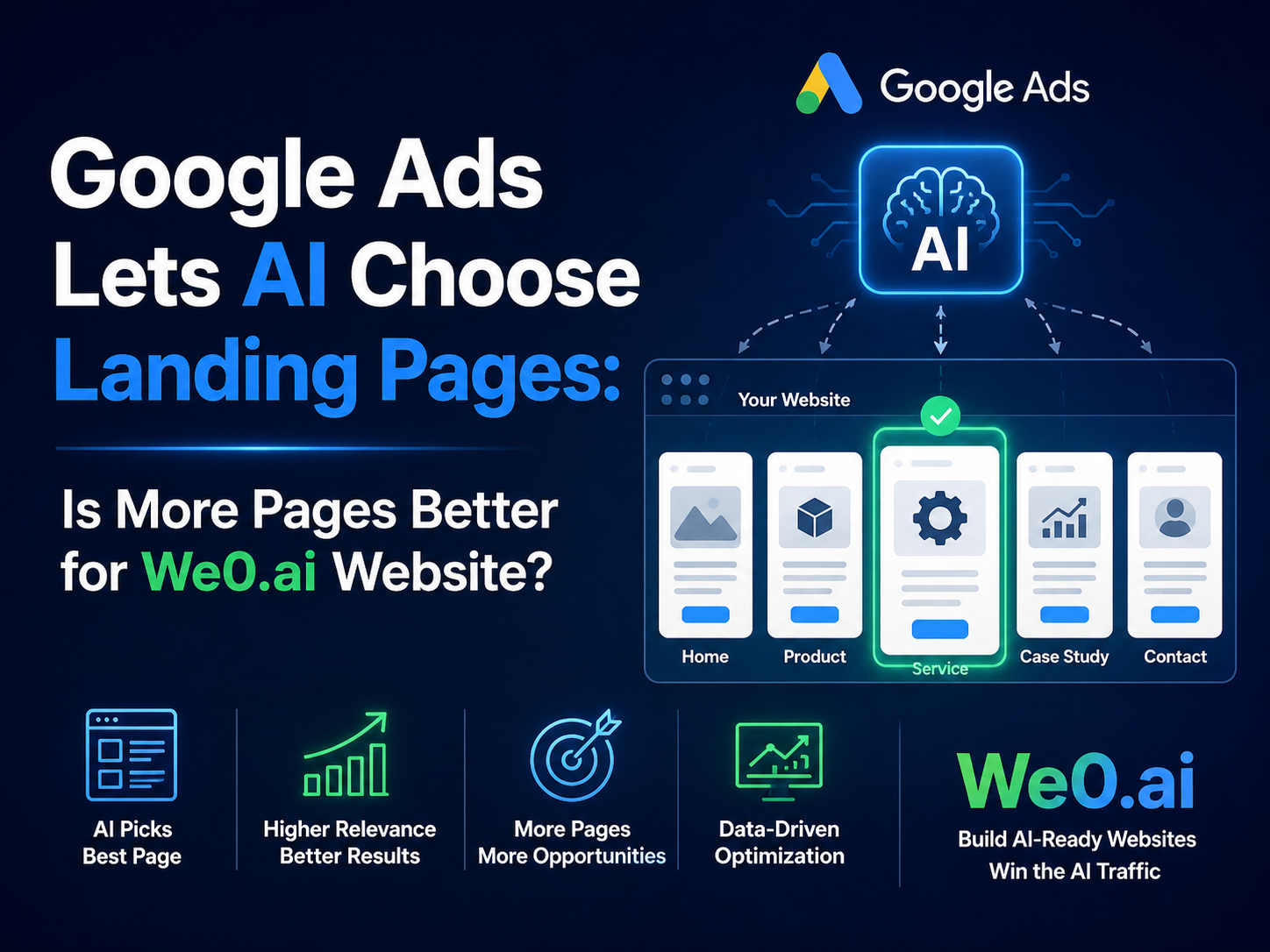
Now That Google Ads Lets AI Choose Landing Pages, Does More Pages Mean Better for a We0.ai Website?
A lot of people's first reaction to this Google Ads change is: **"So should I just pile up tons of pages on my website?"** Especially those building showcase-style sites like We0.ai tend to immediately think, "the more pages, the easier for AI to pick." But let me give you the conclusion right up front: > **It's not about having more pages — it's about having fuller intent coverage, pages that are easier to understand, and pages that actually convert.** AI can choose landing pages for you, but A
Now That Google Ads Lets AI Choose Landing Pages, Does More Pages Mean Better for a We0.ai Website?
Now That Google Ads Lets AI Pick Landing Pages, Does a We0.ai Website Need More Pages?
A lot of people's first reaction to this Google Ads change is:
"So should I just pile up tons of pages on my website?"
Especially those building showcase-style sites like We0.ai tend to immediately think, "the more pages, the easier for AI to pick."
But let me give you the conclusion right up front:
It's not about having more pages — it's about having fuller intent coverage, pages that are easier to understand, and pages that actually convert.
AI can choose landing pages for you, but AI isn't rewarding "page-count tactics."
It's more like helping the system decide: which page looks most like the answer this user actually wants right now.
So the question changes.
It's not "should I create more pages?" but:
- Do my pages cover the key search intents?
- Are my pages clear, focused, and easy to understand?
- Can my pages actually capture visitors and move them toward inquiries, sign-ups, lead capture, or trials?
That's what really matters.
Conclusion First: Page Count Isn't the Core — Page Structure Is
If you build your site with a bunch of duplicate pages, thin-content pages, and pages that compete against each other, AI will find it even harder to choose.
Because it will see:
- These pages all look similar
- These pages are all fighting for the same keyword
- These pages have no clear conversion goal
- None of these pages feels like "the best-fit landing page"
The result: more pages, more problems.
But if your site is well structured, for example:
- The homepage explains who you are
- Product pages explain what you do
- Use-case pages cater to different user needs
- Case study pages build trust
- FAQ pages address objections
- SEO content pages capture long-tail traffic
Then having more pages is actually an advantage.
Because you're not just stacking page counts — you're building a content map that AI can understand.
What Is AI Actually Looking for When It Picks a Landing Page?
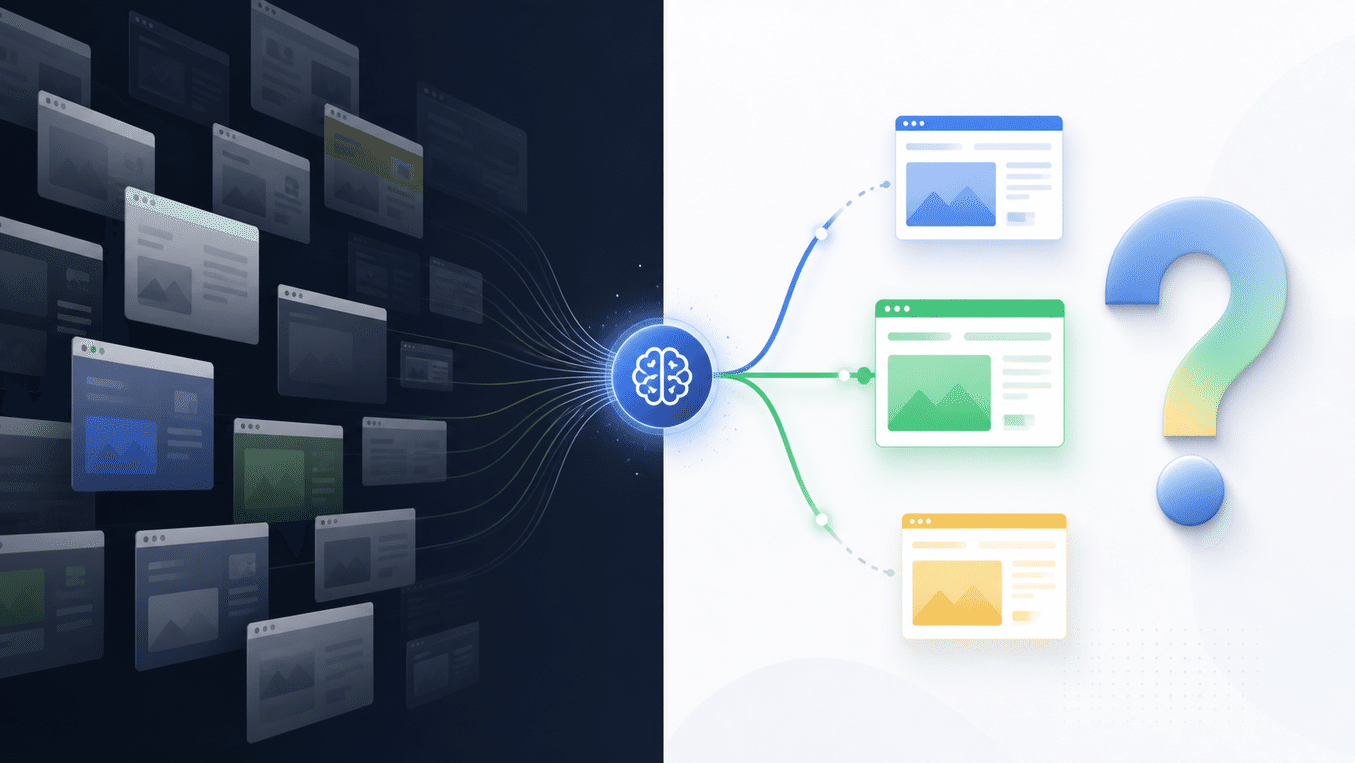
When Google Ads lets AI choose landing pages, it's not randomly jumping between pages.
It's making a judgment:
Which page best matches this search query, this intent, and this conversion goal.
You can think of it in three layers:
| Layer | What AI Is Looking At | What You Should Do |
|---|---|---|
| Relevance | Whether the page matches the search query | Keep each page's topic focused and clear |
| Readability | Whether the page is easy to scan for key points | Make headlines, above-the-fold content, and structure clear |
| Conversion Power | Whether the page can move users toward action | Complete CTA, forms, and pathways |
So AI isn't just checking "does this page contain the keyword."
It's looking more at: "Does this page look like something that can actually capture and hold a user?"
That's why many sites have plenty of pages but still get mediocre results.
It's not because they have too few pages — it's because their pages aren't part of a coherent system.
How Should a We0.ai Website Think About Page Count?
For a site like We0.ai, I'd recommend shifting your mindset:
Don't ask "how many pages should I build" — ask "which intents should I cover."
These are two very different questions.
The former is number-driven thinking.
The latter is growth-driven thinking.
A More Practical Page Framework
| Page Type | Purpose | Worth Building Many? |
|---|---|---|
| Homepage | Positioning + main entry point | Must-have |
| Product pages | Explain capabilities | Must-have |
| Use-case pages | Cater to different user needs | Very worthwhile |
| Case study pages | Build trust | Very worthwhile |
| Pricing page | Qualify and convert | Must-have |
| FAQ page | Address concerns | Worthwhile |
| SEO content pages | Capture long-tail traffic | Very worthwhile |
| Industry solution pages | Target high-intent keywords | Worthwhile |
As you can see, what should be plentiful isn't "duplicate pages."
It's pages that capture different search intents.
This is exactly what We0.ai is best suited for.
Because We0.ai isn't just about finishing a demo page — it's better suited for building:
- Brand websites
- Product showcase sites
- Service landing pages
- Case study pages
- Content sites
- Lead generation pages
- Waitlist pages
In short: it's a growth-oriented showcase site, not a single-page generator.
When Does Having More Pages Help — and When Does It Hurt?
This question is critical.
Not all "more pages" is good.
When It Helps
- Each page serves one clear intent
- Each page can independently answer one question
- Each page has its own conversion goal
- Each page is internally linked to the main site
- Each page can be understood by AI as "a better fit for this person"
When It Hurts
- Large amounts of duplicated content across pages
- Headlines changed slightly, but body content is nearly identical
- One keyword split across ten pages that cannibalize each other
- Thin pages with little substance
- No internal links, no CTA, no conversion path
So a more accurate way to put it is:
It's not about having more pages — it's about having a more complete page network.
This point matters.
If You're Looking at Both Google Ads and SEO, How Should You Structure Your Website?
Looking only at Google Ads, you'd think landing pages should be few and precise.
Looking only at SEO, you'd think content pages should be many and detailed.
The real answer is: you need both.
Because ads and organic search aren't on the same track.
But they can share the same site structure.
A More Balanced Combination
| Goal | Page Strategy |
|---|---|
| Ad conversions | A few high-converting pages focused on a single message |
| Organic search | Topic pages + long-tail pages + FAQ pages |
| Brand trust | Case study pages, about pages, customer stories |
| AI recognition | Clear semantics, stable structure, strong internal linking |
If you're building a We0.ai website, here's my recommendation:
- Use a few core pages for conversions
- Use a set of topic pages to cover different scenarios
- Use SEO content pages as traffic entry points
- Use case studies and FAQs to build trust and comprehensibility
At that point, pages aren't a burden — they're an asset.
Why We0.ai Is Especially Suited for "Structured Page Growth"
Because what We0.ai solves isn't just "get a website up quickly" — it's:
Enabling a website to keep growing traffic, leads, and customers after launch.
That means it can't rely on a single homepage to carry everything.
Websites that actually perform typically look like this:
- Homepage defines positioning
- Product pages define capabilities
- Use-case pages define fit
- Content pages drive search traffic
- Case study pages demonstrate results
- FAQ pages address objections
- CTA pages drive action
This structure is what AI can understand more easily and what users are more likely to convert on.
And that's exactly where We0.ai's value lies:
Not just creating pages, but turning pages into a system that continuously acquires customers.
A Simple Test: Are You "Stacking Pages" or "Paving a Path"?
You can judge directly with these 3 questions:
- Does each page have a clear job?
- Does each page correspond to a real search intent?
- Does each page push the user to the next step?
If most answers are "no," you're just stacking pages.
If most answers are "yes," you're paving a path.
And in the era of AI-picked landing pages, the system clearly rewards "path-paving websites."
Page Ideas Suited for a We0.ai Website
If you're building a We0.ai website right now, I'd prioritize these pages:
- Homepage: One sentence that clearly says who you are
- Product page: Clearly explain Build -> Showcase ->
Grow -> Leads
- Scenario Pages: SaaS / Agency / Creator / Local Service / Indie Hacker
- Case Study Pages: Showcase real projects
- SEO Article Pages: Target high-intent keywords
- FAQ Pages: Reduce decision friction
- Contact / Booking Pages: Drive conversions
This isn't about "having lots of pages."
It's about making it easy for both AI and users to find answers fast.
Bottom Line: Don't Chase Page Count, Chase Page Efficiency
One more time.
Now that Google Ads lets AI pick landing pages, more pages isn't necessarily better.
What really matters:
- Whether you cover more real search intents
- Whether your information hierarchy is better
- Whether your conversion paths are clearer
- Whether you add stronger trust signals
- Whether it's easier for AI to judge "this page is the best fit"
So for We0.ai, the right direction isn't churning out a pile of pages.
It's building a page system that can be discovered, understood by AI, and convert users.
That's what growth really is.
FAQ
1. Now that Google Ads lets AI pick landing pages, should I still specify pages myself?
Yes. Core pages still need clear planning — AI just helps you make smarter choices among suitable pages.
2. Are more website pages more likely to be selected by Google Ads?
Not necessarily. Relevance, clarity, and conversion power matter more than sheer page count.
3. Is it a good idea for the We0.ai website to have many pages?
Yes — but only if every page serves a clear purpose. It's not about duplicating pages, it's about covering scenarios.
4. If I don't have many pages, how can I improve the chance of AI selecting them?
Make each page's topic crystal clear, state the value proposition above the fold, keep a stable structure, complete internal links, and clear CTAs.
相关工具
- We0.ai Website
- Google Ads Help: How AI Max for Search campaigns works
- Google Blog: We're upgrading Dynamic Search Ads to AI Max
- Google Ads Help: About final URL expansion in Performance Max
准备开始构建?
If you're also wondering:
"How many pages should my website actually have?"
Maybe the answer isn't "more."
It's "more precise."
We0.ai can help you turn your pages into a website that showcases, grows, and acquires customers — not just one that looks complete.
Ready to build a website that actually grows?
结论
Now that Google Ads is letting AI choose landing pages, the way we think about website building has truly changed.
It's not about having more pages — it's about making each page look more like the answer.
If you're building a We0.ai website, don't just stare at page count.
Focus on intent, structure, conversion, and continuous growth.
That's what makes a website that actually runs.