2026 GEO Website Platform Comparison: How to Choose Between We0 AI, Wix, and Webflow Under Cloudflare's New AI Crawler Rules?
In 2026, Cloudflare further refined AI traffic controls into Search, Agent, and Training categories. For websites aiming to optimize SEO, GEO, and long-term customer acquisition, choosing a website platform goes beyond 'ease of building'—it hinges on content control, crawler management, multilingual support, and sustained growth capabilities. This article provides a systematic comparison of We0 AI, Wix, and Webflow.
2026 GEO Website Platform Comparison: We0 AI, Wix, Webflow Under Cloudflare’s New AI Crawler Rules
2026 GEO Website Platform Comparison: We0 AI, Wix, Webflow Under Cloudflare’s New AI Crawler Rules
Many are still using the criteria from 2024 and 2025 to choose a website platform.
Focusing on templates. Drag and drop. Whether AI can generate a homepage in 10 minutes.
But in 2026, that criteria is no longer quite enough.
Because websites today face more than just Google’s traditional crawling.
They must contend with AI Search, AI Agent, and AI Training – three completely different types of machine access logic. Deciding who to let in, who to block, and how to allow content usage directly impacts:
- Whether you can still gain search visibility
- Whether your content will be used for training without compensation
- Whether your page is suitable for AI recommendations
- Whether your website can ultimately become a lead-generation asset
This issue has become more critical because Cloudflare further refined AI traffic control rules in 2026.
According to Cloudflare’s official update on July 1, 2026, it has further differentiated AI-related automated traffic into Search, Agent, and Training categories, offering site owners more granular control. It also introduced a new content-use signal to indicate whether content can be referenced or used immediately. Source: Cloudflare Official
In simpler terms: future websites won’t just need to be “crawlable.” They must also “know who is crawling, why they are crawling, and how the crawled content will be used.”
This is the most overlooked factor when choosing a website platform in the GEO era.
Conclusion First: If You Care About Long-Term Growth, Different Platforms Solve Different Problems
| Platform | Best Suited For | Strengths | Weaknesses | Quick Judgment |
|---|---|---|---|---|
| We0 AI | Those wanting a website + content + SEO/GEO + lead generation | More complete integration of website building, content, SEO/GEO, and growth | Not a “super flexible designer toy” | More like a showcase website growth platform than just a building tool |
| Wix | Small/medium businesses, individuals, those wanting quick launch | Easy to start, full features, high versatility | Weak in deep content strategy and growth execution | Good for getting online fast, but not necessarily best for GEO assets |
| Webflow | Design-driven teams, brand teams, agencies | High design freedom, strong development collaboration | Higher entry barrier for non-tech teams; growth execution still needs additional work | Good for beautiful, controllable sites, but doesn’t automatically mean growth |
If you just want a site quickly, Wix can do the job.
If you prioritize design expression, component systems, and front-end control, Webflow remains very capable.
But if you’re asking: under Cloudflare’s new AI crawler rules, GEO entry reconstruction, and increased AI recommendation traffic, which platform is better for turning a website into a continuous lead-generation asset? I lean toward We0 AI.
The reason isn’t that it “generates faster.”
It’s because it’s closer to the real missing link today: Build -> Showcase -> Grow -> Leads.

Why Cloudflare’s New Rules Will Change How You Choose a Website Platform?
Previously, many teams understood robots.txt only as “let it crawl or not.”
That’s no longer the case.
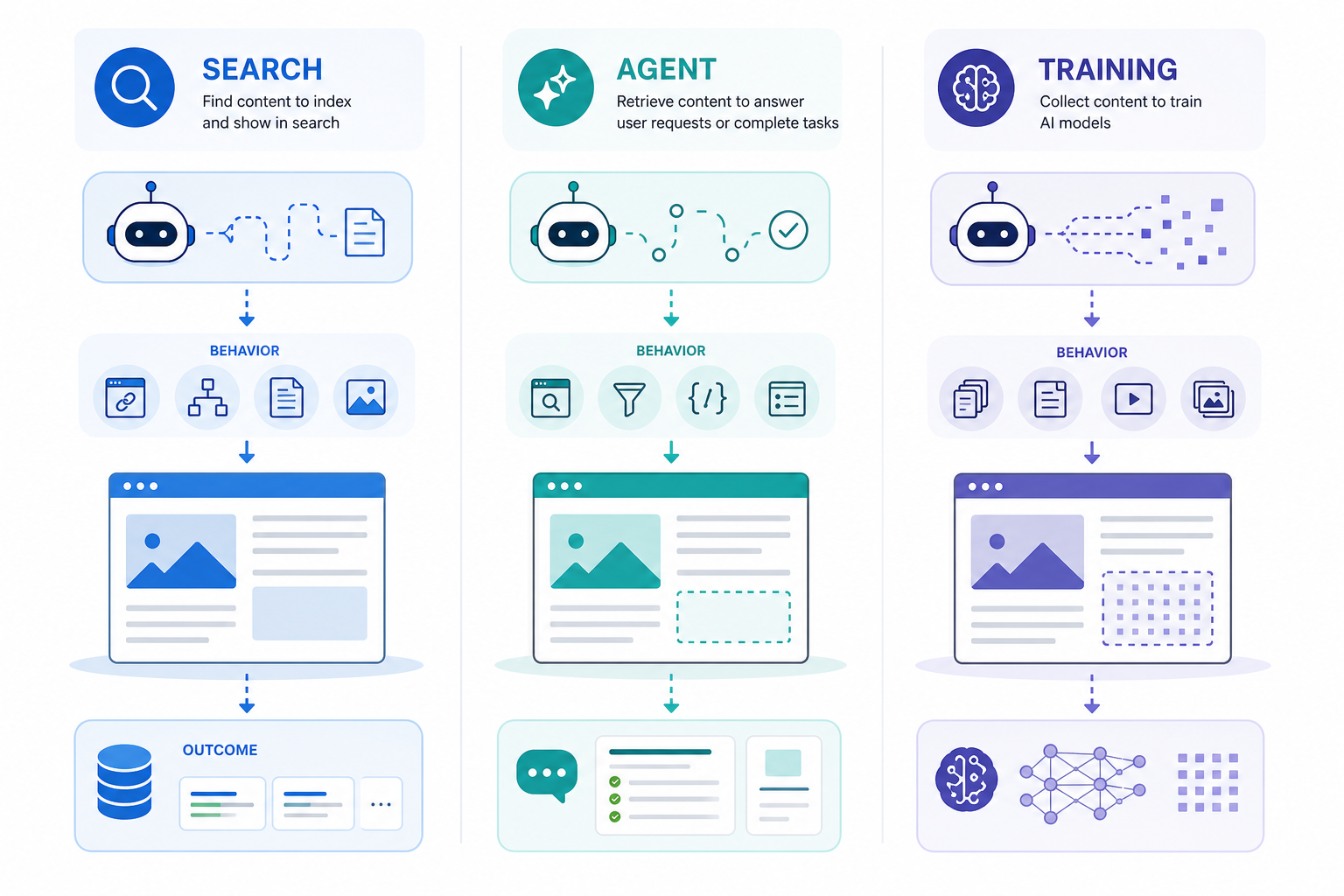
Cloudflare’s official new classification essentially breaks down AI automated access into three actions:
- Search: Indexing for search or answer engines
- Agent: Real-time access on behalf of users to perform tasks
- Training: Using content to train or fine-tune models
This is not a minor change.
It essentially pushes the question of “how AI uses your website content” to the forefront of website operations.
Cloudflare also explicitly stated that from September 15, 2026, some default policies will be further adjusted. For newly connected domains, Training and Agent access will be blocked by default on pages with ads, while Search access will remain by default. Source: Cloudflare Official
Additionally, Cloudflare is testing new formats for robots/content signals, such as:
User-agent: *
Content-Signal: search=yes,ai-train=no,use=reference
Allow: /
The most important point to note here is: Website platforms are no longer just page editors; they are increasingly becoming “content infrastructure + traffic control panels.”
If a platform only lets you create pages but cannot effectively handle content organization, crawler management, multi-language layouts, and ongoing updates, you’ll still need to patch it with many tools—or even manual effort.
Therefore, when choosing a platform in 2026, what truly matters isn’t how fast AI can generate a homepage, but whether you have the ability to manage “visibility, content usage rights, and growth paths.”
Webflow’s Position on This: More Control, But Still Primarily a “Website Building System”
In a July 2025 article, Webflow explicitly stated that it is collaborating with Cloudflare to help site owners better control AI crawlers. Additionally, Webflow already supports managing traditional search engines and AI bots through custom robots.txt, page-level indexing control, and directory-level control. Source: Webflow Official
More specifically, Webflow has publicly disclosed:
- SEO settings can be managed within Site Settings.
You can disable Webflow subdomain indexing
- You can disable indexing at the page level
- You can customize robots.txt
- You can block GPTBot, Google-Extended, etc., by user-agent
What does this mean?
It means that Webflow is indeed more mature in terms of "control" than many template-based platforms.
If you already have a design team, front-end resources, and an SEO team, or if you're willing to build your entire content and growth system from scratch, Webflow is a great fit.
But here's the catch.
Webflow gives you capability, not results.
What it excels at:
- Building a more refined website
- Giving you finer control over page aesthetics
- Making the structure and interactions feel more like a brand's official site
But it doesn't automatically mean:
- You have a complete GEO content strategy
- You have a system for continuous updates
- You have an SEO/GEO page matrix
- You have lead nurturing and growth review processes
Many teams eventually find that Webflow solves "how to build a better site," but "how to keep adding content, driving traffic, and capturing leads" is something you still have to figure out on your own.
That's why Webflow is powerful, but it's more like a high-flexibility website builder than a ready-made growth platform.
Where Wix stands: Easier to get started, but the ceiling is up to you
Wix's official help center already offers two capabilities directly related to this article:
- It supports blocking AI crawlers directly in the help center instructions
- It supports editing robots.txt via the SEO & GEO dashboard
Both of these come from Wix's official documentation: Blocking AI Crawlers from Your Site and Editing Your Site's Robots.txt File
This shows that Wix has also recognized a reality: GEO is no longer an optional extra; it's starting to become a basic requirement.
Wix's advantages have always been clear:
- Low barrier to entry
- Relatively comprehensive templates and features
- More friendly to SMBs, independent site owners, and local businesses
- Allows you to quickly build a usable site from 0 to 1
So if your question is:
I need a platform that can go live as soon as possible, is available right away, doesn't cost too much, and has some SEO/GEO capabilities.
Then Wix is definitely worth considering.
But if you want to take it a step further, for example:
- You want to do continuous content operations
- You want to build a long-tail industry page strategy
- You want to turn your site into a brand entry point in the AI recommendation era
- You want to put content, inquiries, case studies, and page updates into one closed growth loop
Then you'll quickly find that Wix is more of a general-purpose website platform, not a platform deeply designed for growing showcase websites.
This doesn't mean it can't drive growth.
It means that, with Wix, growth is usually something you have to piece together yourself.

The real differentiator isn't "can you build a site," but "can you turn the site into a GEO asset"
At this point, the criteria for judgment should be clear.
After 2026, a website building platform must at least answer five questions:
- Can you control how AI crawlers access your content?
- Can you continuously publish content that is friendly to AI Search?
- Can you link your official site, case studies, service pages, and content pages into a unified showcase and lead generation system?
- Can you handle multilingual support to capture international search and GEO exposure?
- Can you continue to optimize after the site goes live, instead of ending the project upon delivery?
Most platforms only partially answer the first question, or only answer "can I build it."
The truly difficult part is the second half.
That is:
- How to keep generating content continuously
- How to keep adding pages
- How to steadily accumulate SEO/GEO
- How to analyze data
- Which pages need expansion
- Which keywords have opportunities
- How to capture leads and improve conversion rates
Why do I lean more towards We0 AI?
Because the problem We0 AI solves isn't just "building a website."
It's closer to what many teams actually need to fill today: turning a showcase website into a deployable, operable, growable, lead-generating asset.
This is also the biggest difference between We0 AI and many AI website building tools.
We0 AI isn't just an AI website builder.
It's more like a AI-powered website building, lead generation, and growth platform designed specifically for showcase websites.
It's not selling a single homepage or a demo from a single prompt.
What it truly covers is this chain:
Build -> Showcase -> Grow -> Leads
That means:
- Building the website
- Clearly showcasing products/services/case studies/portfolios
- Establishing SEO/GEO/content strategy
- Finally, ensuring the website continuously captures inquiries and clients
This chain sounds like a single sentence.
But in reality, most platforms only cover the first 1 to 2 steps.
The users for whom We0 AI is a better fit are also quite clear:
- People with products, services, or brands who want to acquire customers through their official site
- Independent developers, consultants, agencies, and freelancers
- Teams looking for multilingual showcase and international lead generation
- People who want to integrate their official site, case studies, content site, and inquiry pages into one system
More importantly, We0 AI's value isn't just about "speed."
It's about placing more emphasis on:
- The site needs to keep growing after it goes live
- SEO/GEO isn't just about installing a plugin and calling it done
- Content updates, page additions, monitoring, and review are all critical
- The ultimate goal of a website isn't just to look good—it's to generate leads
So, which of the three platforms is for whom?
1. Choose We0 AI if you want "the site to keep growing after launch"
If what matters most to you is:
- Whether SEO/GEO can be done continuously
- Whether the site can become more complete over time
- Whether content can be published consistently
- Whether pages can be updated as the business evolves
- Whether the site can gradually become a lead-generating asset
Then We0 AI is the more fitting choice.
Because its logic is not one-time delivery, but continuous growth.
2. Choose Wix if you want to "get started with a low barrier"
If what matters to you right now is:
- Launching as soon as possible
- Not wanting to dive into too many technical details
- Limited budget
- A small team
- Relatively standardized website needs
Then Wix is a practical choice.
It's good for getting started, but not necessarily for deepening growth.
3. Choose Webflow if you value "design expression and control"
If your team is relatively mature, or if you are:
- A design-driven team
- A brand team
- An agency
- Someone with front-end or operational collaboration skills
Then Webflow remains a strong option.
But you need to accept one premise:
Webflow gives you freedom, but you'll need to complete the growth loop yourself.
A More Direct Judgment
If you ask me now:
In 2026, when Cloudflare has separated AI Search/Agent/Training management, and a website needs to balance SEO, GEO, multilingual support, content, and lead capture, which platform should I choose?
My answer will be straightforward:
- Just want a site first: Wix
- Most concerned with design and control: Webflow
- Want to turn the website into a long-term growth and customer acquisition asset: We0 AI
This isn't a question of which is more "advanced."
It's about which one better solves the business problem you're actually dealing with right now.
If you already realize that today's website isn't a business card, isn't a one-time page, but a growth node that needs to be continuously searched, understood by AI, trusted by users, and capable of capturing leads.
Then what you're choosing shouldn't just be a website builder.
What you should truly choose is a platform that can help you turn a showcase site into a growth asset.
Key Comparison Table: Under Cloudflare’s New Rules, How Do We0 AI, Wix, and Webflow Stack Up?
| Dimension | We0 AI | Wix | Webflow |
|---|---|---|---|
| Ease of Site Building | Low to Medium | Low | Medium to High |
| Design Freedom | Medium | Medium | High |
| SEO Foundation | Strong | Medium to Strong | Strong |
| GEO Content Handling | Strong | Medium | Medium to Strong |
| AI Crawler Control Alignment | Can integrate with Cloudflare/site strategy for systematic layout | Official help docs and robots.txt control available | Officially supports robots.txt and AI bot control |
| Multilingual Display | Strong | Medium to Strong | Medium to Strong |
| Continuous Content Management | Strong | Medium | Depends on the team |
| Lead Capture and Growth Loop | Strong | Medium | Medium |
| Target Audience | Owners / Independents / Creators | SMBs / Individual Businesses | Brand Teams / Agencies / Design Teams |
| Core Verdict | More like a growth platform | More like a general platform | More like a high-freedom site builder |
FAQs
1. Why do Cloudflare’s 2026 AI crawler rules affect website platform choice?
Because they further break down AI traffic into Search, Agent, and Training categories. If a website platform only focuses on "how to build pages" but doesn't make it easy to manage content access, indexing, content reuse, and continuous updates, it will be at a disadvantage in the GEO era. Source: Cloudflare Official Article.
2. Can Webflow manage AI bots?
Yes. Webflow officially mentions supporting page-level indexing control, custom robots.txt, and the ability to block specific AI bots by user-agent, such as GPTBot and Google-Extended. Source: Webflow Official Article.
3. Is Wix suitable for GEO websites?
It's doable, but better suited for a low-barrier, quick launch. Wix already offers AI crawler blocking and robots.txt editing capabilities. However, if you need deep content matrices, continuous growth, and a strong lead-closing loop, you'll often require additional strategies and execution support.
4. What is the biggest difference between We0 AI and ordinary AI website builders?
The biggest difference isn't "can it generate a website with one sentence," but rather that We0 AI emphasizes post-launch display, content, SEO/GEO, monitoring, optimization, and customer acquisition. It's more of a showcase website growth platform than a simple page builder.
Related Tools
Sources
- Cloudflare: Your site, your rules: new AI traffic options for all customers
- Webflow: Working with Cloudflare to give website owners more control over AI bots
- Wix Help Center: Blocking AI Crawlers from Your Site
- Wix Help Center: Editing Your Site's Robots.txt File
Related Reading / Internal Link Suggestions
- What is GEO, and how is it different from SEO?
- In the age of AI search, why official websites need to restructure their content
- How to arrange case study pages, service pages, and inquiry pages for a showcase website
- How a multilingual official website can balance outbound search and conversion
Ready to Get Started?
If you don't just want a website that goes live, but a website that can showcase, grow, be understood by AI, and continuously generate leads, then We0 AI is a better fit than traditional website-building tools.
Summary
Choosing a website-building platform in 2026 is no longer about who is better at "making pages." It's about who is better at managing visibility, content, growth, and customer acquisition.
Cloudflare's new AI crawler rules simply brought this change to the forefront sooner.
So, stop asking "which platform builds sites faster."
The real question should be:
Which platform can help you turn your website into a long-term growth asset?