Genspark CEO Eric Jing on Why AI’s Real All-in-One Advantage Is Shared Context
Genspark appeared at AGI Playground 2026 in Singapore with both a new product and a broader argument about where AI applications are heading. The product was GenOffice , an open-so
Genspark CEO Eric Jing on Why AI’s Real All-in-One Advantage Is Shared Context
Introduction
Genspark appeared at AGI Playground 2026 in Singapore with both a new product and a broader argument about where AI applications are heading.
The product was GenOffice, an open-source desktop office suite for Windows and macOS that supports documents, spreadsheets, presentations, and PDFs. Genspark says the alpha version was built by one engineer in one week using about $10,000 in model tokens.
The broader argument came from Genspark co-founder and CEO Eric Jing in a conversation with GeekPark founder and CEO Jack Zhang.
Genspark began as an AI search product, moved into a general-purpose Super Agent, and has since expanded into an AI workspace that combines memory, agents, content creation, office tools, and collaboration.
Jing’s central thesis is that the durable value of an all-in-one AI product does not come merely from placing many features inside one interface. It comes from bringing a user’s work context together so that different models and agents can understand what the user is trying to accomplish without repeatedly asking for the same background.
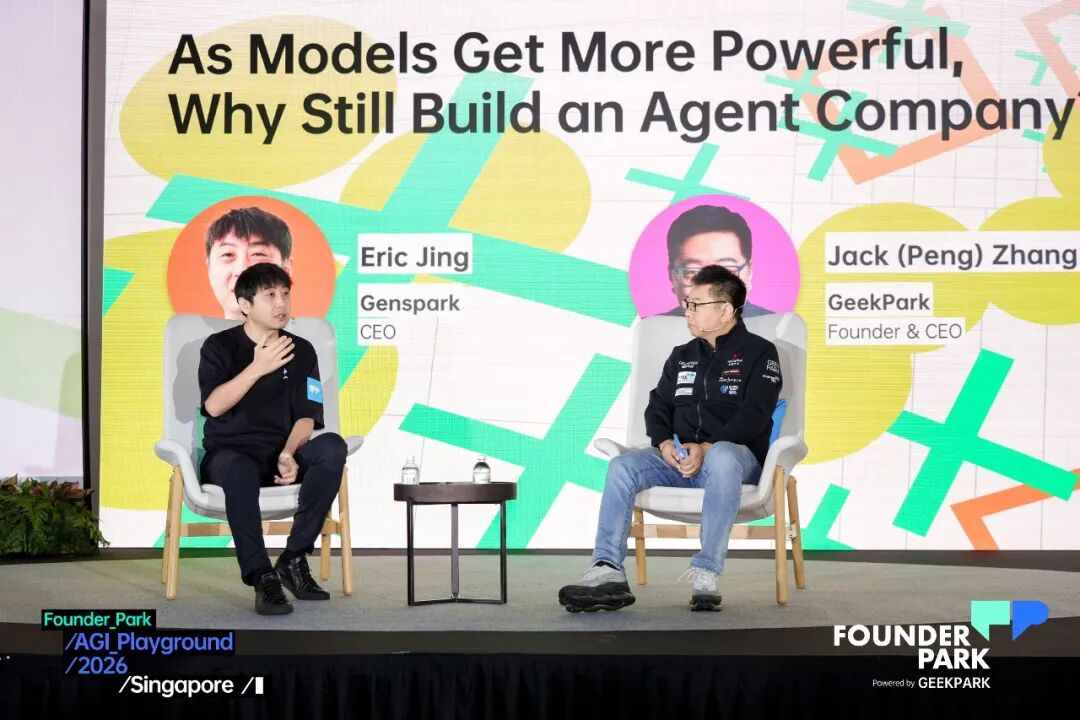
The conversation covered four themes:
- Why Genspark left AI search after gaining more than five million users
- Why “all in one” increasingly means shared context rather than a single interface
- Why application companies create value by translating raw model capability into accessible products
- Why Jing believes an AI application company could eventually reach trillion-dollar scale
The following English adaptation preserves that progression while distinguishing Genspark’s own metrics and forecasts from independently verified facts.
01. Users Will Keep Looking for Better Tools—Standing Still Is the Real Risk
From Search to Completing the Whole Task
Jack Zhang: Genspark started with AI search and reportedly grew beyond five million users. Why move away from a product that already had visible traction?
Eric Jing: My career has been centered on connecting people with information. I joined Microsoft as a software engineer in 2006 and spent much of the following two decades working around search.
Search appears to be about matching people with information, but the user’s real objective is rarely to find a web page. People search because they need to finish something.
They may need to compare products, prepare a presentation, plan a trip, write a report, contact a supplier, or make a decision. Search is often only one step inside a larger job.
Earlier search teams tried to move in this direction. We once explored the idea of making Bing more like a task engine, but the technology was not ready to reliably complete an entire workflow.
ChatGPT changed that calculation. It showed that AI might eventually handle much of the repetitive work surrounding a task, leaving people to focus on judgment and creation.
That was the original ambition behind Genspark: an autonomous agent capable of completing work from beginning to end.
AI Search Was the Practical Starting Point
The first versions of the underlying models were not strong enough for that complete vision.
A startup cannot simply wait indefinitely for the ideal technology to arrive. It needs a real product-market fit with the capabilities available at the time.
Two years ago, AI search was one of the clearest opportunities. It offered a useful product, a familiar user behavior, and a practical starting point for building the company.
Jing says the turning point came when Claude Sonnet 3.7 made longer end-to-end agent workflows appear substantially more feasible.
From the company’s perspective, the move from AI search to an agent was not a rejection of its original direction. It was the next step toward the same goal: helping the user complete the task rather than only finding information.
Why Abandoning Five Million Users Did Not Feel Like the Biggest Risk
Jack Zhang: Five million users is already a meaningful base. Did the team worry that changing the product would destroy what it had built?
Eric Jing: The transition had risk, but remaining still carried more risk.
Users do not stay loyal to an inferior workflow simply because it is familiar. When a new tool makes an important task much easier, people usually migrate after they experience the difference.
The transition was relatively smooth because users received a clear upgrade.
Instead of reading a summary and opening several sources, they could ask for a complete presentation. Instead of manually collecting material and arranging it in documents, they could describe the desired result and let the agent perform more of the process.
For Jing, the important lesson was not that product pivots are safe. It was that failing to respond to a major capability change can be more dangerous than disrupting an existing product.
AI Product Cycles Are Unusually Compressed
The rapid movement from chatbot to AI search, Super Agent, and AI workspace has happened within a very short period.
Jing attributes that speed to two forces.
First, frontier AI capability is improving in discontinuous jumps. Traditional software usually advances through incremental product refinement. A major model release can suddenly make an entirely new product workflow possible.
Second, decades of digital work have already created the data layer AI needs.
Modern organizations have accumulated:
- CRM records
- Meeting transcripts
- Cloud documents
- Spreadsheets
- Project-management histories
- Support conversations
- Calendars
- Internal software data
These systems have been generating work context for years.
When stronger models gain access to that context, the agent can do more than answer a generic question. It can reason about the user’s actual project, colleagues, documents, history, and goals.
Jing describes the combination as a flywheel:
More work context
        ↓
The agent understands the task better
        ↓
The agent completes more useful work
        ↓
More work and feedback enter the system
        ↓
The context becomes richer
The model matters, but the context determines how useful that model becomes to a particular person or company.
02. AI’s “All in One” Is Really an All-in-One Context Layer
The Interface Is Only the First Layer
Jack Zhang: You have long supported all-in-one products. How does that philosophy change in an AI-native product?
Eric Jing: Many successful products are integrated products. Search provides a unified entry to information. A smartphone combines many functions behind one interaction model. WeChat combines communication, payments, services, and content in one familiar environment.
A single interface still has value in the AI era. Users do not want to learn a different product for every small task.
However, the more important form of integration is now behind the interface.
The real question is whether all of the product’s agents and tools can access a coherent understanding of the user’s work.
Model Integration: Choose the Right Model Without Making the User Decide
Jing expects foundation models to become increasingly competitive and more interchangeable over time.
Different models may remain better at different tasks, but users should not have to understand every benchmark, price table, context limit, or architecture before completing ordinary work.
At the event, Jing showed a slide arguing that frontier models had become strong across many tasks while retaining large price differences.
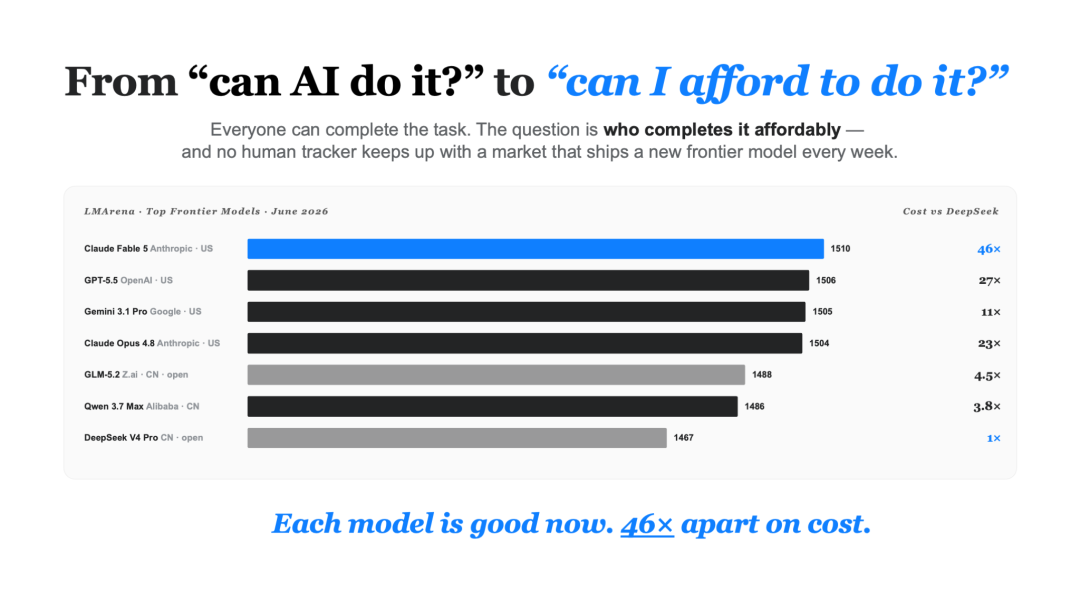
The slide is a company presentation rather than an independent benchmark. Its purpose was to illustrate the product problem: model selection has become too complex for most users and many enterprises.
Jing recalled an anonymous vote at a Microsoft CEO event where executives reportedly identified two recurring concerns:
- They did not know which model provider to choose.
- They worried employees might not adopt an expensive AI service after procurement.
An application layer can address both problems.
It can route tasks to different models based on:
- Capability
- Cost
- Speed
- Modality
- Context length
- Reliability
- Enterprise policy
The user describes the work. The platform decides which model or combination of models should handle it.
Context Integration: Stop Copying Work Between Applications
The second layer is more important than model routing.
Knowledge workers’ data is scattered across many services. A user may need to copy information from email into a document, pull figures from a spreadsheet, recover decisions from meeting notes, and then provide the same background to several AI tools.
A shared context layer reduces that repetition.
Genspark’s official AI Workspace 6.0 architecture expresses the idea through four layers:
- SecondBrain as memory
- Super Agent as the intelligence engine
- Build, Office, and Content Suites as execution tools
- GenTeam as the collaboration layer
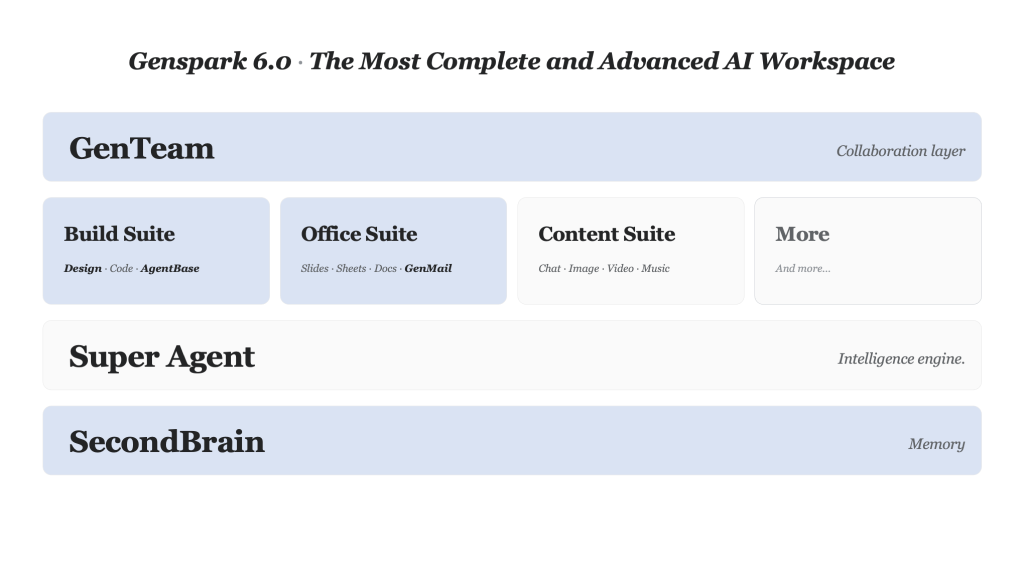
SecondBrain is designed to bring together material from emails, meetings, chats, documents, applications, and Genspark projects.
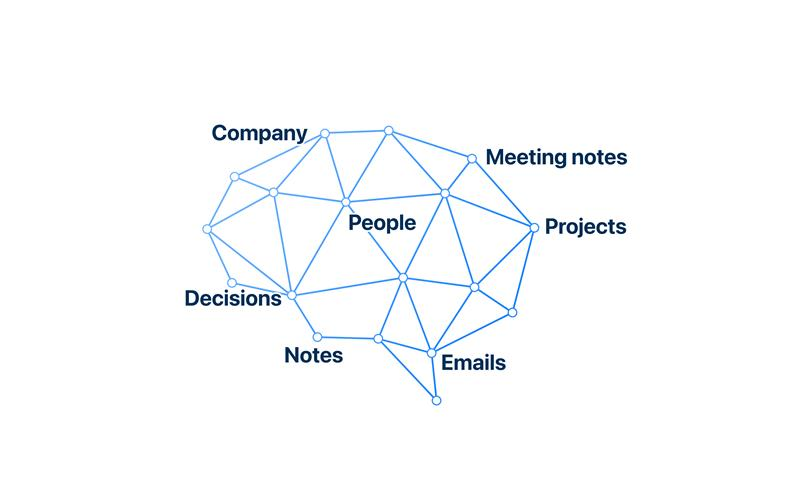
The intended experience is not simply “many AI tools in one website.” It is one work environment in which those tools share enough context to act consistently.
A New Definition of All in One
The older definition of all in one was:
One application
+ many features
+ one interface
The newer AI-native definition is closer to:
Many work surfaces
+ many models and agents
+ one persistent context
+ one orchestration layer
The user may still work inside familiar software rather than constantly visiting one central page.
Jing’s restaurant analogy is useful here.
The old software model asks the user to visit the restaurant. The AI-native model can place the restaurant near the user or deliver the meal directly.
An agent can appear inside email, office documents, a desktop client, or another familiar surface while still writing useful context back to the shared system.
From HTML Slides to GenOffice
Genspark’s slide product illustrates how user feedback can move a company from one format to a broader platform.
The company initially created AI-generated presentations in HTML.
Critics argued that serious business users expected PowerPoint files rather than web slides.
Genspark believed HTML was a natural output format for language models because it could combine content and layout with relatively flexible generation.
Some users accepted the online format for internal communication, especially when they valued quick editing and sharing more than a native file.
The sequence then developed as follows:
- Genspark created an HTML slide generator.
- Users asked for an online editor.
- Users wanted to continue editing in familiar local office software.
- Genspark built Office plugins.
- Users reported that plugins could be slow or costly to maintain.
- The team built a native desktop office suite.
That suite became GenOffice.
Genspark’s official release describes it as an alpha product covering:
- Docs
- Sheets
- Slides
The core office functionality is free and ad-free. AI actions use Genspark credits.
The official GitHub repository is licensed primarily under Apache 2.0, with a separate exception for a future enterprise directory. It includes Electron applications for macOS and Windows, shared document engines, an agent core, file parsers, and model-provider abstractions.
Genspark says the first alpha was built by one engineer in one week using approximately $10,000 in model tokens. That is a company-reported development story, not an independently audited engineering benchmark.
The Email Client Started With a Personal Pain Point
Genspark’s email work followed a similar path.
Jing uses email heavily and often struggled to recover the exact message, attachment, or decision needed for a task.
The product question became: why place an agent beside email when the agent can live inside the email client and understand the correspondence directly?
During preparations for the event, Jing said he used the email agent to:
- Review his previous exchanges with GeekPark
- Reconstruct the full schedule
- Extract information from attached PDFs
- Add activities to the calendar
- Draft follow-up messages in a style similar to his own
These are small tasks individually, but together they represent a meaningful part of daily knowledge work.
The opportunity appears when the product enters the real workflow closely enough to see those details.
Genspark’s Two Product Principles
Jing summarized the company’s product philosophy in two rules.
1. Build a Product the Team Genuinely Wants to Use
The team should be its own first serious customer.
Employees need to ask whether the product actually solves their work rather than assuming that other people will accept an experience they would not use themselves.
2. Look for a Pain Point Shared by Many Similar Users
A private frustration becomes a business opportunity only when enough other people experience the same problem.
The development logic is therefore:
Solve a problem the team genuinely experiences
        ↓
Use the product in real work
        ↓
Listen to repeated external feedback
        ↓
Expand the workflow only when the demand is real
03. AI Product Value Exists in the Translation Layer, Not Only in the Model
Most People Still Do Not Use Advanced Agents
The discussion then shifted from what frontier systems can do to how many people can actually use them.
Jing showed an illustrative slide in which each dot represented roughly 3.2 million people. Most dots represented people who had never used AI; a smaller group had used free chatbots; an even smaller group paid for AI; and only a tiny fraction used advanced agents.
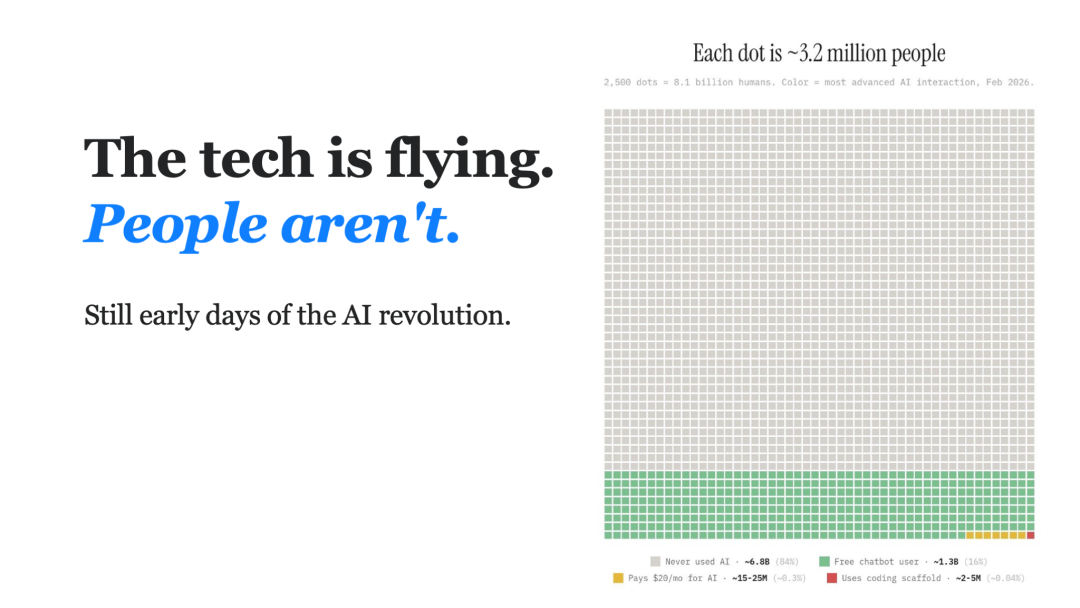
The visualization should be read as a conference illustration, not a precise census of global AI use.
Its product message is clear: technology can advance much faster than adoption.
A company serving only expert users may build something powerful without reaching the much larger group that does not understand agent configuration, model selection, token budgets, or complex workflows.
Go Where the User Already Works
Jing argues that AI companies should reduce the user’s learning burden rather than expecting everyone to become an AI specialist.
The service should appear in familiar places:
- Documents
- Spreadsheets
- Slides
- Desktop applications
- Team conversations
This also improves the product’s understanding of the user.
When the agent participates in the actual workflow, it can learn from the surrounding context instead of receiving only a one-time prompt.
A Coding Agent Is a Supercar; the Mainstream Product Should Feel Self-Driving
Jing compared coding agents with high-performance sports cars.
They are extremely powerful in the hands of developers and researchers, but the user must understand how to operate them.
Genspark wants to deliver similar underlying capability in a form that feels closer to a self-driving vehicle:
- The user should not manually choose every model.
- The agent should run in the cloud rather than depend entirely on local compute.
- Tools should be orchestrated automatically.
- The interface should hide unnecessary complexity.
- The user should focus on the intended outcome.
This is the “translation layer.”
It sits between raw model capability and the person trying to complete work.
The layer translates:
- Model strengths into task routing
- APIs into understandable features
- Tool calls into complete workflows
- Unstructured context into useful actions
- Technical progress into an accessible experience
Is an Agent Company Merely Reselling Tokens?
Jack Zhang: Genspark’s company-reported ARR has passed $250 million. Critics sometimes argue that agent companies will become thin distribution layers that resell model tokens. How do you answer that?
Eric Jing: We do not define Genspark as an “agent company.” It began as search, is now described as an agent or workspace product, and will continue changing as the product form evolves.
The more useful definition is an AI company built around all-in-one context.
Jing also rejects the idea that distribution is inherently low-value.
Many major software companies generate a substantial share of revenue through channels and distribution. Reaching customers, integrating products into workflows, and making complex technology easy to buy and use can itself become a moat.
The Restaurant Analogy
Jing used a food-industry comparison:
- Foundation-model laboratories are like suppliers of raw ingredients.
- A specialized coding product resembles a high-end restaurant focused on one cuisine.
- A routing platform resembles a wholesaler.
- Genspark wants to be a convenient restaurant network that turns many ingredients into meals suited to the customer.
The model is one ingredient.
The application company adds value through:
- Product design
- Context integration
- Tools
- Orchestration
- File systems
- Distribution
- Support
- Workflow knowledge
- User experience
Jing compares the ambition with Apple’s role in hardware. Apple buys many components, but users do not describe the company merely as a distributor of chips and displays because the integration creates the final product experience.
Genspark wants to pursue a similar form of integration above the model layer.
04. The AI Era Could Produce a Trillion-Dollar Application Company
Global Products Need Common Foundations and Local Priorities
Genspark identifies the United States, South Korea, Japan, France, India, and Brazil as important markets.
Jing says the company studies local differences but tries to abstract them into common human needs.
Examples from the conversation include:
- Finance-heavy users in New York work extensively with spreadsheets.
- Japanese users frequently depend on presentations and long commutes.
- South Korea has a strong design culture and high use of creative tools.
The surface behavior varies, but people in each market still need to communicate, analyze information, prepare documents, and complete repetitive work.
The product can adjust feature priorities without becoming a completely different system in every country.
Distribution Can Be Local Even When the Product Is Global
Genspark has also experimented with local marketing.
Jing cited advertising in the New York subway, where passengers often spend time without reliable mobile connectivity and therefore pay attention to physical ads.
The underlying product remains global, while the distribution strategy responds to the local environment.
This mirrors Jing’s experience in search.
Search products can serve people without knowing them personally because they abstract a request into a universal problem: match the need with the relevant information.
A global AI workspace similarly needs to recognize differences without losing the common structure underneath them.
Could an Application Company Reach Trillion-Dollar Scale?
Jing still believes the AI era can produce an application company worth a trillion dollars, although he repeatedly emphasizes that most startups will fail.
His argument depends on three assumptions.
1. Model Cost Will Continue Falling
Jing predicts that a model with today’s level of capability could cost roughly 1% as much to use within two years.
That is a forward-looking company forecast rather than an established industry result.
The broader direction—falling inference cost for a fixed capability level—is plausible and already visible across parts of the market, but the exact 1% figure is uncertain.
2. Model Supply Will Become More Competitive
As closed and open models improve, companies may have more substitutes for many tasks.
The model layer remains essential, but its economics can become more commodity-like when several providers offer comparable results.
3. More Value Can Move Into the Product Layer
If the application company can combine:
- Many models
- Several modalities
- Persistent user context
- Distribution
- Workflow execution
- Enterprise controls
then it may own a more durable relationship with the user than any single model release.
The system becomes increasingly useful because each completed task creates context that improves the next one.
A Future Workday of Approve or Send Back
Jing’s long-term vision is that the agent handles most repetitive work in advance.
The human workday becomes more supervisory.
Instead of manually performing every step, the user mainly decides:
Approve and execute
or
Return for revision
This is not the current reality for most organizations. It is the endpoint Genspark is designing toward.
Enterprise AI Is Moving From Token Expansion to Token Optimization
Before answering a question about founder age, Jing added an observation about enterprise AI.
The enterprise conversation is shifting from using more tokens to using them more efficiently.
Companies are increasingly concerned with:
- Cost per completed task
- Model routing
- Open-model adoption
- Avoiding dependence on one provider
- Employee adoption
- Security and control
- Return on investment
Few enterprises want to place every workflow on one model when capability and pricing can change quickly.
Jing expects open and closed models to coexist inside enterprise systems, with product platforms selecting among them based on both quality and cost.
Founder Age Matters Less Than Intellectual Openness
The final question concerned the preference some investors show for very young AI founders.
Jing does not treat biological age as the main criterion.
He argues that experience can become a disadvantage when it hardens into a filter that rejects every unfamiliar idea. However, experienced people who remain open, energetic, and willing to work directly with new technology can be unusually effective.
Genspark therefore looks for:
- Openness
- Self-motivation
- Speed of action
- Curiosity
- Willingness to relearn
- Useful industry experience
The strongest combination is not youth alone. It is deep experience without a closed mindset.
Key Takeaways From the Conversation
The interview can be reduced to several product principles without losing its central argument.
1. Start With the Capability That Exists, but Keep the Larger Mission
Genspark began with AI search because it was practical at the time. It moved when model capability made a more complete agent possible.
2. Integration Is About Shared Context
Putting many tools in one interface is useful. Letting those tools understand the same emails, meetings, documents, decisions, and preferences is more powerful.
3. Users Should Not Need to Become Model Experts
The platform should route tasks by performance, cost, and policy while presenting one understandable workflow.
4. The Application Layer Can Create Durable Value
Context, orchestration, workflow design, distribution, file handling, and product experience are not trivial layers above the model.
5. Build Inside Real Work
The best opportunities often appear only after a tool enters the user’s actual email, document, presentation, spreadsheet, or team workflow.
6. Treat Cost as a Product Feature
A strong AI system should not only finish the task. It should select an economically sensible path to finish it.
常见问题
What is Genspark?
Genspark is an all-in-one AI workspace that evolved from an AI search product into a platform combining Super Agent, memory, office tools, content creation, application building, and team collaboration. Its official Workspace 6.0 architecture includes SecondBrain, Super Agent, several work suites, and GenTeam.
Why did Genspark move away from AI search?
Eric Jing says search was a practical entry point when foundation models were not yet capable of reliably completing full workflows. As stronger models made end-to-end agents more feasible, Genspark expanded from helping users find information to helping them finish the entire task.
What does “all-in-one context” mean?
It means that emails, meetings, documents, projects, preferences, and previous work can feed one persistent context layer used across several tools and agents. The objective is to stop asking the user to repeat the same background in every application.
Does Genspark use only one AI model?
No. Genspark has described its products as orchestrating multiple models and tools and selecting components based on the task. The exact active model set can change as providers release new systems.
What is GenOffice?
GenOffice is Genspark’s open-source alpha office suite for macOS and Windows. It includes document, spreadsheet, presentation, and PDF applications, with Genspark AI features integrated into the editors.
Is GenOffice completely free?
Genspark says the core office suite is free, ad-free, and has no watermark. AI-powered research, generation, and analysis use Genspark credits, and the repository includes a separate license exception for a future enterprise directory.
Is Genspark’s $250 million ARR independently audited?
The figure was stated during the interview and has appeared in company interviews and external reporting. It should be described as company-reported annual recurring revenue unless audited financial statements are released.
Why does Eric Jing think an AI application company could become worth $1 trillion?
His thesis is that model costs will continue to fall while value shifts toward products that integrate many models, retain shared work context, reach users through familiar workflows, and automate a meaningful share of daily work. The trillion-dollar outcome is an ambition and forecast, not a guaranteed market result.
相关工具
- Genspark AI Workspace: Genspark’s main all-in-one workspace for agents, memory, office work, creation, and collaboration.
- GenOffice: The official download page for Genspark’s open-source desktop office suite.
- GenOffice GitHub Repository: Source code, releases, development commands, architecture notes, licensing, and contribution guidance.
- Genspark Super Agent: Genspark’s no-code agent layer for research, content creation, calls, and multi-step work.
- GenTeam: Genspark’s collaboration layer for people and AI agents working in shared conversations.
- OpenRouter: A multi-model API routing service referenced in the interview’s distribution-layer analogy.
Related Links
- Genspark AI Workspace 6.0: Genspark’s official description of SecondBrain, Super Agent, work suites, and GenTeam.
- GenOffice Launch Announcement: Official details on the alpha build, supported applications, pricing approach, and open-source release.
- GenOffice GitHub Repository: The official codebase for the macOS and Windows office suite.
- OpenAI’s Genspark Customer Story: Background on Genspark’s move from search to Super Agent and its use of multimodal models and tools.
- GenOffice Download Page: Official Mac and Windows downloads plus product information.
- Genspark Blog: Official product announcements and updates from the company.
- Artificial Analysis: Independent model-performance, speed, and pricing analysis useful when evaluating the model-routing problem discussed in the interview.
Summary
Eric Jing’s argument is that AI’s most important form of integration is no longer simply placing many tools inside one application. The deeper opportunity is to build one persistent work context that can support several models, agents, and interfaces.
Genspark’s path from search to Super Agent, Workspace 6.0, GenMail, SecondBrain, and GenOffice reflects that thesis. Each product surface gives the system another place to complete work and another source of context—provided the data is handled with appropriate user control, privacy, and enterprise governance.
The company’s revenue figures, cost comparisons, and forecasts about future model economics remain company claims or forward-looking judgments. The product strategy, however, is clear: make model complexity invisible, meet users inside familiar workflows, and create value through orchestration, context, and distribution.
In Genspark’s view, the winning all-in-one AI product will not be the one with the most buttons—it will be the one that understands the most relevant context and turns it into completed work.