After Figma Make Integrates with GPT-5.6, the Question Is No Longer Just "Can It Be Done?"
There have been many AI website building tools in the past two years. But most people's judgment criteria remain quite simple:
After Figma Make Integrates with GPT-5.6, the Question Is No Longer Just "Can It Be Done?"
There have been many AI website building tools in the past two years.
But most people's judgment criteria remain quite simple:
Whoever is faster, whoever looks more decent, whoever feels like "I can use it right away."
However, after Figma Make integrated with GPT-5.6, things have started to change.
Because once tools enter a phase of stronger natural language collaboration, people begin to ask more realistic questions:
"If I'm building an official enterprise website, should I choose We0 AI or continue using Figma Make?"
This question is crucial.
Because an enterprise website and a regular webpage are fundamentally different.
A regular webpage aims to "get it done."
An enterprise website aims for:
- Stable go-live
- Clear brand expression
- Continuously expandable content
- SEO / GEO readiness
- Sustained operability
- Ultimately, securing inquiries and clients
In other words, an enterprise website is not a portfolio, nor is it a design demo. It is a business asset.
Therefore, this article isn't just about comparing tool features; it's about comparing:
Which one is better suited to turn your official website into something capable of long-term growth.
Let's State the Conclusion First
If you simply want to:
- Quickly create a page
- Align the design, marketing, and product teams first
- Build a prototype, demo, or visual exploration
Figma Make is very powerful.
But if you want:
- A formal, go-live-ready enterprise website
- A website structure that supports ongoing content creation and SEO
- A growth system that can later handle inquiries and conversions
We0 AI would be a better fit.
Because the most important thing for an enterprise website is not "whether it can be generated," but "whether it can continue to grow after being generated."
This is the true dividing line between the two.
What Does GPT-5.6 Being Integrated into Figma Make Mean?
On the surface, Figma Make has simply become more powerful.
But from a workflow perspective, it is actually moving towards a more complete AI collaboration environment.
This means:
- The barrier to creating pages with natural language is lower.
- Efficiency in design, prototyping, layout, and localized generation is higher.
- Communication costs between teams will continue to decrease.
This is certainly a good thing.
Especially for design teams, brand teams, and creative teams, Figma Make will be more convenient.
You can get from an idea to a visual draft faster.
It's also easier to first clarify "what this official website roughly looks like."
But note, what is primarily being solved here is "production efficiency," not "website growth efficiency."
These two concepts are vastly different.
The Biggest Fear for Enterprise Websites Isn't Slowness, It's Fragmentation
The most common problem for enterprises building official websites is not "being unable to create it."
It's that the process becomes fragmented along the way.
Where does the fragmentation occur?
- Visuals are in one tool
- Copy is in another document
- Publication is on another platform
- SEO needs to be supplemented separately
- Multi-language support requires separate management
- Data needs to be integrated independently
- Subsequent revisions require new rounds of coordination
In the end, the official website becomes a patchwork project.
Everyone feels it's fast in the beginning.
Everyone feels it's tiring later on.
This is exactly why choosing the right tool for an official website cannot be based solely on its "generation capability."
You need to see if it can also handle the subsequent tasks:
- Can pages be continuously expanded?
- Can content be continuously updated?
- Can search traffic be accumulated?
- Can page performance be monitored?
- Can the lead generation path be clear?
If a tool only helps you with the first half, it's more like a "drafting tool."
If it can also manage the second half, it is more like a "website system."
We0 AI and Figma Make Are Fundamentally on Different Levels
This point is very important.
Many people mistakenly believe:
"Since both can build websites, let's just directly compare which one is more powerful."
This is not the case.
What is Figma Make more like?
It's more like the design and prototyping layer.
It excels at collaboration, visualization, generation, and rapid alignment.
What is We0 AI more like?
It's more like the growth layer for showcase websites.
It doesn't just generate pages; it places the official website within a more complete growth chain:
Build -> Showcase -> Grow -> Leads
This means:
- First, set up the website
- Then, clearly showcase products, services, case studies, and brand
- Next, perform SEO / GEO / content expansion
- Finally, generate inquiries and clients
This is the true lifecycle of a corporate website.
So, Figma Make is very strong at “making.”
But We0 AI is more complete when it comes to “what to do after it’s made.”
A Quick Comparison Table
| Dimension | We0 AI | Figma Make |
|---|---|---|
| Core Positioning | Display-Oriented Website Growth Platform | Design Collaboration / Prototyping / Generative Production |
| Suitable for Official Website | More suitable | Suitable for early-stage production, not a complete official website system |
| Go-Live Capability | Emphasizes go-live and operability | More focused on production and collaboration |
| Content & SEO | Built-in growth logic is stronger | Usually requires external integration |
| Multi-Page Expansion | Better for long-term expansion | Suitable for initial setup and alignment |
| Multi-Language Website | Better for long-term business use | Depends on the team’s own process supplementation |
| Data Monitoring | Closer to a growth loop | Not a strength |
| Lead Generation | Clearly considers acquisition paths | Not a primary goal |
| Best For | Owners, marketing teams, consultants, agencies, B2B companies | Designers, brand teams, creative teams |
Why is a Formal Website More Aligned with We0 AI?
Because a formal website’s goal has never been to just “look like a website.”
It actually needs to drive business.
A formal website typically needs to do these things:
- Explain who the brand is
- Explain what problem the product solves
- Explain why the service is trustworthy
- Explain case studies and proof
- Explain the pricing or consultation path
- Explain how to contact you
- Explain how to keep consuming content
These things can’t be accomplished with just a generative tool alone.
What’s needed is a system that can be continuously operated.
And We0 AI’s positioning is closer to that system.
It doesn’t just help you create the homepage for the day.
It’s more like setting up your website from day one in a way that “can grow.”
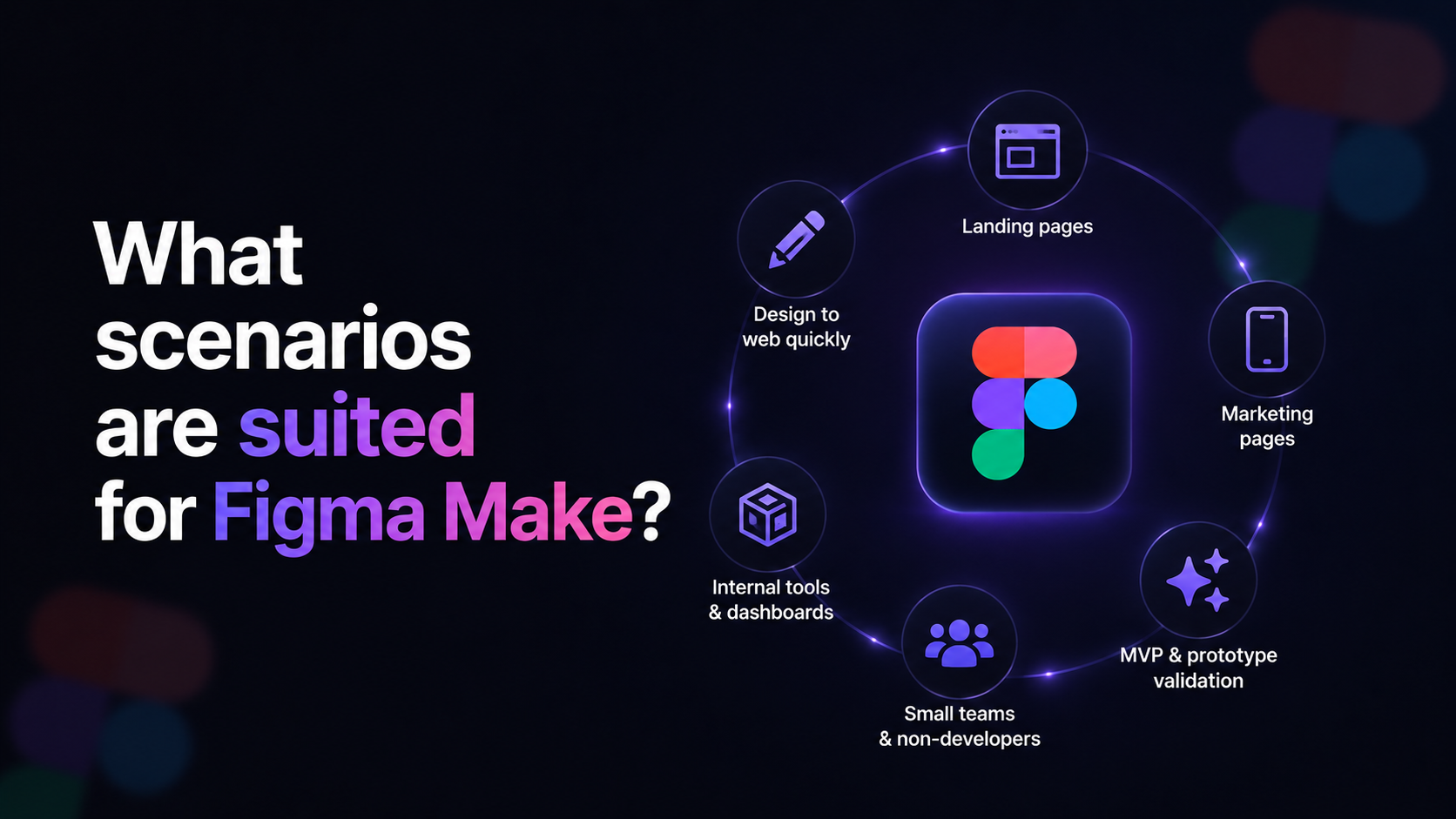
What Scenarios is Figma Make Suitable For?
To be clear, Figma Make isn't bad.
It’s just more suitable for the following scenarios:
1. Early-Stage Visual Exploration
If you want to quickly explore several directions, Figma Make is very convenient.
2. Team Collaboration & Alignment
When design, marketing, and brand teams review drafts together, it’s highly efficient.
3. Prototypes & Partial Pages
Landing pages, event pages, concept pages—these are all very suitable.
4. Design-Driven Companies
If your company is strongly design-oriented, Figma Make will feel very smooth.
But if you are currently asking:
“Who should I choose for a formal website?”
Then the answer isn’t “who can generate better.”
It is:
Who can better turn the website into a long-term, operable business asset.
In this case, Figma Make’s boundaries become clear.
It acts more like a powerful front-end production and collaboration tool.
But a formal website still needs that entire growth chain afterwards.
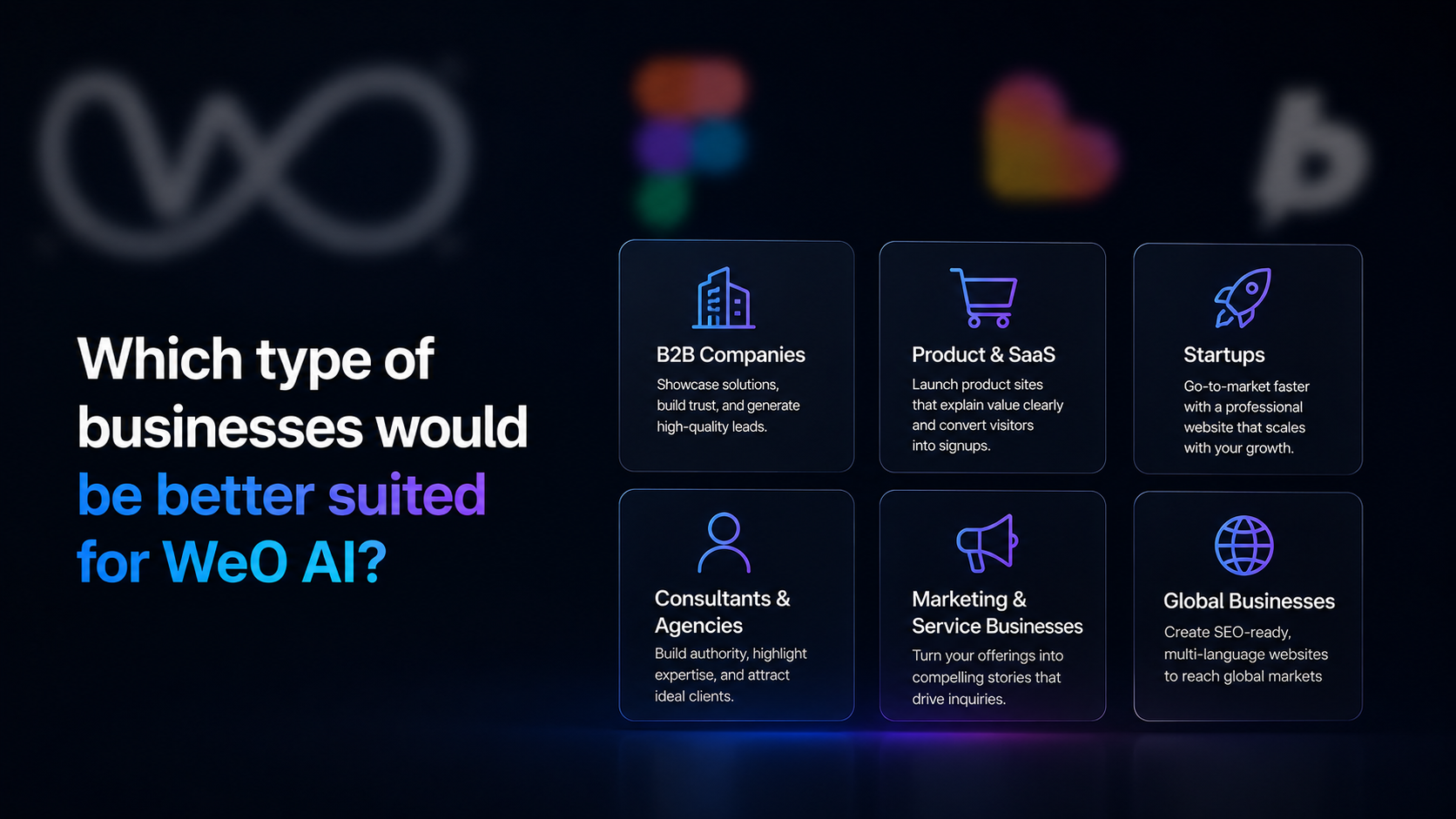
What Businesses is We0 AI Better Suited For?
If your business falls into one of these categories, We0 AI will be a better fit:
- B2B Companies needing their website to handle inquiries
- SaaS / AI Product Teams needing product introductions, feature pages, and case study pages
- Foreign Trade / Going-Global Teams needing multi-language websites and content expansion
- Agencies / Consultant Teams needing service showcases, case studies, and conversion entry points
- Brands with Continuous Content Needs relying on search and content for traffic
Because these scenarios all share one common trait:
The website is not a one-time project, but a long-term growth entry point.
For this type of website, the biggest fear is that no one manages it after it's built.
Also, the biggest hassle is needing complex changes every time.
This is where the value of We0 AI lies.
It’s more like a way of working that combines the website, content, SEO, growth, and acquisition.
The Final Judgment is Simple
If you just want to:
- Quickly produce design drafts
- Quickly make page prototypes
- Quickly align visuals with the team
Figma Make is very suitable.
If what you want is:
- A formal corporate website
- Sustainable operation
- Content and SEO that can drive results
- Future growth and acquisition capabilities
We0 AI is more suitable.
Because a formal website is not as simple as “generating a page.” It needs to become a business asset.
And for this, We0 AI’s direction is more complete.
Frequently Asked Questions
1. After Figma Make integrates GPT-5.6, can it be used directly for a formal website?
It can do a part, but it’s more suitable for early-stage production, prototyping, and collaboration. A formal website also needs to consider go-live, operations, SEO, GEO, and conversion.
2. What is the biggest difference between We0 AI and Figma Make?
Figma Make is more about production, We0 AI is more about growth. One is more like a powerful tool, the other is more like a website system.
3. Why can’t a corporate website just focus on page generation speed?
Because a website is not a one-time display page. It also needs content, search, data, conversion, and continuous operation.
4. If a company urgently needs to go live with a website, which is faster?
If it’s just for early visual drafts and collaboration, Figma Make is fast; if you want the website to continuously grow after going live, We0 AI is more stable.
5. What teams is We0 AI Suitable For?
It’s suitable for enterprise teams that need to operate their website long-term, especially B2B, SaaS, going-global companies, consultants, agencies, and content-driven brands.
Related Tools
References
- 《OpenAI | Research & Deployment》:https://openai.com/
- 《Figma product news and releases》:https://www.figma.com/blog/
Notes: https://www.figma.com/release-notes/
- Introducing GPT-Live: https://openai.com/index/introducing-gpt-live/
Ready to Start?
If you're building a formal official website, what you truly need isn't a tool that can "generate pages," but a system capable of sustaining subsequent operations and growth.
This is why We0 AI is better suited for enterprise websites:
It's not just about creation—it's about enabling continued growth after launch.
Summary
Figma Make's integration of GPT-5.6 has indeed advanced AI-powered website creation.
But for businesses building a formal official website, the evaluation criteria should not be simply "who generates better."
The real question is:
Who can better drive the launch, operation, growth, and customer acquisition of the website?
From this perspective, Figma Make is powerful, suitable for early-stage creation and collaboration.
But if you're asking about a formal official website,
We0 AI is the better choice.